Team Leadership Culture
  • Team
  • Leadership
  • Culture
  • Myers-Briggs
  • Trust Me
  • Short Book Reviews
Top Posts
Obituary
REPOST: Four Functions, Three Rules
ROUNDUP: The Rise of AI
REPOST: Facing Adversity Series
ROUNDUP: Curiousity
ROUNDUP: Deep Work
REPOST: Character vs. Competence
REPOST: Opposite of Victim
REPOST: Listening With the Intent to Understand
REPOST: Performance vs Trust
  • About
  • Services
  • Resources
    • Trust Me
    • Short Book Reviews
  • Contact

Team Leadership Culture

  • Team
  • Leadership
  • Culture
  • Myers-Briggs
  • Trust Me
  • Short Book Reviews
Tag:

Growth

BlogLeadership

Optimism Leads to Success

by Ron Potter March 5, 2020

A recent quote about Warren Buffet said:

Your success didn’t lead to optimism, your optimism lead to your success.”

Optimism

Wikipedia defines optimism as “A mental attitude reflecting a belief or hope that the outcomes of some specific endeavor will be positive, favorable, and desirable.”

Notice that it says a mental attitude.  In simple terms, pilots are interested in altitude and attitude.  Altitude refers to how high you are.  How much you have achieved.  Some measure of success (money, position, title).

Attitude is a reference to the natural horizon.  Are you pointed up, down, left-leaning or right-leaning?

Success to Optimism

If your optimism depends on success, you’ll soon realize that success is fickle.  One change regardless of the cause can change your success overnight.

  • Markets change – talk to Polaroid or VHS producers.
  • Appetites change – ask package food companies
  • Fashion changes – ask Henry Ford about auto colors.  He is reported to have said, “They can have any color they want as long as it’s black.”
  • Disruption– ask companies about competitors coming out with new products that eat into margins of successful products

The point here is that “success” can change very rapidly and have nothing to do with your actions.  If your optimism depends on success, it will change as rapidly.

Optimism to Success

On the other hand, if you tend to be an optimistic person, that seems to withstand external success and failure.  I’ve had three different successful careers.  Upon graduation from engineering school, I had a “successful” career working with wonderful teams building large projects.  Some of them approaching a billion dollars in their construction budget.

Then one day I was introduced to my first pc.  This was before Microsoft,  IBM, and Apple.  And yet I felt that this little box was about to change our lives.  I spent the next ten years with a “successful” career in the software development business.

Then I took on the career that I felt I had been headed for all my life.  I became an external coach focused on Teams, Leadership and Culture.  I spent nearly thirty wonderful years in that career.

You were just lucky

Along the way, many people would tell me that I was just lucky.  I guess they just chose to ignore those times when I went broke pursuing those careers.  They seem to ignore the hard work and difficulties that I overcame to achieve my “success.”  But there were those few that understood the hard work and heartaches that I was going through during those tough times.  One colleague whom I had not seen in person for many years asked me how I was doing.  When I answered with a simple “OK”, his reaction was that I must be really down.  He explained that I had always been one of the most optimistic persons he had ever known so if I was simply doing “OK” I must really be down.

Your success didn’t lead to optimism, your optimism lead to your success

Times were indeed difficult.  But I was always optimistic.  It may just be me but I’ve noticed through the years that I don’t even care to be around people who are pessimistic.  They’re just downers in my mind.  Times were always difficult in one way or another.  But being optimistic vs pessimistic is a choice.  Chose Optimistic.  It makes life much easier along the way.

0 comments
1 FacebookTwitterEmail
BlogTeam

GPS4Leaders

by Ron Potter February 20, 2020

Over the last couple of years, I have been working with a team of people to bring some of our (myself and other coaches on the team) experiences to users in an app.  I would like to share a video with you about that journey.

http://www.teamleadershipculture.com/wp-content/uploads/2020/02/SME-RPotter-to-Clients-Rev-3.mp4

GPS4Leaders

Good GPS devices perform three functions:

  • Show you where you are
  • Show you where you’re going
  • Give you the best route to get there.

GPS4Leaders performs the same functions.  It will show you where you are as a team through

  • Personal Assessments
  • Team Dynamic Assessments

It will show you where you’re going through

  • Models of great teams, leaders, and cultures

It will give you the best route to get there

  • By talking team dynamic assessment, showing you where to focus and progress towards becoming great teams, leaders, and culture

Cost-Effective

GPS4Teams (including two of the four modules of GPS4Leaders) is very cost-effective.  At $150/year/person it will cost only a fraction of a good executive or team coach.   However, our goal is not to replace the good executive or team coach, it’s to help them be much more effective by focusing their work and requiring less of their time to help you grow teams, leaders, and cultures.

Visit GPS4Leaders.com

Join us today to help grow your organization.

0 comments
0 FacebookTwitterEmail
BlogCultureCulture Series

Culture – Adaptability: Summary

by Ron Potter October 3, 2019

It’s easy to see but often challenging to implement an adaptable organization.

It takes

  • Learning
  • Listening
  • Changing
  • Humility
  • Respect

Humility is required because it forces you to suspend your belief about what is the right direction to learn, listen, and change.

It also requires respect.  I’ve talked about Jordan Peterson and his 12 Rules for Life.  One of my favorite rules is number nine, which states “Assume that the person you are listening to might know something you don’t.”  Live by that rule alone, and you’ll experience change and growth.

But, now that we’ve looked at the first two quadrants, Mission and Adaptability, I would like to think about them as a pair.

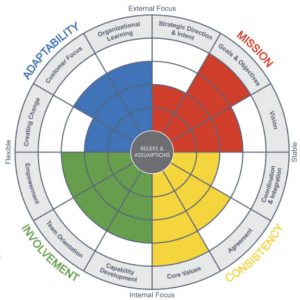
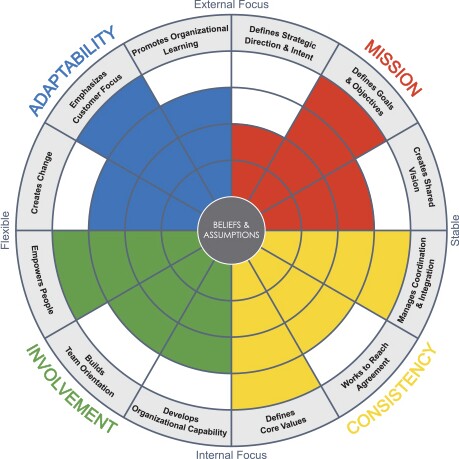
Mission and Adaptability are at the top of the Denison Culture Survey.  If you look at the very top of the circle, you’ll see

the words “External Focus.”  External Focus means that the quadrants of Mission and Adaptability look “outside.”  They are not focused on what goes on internal to the organization, but what is going on beyond the walls of the organization.

Organizations who have high scores in these quadrants at the top of the chart tend to be focused on and achieve growth and market share.

What I find interesting is the research behind these two quadrants.

Research indicates that during down times when market share and growth shrink, companies who have high scores in these two quadrants seem to be less impacted by the negative situation.

If growth and market share is your goal, make sure the people of your company score you highly in these two quadrants.

0 comments
0 FacebookTwitterEmail
BlogCultureCulture Series

Culture – Adaptability: Creating Change

by Ron Potter September 26, 2019

One of the more impactful aspects of this Creating Change sections is summed up in the statement:

“We respond well to competitors and other changes in the business environment.”

One of my first experiences with the Denison Culture Survey was with a company that had been the undisputed leader of their industry for over 100 years.  However, over the last few years, they had been losing market share to new start-ups in their industry.  By the time they needed outside help, things had fallen to critical points, and their profitability had all but disappeared.

First Culture Survey

When we saw the results of their first survey, it was immediately obvious from a consulting point of view.  They scored highest in the Consistency quadrant.  Meaning they had been doing things in a very consistent way for over 100 years (we’ll look at the Consistency quadrant in more detail in future posts).

They scored lowest in the Creating Change section of Adaptability.

And on the statement “We respond well to competitors and other changes in the business environment,” they scored in the bottom 10% of all companies.  They did NOT respond well to competitors and other changes in the business environment.

Why had they not responded?

After gathering the results of the survey, we displayed the overall graph of their results.  The leadership team went silent after reviewing the results.  It was not because they were in shock.  It was because the results revealed what they suspected was the problem all along.   They had continued to function just as they had done for over a century in spite of knowing that the market place was rapidly changing around them.

But, this visual representation of their situation allowed them to open up and be honest with each other for the first time.

We’ve always done it this way

Their first response was to admit they knew they were in trouble over three years ago when they first experienced a loss of market share and a drop in their profits.  At their annual leadership retreat, they decided that the drop would be overcome if they just buckled down and did a better job.  After all, they had been successful for over 100 years.  If they just did a better job of doing what they did well, they would pull out of this tailspin.

We don’t have a better solution

At their leadership retreat two years ago the results had continued to drop but they decided it must be a temporary issue and if they just continued to stay focused and work harder, this would be overcome like many dips throughout their history.  They didn’t have a better answer.

Now we see the problem

While they were stunned with the results of their culture survey, you could almost detect a sense of relief on many of their faces.  They were all exhausted from working hard and long.  They had sacrificed their personal lives including family and health just because they didn’t have a better answer.  Now they could see the issue more clearly which allowed them to talk about and work toward a more feasible solution.

Coherent Change

Other areas of the Creating Change section referred to issues such as:

  • Flexibility
  • Improved processes
  • New ways of doing things
  • Lower the resistance to change
  • Get the entire organization pulling together in the new direction

These things they could begin to plan around.  The Culture Survey had added a new vitality to the leadership team.  You could feel the energy rising in the room as they began to talk about and plan for change and a new way of doing things.

Improvement

While they never fully recovered the overwhelming market share they once held, they did become a much more competitive force in the market place.  They were suddenly fighting for and scrapping for every inch of growth in the market place, and the “new” competitors were fighting a new approach from an old competitor.  They were now forcing changes in the industry, and the “new” competitors had to respond.

Blockbuster

If I tried to list all of the companies that were once a force in the industry but no longer existed, there would be too many to include in a blog.

I read the other day that Blockbuster (the DVD company with thousands of retail stores) had a chance to purchase Netflix for a very reasonable amount.  They passed.  It would have eaten into their retail store, walk-in business.

Today, Netflix is one of the hottest companies in the market place.  Blockbuster doesn’t exist.

Change or Die

We’ve used this adage many times in the last several blog posts.  But it’s true.  If you’re not changing and adapting, you will soon be nothing more than an empty store in a strip mall with a faded outline of your logo and former glory.

0 comments
0 FacebookTwitterEmail
BlogTrust Me

Becoming a Trusted Leader

by Ron Potter June 24, 2019

Grasping leadership greatness starts by letting go:

If we do not let go, we make prisoners of ourselves.…

Let go of the strategies that have worked for us in the past…

Let go of our biases, the foundation of our illusions…

Let go of our grievances, the root source of victimhood…

Let go of our so-often-denied fear…”
—Gordon MacKenzie

Letting go is not a one-time deal. You must do it again and again and again.

Many of the most enduring ideas and values in our lives today have been shaped and molded by modern-day “blacksmiths.” Ancient or modern, the principles are the same: The blacksmith heats the iron at the forge, shapes it on his anvil, and cools it in the water.

The blacksmith heats the metal to prepare it for change. The trusted leader warms people to change through humility and compassion. The blacksmith hammers the metal to form a new shape. The trusted leader shapes an organization through commitment and focus. The blacksmith cools the metal to “settle” its strength. The trusted leader uses peacemaking to give the changed organization meaning and understanding. The forged metal, once cooled, becomes the powerful sword, the productive plow, or the beautiful wrought-iron gate.

By understanding the elements that build and destroy trust, effective leaders shape strong and productive organizations:

At the end of the same session when Jesus shared his Beatitudes with his followers—the ideas on which the eight attributes are based—he told an interesting story. Jesus said that if his team members would put what he had taught them into practice, their lives would be like a man who built his house on a solid rock foundation. No matter what kind of storm hit, Jesus promised that the house would stand. But if these men did not pay attention to the truth Jesus shared, their lives would be like the man who built his house on a foundation of shifting sand. When the storm hit that house, it would crumble and wash away.”

I believe the eight attributes of leadership will have that kind of effect on you. Allow them to permeate you from the inside out, and you will have a career—and a life—built on solid rock. You will be known as a person who can say with clear-eyed conviction, “Trust me.”

And others will follow.

0 comments
0 FacebookTwitterEmail
BlogTeamTeam Series

Team Elements – Commitment: Diversity

by Ron Potter June 20, 2019

We’re looking at the element of Commitment in our Truth, Respect, Elegance, Commitment (TREC) journey to great teams.

Last week we talked about the trust required in great teams.  Trust of purpose, leader, and team members.  In building that trust we must look at the diversity of thinking and points of view.

Word of Caution

During my career, I have been asked to either lead a “diversity” effort or coach the person who was leading the effort.   The first thing that struck me was that diversity was defined by outward appearance.  Race and gender were the two most common ones but any number of characteristics can be identified.

Inclusion, not Diversity

One of my first reactions was that it shouldn’t be called “Diversity training” it should be named “Inclusion training.”  Because the name identified it as diversity, it seemed like the curriculum was based on emphasizing the diversity rather than turning it to inclusion.

As I got to know the people who were to be part of the process, I noticed that two members thought similar to each other even though they were of a different race and gender.  While another pair almost never saw eye-to-eye even though they were the same race and gender.

Diversity of Thinking

Great teams have learned to respect different points of view and how to work with those differences as simply differences.  Not good or bad.  Not right or wrong.  Just differences.

In my car the other day, I heard an old song by Dave Mason that hits this one right on the head.  The words are:

There ain’t no good guy, there ain’t no bad guy
There’s only you and me and we just disagree

No good.  No bad.  Just disagreement.  Let’s start with the fact that we just see things differently.

Brain Science

Why is that?  Why can we observe the same thing and yet it seems like we see things differently?

One of the tools that have helped answer that question is the functional MRI (fMRI).  The MRI has been around for years but it simply took a snapshot.  The fMRI takes video!  We can actually see movement within the brain.

When our eyes observe an event, the image isn’t simply recorded on our brain and then stored on our “hard drive.”  There are two major flaws in believing that’s how we see the world around us.

Brain Processing Centers

First, are the known processing centers of our brain.

  • Values
  • Emotions
  • Goals
  • Beliefs
  • Ideas
  • Memories
  • Pain
  • Stress
  • Experiences

There are somewhere over twelve processing centers known today and many scientists believe there may be at least twice that many.

What we know from the fMRI is that when an image enters our eyeball and the optic nerve, it is split into at least 127 million bits of information and dispersed throughout the processing centers named above.  The image is then funneled through the ancient processing centers of motion detection and object recognition before being “reassembled” into coherent perception.

Think about that for a minute.  You and I can watch the same event.  But, because I have very different emotions, goals, beliefs, memories. etc. the image that is “reassembled” in my brain can and will be different from the image reassembled in your brain.  We see different things!

Courtroom judges will tell you that if two eyewitnesses tell the same story, the judge knows there has been collusion because “no two eyewitnesses ever see the same thing!”  We see things differently!  Just because someone has a whole different take on a situation don’t mean they’re not telling the “truth.”  “There ain’t no good guy, there ain’t no bad guy.  There’s only you and me and we just disagree.”

Memory is Not a Hard drive

Because we’ve been using personal computers now for several decades, we’ve come to think that our memory functions much the same as computer memory.  Nothing could be further from the truth.  When we enter data onto a computer storage device or in the cloud, we can depend on it to be exactly the same when we retrieve it in the future.  However, our human memory doesn’t work that way.  Not only is it modified by the processing centers that we just talked about, but new experiences are also constantly modifying our memory from the moment it’s stored.  Our memory is never an accurate representation of what was first stored in our brain.

Beliefs and Assumption

Because of this science-based understanding, we should start conversations about decisions and difficult topics by having everyone share their beliefs and assumptions.  They’re all valid.  It will help you understand where others are coming from.  It will help them understand your position.  It will actually give the team a great foundation to begin working toward a position of commitment.

Appreciate diverse thinking!  It’s powerful!  It gives us a broader range of perspectives and helps us move forward together.  Every point of view is an accurate one.

0 comments
0 FacebookTwitterEmail
BlogTeamTeam Series

Team Elements – Commitment: Building Trust

by Ron Potter June 13, 2019

Building Commitment from Unity is the last element of our TREC to build a great team.  Remember that TREC is our acronym for:

  • Trust
  • Respect
  • Elegance
  • Commitment

Building Commitment requires the following three pieces:

  1. Trust in Purpose, Leader, and Team Colleagues
  2. Diverse Points of View
  3. Good Process

Purpose

Building Trust in the purpose of the team can sometimes be difficult.  Often team members don’t feel they have any power to set the purpose of the team or even tweak it slightly.  It seems to be dictated from on high.

It’s important to note that you always have a choice.

  • You can go along with the purpose even if you don’t believe it.
  • You can decide that the purpose of the team doesn’t align with your personal values or direction and make a move.
  • You can be a part of building a team that’s open to the discussion about the purpose of the team to help align it with personal and corporate goals.
Going Along

Going along, even when you don’t believe in the goal can be a dangerous route.  Going along will make it difficult getting out of bed in the morning and headed out to a job you don’t believe in.  Not speaking up when you don’t agree with the purpose and direction has been directly linked to some of the more horrific events in life.  Be very careful about making this choice, it will affect your well being and may affect the well being of others.

Make a Move

Making a move can also be a difficult decision.  The need for security plays a big part in our lives and making a move means leaving what we know, even if we’re uncomfortable and moving into the unknown.  The unknown is always scary.  However, I have seen this play out in my life and the lives of many of the people I’ve worked with through the years.  If you need to make that move, make it!  Dealing with the scariness of the unknown is much better in the end that living with the consequences of staying in a place that isn’t right for you.

Build a Great Team

Being part of a great team gives us much better options in life.  Building a great team starts with being able to speak the truth with each other.

All good teams start difficult discussions by being open to everyone’s beliefs and assumptions about the topic.  When we understand that we’re not necessarily speaking a “truth” but only our beliefs and assumptions based on our unique lifetime of experiences, it’s easier to state a position that may be very different from the expected purpose.

By starting with beliefs and assumptions, teams can often reach a unique solution that everyone sees as positive and leads to team commitment.  However, keep in mind that this process may lead you back to options one or two, going along or making a move.  I don’t believe going along is ever a good option but if it leads to the need to make a move, it will be much easier to accomplish and will happen with the support of many team members which will make the decision much easier to make and execute.

Trusted Leader

Having a trusted leader for the team is also key to developing commitment.  There are eight great attributes of trusted leaders but the first and most powerful one is Humility.  It almost seems like a paradox or dichotomy but humble leaders are very confident and have great self-esteem.  They just don’t wield either one of them like a sword.  They remain very open to listening and learning from anyone and any circumstance.  Research confirms time and time again, that the number one reason people leave a position is because of their boss.  If you’re the leader, develop into a trusted leader.  If you’re a team member, mentor your boss (mentors are not simply the older person).

Trusted Colleagues

Trusted colleagues possess two great qualities:  They are truthful and they are respectful.  This combination of truth and respect can be found throughout history and has a great biblical foundation.  This series of Team Building started with those two attributes, truth, and respect!

Committed

Teams must be committed to the purpose, the leader, and their colleagues in order to build great teams.  When you see it in action, there’s nothing quite like it.  And, there’s nothing more thrilling than being a part of it.  If you’re not experiencing that kind of joy in your life, figure out why you or others are not committed to the purpose, leader, and members of your team.  Today!

0 comments
0 FacebookTwitterEmail
BlogTeamTeam Series

Team Elements – Elegance: Summary

by Ron Potter May 23, 2019

We’ve looked at three of the four sections that will help us build great teams: Truth, Respect, and now Elegance.  This week’s blog is a summary of the Elegance portion that has been written about over the last three weeks.

Elegance is made up of Simplicity, Focus, and Role Clarification.

Simplicity

Simplicity:  We all know the old adage KISS, Keep It Simple, Stupid.  I love old adages because they’re built on truth, even if they are a little rude like this one.  But the point is right on target.  Keep It Simple!  Once we start adding complexity to an issue, it becomes less elegant, more prone to mistakes, missteps, miss understandings, and missed results.  Our human brain is lazy and overloaded.  It looks for ways to simplify things so we have the capacity to understand and deal with complexity.  The more we simplify the greater chance the team has to perform together.

Focus

Books have been written about how our modern technology is not only destroying our focus but is destroying our ability to focus.  That’s scary to me.  But, like any muscle or ability, we can enhance that ability through dedication and practice.  You’re not going to be in good physical shape without regular exercise.  You’re not going to be a good reader without reading on a regular and disciplined base.  You’re not going to be focused without regular exercising of focus.

In every case, the concept is simple but the execution is difficult.

  • Go out for that walk, run, or bicycle ride on a regular basis.  Get to the gym several days per week.  Seems simple enough.  But it takes dedication and determination
  • Pick up that book rather than turn on the TV or flip through social media or complete just two more games on your phone.  Seems simple enough.  But, there we are, watching TV, finally looking up from our social media not realizing that we just spent an hour.  Time is more valuable than money.  We can always earn more money.  But, once you spend that hour, ten minutes or even ten seconds on something frivolous, it’s gone forever.  You’ll never get it back.  Focus.

Role Clarification

This one is a negative, not a positive.  While simplicity and focus are things that will greatly enhance teams, demanding that everyone stay in their “swim lane” or just do their role well and don’t worry about everyone else is a negative when it comes to great teams.  Yes, good teams rely on everyone knowing and doing their roles well but great teams tend to blend and mix thinking and perspectives in order to come up with the best solution.  Great teams function more like orchestras where the parts blend well together and are much richer and stronger in harmony they are as individuals.

Elegance

Elegance is the third leg of our team journey.  It’s an important and positive leg but is more subtle than the previous two.  When we’re not sharing the truth or showing respect, it’s obvious.  When our Elegance is slipping it is not always to see it happening right away.  Stay diligent on this one.  Look for the signs of Elegance waning.  Build an Elegant team.  It’s powerful!

0 comments
1 FacebookTwitterEmail
BlogTeamTeam Series

Team Elements – Truth: Summary

by Ron Potter February 21, 2019

Over the last several blog posts we’ve been on a TREC to discover the elements of highly effective and happy teams. The reason I use the word “happy” here is because this is the highest level of Aristotle’s four levels of Happiness. Being a part of a highly effective team will provide some of your greatest moments of happiness.

TREC comes from:

  • Truth
  • Respect
  • Elegance
  • Commitment

The acronym TREC sounds the same as the word TREK. The definition of a TREK is “A trip or movement especially when involving difficulties or complex organization: an arduous journey.”

Building a great team in a complex organization during difficult times is an arduous journey.

We have spent several posts unpacking our understanding of the complex issues of Truth. Highly effective teams can share the “truth,” but the concept of truth can become very complex.

There are three concepts that must be understood to share the “truth.”

  • Develop and maintain Trust
  • Be able to share Beliefs and Assumptions openly, without recrimination
  • Believe that every member of the team has a Valid Perception of the issue.

To get at the truth, a team must TAP into the underlying issues:

  • Trust
  • Assumptions
  • Perceptions

Trust

Building trust is part of the long, arduous journey. It requires humility, development, focus, commitment, compassion, integrity, peacemaking and endurance.

Without these elements in place with each member of the team, you’ll never be able to build the trust required to tell the truth to each other. You must talk about these elements. You must hold each other accountable. It’s the first step required to make it through an arduous journey of building great teams.

Assumptions

The second step in TAPPING into the underlying issues of building a great team based on Truth is Beliefs and Assumptions. A team at MIT developed the concept of Triple Loop Learning. Unless you start with understand everyone’s beliefs and assumptions, you can’t provide useful systems, processes, procedures, policies, to guide and direct complex organizations on their arduous journey. Beliefs and Assumptions will always win the day over systems. They’ll win the day either overtly or covertly. And usually, the covert path is the chosen. Therefore, if your systems, processes, procedures, policies don’t seem to be solving your problems, you haven’t brought all the Beliefs and Assumptions to the surface. They are covertly sabotaging your efforts.

Perceptions

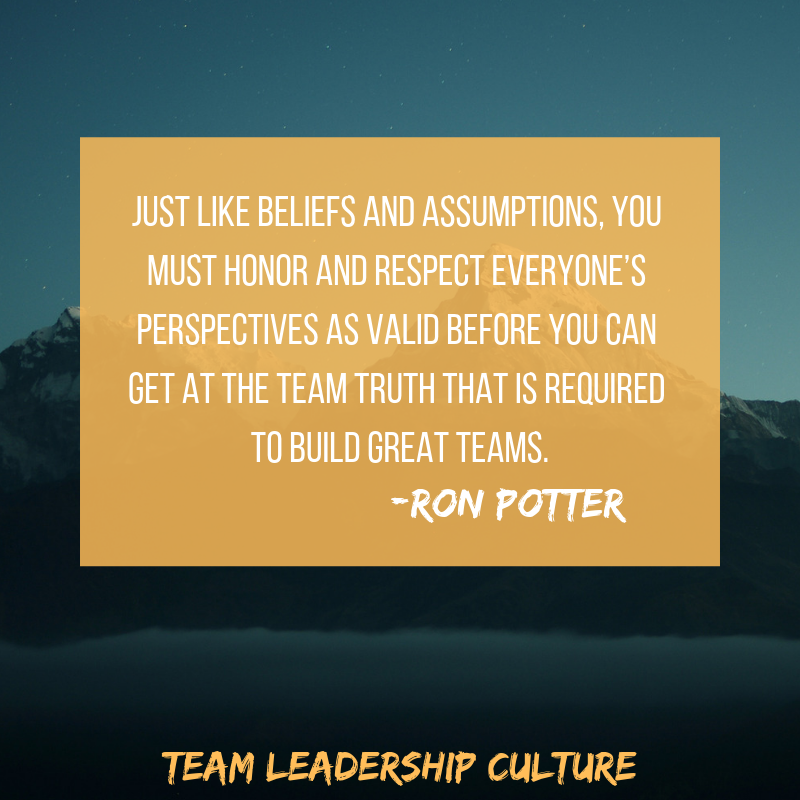
We each have different perceptions. Perceptions are modified by events and experiences over time. If you, as a team leader or a team member assume that you have the “truth” and don’t realize that you have one of many perceptions, just like everyone else, an effective team will never materialize. Just like Beliefs and Assumptions, you must honor and respect everyone’s perspectives as valid before you can get at the Team Truth that is required to build great teams.

TAP into Greatness

To experience the sweetness of wonderful maple syrup, you must TAP into the trunk of the tree. Oak trees have deep TAP roots to withstand the ravages of nature. Whatever analogy you want to use, you must TAP into the core of your team to build the foundation of Truth.

  • Trust
  • Assumptions
  • Perceptions

0 comments
0 FacebookTwitterEmail
Being GenuineBlogCulture

Being Genuine – Part VI

by Ron Potter December 20, 2018

This series of blog posts is based on an article written by Travis Bradberry in Forbes titled “12 Habits of Genuine People.” Be sure to check out last week’s installment here.

Here is his list of 12:

  1. They don’t try to make people like them.
  2. They don’t pass judgment.
  3. They forge their own paths.
  4. They are generous.
  5. They treat everyone with respect.
  6. They aren’t motivated by material things.
  7. They are Trustworthy.
  8. They are thick-skinned.
  9. They put away their phones.
  10. They aren’t driven by ego.
  11. They aren’t hypocrites.
  12. They don’t brag.

In this blog, I would like to consolidate points 1, 2 and 7.

They are Trustworthy

What does it mean to be trustworthy? Mr. Bradberry writes in the original Forbes article,

People gravitate toward those who are genuine because they know they can trust them. It is difficult to like someone when you don’t know who they really are and how they really feel. Genuine people mean that they say, and if they make a commitment, they keep it. You know that if they say something, it’s because they believe it to be true.

I would interpret his words for being trustworthy as having integrity. The dictionary uses the words “strong moral principles, moral uprightness, being whole, undivided” to describe integrity.

Bradberry says it’s difficult to like someone when you don’t know who they really are. I say it’s difficult to be influenced by someone who you don’t believe to have integrity. Without integrity (or being trustworthy) you have no ability to influence. Without the ability to influence, you have very little worth.

They Don’t Pass Judgment

I will once again go back to Mr. Bradberry’s words,

Genuine people are open-minded. No one wants to have a conversation with someone who has already formed an opinion and is not willing to listen.

Scott Fitzgerald said, “The test of a first-rate intelligence is the ability to hold two opposed ideas in mind at the same time and still retain the ability to function.”

Genuine people listen with the intent to understand and are perfectly willing to accept opposing ideas as both being valid at the same time. We talked about this in the last blog which described Genuine People as being “thick-skinned”, or in my words, comfortable in their own skin.

Genuine people are open-minded.

They don’t try to make people like them

This is the number one attribute of Genuine People identified in Travis Bradberry’s article.

We talked about Aristotle’s Levels of Happiness in our last blog. He identified Level 4 as Sublime Beatitudo: Providing blessings with such excellence and grandeur as to inspire great admiration or awe.

The words that Aristotle used for Level 4 were Truth, Love, Beauty, Unity (I’ve seen different interpretations the fourth attribute, but I’ve enjoyed the concept of Unity in terms of building great teams.)

I believe that one mistake made today is assuming that the first two, Truth and Love are opposite ends of a continuum. All too often people believe they can either tell a person the truth or love (offer them respect) them. However, they exist on different axes of the chart.

Think of Truth being the scale up the left side of the chart and Love being the scale along the bottom of the chart.

Low Truth, Low Love – Manipulative Insensitivity.

The receiver doesn’t believe the sender is speaking the truth nor do they exhibit any respect. It just feels manipulative.

High Truth, Low Love – Obnoxious Aggression

The receiver knows the sender is speaking the truth as they see it but with no respect. It’s just aggressive behavior.

Low Truth, High Love – Ruinous Empathy

The receiver may feel the respect from the sender but knows they are not getting the whole truth. This leaves them with an inability to improve.

High Truth, High Love – Positive Candor

The receiver feels respected and at the same time is given the truth they need to improve. This creates the ability to learn.

Genuine people want to help the people grow and develop. Genuine people want to grow and develop themselves. This requires both Truth and Love on everyone’s part. Simply getting people to like you doesn’t help and doesn’t work in the end.

0 comments
0 FacebookTwitterEmail
Being GenuineBlogCulture

Being Genuine – Part V

by Ron Potter December 13, 2018

This series of posts is based on an article written by Travis Bradberry in Forbes titled “12 Habits of Genuine People.”  You can catch last week’s discussion here.

Here is his list of 12:

  1. They don’t try to make people like them.
  2. They don’t pass judgment.
  3. They forge their own paths.
  4. They are generous.
  5. They treat everyone with respect.
  6. They aren’t motivated by material things.
  7. They are Trustworthy.
  8. They are thick-skinned.
  9. They put away their phones.
  10. They aren’t driven by ego.
  11. They aren’t hypocrites.
  12. They don’t brag.

In this post, I would like to consolidate points 8 and 3.

Thick Skinned and Forge their Own Paths

Thick Skinned or Comfortable in Their Own Skin.

Thick Skinned is an interesting concept. The dictionary definition says “insensitive to criticism or insults.” This seems to say that in their desire to forge their own paths, they are a “damn the torpedoes, full steam ahead” kind of person. This seems to indicate a loner or a person totally on an island forging their own paths.

I don’t experience genuine people that way. To me a genuine person is warm and open, inviting and embracing. They’re not a loner or an isolated figure taking on the world with their own view of how things should or could work. They’re engaging and inviting. They’re genuine!

I don’t find genuine people thick-skinned, I find them practical, looking for truth and reality and being open to different perspectives and understanding. The reason they don’t seem to be affected by criticism and insults is that they are confident of who they are yet open to other’s beliefs and assumptions. They don’t take statements as criticism or insults because they see others as trying to express a different point of view, even if they’re doing it very poorly.

I wouldn’t consider genuine people as thick skinned, I would consider them as being comfortable in their own skin. They’ve been open to criticism and different points of view while being self-reflective enough to put the other point of view in perspective with their own view of the world.

Forge Their Own Path

Again, I don’t see genuine people forging their own path in complete isolation. They are constantly looking at, listening to and trying to understand the world around them. They do however remain optimistic about forging a path to a new and better place. While they do experience discouragement, they don’t really get discouraged. While they do face obstacles, they don’t feel like or behave like victims. Maybe we can think of them as the early pioneers. What moved them forward through great setbacks, discouragement and obstacles was their belief in a better life in the west.

They didn’t do it alone. Those who tried died. They didn’t do it without the guidance of those who went before them. They were realistic about the obstacles, threats, and dangers. Yet, they kept going. Forging their “own” paths.

Their “courage” came from their vision of a better future. But the path they took was with other people to offer support and care as well as guides and mentors who have experienced some if not all the path forward.

Genuine people are comfortable in their own skin and forge a path to a new and better future with companions along the way.

0 comments
0 FacebookTwitterEmail
BlogCultureOrganizational IntegrityTrust Me

Organizational Integrity: Prioritizing People-Development

by Ron Potter December 10, 2018

For the next few Monday posts, I want to provide some snapshots into what makes up organizational integrity.

To have a great organization, integrity must be widespread. It won’t do to be a saintly leader of highest integrity if the rest of the team consists of liars, backbiters, and thieves. Integrity must exist from top to bottom. There are some key qualities that need to be modeled by leadership in order for an organization to embrace integrity.

Last week we started with self-disclosure. This week we explore Prioritizing People-Development.

Prioritizing People-Development

In 1997 Dennis Brozak, the president of Design Basics, a company with revenues of $4 million, handed over day-to-day operations to Linda Reimer, a highly qualified fifty-three-year-old whom he had found three years earlier at, of all places, a copy machine. Brozak saw that Reimer had management potential, but the intensive systematic training he gave her was the key to her rapid advancement in the company.

Back in 1991, Reimer was a longtime preschool director who wanted a part-time summer job. She took a low-level job photocopying blue prints for Design Basics, a company based in Omaha, Neb., that sells blueprints for homes via catalog. She did that job so well that Brozak hired her full-time in1994.

Over the next two years, Brozak gave Reimer various assignments that tested the potential executive’s leadership capabilities. First, he made her a human resources director and asked her to switch the department’s focus from advocating employees’ rights to developing their professional growth. She succeeded. Brozak began challenging her more and more. “I wanted to find out a lot about her,” he says. “Can she manage and motivate people? Can she delegate accurately and appropriately? And she had to be able to fire people when necessary. She has a big heart,
but she passed that test, too.”

Then, to see if she understood the market and the industry,
Brozak put Reimer in charge of one product, a catalog. The catalog’s home designs sold well. Brozak then evaluated her financial acumen
by making her an operations director, and he watched how well she used the company’s money. Again, he says, she did well. So Brozak
gave her control over all the company’s publishing. Once more, she produced a hit.

Finally, Brozak tested Reimer, by then a vice president, with new product development. He figured that assignment would show whether she was a big-picture thinker. Reimer identified a new niche that has become a major profit center for the company. “She changed the direction of our sales,” Brozaksays. By 1996, after 13 years at the company’s helm, Brozak wanted more free time. He began passing day-to-day operations to Reimer, giving her new responsibilities gradually to make sure she was ready to be promoted. In April 1997, Reimer officially became president.

Mike Hoffman, “The Leader Within,” Inc.,September 1998

If leaders want to develop others, they need to embrace these assumptions:

  • “Everyone wants to feel worthwhile.
  • Everyone needs and responds to encouragement.
  • People buy into the leader before they buy into the plan.
  • Most people don’t know how to be successful.
  • People are naturally motivated.
  • Most people will move once they receive permission and equipping.”

John C. Maxwell, The Maxwell Leadership Bible: Developing Leaders from the Word of God (Nashville: Nelson, 2002), 1437.

0 comments
0 FacebookTwitterEmail
Newer Posts
Older Posts
  • Facebook
  • Twitter
  • Linkedin
  • Rss
  • About This Site
  • About
    • Clients
  • Services
  • Resources
    • Trust Me
    • Short Book Reviews
  • Contact

About this Site | © 2024 Team Leadership Culture | platform by Apricot Services


Back To Top
Team Leadership Culture
  • Team
  • Leadership
  • Culture
  • Myers-Briggs
  • Trust Me
  • Short Book Reviews
 

Loading Comments...