

Team Leadership Culture
  • Team
  • Leadership
  • Culture
  • Myers-Briggs
  • Trust Me
  • Short Book Reviews
Top Posts
Obituary
REPOST: Four Functions, Three Rules
ROUNDUP: The Rise of AI
REPOST: Facing Adversity Series
ROUNDUP: Curiousity
ROUNDUP: Deep Work
REPOST: Character vs. Competence
REPOST: Opposite of Victim
REPOST: Listening With the Intent to Understand
REPOST: Performance vs Trust
  • About
  • Services
  • Resources
    • Trust Me
    • Short Book Reviews
  • Contact

Team Leadership Culture

  • Team
  • Leadership
  • Culture
  • Myers-Briggs
  • Trust Me
  • Short Book Reviews
Author

Ron Potter

Ron Potter

Absurd!BlogIn-Depth Book Reviews

Absurd!: Lost Causes are the Only Ones Worth Fighting For

by Ron Potter May 8, 2017

“Whenever I have the arrogance or audacity to believe that I can reform people, I get nowhere. But when I fundamentally recognize that I cannot possibly accomplish those reforms, I can move ahead with a more humble posture and, paradoxically, perhaps then there is a chance that the situation can change. The absurd lesson is to recognize that it is a lost cause and work on it anyway.”

“They make me so mad.”

“I can’t do anything because of them.”

“They’re the reason I haven’t been able to get that promotion.”

Heard these? Spoken these? It’s absurd to think you can change someone. The only person you even have a chance of changing (and sometimes that’s a slim chance) is yourself.

It’s absurd to think that just because you change, the other person will change also. Change anyway! Become a better person. Develop into a better leader, follower, team member. As Farson says, it’s the only game in town. We spend so much energy on wanting, expecting, trying to change other people. “I’ll forgive them when they apologize to me.” Forgiveness is not conditional. Forgiveness is something you do for yourself.

Let me close this series on that most delightful small book, “Absurd” with our authors own words:

“If absurdity is ubiquitous, if the most important goals are lost causes, why do we keep playing this absurd game? We play it because it is the only game in town. Of course it is absurd. Of course it is only a game. But it is a game well worth playing – and worth playing well.”

And finally, maybe the best quote in the book “My Advice is Don’t Take My Advice.”

I wouldn’t do any good anyway. My advice won’t change your thinking. Only your own advice will change how you view the world. Advise wisely.
I’m continuing my series on an in-depth look at a wonderful little book that’s twenty years old this year. The title is Management of the Absurd by Richard Farson. You may want to consider dropping back and reading the previous blog posts about ABSURD! I think it will put each new one in great context.


0 comments
0 FacebookTwitterEmail
BlogCulture

OH NO, a LION!

by Ron Potter May 5, 2017

One of my morning reads offered advice on managing stress. It suggested listing stressful situations survived in the past. Learn from them for dealing with stress in the future.

That’s good advice but the first thing that came to my mind was the tremendous auto accident I survived years ago. I couldn’t think of anything I could have done to survive. One solution was to avoid being in that spot at that moment. But I wasn’t sure how I could have managed that.

I also read a chapter or two of my lasted book quest. This morning I was reading, “Why Zebras Don’t Get Ulcers: The Acclaimed Guide to Stress, Stress-Related Diseases, and Coping” by Robert M. Sapolsky.

The line that got me laughing this morning was “It’s one of those unexpected emergencies: you’re walking down the street, on your way to meet a friend for dinner. You’re already thinking about what you’d like to eat, savoring your hunger. Come around the corner and—oh no, a lion!”

OH NO, a LION! Now that I can relate to. Some days seemed to be filled with lions around every corner. These funny stories, help us understand our stress response system. Understanding is the first step in conquering an issue. Good read.

Performing under Pressure is another book I’ve referred to many times. The authors, Hendrie Weisinger, and J. P. Pawliw-Fry do a great job of separating stress and from pressure. They offer good advice on dealing with pressure. Their point is to put on your COTE of Armor.

  • Confidence
  • Optimism
  • Tenacity
  • Enthusiasm

Tenacity includes Goals, Focus, and New Perspectives among other key issues.

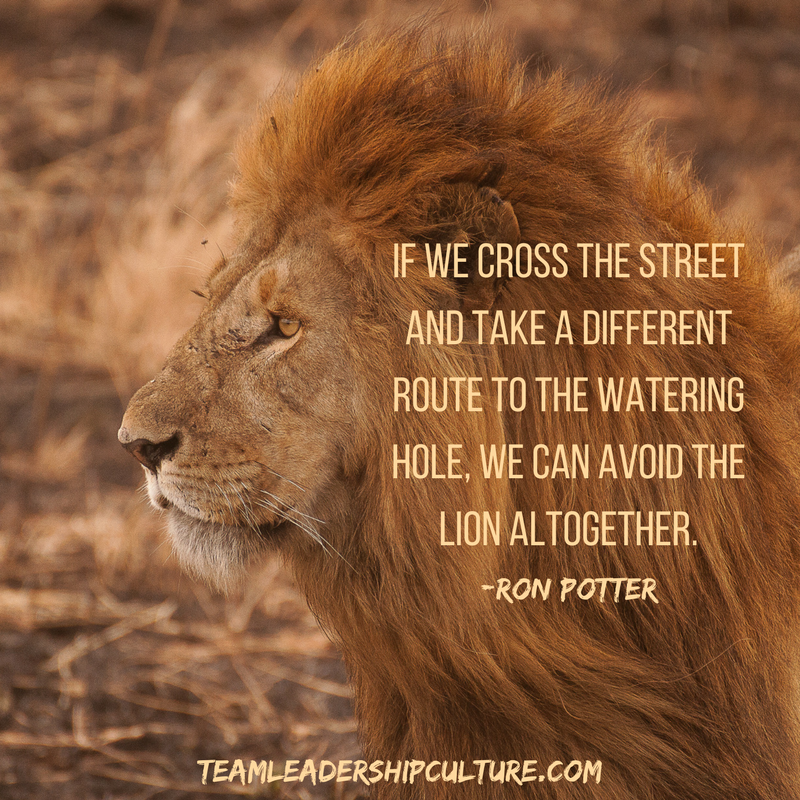
Goals! It seems that when we turn the corner and are facing the lion, our current goals fly out the window. When confronted with a lion, staying focused on your goals reduces stress-related diseases. Our instinct is to run when facing a lion. But maybe we should grab our knife and let out with our best Tarzan scream and go straight at it. If we notice the lion is feasting on its previous prey it has no interest in attacking us. Relax. If we cross the street and take a different route to the watering hole, we can avoid the lion altogether.

Notice how many times the lion prevents you from achieving your goals today.

Is the lion real or imagined?

Is there a way around the lion?

Should you go directly at the lion?

Rather than remembering that car accident, try sticking tenaciously to your goals. You may avoid the lion and reduce some of those stress-related diseases.

0 comments
0 FacebookTwitterEmail
Short Book Reviews

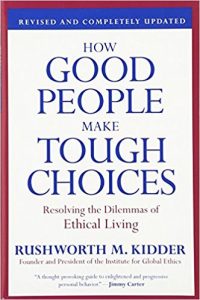
How Good People Make Tough Choices

by Ron Potter May 1, 2017

Ron’s Short Review: This is the book to help you deal with Right vs Right decisions. Most business decisions are Right vs Right but we frame them as Right vs Wrong which makes them impossible to solve. This one should stay on the bookshelf.


0 comments
0 FacebookTwitterEmail
BlogDecision Making with Myers-BriggsMyers-Briggs

Decision Making with Myers-Briggs – Part III

by Ron Potter May 1, 2017

This is the third in a Myer-Briggs series on Decision Making. Over the first two blog posts we looked at the Perceiving Function (how people take in information), and the Judging Function (how people make sense of what they perceive). This blog post will be focused on how we put it all together in the Decision-Making Process.

Background

Carl Jung was the famous psychiatrist who broke with Sigmund Freud. While Freud seemed to study what was wrong with us as human beings, Jung thought it better to study what was right and natural about us humans and what we could learn about ourselves with the proper framework. His work on Psychological Types led Myers and Briggs to put together their framework for understanding how we work.

Of the four functions pairs (making up the 16 possible archetypes) Jung and Myers-Briggs believed that the middle two were used in our decision-making process. It’s important to understand how these two functions work and in which order to under our and others decision-making process.

The simple concept is that we spend our days cycling between perceiving (observing what’s going on around us) and making judgments (decisions) based on that observation. A simple example is that when we’re leaving the house in the morning we look out the window and notice (perceive) that it’s raining. We then judge the situation to require (decide) to take an umbrella.

Depending on your personal type, one of the four function, Sensing, iNtuition, Thinking or Feeling is your primary function. If you’re going to make a decision you will need your primary function satisfied. My primary function is Thinking. If the answer does not look logical to me, I would (can’t) make the decision. Even more important to corporate teams or leadership, if my primary function is not satisfied, I will not commit to a decision. I may comply with it, but I will not make a full commitment to the decision. One of the most destructive events with teams is when people give compliance to a decision during a team meeting but it becomes obvious they are not committed to the decision in the long run.

Reaching Decisions and Commitments

Every person must have their primary function fully satisfied in order to make a decision or commit to a decision. Further, if their secondary function can also be satisfied, that’s all they need. They will now be onboard.

The problem is the facilitator, leader, decision maker always knows which two functions they need satisfied in order to commit to a decision, either consciously or subconsciously. Therefore, they direct the conversation to cover their two needed functions. Maybe it’s Sensing, getting all of the facts on the table, followed by Thinking, putting them into a logical order. That works great for that person and other ST’s on the team but for those who rely on N and/or F, all of the conversation sounded like the adults speaking in the Peanuts cartoons: Wha, wha wha. It’s like an English speaker sitting on a team of Chinese speakers listening to a language that is not understood at all until the question is put forth in English; “Are you ready to decide now?”

The Key

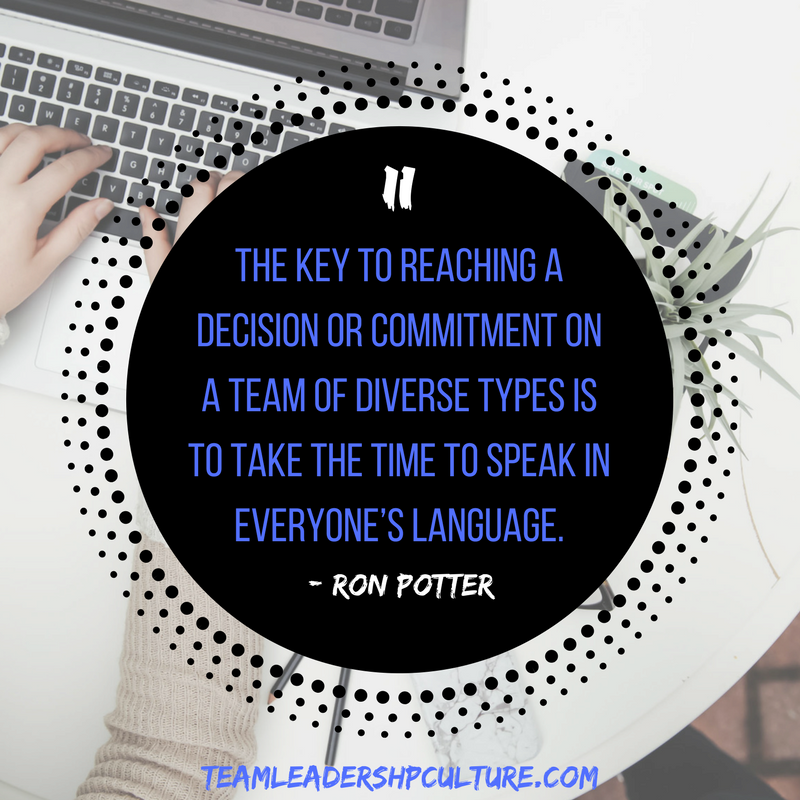
The key to reaching a decision or commitment on a team of diverse types is to take the time to speak in everyone’s language.

Sensing

Ask and answer the Sensing questions: What do we know about the situation? What are the facts? Do we have all the facts? What have we done so far and what were the results? What do we need to accomplish next?

iNtuition

Ask and answer iNtuitive questions: Where are we trying to go? What should the end results be? What other possibilities could we consider? What does the data seem to imply?

Thinking

Ask and answer Thinking questions: Is there a logical conclusion? Can we list the pros and cons of each option? Do we know what the costs of each option are? Can we put priorities to each possible outcome?

Feeling

Ask and answer Feeling questions: Do these answers support or violate our values? How will people (ours, customers, vendors, etc) react to the outcome? Who will commit to putting in the sacrifice needed to accomplish these goals?

Balance, balance, balance

It’s only when each of the four function is given equal time, honor and trust that we can count on getting to a committed answer and a team that acts in an aligned and committed manner.

Learn to cycle through these four functions and keep cycling until everyone is onboard and committed to the decision. You’ll be amazed at the power of an aligned and committed team.

0 comments
0 FacebookTwitterEmail
BlogCulture

Are you a Fighter Pilot?

by Ron Potter April 27, 2017

There are many outstanding characteristics associated with fighter pilots: Confidence, Intelligence, Assertiveness, Self-Discipline, Trustworthiness, Decisiveness, Dedication and others. But, the one characteristic that appears only on the list of fighter pilots is multitasking. Notice that I said “only” on the list of fighter pilots.

Many studies have confirmed that the only group of people who are good at multitasking are highly trained and skilled fighter pilots. And it’s not really the skill that makes the difference, it’s the highly-trained component. Through hours of dedicated and focused training, pilots learn to multitask effectively. The rest of us never put in the time, training and effort to become good at multitasking. But that doesn’t seem to stop us from trying.

A recent study by researchers at Stanford attempted to identify why the current generation of college students seemed to be better at multitasking than previous generations. Researchers are thrilled when their studies identify a single prominent reason for their complex research question. This study concluded with one of those Eureka moments.

What is the clear reason for current student’s ability to multitask better? They don’t! They suck at it. They’re actually promoting damaging effects.

The finding: Their ability to multitask diminishes over time. They also lose ground on other abilities. Multitasking leads to stupidity. That’s not what the study concluded but it seems like a logical conclusion to me.

Research seems to be flying at us from all directions to stop the multitasking. It doesn’t help us think. It doesn’t help us be productive. It doesn’t help us keep on top of things. It diminishes our ability to do all those things and more.

Deep work. Times of silence. Shut out the world. Get into deep thought. These are the things that help us be more productive and happier. But these take discipline, grit, determination, resolve.

Are you a fighter pilot? Are you trying to multitask like one? If so, your hurting your chances for success.

Carve out that time. Get away from the activity. Turn off the electronics (or at least stick them under a pillow or in a drawer). Get into some deep thought. If you haven’t thought about it (really thought about it) you’re not allowed to express an opinion. Our world is being buffeted by thoughtless opinions. The more multitasking we do the more thoughtless the opinions. Stop and think.

“Did you stop to think?” was a question I often heard from my parents. As a teenager, I thought that was just the stock response for when I did something stupid. I didn’t realize at the time it was a recipe to avoid being stupid as an adult.

Stop multitasking. Stop to think!

0 comments
0 FacebookTwitterEmail
Absurd!BlogIn-Depth Book Reviews

Absurd!: To Be a Professional One Must be an Amateur

by Ron Potter April 24, 2017

Amateur stems from the Latin word amator, which means “lover,” Amateurs do what they do out of love. Love is fundamental to good leadership because leadership is all about caring.

Aristotle spoke of Love as being one of the key elements to the highest level of happiness. His other words included at that level are Trust, Beauty, and Unity. All traits of great teams. Great leaders care for their people. Farson says “Indeed, caring is the basis for community, and the first job of the leader is to build community, a deep feeling of unity, a fellowship. Community is one of the most powerful yet most fragile concepts in the building of organizations.”

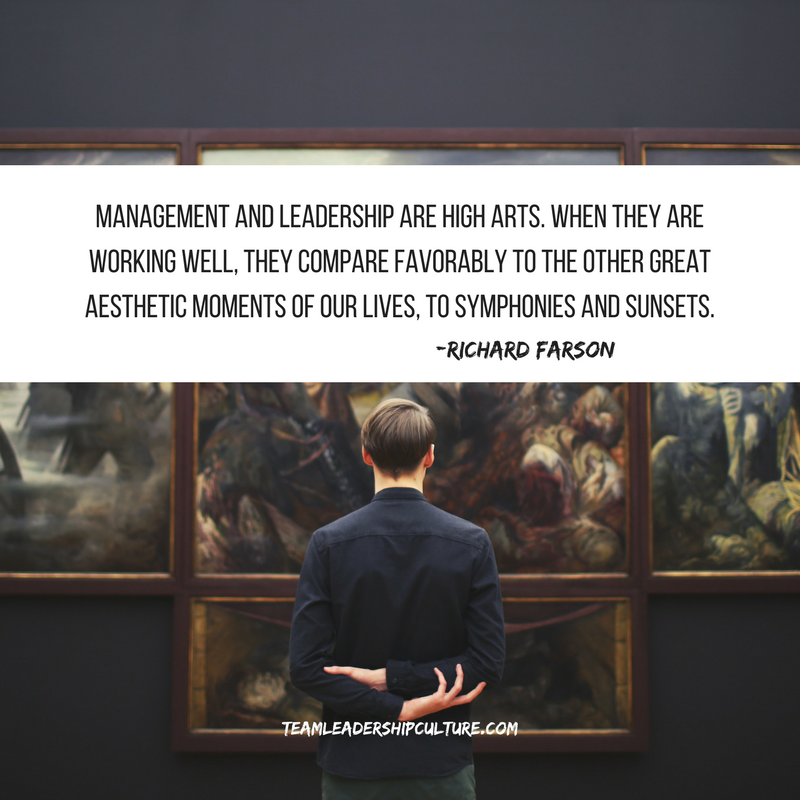
I’m afraid the lovers of the arts would never understand or agree that leadership would fall into the same category as a great symphony or painting, but I’ve experienced that kind of joy when great teams really get on a roll. “Management and leadership are high arts. When they are working well, they compare favorably to the other great aesthetic moments of our lives, to symphonies and sunsets.”

Leaders like to think of themselves as professional and indeed they are. “But the amateur performs work out of love, out of sensuous pleasure in the act of accomplishment, in the creation of community, in the bonds of compassion that unite.”

Great teams are built with great leaders based on the highest level of happiness: Truth, Love, Beauty and Unity. Aristotle may not have been thinking about our corporate leadership teams of today when he explained the four levels of happiness. But our nation’s founding fathers knew it was relevant when they declared in our Declaration of Independence that we find life, liberty and the “pursuit of happiness” to be our unalienable Rights.

What will you do to be an amateur today?

I’m continuing my series on an in-depth look at a wonderful little book that’s twenty years old this year. The title is Management of the Absurd by Richard Farson. You may want to consider dropping back and reading the previous blog posts about ABSURD! I think it will put each new one in great context.
0 comments
0 FacebookTwitterEmail
BlogCulture

I had a great day today… I got criticized

by Ron Potter April 20, 2017

Accept criticismThose are the words of Dr. Hank Weisinger co-author of the book Performing Under Pressure. On his blog, he writes about dealing with pressure by dealing with criticism.

When receiving criticism, we experience emotion. Emotions such as:

  • feeling hurt
  • anger
  • dejection
  • disappointment
  • resentfulness

These and other emotions are natural. But, if we’re good at evaluating our emotions we will be better at dealing with the pressure.

Dr. Weisinger suggests 4 steps to deal with criticism more productively.

Increase your receptivity to criticism

You can’t use criticism to your advantage if you are not going to at least listen to it. Align your definition of criticism with its historical helpful intent by programming yourself with the thought “criticism is information that can help me grow.” The more you internalize this thought, the less likely you will respond to criticism with defensiveness, anger, and hurt.

Appraise the criticism

Being receptive to criticism gives you the opportunity to evaluate what you are being told and to decide whether it is in your best interest to act upon it. High performers use multiple criteria to help them decide:

  • How important is the information to my life/job?
  • Is the source of the criticism credible?
  • Do other people agree with the criticism?
  • How much effort is required to respond productively?
  • What are the benefits to me?

The real value in appraising the criticism using these criteria is that it slows down your response and minimizes the chances that you will dismiss criticism impulsively when it fact, it could be very helpful.

Acknowledge your appraisal

High performers show respect and appreciation to their critics by sharing how they evaluated the criticism provided. This often leads to a productive exchange of viewpoints, and often in the case of high performers, new insights are gleaned that lead him or her to agree with their critic.

Take action

What if the criticism is valid —it’s in your best interest to act upon it? If this is the case, high performers distinguish themselves by taking steps to make sure they make the necessary changes/improvements that the criticism demands.

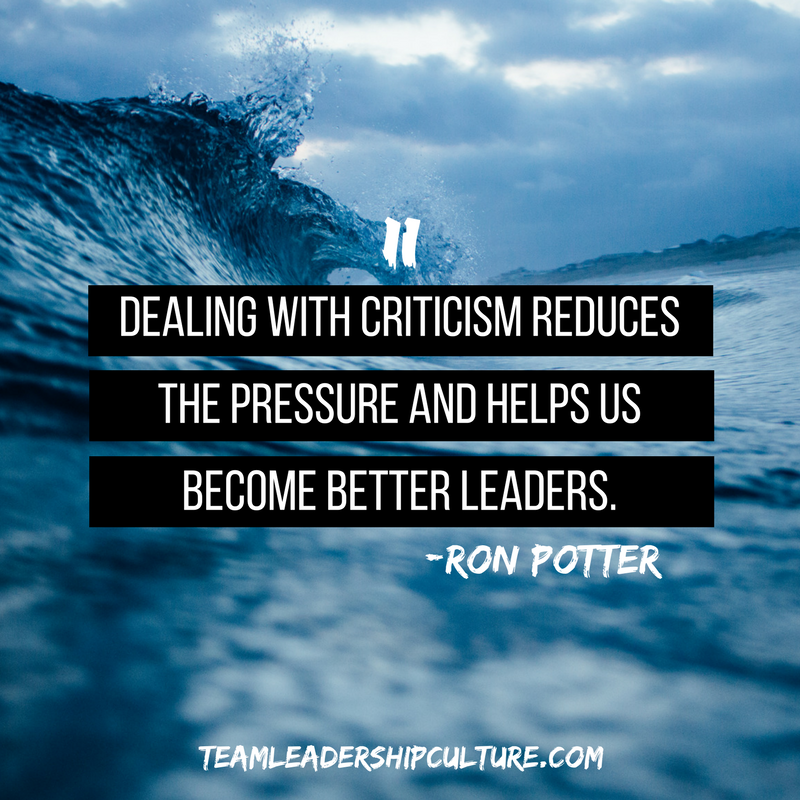
I’ve referred to Dr. Weisinger’s book often when helping clients deal with pressure. Dealing with criticism reduces the pressure and helps us become better leaders.

Enjoy your day. Enjoy the criticism.

0 comments
0 FacebookTwitterEmail
BlogDecision Making with Myers-BriggsMyers-Briggs

Decision Making with Myers-Briggs – Part II

by Ron Potter April 13, 2017

This post is the second in a Myer-Briggs series on Decision Making. Over three blogs we’ll look at the Perceiving Function (how people take in information), the Judging Function (how people make sense of what they perceive) and finally the Decision-Making Process.

Background

Carl Jung was the famous psychiatrist who broke with Sigmund Freud. While Freud seemed to study what was wrong with us as human beings, Jung thought it better to study what was right and natural about us humans and what we could learn about ourselves with the proper framework. His work on Psychological Types led Myers and Briggs to put together their framework for understanding how we work.

Of the four functions pairs (making up the 16 possible archetypes) Jung and Myers-Briggs believed that the middle two were used in our decision-making process. It’s important to understand how these two functions work and in which order to under our and others decision-making process.

The simple concept is that we spend our days cycling between perceiving (observing what’s going on around us) and making judgments (decisions) based on that observation. A simple example is that when we’re leaving the house in the morning we look out the window and notice (perceive) that it’s raining. We then judge the situation to require (decide) to take an umbrella.

Judging

In this post, we’ll look at the Judging function. We looked at the Perceiving function earlier. We’ll finish the series with a Decision Process post.

How do you Judge what you have perceived about the world around you? Don’t think of this word as the negative form of “Judgement”. You’re not being a judgmental person. Myers-Briggs calls this your Deciding function. Once you’ve taken in information with your Perceiving function (previous blog), how do you then finally decide?

Thinking

The thinking function is driven mostly by logic. Add it up, pros and cons, bottom line; there’s your answer.

Feeling

The Feeling function is driven mostly by values. “I see your logic and may even concede that it’s correct, but who cares?” How will this logical answer affect our people, our customers, our vendors? Does it reflect our values?

It’s important to note that this is not feelings of emotion, though it’s often mistaken for that. It’s more a question of values and how people will be affected.

Both Thinking and Feeling functions are valid. I’m always emphasizing balance when I conduct Myers-Briggs sessions. Balance, balance, balance. It’s best when we can depend on and blend both functions. We’ll get into trouble relying too much on one or the other. Therefore, I like to use Myers-Briggs with teams. It’ easier for a team to balance functions when we have a mixture of both types on the team.

I often run a little experiment with my leadership teams. At one point I’ll ask the team what they “think” about moving forward. If I ask a thinking-preferenced person, I’ll often get a fairly robust answer. Something like; “I think we should take steps one, two and three which will lead us to a decision point about which way we should proceed after that.” As I work my way around the room and ask the same “thinking” question of a feeling-preferenced person, I’ll get a less robust answer. Something like “The logic in the previous answer looks correct. I could probably support that answer.”

But, a little later, I’ll ask the same question but I’ll speak of it in Feeling terms; “What do you “feel” we do about moving forward. The thinking-preferenced person doesn’t understand the difference in the question. Their response will be something like “I just told you what I “thought” a minute ago. But if I ask the feeling question of a feeling-preferenced person, I often get a more robust answer. “I think the logic is correct and we could defend it. But do any of you understand how upset our customers are going to be with that decision? I fear we’ll lose a percentage of our customer base that we’ll never get back!” Was it a logic answer? No. Was it a powerful answer? Indeed. In fact, it will likely change the team answer.

Like our Sensing and iNtuitive types, Thinking types are no less feeling than Feeling types. And Feeling types are no less logical than Thinking types. But, decisions will be driven by the preferred type. We need to address both to reach balanced conclusions.

The best answer is a balanced one. Weigh and compare the thinking attention to logic with the feeling attention to values and impact. It often takes a partnership or team to do this well.

0 comments
0 FacebookTwitterEmail
BlogCulture

Anyway Love

by Ron Potter April 13, 2017

People are illogical, unreasonable, and self-centered. Love them anyway.

Aristotle uses the word Love as one of the key elements of the highest level of happiness. The Greeks had several words that get transcribed into the English word Love. This one has no emotional connotation to it. It’s more about how you treat people. Treating people with respect, kindness and patience meant you were exhibiting this kind of love.

People are messy. They are illogical, unreasonable and self-centered. At least from our point of view. But we are also illogical, unreasonable and self-centered from their point of view. Guess what, we’re illogical, unreasonable and self-centered. Get over it and get over others being that way. Love them anyway. The more we treat each other with respect, kindness, and patience, especially when it appears we don’t deserve it, the more love we’ll experience.

Love them anyway!

Headlines from a wonderful little book titled Anyway by Kent Keith

0 comments
0 FacebookTwitterEmail
Absurd!BlogIn-Depth Book Reviews

Absurd!: Leaders Cannot Be Trained, but They Can Be Educated

by Ron Potter April 10, 2017

“Training leads to development of skills and techniques…Education on the other hand, leads not to technique but to information and knowledge, which in the right hands can lead to understanding, even to wisdom. And wisdom leads to humility, compassion, and respect—qualities that are fundamental to effective leadership.”

I like the word develop rather than education but I believe the principle is the same. Early in my consulting career, I wanted to teach leaders everything I had learned. I figured out very quickly that I couldn’t teach anyone anything, all I could do was to help them learn. The only thing they would learn was what they were ready to learn and what they wanted to learn. Beyond that, I couldn’t teach them anything.

New or prospective clients wanted me to provide an outline of my “training program.” I often had a hard time explaining that I didn’t have a program, we would figure out what the leader or team needed at that moment and would learn it together. Farson says is well: “Training makes people more alike. Education, because it involves an examination of one’s personal experience in the light of an encounter with great ideas, tends to make people different from each other. So, the first benefit of education is that the manager becomes unique, independent, the genuine article.” They develop integrity. They lead from who they are. Farson further says: “Managers can gain better self-understanding, learn about their own interpersonal selves, their reactions to and the impact on others, prejudices and blind spots, strengths and weaknesses. A better understanding of themselves and of their feelings gives all managers added trust in their perceptions, reactions, impulses, and instincts.

The following are words that appear in this blog. Go back and read them again with thought and reflection. There’s a lot of buried treasure in these words.

Wisdom leads to:

  • Humility
  • Compassion, and
  • Respect

Examines:

  • Personal experience
  • Great ideas, and
  • People who are different from each other

Managers [Leaders] become:

  • Unique
  • Independent
  • The genuine article
  • They develop integrity

Leaders are not alike. They are unique and whole.

I’m continuing my series on an in-depth look at a wonderful little book that’s twenty years old this year. The title is Management of the Absurd by Richard Farson. You may want to consider dropping back and reading the previous blog posts about ABSURD! I think it will put each new one in great context.

0 comments
0 FacebookTwitterEmail
BlogCulture

What’s the point of your point of view?

by Ron Potter April 6, 2017

The world doesn’t change but your point of view changes the world.

Leadership Step-by-Step by Joshua Spodek is one of my recent book reviews. Josh and I were able to get acquainted over the internet and phone and decided to work on a podcast together. Josh had been doing podcasts and I was anxious to learn from experiencing the process.

We corresponded over a couple of weeks leading up to the interview for the podcast. And even though we exchanged a few emails about topics, the start of the process turned very awkward.

Being cordial, Josh asked me a few questions and then hesitated.  He was waiting for me to kick off the interview process.

I was enjoying the early exchange but then seemed to run out of things to say.  I was waiting for him to kick off the interview process.

It dawned on each of us that we were expecting the other person to lead and record the interview. We approached a very simple and enjoyable situation from different points of view.  It became awkward for both of us.

We persevered and had a wonderful exchange of ideas and thoughts.

Josh must have been thinking “This is awkward and this guy doesn’t know what he’s doing. Am I about to waste an hour of my valuable time?” What if Josh had turned those questions into a point-of-view?

  • This guy is a loser.
  • I’m not going to get anything out of this exchange.

The interview would have ended ugly with no real value to either of us.

But Josh came into the interview with a good point-of-view. He believed there was

  • Value in learning from other people (maybe questioning this particular person)
  • It was always worthwhile to listen and learn.

With that point-of-view, Josh lives in a much more positive world that many of us.

I could list dozens of different point-of-views that Josh may bring  to the interview.  8 out of 10 of them would have led to a negative result.

But that didn’t happen. Josh starts each day with a point-of-view that the world is an amazing place full of amazing people. He believes that we can learn so much from each other if we

  • understand and lead ourselves before we
  • understand and lead others (check out his book for lessons on this concept).

We had an enjoyable interview (that ran overtime) and I look forward learning more from Josh in the future.

What point of view do you bring to the table?

0 comments
0 FacebookTwitterEmail
BlogDecision Making with Myers-BriggsMyers-Briggs

Decision Making with Myers-Briggs – Part I

by Ron Potter April 3, 2017

This will begin a Myer-Briggs series on Decision Making. Over three blog posts we’ll look at the Perceiving Function (how people take in information), the Judging Function (how people make sense of what they perceive) and finally the Decision-Making Process.

Background

Carl Jung was the famous psychiatrist who broke with Sigmund Freud. While Freud seemed to study what was wrong with us as human beings, Jung thought it better to study what was right and natural about us humans and what we could learn about ourselves with the proper framework. His work on Psychological Types led Myers and Briggs to put together their framework for understanding how we work.

Of the four functions pairs (making up the 16 possible archetypes) Jung and Myers-Briggs believed that the middle two were used in our decision-making process. It’s important to understand how these two functions work and in which order to under our and others decision-making process.

The simple concept is that we spend our days cycling between perceiving (observing what’s going on around us) and making judgments (decisions) based on that observation. A simple example is that when we’re leaving the house in the morning we look out the window and notice (perceive) that it’s raining. We then judge the situation to require (decide) to take an umbrella.

Perceiving

In this post, we’ll look at the Perceiving function followed by a Judging blog and finally a Decision Process blog.

How do we perceive the world around us? For many years, Myers-Briggs called this your Attending function, what do you pay attention to? The two descriptors associated with our Perceiving function are Sensing and iNtuition. S vs N. That’s not a type in the word intuition. Myers-Briggs had already used the capital I to indicate Introversion (other blogs) so they used the capital N to signify intuition.

Sensing

The sensing function is focused on things we can notice with our five senses. Because of this, “Sensors” are focused on facts, details, the present and the practical. Things that we can see and know now.

iNtuition

Those who are intuition based seem to think and notice things like concepts, patterns, future, imaginative. Things that we can deduct or speculate about the future.

Balance

Both perceiving functions are valid, useful and necessary. I’m always emphasizing balance when I conduct Myers-Briggs sessions. Balance, balance, balance. It’s best when we can depend on and blend both functions. We’ll get into trouble relying too much on one or the other. Therefore I like to use Myers-Briggs with teams. It’ easier for a team to balance functions when we have a mixture of both types on the team.

I first experienced this function even before I knew of the Myers-Briggs framework. I have a preference for iNtuition and years ago I was working for a boss who had a clear preference for Sensing. He asked me a question that had great consequences for our business and I quickly answered him from my conceptual view of the world. He said to me, “You shouldn’t make important decisions like that so flippantly!” I didn’t feel it was flippant but he insisted that I spend time creating a business plan to support my flippant answer. Three weeks later I was back with my completed spreadsheet business plan and the answer was still the same. At that point I was curious. Didn’t he know the answer three weeks ago? Didn’t he at least have a hunch? He said, Yes, he figured the answer was likely to go that way but he was not willing to make the decision until he could see the numbers. This was an important revelation to me (later confirmed by Myers-Briggs). Sensing types are no less intuitive than iNtuitive types. He figured the answer would likely go that way. But, they won’t make decisions without the details and facts. iNtuitive types pay no less attention to the details (I’m very good at spreadsheet development and analysis) but they’re willing to make decisions based on that intuition without confirming the details.

The best answer is a balanced one. Weigh and compare the sensing attention to detail with the intuitive attention to the concept. It often takes a partnership or team to do this well.

1 comment
0 FacebookTwitterEmail
Newer Posts
Older Posts
  • Facebook
  • Twitter
  • Linkedin
  • Rss
  • About This Site
  • About
    • Clients
  • Services
  • Resources
    • Trust Me
    • Short Book Reviews
  • Contact

About this Site | © 2024 Team Leadership Culture | platform by Apricot Services


Back To Top
Team Leadership Culture
  • Team
  • Leadership
  • Culture
  • Myers-Briggs
  • Trust Me
  • Short Book Reviews