
Team Leadership Culture
  • Team
  • Leadership
  • Culture
  • Myers-Briggs
  • Trust Me
  • Short Book Reviews
Top Posts
Obituary
REPOST: Four Functions, Three Rules
ROUNDUP: The Rise of AI
REPOST: Facing Adversity Series
ROUNDUP: Curiousity
ROUNDUP: Deep Work
REPOST: Character vs. Competence
REPOST: Opposite of Victim
REPOST: Listening With the Intent to Understand
REPOST: Performance vs Trust
  • About
  • Services
  • Resources
    • Trust Me
    • Short Book Reviews
  • Contact

Team Leadership Culture

  • Team
  • Leadership
  • Culture
  • Myers-Briggs
  • Trust Me
  • Short Book Reviews
Category:

Trust Me

BlogTrust Me

The Integrity of Quality

by Ron Potter May 30, 2016

0Ad9yHP8QdCYBUqKxoiw_Stockholmsnow

Many believe that quality and productivity will define the economics of the twenty-first century. One of the principal events of the last century was Japan’s postwar emergence as an economic superpower. This came about primarily because of the quality revolution among Japanese manufacturers of automobiles and electronics, who zoomed past their American counterparts as consumers demonstrated with their wallets a preference for imports and the quality (perceived or real) of the products brought to the marketplace. In the process, American companies exported millions of jobs and, at the same time, were jolted into the reality that American consumers wanted, and even demanded, the highest quality.


To stop the outflow of consumer dollars, American manufacturers instituted many programs to improve quality. Total Quality Management (TQM) became more than just a popular catch phrase. It became a process driver for hundreds of companies and the focus of many leaders.


Authors Tom Peters and Nancy Austin wrote: “Any device to maintain quality can be of value. But all devices are valuable only if managers—at all levels—are living the quality message, paying attention to quality, spending time on it as evidenced by their calendars.”


The spotlight on quality remains. Today, consumers expect every product and service to be of the highest quality. Joseph Juran, publisher of the classic Quality Control Handbook, states, “We’ve made dependence on the quality of our technology a part of life.”


Clearly, American leaders need to emphasize quality in every aspect of their organizations. Whether they are service-driven or product-driven, company leaders must completely understand the need for quality and communicate that message down the line so that everyone in the organization fully understands the importance of maintaining and improving quality.


This addresses organizational quality, but what about personal TQM?


In the wake of the Volkswagen scandal as well as other corporate meltdowns, investors have lost hundreds of billions of dollars and tens of thousands of people are out of work. Cooked books, deceitful executives, and lackadaisical board members have caused a collapse of inconceivable proportions. The disintegration of these companies represents an unimaginable failure of leadership and governance. What has happened to personal quality?


As you learn and apply the principles of trustworthy leadership presented in my book, Trust Me, you will become a leader known for personal “total quality.” Specifically, no leader can have a life of quality without integrity. And the same is true for the entire organization. Without integrity, it will be impossible for the organization to have a truly high-quality reputation with customers, employees, peers, and shareholders.

Integrity is absolutely necessary for the success of a leader and an organization. A total quality life insists on integrity.

0 comments
0 FacebookTwitterEmail
BlogCultureOrganizational IntegrityTrust Me

Organizational Integrity

by Ron Potter May 16, 2016

photo-1462871287569-28d4c9a0ab7bHow can you build a team integrity? By modeling some key qualities.

Vulnerability

A leader who is approachable, available, and open to other ideas, thoughts, and even criticism has learned to be a humble person and further develops his or her integrity.
Executives often overlook the power of vulnerability. They confuse vulnerability with being weak. Too often, and for whatever reason (fear, circumstances, office politics, and so on), leaders build walls around themselves. They add one brick at a time until one day they become walled off from their people and their peers. The walls give them protection, but at the same time, the walls hide them from the harsh realities that confront every leader and keep them from communicating effectively. They are insulated and protected, but they are also cut off from others. Behind the walls, they can control and be hidden from failure. Behind the walls, they do not need to trust others or be vulnerable.
Gates, instead of walls, give others access to leaders, which enables leaders to demonstrate that they are trustworthy, open, and humble. Gates also allow leaders to share their visions and values with others. Open gates allow leaders to be vulnerable, to let go, and to trust others, which in turn builds others’ trust in their leaders.
Once a leader takes this step of vulnerability, others will give back, and an effective team can be built on interpersonal integrity.

Self-Disclosure

Leaders need to be the first to share what they stand for, what they value, what they want, what they hope for, and what they are willing to do in order to get where they want to go.
Self-disclosing leaders also need to be willing to risk trusting and being open with others if they want people’s trust and openness in return. The only way to receive others’ trust is to first trust others yourself.
Self-disclosure is risky for a leader. However, most people will appreciate the openness and will buy into a leader’s plans, vision, dreams, and actions more easily than if a leader is walled off.

Prioritizing People-Development

Daniel Pink in his book “Drive” helps us understand that the three main driving forces of motivation are Autonomy, Mastery, and Purpose. People have a strong need to direct their own lives, a great desire to get better and better at something and a yearning to accomplish things in service of something larger then themselves. Giving people a purpose and then helping them grow and develop so that they become capable of doing great things on their own and with others adds to the integrity, wholeness of a team.

Learning to Change

Another way a leader builds team integrity is through a willingness to make changes. How does a leader do that? How does a leader react when challenged or confronted by peers or subordinates?
Tom Peters is no stranger to change. He insists that embracing change is the single most competitive weapon in business. He suggests the following major points to help leaders effect change:

  • Trust/respect/don’t underestimate potential.
  • Insist upon (and promote) lifelong learning.
  • Share information.
  • Get customers involved.
  • Emphasize ‘small wins.’
  • Tolerate failure to the point of cheerleading.
  • Reject ‘turf’ distinctions.”

Trusting Others

When leaders work to create high-trust cultures within their organizations and to ensure a sense of security, people feel that they can trust one another.

0 comments
0 FacebookTwitterEmail
BlogTrust Me

Trust and Integrity

by Ron Potter May 9, 2016

photo-1452690700222-8a2a1a109f4cTo have a great organization, integrity must be widespread. It won’t do to be a saintly leader of highest integrity if the rest of the team consists of liars, backbiters, and thieves. Integrity must exist from top to bottom.
As leader, you are the key. If you are a person of integrity, you will be trusted, and “trust has been shown to be the most significant predictor of individuals’ satisfaction with their organization.”
Integrity and trust are inseparable—one cannot exist without the other. According to Charles O’Reilly and Karlene Roberts,

Leaders who build trusting relationships within their team are willing to consider alternative viewpoints and to make use of other people’s expertise and abilities. They feel comfortable with the group and are willing to let others exercise influence over group decisions. In contrast, managers in a distrustful environment often take a self-protective posture. They’re directive and hold tight the reins of power. Those who work for such managers are likely to pass the distrust on by withholding and distorting information.

In a research study several groups of business executives were asked to be involved in a role-playing exercise. The groups were given identical factual information about a difficult policy decision, and then they were asked to solve a problem related to that decision. Half of the groups were briefed to expect trusting behavior from the members of their group; the other half were told to expect untrusting behavior (“You cannot openly express feelings or differences with members of your group”).
After thirty minutes of discussion, each group member as well as those who had observed the role playing completed a questionnaire. The responses were in harmony with each other: The discussions among members in the high-trust group were significantly more positive than the discussions among members of the low-trust group. In fact, people in the low-trust group who tried to be open and honest were virtually ignored. Hostility was caused by a mere suggestion, and it quickly spread throughout the group. The people in the low-trust groups realized that the lack of trust kept them from high achievement. They did not feel free to be vulnerable due to the actions and rejection of other group members.
Here are some findings on the high-trust group:

  • Members were more open about their feelings.
  • Members experienced greater clarity of thinking.
  • Members searched for more alternative courses of action.
  • Members reported greater levels of mutual influence on outcomes.

The high-trust group opened the gate of personal vulnerability, and the result was a better team and a model of integrity-based leadership.
When people do not trust one another, it is difficult for the organization to succeed and for the people within the organization to feel completely fulfilled. People who feel trusted and who trust their leaders are more satisfied, and their work environment is less stressful. There exists a feeling of openness and confidence and a greater ability for people to believe they can take risks.

0 comments
0 FacebookTwitterEmail
BlogTrust Me

A Life of Integrity

by Ron Potter April 18, 2016

photo-1415226581130-91cb7f52f078 (1)Before Peter Parker—the superhero Spider-Man—went public with his newfound superpowers, he had a heart-to-heart conversation with his Uncle Ben. Sitting in the car, Uncle Ben admonished, “These are the years when a man becomes the man he’s going to be for the rest of his life. Just be careful who you change into. You’re feeling this great power, and with great power comes great responsibility.”

Although these are fictional characters, Uncle Ben’s advice was sound: Be careful what you become.

Stephen Covey’s insights on staying consistent to a vision are well known but deserve repetition. He writes:

[To] “begin with the end in mind” is to begin today with the image, picture, or paradigm of the end of your life as your frame of reference or the criterion by which everything else is examined.… By keeping that end clearly in mind, you can make certain that whatever you do on any particular day does not violate criteria you have defined as supremely important, and that each day of your life contributes in a meaningful way to the vision you have of your life as a whole.

Peter Drucker describes the “mirror test” in which leaders make sure that the person they see in the mirror in the morning is the kind of person they want to be, the kind of person they can respect and believe in.  If there is a lack of consistency between our public and private lives, then eventually we will be unable to manage the divide. Integrity will crumble. We read of far too many leaders who have fallen as the truth about their private lives has emerged.

Living a “whole” life means doing things in a way that is consistent with our values and vision. It means standing firm on tough issues and making difficult choices. In a word, it means integrity. Here are three ways to reach that goal.

Act boldly

Bold acts issue from a person who has unshakable confidence. That confidence comes from knowing the principles that guide your life and knowing that these principles will lead to integrity.

It is important to know the values and principles that drive your behavior. Only then will you have the confidence to act boldly in spite of peer pressure or prevailing opinions.

Leaders who want a total quality life seek to act boldly when faced with compromising decisions and actions. They have no fear because they fall back on their values and their deep need to live a life of integrity and trust.

Exhibit a great attitude

Another path to integrity as a “whole” existence is to approach all you do with a joyful, positive, uplifting mind-set. The pursuit of integrity requires what is best and noble in your character. You can’t afford the defeating, polluting influence of a negative outlook.

Performance specialist Dr. Bob Rotella writes about golf, yet his insights translate to leadership as well: “Standing on the tee and thinking about your drive going to the target doesn’t guarantee that it will go there. It only enhances the chances. [By contrast] Negative thinking is almost 100 percent effective.”

To succeed in business or any other challenge, we must maintain a great attitude. No matter what the obstacle or opposition, successful leaders believe they can overcome and win the battle. Their mind-set influences their performance, and there is no substitute for a positive outlook.

Understandably, it is hard to have a positive perspective when we are weighed down by doubts about our own character. When we’re one person in the mirror and another person to our employees, we’re divided and out of sync. When we—or others—question our integrity, it’s difficult to not allow doubt to overshadow our attitude and performance.

Develop trust

Integrity and trust are interwoven like two strands in a tightly wound cord. It’s really impossible to have one quality without the other. How do you become a person others trust?

In the organizational setting in particular, trustworthiness is based on both character—what you are—and competence—how well you do what you do. It is quite possible to have one quality and not the other. If you have confidence in my character but consider me woefully incompetent at my job, you may like me but not trust me.

Trustworthy people are dependable and consistent; their actions and lifestyles set an example of integrity and competence.

Building trust takes time. We can trust others and gain their trust when certain qualities are present, but we also need to remember that years of baggage associated with our personal lives, our leadership style, and how we do things can get in the way. Therefore, patience and understanding become necessary allies as we sort through our lives and seek to trust others.

0 comments
0 FacebookTwitterEmail
BlogTrust Me

The Real Deal: The Barriers to Integrity

by Ron Potter April 4, 2016

photo-1453230806017-56d81464b6c5The root word for integrity is integer—a whole or complete number. Leaders who focus on integrity chose to live a “whole” life.

Of course, they won’t do it perfectly, but in spite of normal and expected human frailties, a principled leader strives to be whole, undivided. He or she is “the real deal.”

William Pollard wrote in The Soul of the Firm,

As we seek to understand and apply a cause for our work, our desire is not to be known for what we know but for what we do and who we are. We must be people of integrity seeking to do that which is right even when no one is looking and staying committed whether the test is adversity or prosperity.

Yes, that’s exactly it. Integrity.

Fear

Anyone called into the principal’s office in elementary school understands the fear associated with integrity. Do I tell the truth? Do I keep my friends out of trouble? What will happen to us if I tell the principal exactly what we did?

If we do not combat fear, a downward spiral begins. Fearful thoughts lead to paralysis. President Harry S. Truman once said,

The worst danger we face is the danger of being paralyzed by doubts and fears. This danger is brought on by those who abandon faith and sneer at hope. It is brought on by those who spread cynicism and distrust and try to blind us to the great chance to do good for all mankind.

When we are paralyzed by fear, we tend to lose perspective and often make decisions or act in ways that do not support our integrity. Fear-caused paralysis then leads to procrastination.

Fear does tend to immobilize. Our people, the project, and the organization wait for us to act, and we cannot. When they observe our inaction, people begin to wonder what is so important about the assignment or initiative. Our lack of action sends a powerful—if unintended—message: Our actions (or resulting inactions) do not match our intentions.

Finally, as we hit bottom in this fear spiral, procrastination leads to purposelessness. We find ourselves losing our vision and hope. We vacillate and lose heart. We are paralyzed, we procrastinate, and then we simply give up. Integrity and living a life of quality sink below our radar. We expect—or others expect us—to deliver results, but we are bound by such fear that we lose our sense of direction and, along the way, our core strength.

Compromise

Compromising values happens gradually over time—one little lie or indiscretion adds to another until, almost imperceptibly, integrity and character erode. Finally, at some point our integrity is overwhelmed.

Most people don’t just plunge into compromising situations. It happens one step at a time.

Many of the business tragedies we are living through today started as minor omissions or small wrong decisions. Over time they grew, and suddenly the CEOs found themselves telling lies to their stockholders, employees, and the media. Records were fudged; fortunes have been lost. And it all started with one small compromise.

Hypocrisy

Sir Francis Bacon once wrote, “A bad man is worse when he pretends to be a saint.” Hypocrisy, like fear and compromise, can destroy integrity and render leaders trustless.

In leadership, integrity is about actions matching beliefs. Do leaders “act” the part or are they genuine? Does their walk match their talk?

I once worked with a company where the CEO played many “parts.” In fact, he played so many parts that on many days the employees could not uncover who he really was. He was one person to the stockholders, another to his direct-reports, and a third person to employees (when he chose to speak to them). He would talk eloquently at company meetings about teamwork but work hard behind the scenes to create fear and tension between the divisions. He would promise profits to the shareholders but make wasteful decisions that eroded profits and cash flow. Eventually he left the company, but the wake of his hypocrisy nearly bankrupted the organization.

Fear, compromise, and hypocrisy are daunting barriers to a life of integrity. But living the alternative—a whole life of integrity—is definitely possible and well worth the effort.

One last thought:

If I don’t believe you have integrity, I’m not interested in being influenced by you.  If we think about it we would probably all agree with that.  Leadership is only influence!  If you lose your integrity, you lose your ability to influence, you lose your ability to lead!

1 comment
0 FacebookTwitterEmail
BlogTrust Me

The Rewards of You-First Leadership

by Ron Potter March 21, 2016

photo-1458242462449-7b6697b7caefAre you the kind of person who believes in the “fixed pie” view of the world? “There is only so much pie to go around, so if I don’t get mine first, there won’t be any left after everyone takes theirs.” Or do you believe in an expanding pie? “If we all do a great job, there will be more than enough to go around for all of us.” “You first.”

A “you-first” leadership style goes beyond humility. Humility says, “I’m no better than you; we are equally important.” A “you-first” attitude puts the other person out front.

Becoming a “you-first” leader may sound a bit like career suicide. Isn’t this just another way to get trampled while climbing the corporate ladder? While this can happen, there are actually great personal and professional rewards awaiting the person intent on taking care of the needs of others first. In the long run compassion, like humility, will be an asset that will propel you into being an admired leader, one whom others will follow. It will also provide you with a great deal of personal satisfaction and delight.

Having a “you-first” attitude will result in a new and better personal leadership paradigm. Instead of viewing employees and others as those in need of control and reshaping, you will move toward becoming a coach who provides people with honest feedback. You will create a safe environment in which people are free to share honestly about your programs, ideas, vision, and initiatives.

Another way to look at yourself and develop good habits is to examine whether you act as an old-style boss, or whether your actions (not intentions, but real actions) are directed toward empowering others.

Though simple in concept, being a leader who puts his or her people first is difficult to put into practice. It takes time, energy, commitment, patience, and a host of other self-sacrificing qualities. That’s the price. However, putting others first does work. This way of showing compassion will create an environment where top performance is possible. And you will experience great personal satisfaction as you watch people grow, learn, stretch, and become “you-first” leaders themselves.

My hope is that you will embark on this journey of putting others first. It may take a lifetime to get this “right,” but you will never regret it.

0 comments
0 FacebookTwitterEmail
BlogTrust Me

Characteristics of a “You-First” Leader

by Ron Potter March 14, 2016

photo-1417037129170-06a2750eaa47One way to find out whether a leader has a “you-first” perspective is to ask, “Do others grow as individuals under this person’s leadership?” While benefiting from this leader’s compassion, do others become healthier, wiser, freer, more autonomous, and more likely themselves to develop a “you-first” attitude?

The following qualities define a leader who is committed to being last rather than first:

1. Commitment to the growth of people

In their book The Leadership Challenge, James Kouzes and Barry Posner write, “Any leadership practice that increases another’s sense of self-confidence, self-determination, and personal effectiveness makes that person more powerful and greatly enhances the possibility of success.”

A commitment to growing people is not a temporary fix, a quick solution to a problem, or a short-term shot in the arm that helps them only today. Commitment to growth is a long-term investment in other people. It increases their opportunities to grow, learn, and use what they have learned to its greatest benefit. When their growth multiplies, the organization’s growth and maturity multiplies.

2. Listening

Good leaders are too often viewed as being great verbal communicators and decision makers. While these attributes are important, leaders need to expand their leadership style to include a deep commitment to listening to others. How can an effective leader understand the needs of his or her employees, customers, suppliers, or market without listening intently to them? Psychologist Dr. Joyce Brothers remarked, “Listening, not imitation, may be the sincerest form of flattery.”

What made a difference for me was when I finally grasped the concept of listening with the intent to understand. I had always listened with the intent to respond. The entire time I was listening, my mind was developing responses, recording counterpoints, cataloging quick points that I was sure the other person would find helpful when I responded. Listening with the intent to respond is not compassionate. It is not humble. It’s self-focused. Listening with the intent to understand is indeed focused on the other person.

As I work with leaders and spend time listening with the intent to understand, I’m amazed at how much they are willing to share with me when they know I fully intend not to just hear them but also to understand.

3. Awareness

Both self-awareness and general awareness direct leaders to better understand situations and people. Robert Greenleaf wrote, “Awareness is not a giver of solace—it is just the opposite. It is a disturber and an awakener. Able leaders are usually sharply aware and reasonably disturbed. They are not seekers after solace. They have their own inner serenity.”

Awareness helps leaders discern how to properly put others first.

4. Empathy

This is identifying with and understanding another’s situation, feelings, and motives. People need to know they are accepted and recognized for their special gifts and talents.

5. Healing

One of the greatest assets of a “you-first” leader is the ability to approach another person as a healer in a spirit of help and compassion.

6. Persuasion over power

Many times when a job is hard to do, poor leaders rely on sheer power rather than persuasion. The compassionate leader seeks to engage others rather than force compliance. There’s a desire to build consensus rather than use authoritarian power. Compelling stories, sometimes called parables help people see not only a different perspective but often how things can be better for them. Power trips and plays deflate people and do not allow them to think for themselves.

This list of six characteristics of a “you-first” leader is by no means exhaustive, but each quality is fundamental if you want compassion to be a key component of your leadership style.

0 comments
0 FacebookTwitterEmail
BlogTrust Me

You First

by Ron Potter February 29, 2016

photo-1444076295597-e246c794dc5fCompassion is not easy or cheap. A leader who sincerely seeks to understand and care for others will pay a price. But the rewards are satisfying and great.

This post will examine compassion from the perspective of a “you-first” leader—the man or woman whose focus is on responding to the needs of employees, customers, and community before his or her own needs.

I urge you to be to be a person and leader known for radical acts of compassion. Here’s an incredible example:

It was 1944, and Bert Frizen was an infantryman on the front lines in Europe. American forces had advanced in the face of intermittent shelling and small-arms fire throughout the morning hours, but now all was quiet. His patrol reached the edge of a wooded area with an open field before them. Unknown to the Americans, a battery of Germans waited in a hedgerow about two hundred yards across the field.

Bert was one of two scouts who moved out into the clearing. Once he was halfway across the field, the remainder of his battalion followed. Suddenly, the Germans opened fire, and machine gun fire ripped into both of Bert’s legs. The American battalion withdrew into the woods for protection, while a rapid exchange of fire continued.

Bert lay helplessly in a small stream as shots volleyed overhead. There seemed to be no way out. To make matters worse, he now noticed that a German soldier was crawling toward him. Death appeared imminent; he closed his eyes and waited. To his surprise, a considerable period passed without the expected attack, so he ventured opening his eyes again. He was startled to see the German kneeling at his side, smiling. He then noticed that the shooting had stopped. Troops from both sides of the battlefield watched anxiously. Without any verbal exchange, this mysterious German reached down to lift Bert in his arms and proceeded to carry him to the safety of Bert’s comrades.

Having accomplished his self-appointed mission, and still without speaking a word, the German soldier turned and walked back across the field to his own troop. No one dared break the silence of this sacred moment. Moments later the cease-fire ended, but not before all those present had witnessed how one man risked everything for his enemy.


How would your business, your family, your community—our world—be better if more of these radical acts of compassion occurred on a daily basis?

An entire, well-established management perspective called the Servant-Leader has evolved from this concept of service to others. Robert K. Greenleaf of AT&T first used the term servant leadership in an early essay.

This is a very counterintuitive notion in a day when competition is fierce in nearly every area of life. You can’t “look out for number 1” and say “you first” at the same time. So then how do we learn to put others first?

Over the following weeks, we’ll be taking a deeper look at being a “You-First” leader through the Trust Me posts. Tune back in and join the discussion and share with your friends.

0 comments
0 FacebookTwitterEmail
BlogQualities of a Caring LeaderTrust Me

Qualities of a Caring Leader: Spontaneous Compassion

by Ron Potter February 1, 2016

photo-1447619297994-b829cc1ab44aOver the next few weeks, our Trust Me posts will explore the qualities of a caring leader. We explored the first quality – Understanding here. Then we took a look at the second quality – Concern. Communication was the third quality. Then we discussed Confrontation. Today we look at Compassion.

I observed a wonderful incident of compassion once while preparing a webcast for a client. The man helping set up the equipment and handling the technical details received a telephone call from one of his employees who was troubleshooting at another location. My writing partner Wayne and I learned that this employee was working on a crisis situation of great importance to her company.

Hearing just half of his conversation, we picked up that she was reporting on her progress in solving the problem. Later, when our technical helper gave us the details of the conversation, we learned that almost in passing she mentioned, “I have to check on my father. I think he had a heart attack or stroke or something.”

Our man interrupted the conversation right then and said bluntly, “You need to go to your father.” He didn’t even ask, “Do you need to go to your father?” He just said, “You need to go to your father.”

The employee protested, “No, I’m not going to go until this is fixed.” Her boss just kept saying, “Get off the phone, get on a plane, and go to your father.”

We knew that this man might get into trouble for making that kind of decision; his employee was trying to solve a serious problem. But he insisted, and she went home.

We reach several conclusions from this leader’s act of spontaneous compassion: First, this woman will be one of his most loyal and productive employees from now on. Second, he did the right thing even though painful consequences might follow. A trusted leader acts like that. Finally, he showed a true heart of compassion. He decided to care for the person. In that moment when he had to make a choice, he understood and responded to the needs of the person, not just a valued cog in the company machine.

That’s what compassion is all about.

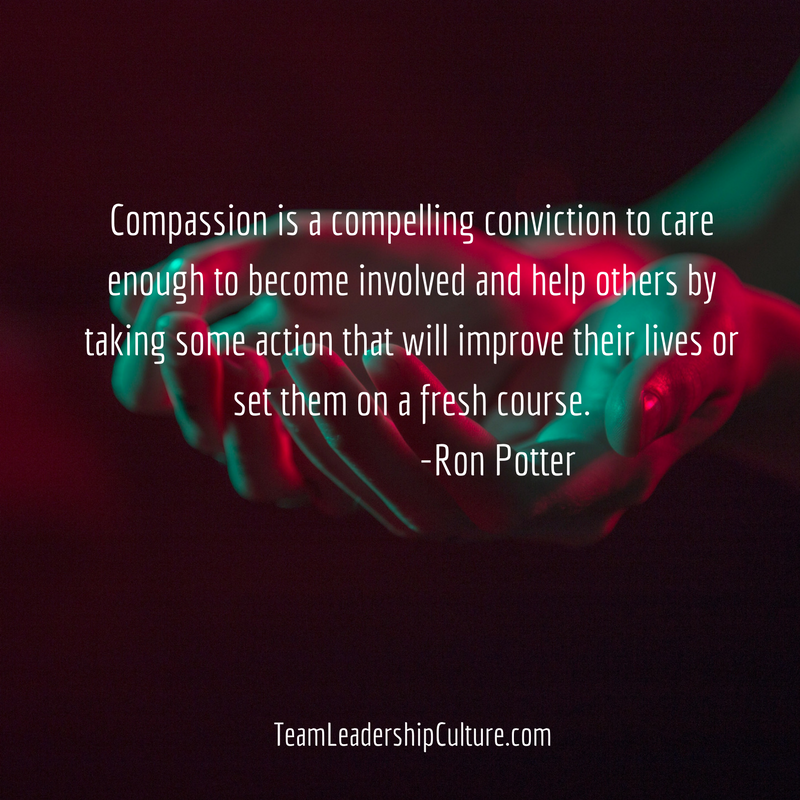
Compassion is a compelling conviction to care enough to become involved and help others by taking some action that will improve their lives or set them on a fresh course.

Team Leadership Culture Meme 6

2 comments
0 FacebookTwitterEmail
BlogQualities of a Caring LeaderTrust Me

Qualities of a Caring Leader: Confrontation

by Ron Potter January 25, 2016

photo-1414058862086-136de6c98e99Over the next few weeks, our Trust Me posts will explore the qualities of a caring leader. We explored the first quality – Understanding here. Then we took a look at the second quality – Concern. Communication was the third quality. And today we discuss Confrontation.

Part of leading is confronting people and urging them toward better performance.
Confrontation does not involve giving a report on another person’s behavior. It means offering feedback on the other’s role or response. Its goal, in the business environment, is to bring the employee, boss, or peer face to face with issues (behavior, emotions, achievement) that are being avoided.
For us to be effective in confrontation, we need to focus on four things:

Balanced truth

You cannot confront someone on hearsay alone. Get the facts. Investigate the matter; check it out. There are always two sides to every story. What are they? Neither one is likely to be the “complete” truth. Look for the balanced story.

Right timing

We recently witnessed a near catastrophe. A client of ours was going to confront a customer. The customer had called the day before and verbally leveled several people on our friend’s staff. Our client was going to call the customer and confront him with some brutal truth: “Everyone in the office is afraid of you and doesn’t want to talk to you because of your aggressive style and attitude.” Just before our client was to make the call, someone in the office discovered that the customer’s wife had colon cancer and possibly multiple sclerosis. The customer was suffering right along with his wife, in addition to trying to be both Dad and Mom to the kids, coaching a sports team, and running a tough business. Instead of calling to confront the customer with the brutal facts, our client decided to confront him with care and sympathy.
Many situations will not be this clear-cut. The right timing may be harder to gauge. For sure, though, it is best to deal with a situation when the heat of the moment has passed. Having the courage and taking the time to come back to it after emotions have subsided is actually quite difficult. There never seems to be the same urgency later, but good leaders force themselves to pick up the issue at a better moment. When it is the right time to confront, the green lights will be flashing. Until then, hold on.

Wise wording

We suggest that you carefully plan what you will say when you confront someone. A proverb says, “Timely advice is as lovely as golden apples in a silver basket. Valid criticism is as treasured by the one who heeds it as jewelry made from finest gold.” Words have the power to destroy or heal. Choose them carefully when entering in to confrontation.

Fearless courage

Don’t fall back in fear when you need to confront someone. If you have assembled the truth, believe it is the right moment, and have carefully prepared what you will say, move forward and confront. As Roger Clemens did with Curt Schilling, press on: “How can I help this person be better, regardless of how I feel?” It may mean finding a more productive or satisfying place for the person—even if it’s with another company. In the end this option is better for the organization and, in most cases, for the other person. What is worse is allowing a person to continue in a harmful behavior or self-destructive attitude.

0 comments
0 FacebookTwitterEmail
BlogQualities of a Caring LeaderTrust Me

Qualities of a Caring Leader: Communication

by Ron Potter January 18, 2016

photo-1429623077761-9635d93ddd02Over the next few weeks, our Trust Me posts will explore the qualities of a caring leader. We explored the first quality – Understanding here. Then we took a look at the second quality – Concern. Today, we discuss the third quality of a caring leader – Communication.


The groundbreaking book In Search of Excellence stressed the concept known as MBWA, “management by walking around.” The concept is taken further in the book A Passion for Excellence:

How good are you? No better than your people and their commitment and participation in the business as full partners, and as business people. The fact that you get them all together to share whatever—results, experiences, recent small successes and the like—at least once every couple of weeks seems to us to be a small price indeed to pay for that commitment and sense of teamwork and family. The “return on investment” is probably far and away the best of any program in the organization.

MBWA stresses getting out of our individual comfort zones and getting to know other people. Whether you attend company-wide meetings or individual private sessions, the lesson is clear: Get out of your office and communicate with your people.

We tend to assume that communication is merely the process of delivering information from one person to another. However, it is much more than just good delivery. Pat Williams writes:

“Communication is a process by which we build relationships and trust, share meaning and values and feelings, and transcend the aloneness and isolation of being distinct, individual souls. Communication is not just a data dump. Communication is connection.”

Communication means being connected with your people. It means getting out of your office into their offices and workspaces. Go.

1 comment
0 FacebookTwitterEmail
BlogQualities of a Caring LeaderTrust Me

Qualities of a Caring Leader: Concern

by Ron Potter December 28, 2015

photo-1450436993444-721cd28f6187Over the next few weeks, our Trust Me posts will explore the qualities of a caring leader. We explored the first quality – Understanding here. Today we look at the second quality – Concern.

One of my favorite old adages says “I don’t care how much you know until I know how much you care.”  Remember, an old adage hangs around for hundreds of years because it is solidly true.

Many leaders believe they must completely separate their work life from their personal life. Many of them will say, “I don’t dare get too close to these people because I won’t be able to be objective if I need to give them critical feedback.”

But people follow leaders who care. People know they care, and they develop trust. If you are a caring, honestly challenging leader, people will follow you through the tough course of business ups and downs.

I have seen great leaders demonstrate care. They don’t just know the members of their team, they help them by taking action to improve their lives or set them on a fresh course.  When a leader cares about their team, the team cares for one another as well.

I often run an exercise with my clients that I call “Human Beings, not Human Doings.”  The point of the exercise is that when we relate to each other based entirely on what we “do”, things can get off base.  Maybe something wasn’t done right or on time or to the standards that were expected and we start to assign that disappointment to the person responsible for the work.  But when we begin to understand and relate to who people “are”, not just what they do, we often begin to understand people better.  We begin to care.  Under caring circumstances we begin to help each other and the team to improve our overall performance.  Caring produces results.

2 comments
0 FacebookTwitterEmail
Newer Posts
Older Posts
  • Facebook
  • Twitter
  • Linkedin
  • Rss
  • About This Site
  • About
    • Clients
  • Services
  • Resources
    • Trust Me
    • Short Book Reviews
  • Contact

About this Site | © 2024 Team Leadership Culture | platform by Apricot Services


Back To Top
Team Leadership Culture
  • Team
  • Leadership
  • Culture
  • Myers-Briggs
  • Trust Me
  • Short Book Reviews