
Team Leadership Culture
  • Team
  • Leadership
  • Culture
  • Myers-Briggs
  • Trust Me
  • Short Book Reviews
Top Posts
Obituary
REPOST: Four Functions, Three Rules
ROUNDUP: The Rise of AI
REPOST: Facing Adversity Series
ROUNDUP: Curiousity
ROUNDUP: Deep Work
REPOST: Character vs. Competence
REPOST: Opposite of Victim
REPOST: Listening With the Intent to Understand
REPOST: Performance vs Trust
  • About
  • Services
  • Resources
    • Trust Me
    • Short Book Reviews
  • Contact

Team Leadership Culture

  • Team
  • Leadership
  • Culture
  • Myers-Briggs
  • Trust Me
  • Short Book Reviews
Category:

Blog

Absurd!BlogIn-Depth Book Reviews

Absurd!: Relationship Over Skill

by Ron Potter February 13, 2016

photo-1448749927985-5565d99c10aeI’m continuing my series on an in-depth look at a wonderful little book that’s twenty years old this year.  The title is Management of the Absurd by Richard Farson.  You may want to consider dropping back and reading the previous blogs about ABSURD!  I think it would put each one in great context.

Chapter 3 is titled “The More Important a Relationship, the Less Skill Matters”.

I often start many of my team consulting assignments with a session called “Human Beings vs Human Doings.”  The point is we do most of our relating to each other at work based on what we do or in some cases by what we are not doing.  In either case we tend to relate to each other as Human Doings.

But we’re not human doings, we human beings!  Who you are not what you do is what really makes the difference.  I never know where these sessions will lead because it’s often one of the first things I do with a team and I haven’t had the opportunity to get to know them as individuals yet.  But in every case some of the most profound stories about human lives have come out.  There have been tears, roaring laughter, broken hearts and considerable pride as we listen to each other’s stories.

What strikes me is there are often certain story lines that seem to repeat themselves on certain teams.  I remember one team several years ago where three of the team members had grown up in families with severely handicapped siblings.  Even though they had worked with each other for a few years they didn’t know about the shared experiences.  Even when there is complete dedication and love, families with handicapped children share a great deal of stress and pressure together.  Knowing there were other members of the team that had shared similar experiences created a bond and a determination to help and support each other (all members, not just the ones with the handicapped siblings) that was far beyond anything that could have been created through your normal corporate team building exercises.  We began to form true bonds.  The more important the relationship, the less skill matters.

The author shares a couple of stories in the book when talking about what people remembered about their boss.

“They tended to be moments that the bosses were not likely to remember and would probably think were insignificant, yet often revealed something of their humanity.”

He also goes on to say “In both parenthood and management, it’s not so much what we do as what we are that counts.”

Have you established some real human bonds with your team?  People want to know who you are, not just what you do.  Being real human beings, not just corporate facades creates the bonds that we need to build real team, overcome the challenges of live and work, and allow for the patience that it takes to make mistakes and grow together.

Being genuine and being vulnerable are two of the phrases I’m hearing a lot lately in corporate consulting circles.  Being genuine and vulnerable makes you real.  People want to work with and for real people.

1 comment
0 FacebookTwitterEmail
BlogMyers-Briggs

The Only Team I Ever Recommended Be Split Up

by Ron Potter February 8, 2016

Diversity

The best teams I’ve ever worked with have had a great deal of diversity of Myers-Briggs Type Indicator (MBTI) preferences on the team.  However, diversity alone is not enough to ensure a high performance team.  But, it is a great foundation.

photo-1453474473052-08cd150dfe87 (1)There has only been one time in my twenty-five plus years of Team and Leadership Consulting that I’ve recommended a team be split up and given other assignments.  That team of seven people were all resident in one particular Myers-Briggs Type Preference.  And while MBTI is certainly not the end-all measurement of team diversity, it produced a very discernable pattern.

THE answer to the question

I would find myself asking a question of one member of the team.  That member often would give me a very complete and articulate answer.  But then I would ask each of the other members if they agreed with the answer and the response was:

  • Yup,
  • Yup,
  • Yup,
  • Yup,
  • Yup,
  • Yup!

All of the other six members responding with a pleasant smile and a subtle nod of the head!

OK, let’s ask a different question: “Could we look at this question from a different perspective and maybe come up with a different answer?”

  • Nope,
  • Nope,
  • Nope,
  • Nope,
  • Nope,

All of the other six members responding with a pleasant smile and a subtle twist of the head!

Different Perspectives

Even when I tried some of the more off-the-wall approaches to perspective shifts:

“How would a gorilla solve this problem?

  • He would grab it by the head and beat it to death!
  • Yup,
  • Yup,
  • Yup,
  • Yup,
  • Yup,
  • Yup!

“How would a giraffe solve this problem?

  • He couldn’t. He’s not strong enough to beat it to death!
  • Nope,
  • Nope,
  • Nope,
  • Nope,
  • Nope,

Change of Scenery

After a few more tries at this I was finally convinced that the members of this team needed to be split up and combined with other people with different perspectives.  My assumption is that didn’t go well.  This team had been together for a long time and in the early days had been extremely productive at getting projects completed.  But the environment had changed and they not only needed to be good project managers, they needed to adapt to changing environments.  Most of them probably had a difficult time blending into teams that didn’t all think alike and in particular didn’t think like they did.

Diversity

Knowing your Myers-Briggs type is not about (or should not be about) what type preference you have and if that’s the “right” way to view the world or not.  The point is that there are 16 healthy type preferences that will each view the world slightly differently.  The point is to use the diversity for the betterment of the team.  You accomplish that be showing respect for and learning from each view point and then determining together the best route for the team to pursue.  Together!

2 comments
0 FacebookTwitterEmail
Absurd!BlogIn-Depth Book Reviews

Absurd!: Exploring Management of the Absurd

by Ron Potter February 4, 2016

lIZrwvbeRuuzqOoWJUEn_Photoaday_CSD (1 of 1)-5I picked up small book off my bookshelf this week that is twenty years old.  When I say it’s small I mean in size (small format and just 172 pages) not stature or content.  It is a profound book and should not be forgotten.  I don’t know if it every achieved numerical success but the forward was written by Michael Crichton (the late author who wrote books such as The Andromeda Strain, Jurassic Park and others). That should have gotten the attention of a lot of people.

The title of the book is Management of the Absurd: Pardoxes in Leadership by Richard Farson.  You’ll find it on my Reading List but as I said, it’s twenty years old so you may not have spotted it.  But this book is timeless.

Just look at a few of these chapter titles:

  • Nothing is as invisible as the Obvious
  • Effective Managers Are Not in Control
  • Most Problems That People Have are Not Problems
  • Technology Creates the Opposite of Its Intended Purpose

If you’re like me these titles grab you before you’ve read one word in the chapter.  I wish I was as good at creating grabbing titles as this.

I haven’t done this before but I’m going to spend some time going through Management of the Absurd with you.  I’ll capture a few thoughts and lines from various chapters and talk about the timeless nature of the principle.  I believe you’ll begin to see that the truths that guide good management and leadership are ageless and should frequently remind us of the seemingly absurd nature of good leadership.

Chapter one is titled “The Opposite of a Profound Truth is Also True.”  And in the first few paragraphs Farson reminds us that:

“We have been taught that a thing cannot be what it is and also its opposite.”

This belief that if my position or perspective is true than yours must be false leads to an incredible amount of conflict, strife and division within organizations.

F. Scott Fitzgearld reminds us:

“The test of a first-rate intelligence is the ability to hold two opposed ideas in the mind at the same time, and still retain the ability to function.”

Now I think having a first-rate intelligence would be a great starting point for a good leader but notice that I don’t say a high IQ.  There has never been any correlation found between IQ and success and one measure of a great leader is achieving success.  So it’s not IQ, its intelligence.  Don’t believe that the opposite of a profound truth, your truth, is not also true.

In his book The Primes, Chris McGoff points out that often when teams don’t seem to be able to reach a decision it’s because they are assuming they’re in a right vs wrong argument when in reality they’re in a right vs right argument.  The opposite of a profound truth is also true.  Great leaders realize that they are often choosing between right vs right, not right vs wrong.  Assuming everything is a right vs wrong argument is childish.  Great leaders are also mature.

Don’t let your leadership or management style look like it has the maturity of a teenager.  Realize that even though you may hold the truth on a topic, others on your team also hold the truth.  Bring all the truth’s out together and then decide which direction the team should take.

1 comment
0 FacebookTwitterEmail
BlogQualities of a Caring LeaderTrust Me

Qualities of a Caring Leader: Spontaneous Compassion

by Ron Potter February 1, 2016

photo-1447619297994-b829cc1ab44aOver the next few weeks, our Trust Me posts will explore the qualities of a caring leader. We explored the first quality – Understanding here. Then we took a look at the second quality – Concern. Communication was the third quality. Then we discussed Confrontation. Today we look at Compassion.

I observed a wonderful incident of compassion once while preparing a webcast for a client. The man helping set up the equipment and handling the technical details received a telephone call from one of his employees who was troubleshooting at another location. My writing partner Wayne and I learned that this employee was working on a crisis situation of great importance to her company.

Hearing just half of his conversation, we picked up that she was reporting on her progress in solving the problem. Later, when our technical helper gave us the details of the conversation, we learned that almost in passing she mentioned, “I have to check on my father. I think he had a heart attack or stroke or something.”

Our man interrupted the conversation right then and said bluntly, “You need to go to your father.” He didn’t even ask, “Do you need to go to your father?” He just said, “You need to go to your father.”

The employee protested, “No, I’m not going to go until this is fixed.” Her boss just kept saying, “Get off the phone, get on a plane, and go to your father.”

We knew that this man might get into trouble for making that kind of decision; his employee was trying to solve a serious problem. But he insisted, and she went home.

We reach several conclusions from this leader’s act of spontaneous compassion: First, this woman will be one of his most loyal and productive employees from now on. Second, he did the right thing even though painful consequences might follow. A trusted leader acts like that. Finally, he showed a true heart of compassion. He decided to care for the person. In that moment when he had to make a choice, he understood and responded to the needs of the person, not just a valued cog in the company machine.

That’s what compassion is all about.

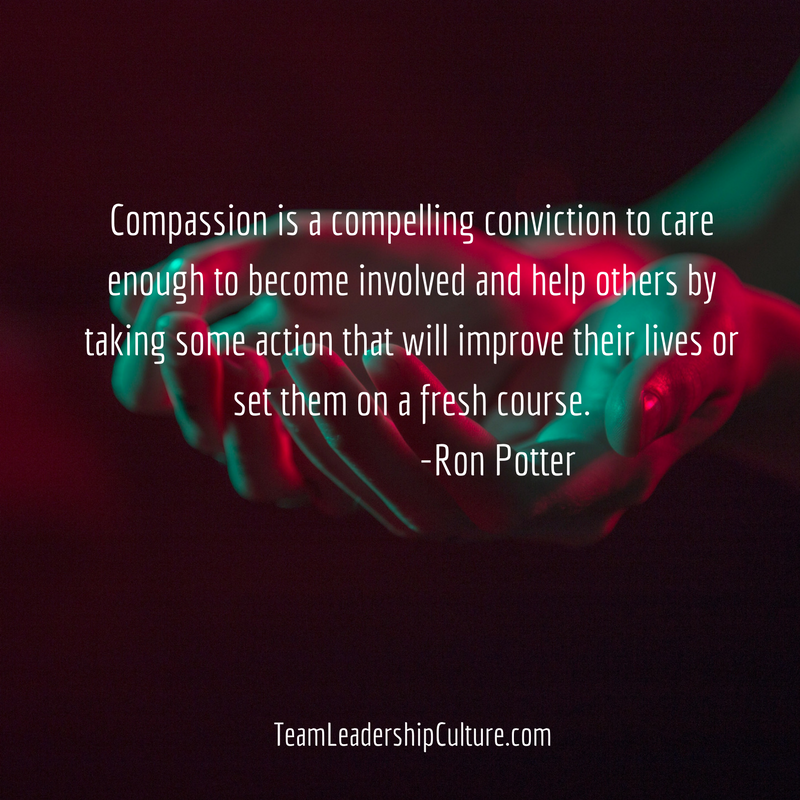
Compassion is a compelling conviction to care enough to become involved and help others by taking some action that will improve their lives or set them on a fresh course.

Team Leadership Culture Meme 6

2 comments
0 FacebookTwitterEmail
BlogQualities of a Caring LeaderTrust Me

Qualities of a Caring Leader: Confrontation

by Ron Potter January 25, 2016

photo-1414058862086-136de6c98e99Over the next few weeks, our Trust Me posts will explore the qualities of a caring leader. We explored the first quality – Understanding here. Then we took a look at the second quality – Concern. Communication was the third quality. And today we discuss Confrontation.

Part of leading is confronting people and urging them toward better performance.
Confrontation does not involve giving a report on another person’s behavior. It means offering feedback on the other’s role or response. Its goal, in the business environment, is to bring the employee, boss, or peer face to face with issues (behavior, emotions, achievement) that are being avoided.
For us to be effective in confrontation, we need to focus on four things:

Balanced truth

You cannot confront someone on hearsay alone. Get the facts. Investigate the matter; check it out. There are always two sides to every story. What are they? Neither one is likely to be the “complete” truth. Look for the balanced story.

Right timing

We recently witnessed a near catastrophe. A client of ours was going to confront a customer. The customer had called the day before and verbally leveled several people on our friend’s staff. Our client was going to call the customer and confront him with some brutal truth: “Everyone in the office is afraid of you and doesn’t want to talk to you because of your aggressive style and attitude.” Just before our client was to make the call, someone in the office discovered that the customer’s wife had colon cancer and possibly multiple sclerosis. The customer was suffering right along with his wife, in addition to trying to be both Dad and Mom to the kids, coaching a sports team, and running a tough business. Instead of calling to confront the customer with the brutal facts, our client decided to confront him with care and sympathy.
Many situations will not be this clear-cut. The right timing may be harder to gauge. For sure, though, it is best to deal with a situation when the heat of the moment has passed. Having the courage and taking the time to come back to it after emotions have subsided is actually quite difficult. There never seems to be the same urgency later, but good leaders force themselves to pick up the issue at a better moment. When it is the right time to confront, the green lights will be flashing. Until then, hold on.

Wise wording

We suggest that you carefully plan what you will say when you confront someone. A proverb says, “Timely advice is as lovely as golden apples in a silver basket. Valid criticism is as treasured by the one who heeds it as jewelry made from finest gold.” Words have the power to destroy or heal. Choose them carefully when entering in to confrontation.

Fearless courage

Don’t fall back in fear when you need to confront someone. If you have assembled the truth, believe it is the right moment, and have carefully prepared what you will say, move forward and confront. As Roger Clemens did with Curt Schilling, press on: “How can I help this person be better, regardless of how I feel?” It may mean finding a more productive or satisfying place for the person—even if it’s with another company. In the end this option is better for the organization and, in most cases, for the other person. What is worse is allowing a person to continue in a harmful behavior or self-destructive attitude.

0 comments
0 FacebookTwitterEmail
BlogLeadership

Decoding Leadership: What Really Matters

by Ron Potter January 21, 2016

photo-1452573992436-6d508f200b30

That’s the title of a recent McKinsey Quarterly Report.  Great stuff.  What does really matter?

In typical McKinsey style they described their survey approach:

  • We started with our own list and relevant literature list of 20 traits.
  • We surveyed a large number of people
  • In a large number of organizations
  • Compared it to our healthy organization index
  • Boiled it down to 4 traits that explained 89% of the differences between strong and weak organizations in terms of leadership effectiveness.

Big organizations like McKinsey are really good at doing these large scale analysis projects and I really appreciate their ability to do it and their willingness to share it.

4 Traits explained nearly 90% of the difference between good and bad leadership effectiveness.  What were the four (you should be asking at this point)?

  • Being supportive
  • Operate with strong results orientation
  • Seek different perspectives
  • Solve problems effectively

The article doesn’t indicate that these are in any particular order so for our evaluation let’s separate out the 2nd one, Operate with strong results orientation.  People want to accomplish things.  People want to build, create, produce, provide goods and services that other people value.  Without both sides of that equation: people wanting valuable products and people wanted to produce value, there would be no commerce at all.  Yes, we all want results.  All too often leaders assume that people don’t want to produce and don’t realize that it’s the culture and structure that they’ve created that prevents them from doing so.

The other three require a humility and openness to accomplish.

Being supportive requires that I’m interested in who you are, how you think and what you want to create and accomplish.

Being open to your perspectives requires that I’m interested in who you are, how you think and what you want to create and accomplish.

Being good at solving problems effectively requires that I’m interested in who you are, how you think and what you want to create and accomplish.

Being supportive, open and a good problem solver requires humility!

Every piece of valid research on leadership effectiveness you find will somehow have its foundation based on humility.  Ego and hubris reflect the needs of the person in the leadership position.  Humility starts with the needs of the people being led.


0 comments
0 FacebookTwitterEmail
BlogQualities of a Caring LeaderTrust Me

Qualities of a Caring Leader: Communication

by Ron Potter January 18, 2016

photo-1429623077761-9635d93ddd02Over the next few weeks, our Trust Me posts will explore the qualities of a caring leader. We explored the first quality – Understanding here. Then we took a look at the second quality – Concern. Today, we discuss the third quality of a caring leader – Communication.


The groundbreaking book In Search of Excellence stressed the concept known as MBWA, “management by walking around.” The concept is taken further in the book A Passion for Excellence:

How good are you? No better than your people and their commitment and participation in the business as full partners, and as business people. The fact that you get them all together to share whatever—results, experiences, recent small successes and the like—at least once every couple of weeks seems to us to be a small price indeed to pay for that commitment and sense of teamwork and family. The “return on investment” is probably far and away the best of any program in the organization.

MBWA stresses getting out of our individual comfort zones and getting to know other people. Whether you attend company-wide meetings or individual private sessions, the lesson is clear: Get out of your office and communicate with your people.

We tend to assume that communication is merely the process of delivering information from one person to another. However, it is much more than just good delivery. Pat Williams writes:

“Communication is a process by which we build relationships and trust, share meaning and values and feelings, and transcend the aloneness and isolation of being distinct, individual souls. Communication is not just a data dump. Communication is connection.”

Communication means being connected with your people. It means getting out of your office into their offices and workspaces. Go.

1 comment
0 FacebookTwitterEmail
BlogCulture

Engagement Surveys

by Ron Potter January 15, 2016

photo-1452690700222-8a2a1a109f4cHow Engaged are Your Employees?

Most of my clients are engaged in some sort of engagement survey (pun intended).  The Gallup organization (which may have started this whole movement with their surveys) keeps a running percentage of “engaged” employees on their web site, currently sitting at 34.2%.  You mean that only a third of our employees are engaged at work?  How could our companies possibly survive (at least for long) with a figure that low?

Well, part of the problem is that’s the wrong question.  AON Hewitt did a nice job of grappling with this issue.  In an article titled “What makes someone an engaging leader?” they explain that the two don’t necessarily go together.  The most sustained approach is to push for both financial performance and employee engagement.

Based on conversations I’m having with almost every client, this need for both profitability and employee engagement, mainly leading to innovative ideas to deal with major disruptions, is ongoing and impactful.

AON Hewitt continues the conversation by listing the attributes that create engaging leaders.

  • Self-Confidence
  • Humility
  • Compassion
  • Connectedness

Self-Confidence

I’m going to connect and contrast this one with Humility which is next on the list.  Most people would look at those two works and say “Aren’t we dealing with an oxymoron?  How can you be self-confident and humble at the same time?”  I don’t mean to put words in the mouths of the AON Hewitt people because I believe they could defend their choice of words very effectively.  But for clarification purposes let me use the word self-esteem.  I have found though the years that it takes a lot of self-esteem to be humble.  The idea is that you are very comfortable with who you are and why you’re there.  Maslow in his hierarchy of needs would likely refer to this as self-actualized.  It reminds me of a commercial with several recognizable athletes doing silly things and ending the commercial with the words.  I’m so-and-so and I’m very comfortable in my skin.  People who don’t seem to have a reasonable level of self-esteem have difficulty being humble because they always have a need to prove themselves (to themselves mostly).

Compassion

When we first included Compassion as one of the eight essential elements of great leadership as described in our book “Trust Me: Developing a leadership style that people will follow” I took a little grief from my hard-nosed executives.  After listening to them about how they had to be tough not compassionate I always ended the conversation with the old adage “I don’t care how much you know until I know how much you care.”  If you want people to care about what you know, let them know that you care about who they are.

Connectedness

This word seems to be synonymous with the word Team.  Building a great team connecting strong people for a single purpose.

My conclusion is that if you want engaged employees, learn to be a humble leader, create great teams, accomplish your collective purpose.  All people want to be engaged in doing something worthwhile.

0 comments
0 FacebookTwitterEmail
BlogCulture

Discovering Ancient Truths

by Ron Potter January 7, 2016
Source: Dogancan Ozturan, Creative Commons

Source: Dogancan Ozturan, Creative Commons

A recent CBS News article caught my eye.  The headline read:

Are you happy? Do you know how to be happy?

After decades of studying and working with tens of thousands of patients, researchers at the Mayo Clinic say they’ve cracked the code to being happy.

Psychiatrist John Tamerin says for many people the root of everything we’re chasing, a better job, more money or true love, is happiness.

But this endless pursuit often backfires.

Now, after decades of research and a dozen clinical trials, researchers at the world-renowned Mayo Clinic, say they’ve actually cracked the code to being happy, and published it in a handbook.

Dr. Amit Sood led the research and says the first and foremost way to be happy is to focus our attention.

“… one of the biggest hindrances to being happy is too much thinking about one’s self, research shows.

So why did the Mayo Clinic decide to study happiness? Studies show happier people are healthier people.

Wow, “after decades of research and a dozen clinical trials” the researchers cracked the code to happiness.  Even though over 2,300 years ago Aristotle wrote in his “Nicomachean Ethics” that the pursuit of happiness was the ultimate purpose of human existence.

This concept of the pursuit of happiness really forms the foundation for great leadership and great teams.  I’m currently working my second book on how to create great teams.  It’s built precisely on the concepts of Aristotle’s pursuit of happiness.

If you take a look at the four levels in the pursuit of happiness that Aristotle lays out, you’ll see that levels one and two are focused on self.  As the researchers says above, “one of the biggest hindrances to being happy is too much thinking about one’s self.”  Levels 3 and 4 are built on thinking about and blessing others.  Level 3 describes the perfect model for great leadership.  Level 4 describes the elements of great teams.

So, if you want to break your own code to happiness, become a great leader of people and a great team member.  It provides the ultimate level of happiness.

0 comments
0 FacebookTwitterEmail
BlogMyers-BriggsYou Might Be a Jerk If

You Might Be a Jerk If: Feeling

by Ron Potter January 4, 2016

You Might be a Jerk If

“Let’s change the topic, I don’t want to deal with this at the moment.”

“Look, it’s your fault that we’re in this mess anyway.  If you had made arrangements for this while you were on vacation it wouldn’t have happened in the first place.”

“I just don’t want to hear it any more, this is the way it’s going to happen!”

(If you didn’t start with the introduction to this “You might be a jerk if…” series, I suggest you make a quick review because it will help you better understand these subsequent blogs.)

Brenda is stuck!  Her dominant function is Feeling which helps her know what’s really important in most situations and appreciate input from just about anyone.  And normally, she’ll balance these great skills with either a good conceptual view of the world or a great grasp of the data, depending on her complete type.

There are four types that have this particular combination, the Introverted ISFP, INFP and the Extraverted ESFJ, ENFJ.  As noted above the dominant in all four cases is Feeling and the inferior in all four cases is Thinking.  These are what’s known as our Deciding functions, how do we decide what to do after we have taken in the data through our Perceiving functions of Sensing and iNtuition.

In a healthy state, these Deciding functions would then work in tandem with the “perceiving” functions of Sensing or iNtuition depending type.  But, under pressure or stress, Brenda begins to lose this natural balance, falling back to her dominant function which will expose her feelings, no matter how raw they may be.  Brenda will either become hypercritical or hypersensitive or both under pressure.

Balance, Balance, Balance

This is where team members and colleagues come into play.  It’s difficult for any one of us to break out of these pressure packed situations.  As colleagues, we want to help Brenda back into a balanced state by asking and sometimes even forcing her to use his auxiliary function.  Notice that Brenda’s auxiliary function could be either Sensing or iNtuition depending on type.  Let’s start with the Sensing balance.

“Brenda, we can’t ignore the topic right now, we need to make a decision this week.”

“I’m sorry I just can’t deal with it right now, there are just too many things this could impact.”

“Can we take a look at the data and see where that might be leading us and then discuss how that might impact the values of the company, if at all?”

“Yes, if you guarantee that we’ll see how these figures will impact the way we’re going to work this out with the people.”

As we begin to force Brenda to try a little balancing act, she’ll begin to regain her footing.  Note that we can’t tell Brenda that his data problem doesn’t impact our overall values.  Brenda has to come to grips with that through balancing her own natural Feeling and Sensing functions.

If we’re dealing with either the INFP or ENFJ than iNtuition is the auxiliary function, not Sensing.  The approach is similar, but focused more on the conceptual or future view (iNtuition) rather than the data (Sensing).

“Brenda, we really don’t think this new direction will impact our care and concern for the employees but let’s see if we can see a way through this.”

“I just don’t see how it’s going to happen.  I’m concerned we’ll end up in a very bad place.”

“We’ll, let’s talk through that.  Describe for me the outcome you see as most likely in this case.”

“It’s just not going to end well.”

“Well, let’s get a grip on the possible outcomes and then really talk through the good and bad of the situation and see how we could mitigate any negative outcomes.”

“OK, I guess we’re just talking anyway.  We can make the decisions as we figure out the best path.”

As we begin to force Brenda to try a little balancing act, she’ll begin to regain her footing.  Note that we can’t tell her where the scenarios will lead.  Brenda has to come to grips with that through balancing her own natural Feeling and iNtuition functions.

Stay tuned.  We’ll continue to explore other ways to conduct your own “balancing” act.  The best leaders have learned to balance their natural temperament functions with those of the people and teams around them.  It’s when the functions get out of balance or opposed to each other that we get stuck as individuals and teams.

When it comes to your temperament, balance, balance, balance is the key to success.


0 comments
0 FacebookTwitterEmail
Happy Anniversary Team Leadership Culture
BlogCulture

Happy Anniversary

by Ron Potter December 31, 2015

Happy Anniversary Team Leadership Culture2015 is an anniversary year for me.  25 years in the consulting business, 15 of those years as Team Leadership Culture (TLC).

Someone suggested that I write the “25 things I’ve learned in 25 years!”  Sounds like a great idea.

#1 thing I’ve learned in 25 years of consulting:

Hit the Sweet Spot!

If you’re a golfer (or at least someone who enjoys the game regardless of skill level like I am), you know that when you hit the sweet spot of the club face, wonderful things happen.  The ball tends to sore long and straight and you’re usually rewarded by hitting at or near your target.  The other thing that golfers experience is that when you do hit the sweet spot, there is this wonderful feeling that it was almost effortless.  There was no clank of the club hitting the ball and no vibration sent up through the shaft upon impact.  Just a nice smooth striking of the ball in a pure form that feels wonderful.

Hitting the sweet spot in business is much the same.  It feels good, things seem to be working in harmony and we create a trajectory that tends to be long and straight.  Wonderful.

But the real question is “So, what is that sweet spot?”  To me it has become abundantly clear over the last 25 years.

That’s the sweet spot.

Again with the golf analogy: as I’ve observed my game through the years I began to realize that on my poor days I only have one (and sometimes none) aspect of my game working, driver, irons or putter.  On my good days I seem to have two of the three working.  But as I look back as my most successful rounds, all three aspects were working on that given day.  Business is much the same.

At every company I work with I can see patterns related to how many “cylinders” the company is hitting on.  As I’m writing this I can see very clearly in my mind one company in particular.  The individual leadership in many instances seems to be very solid and up to the challenge.  This company has a deep culture that has been in place for many years and drives their performance.  But as I look back over the years there seemed to be a particular turning point when team work began to fade.  Individual success, loyalty to a particular leader, unit and division success rather than whole company success began to be the measured standard.  Team work simply seemed to fade away over time.

In decades past it didn’t seem to make much difference.  Success always came.  Conditions in the market place could always be overcome or exploited.  They were the king of the hill and were reward for being on top.  But, in today’s fast paced, every changing world, companies are finding that they need to be quick and nimble.  Only team oriented companies can respond quickly with nimbleness.  Great leadership and deep cultures alone will not survive.  All three, Team, Leadership and Culture, are required to survive in today’s world.

Well, number one of the 25 things I’ve learned over 25 years seemed to come easily.  I’ll have to think about the next 24.  But as I do, I’ll share them with you.

2 comments
0 FacebookTwitterEmail
BlogQualities of a Caring LeaderTrust Me

Qualities of a Caring Leader: Concern

by Ron Potter December 28, 2015

photo-1450436993444-721cd28f6187Over the next few weeks, our Trust Me posts will explore the qualities of a caring leader. We explored the first quality – Understanding here. Today we look at the second quality – Concern.

One of my favorite old adages says “I don’t care how much you know until I know how much you care.”  Remember, an old adage hangs around for hundreds of years because it is solidly true.

Many leaders believe they must completely separate their work life from their personal life. Many of them will say, “I don’t dare get too close to these people because I won’t be able to be objective if I need to give them critical feedback.”

But people follow leaders who care. People know they care, and they develop trust. If you are a caring, honestly challenging leader, people will follow you through the tough course of business ups and downs.

I have seen great leaders demonstrate care. They don’t just know the members of their team, they help them by taking action to improve their lives or set them on a fresh course.  When a leader cares about their team, the team cares for one another as well.

I often run an exercise with my clients that I call “Human Beings, not Human Doings.”  The point of the exercise is that when we relate to each other based entirely on what we “do”, things can get off base.  Maybe something wasn’t done right or on time or to the standards that were expected and we start to assign that disappointment to the person responsible for the work.  But when we begin to understand and relate to who people “are”, not just what they do, we often begin to understand people better.  We begin to care.  Under caring circumstances we begin to help each other and the team to improve our overall performance.  Caring produces results.

2 comments
0 FacebookTwitterEmail
Newer Posts
Older Posts
  • Facebook
  • Twitter
  • Linkedin
  • Rss
  • About This Site
  • About
    • Clients
  • Services
  • Resources
    • Trust Me
    • Short Book Reviews
  • Contact

About this Site | © 2024 Team Leadership Culture | platform by Apricot Services


Back To Top
Team Leadership Culture
  • Team
  • Leadership
  • Culture
  • Myers-Briggs
  • Trust Me
  • Short Book Reviews