
Team Leadership Culture
  • Team
  • Leadership
  • Culture
  • Myers-Briggs
  • Trust Me
  • Short Book Reviews
Top Posts
Obituary
REPOST: Four Functions, Three Rules
ROUNDUP: The Rise of AI
REPOST: Facing Adversity Series
ROUNDUP: Curiousity
ROUNDUP: Deep Work
REPOST: Character vs. Competence
REPOST: Opposite of Victim
REPOST: Listening With the Intent to Understand
REPOST: Performance vs Trust
  • About
  • Services
  • Resources
    • Trust Me
    • Short Book Reviews
  • Contact

Team Leadership Culture

  • Team
  • Leadership
  • Culture
  • Myers-Briggs
  • Trust Me
  • Short Book Reviews
Category:

Blog

BlogCulture

Restoration or Revenge

by Ron Potter August 9, 2018

Team Unity is the most powerful productivity booster that can be applied.

There are several “multipliers” to team productivity. One is trust. Another is respect. And you need both in place to build unity. But unity is the greatest productivity booster of all.

Whenever people are involved there will always be conflict and friction. It’s just the nature of things. How we respond to the conflict and friction will determine the value of the team.

Revenge is a power play. When you take a tit-for-tat approach to conflict and friction it’s because you want to maintain power over the other person. Teams are not built on power, they’re built on unity.

Unity requires reconciliation. Reconciliation requires giving up power and control. This doesn’t mean you need to give up your beliefs and assumptions or cave into another person’s need for power and control but it does take humility. The original definition of humility meant tremendous power under complete control. Being under control means self-control, not controlling others. Restoration helps build trust.

Restoration means reaching out to others. Listening to their point of view. Not arguing or countering every point they make but attempting to understand their background, experiences, beliefs, and assumptions that are leading to their position. Steven Covey addressed this approach in his 7 Habits of Highly Successful People when he said, “Seek to understand first before being understood.” Few people seem to have the patience to fully understand the other person before expressing their point of view but when it does happen, it is very powerful.

However, there are occasions that despite the effort to understand and reconcile, the other person may not be willing to reconcile. In these cases, there is an ancient process that says bring one or two others with you to help reconcile. That doesn’t mean that you bring one or two supporters to overcome your “opponent.” It does mean to bring one or two others to help assure that the process is facilitated well and that both sides are completely understood.

If after making the effort with a good facilitator or two, reconciliation still seems to allude you, this is an issue that needs to come to the team. Letting it fester in the background or simply agreeing to disagree will never bring the trust and unity needed to build a great team. Great teams reach unity and commitment. Without unity and commitment, the full power of the team will never be realized.

0 comments
0 FacebookTwitterEmail
BlogCaring in ActionTrust Me

Caring in Action: Confrontation

by Ron Potter August 6, 2018

Caring becomes real to another person only when some action occurs. I believe that communication, confrontation, and challenge are three of the best ways a leader puts “feet” to true caring.

Over the next few weeks, we’ll unpack each of these aspects of caring and will continue this week with confrontation.

Confrontation

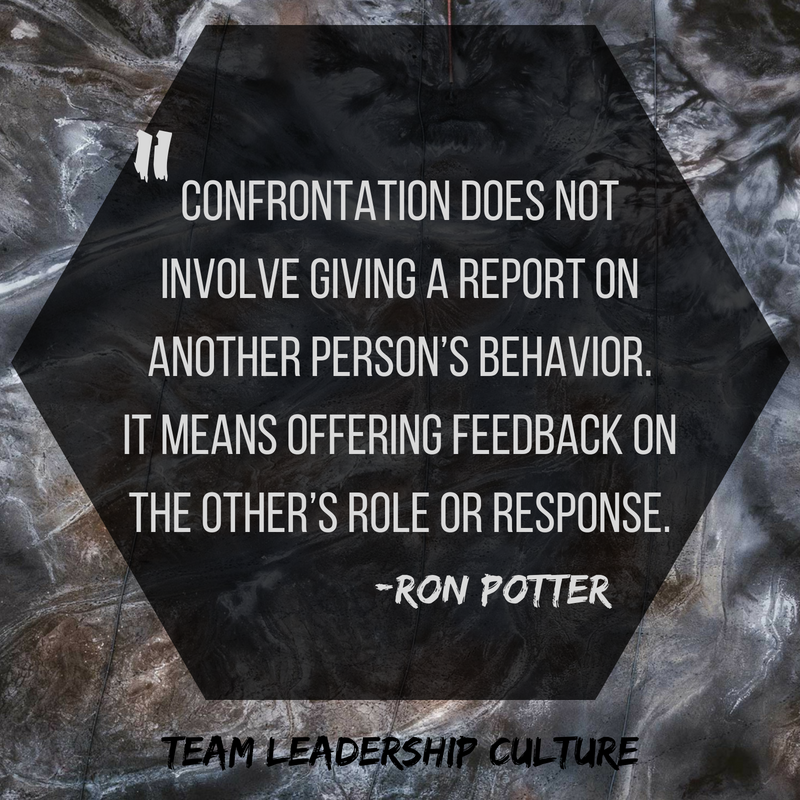
Confrontation does not involve giving a report on another person’s behavior. It means offering feedback on the other’s role or response. Its goal, in the business environment, is to bring the employee, boss, or peer face to face with issues (behavior, emotions, achievement) that are being avoided.

For us to be effective in confrontation, we need to focus on four things:

Balanced truth

You cannot confront someone on hearsay alone. Get the facts. Investigate the matter; check it out. There are always two sides to every story. What are they? Neither one is likely to be the “complete” truth. Look for the balanced story.

Right timing

I once witnessed a near catastrophe. A client of ours was going to confront a customer. The customer had called the day before and verbally leveled several people on our friend’s staff. My client was going to call the customer and confront him with some brutal truth: “Everyone in the office is afraid of you and doesn’t want to talk to you because of your aggressive style and attitude.” Just before our client was to make the call, someone in the office discovered that the customer’s wife had colon cancer and possibly multiple sclerosis. The customer was suffering right along with his wife, in addition to trying to be both Dad and Mom to the kids, coaching a sports team, and running a tough business. Instead of calling to confront the customer with the brutal facts, our client decided to confront him with care and sympathy.

Many situations will not be this clear-cut. The right timing may be harder to gauge. For sure, though, it is best to deal with a situation when the heat of the moment has passed. Having the courage and taking the time to come back to it after emotions have subsided is actually quite difficult. There never seems to be the same urgency later, but good leaders force themselves to pick up the issue at a better moment. When it is the right time to confront, the green lights will be flashing. Until then, hold on.

Wise wording

I suggest that you carefully plan what you will say when you confront someone. A proverb says, “Timely advice is as lovely as golden apples in a silver basket. Valid criticism is as treasured by the one who heeds it as jewelry made from finest gold.” Words have the power to destroy or heal. Choose them carefully when confronting.

Fearless courage

Don’t fall back in fear when you need to confront someone. If you have assembled the truth, believe it is the right moment, and have carefully prepared what you will say, move forward and confront. As Roger Clemens did with Curt Schilling, press on: “How can I help this person be better, regardless of how I feel?” It may mean finding a more productive or satisfying place for the person—even if it’s with another company. In the end this option is better for the organization and, in most cases, for the other person. What is worse is allowing a person to continue in a harmful behavior or self-destructive attitude.

Next week we’ll continue our discussion by unpacking caring through challenge.

Confrontation Quote

0 comments
0 FacebookTwitterEmail
BlogLeadership

The Dilemma of Leadership

by Ron Potter August 2, 2018

The dilemma of leadership: If you’re not dealing with dilemma’s, you’re not leading.

Quality, Fast, Cheap

You might remember the old joke about the watch repair shop with the sign that said “High Quality, Fast, Cheap. Chose any two.”

Unfortunately, many leadership teams work on these kinds of issues. How do they deliver quicker, with higher quality and keep their costs down at the same time? It’s difficult to deliver all three but they believe doing so is the holy grail of business.

That may be true but it’s not leadership, it’s management. Michael Hammer, who I respect as a researcher and business consultant, put out a book a few years ago titled Faster, Cheaper, Better: The 9 levers for transforming how work gets done. And he’s right, this will transform how work get’s done. That’s the business of management. Getting work done better.

Leadership is not Management

However, leadership is not management. Management knows what the goals are and are working towards getting there faster, cheaper and better. If your leadership team is focused on any one, two or three of these issues, realize that you’re a management team.

Dilemmas

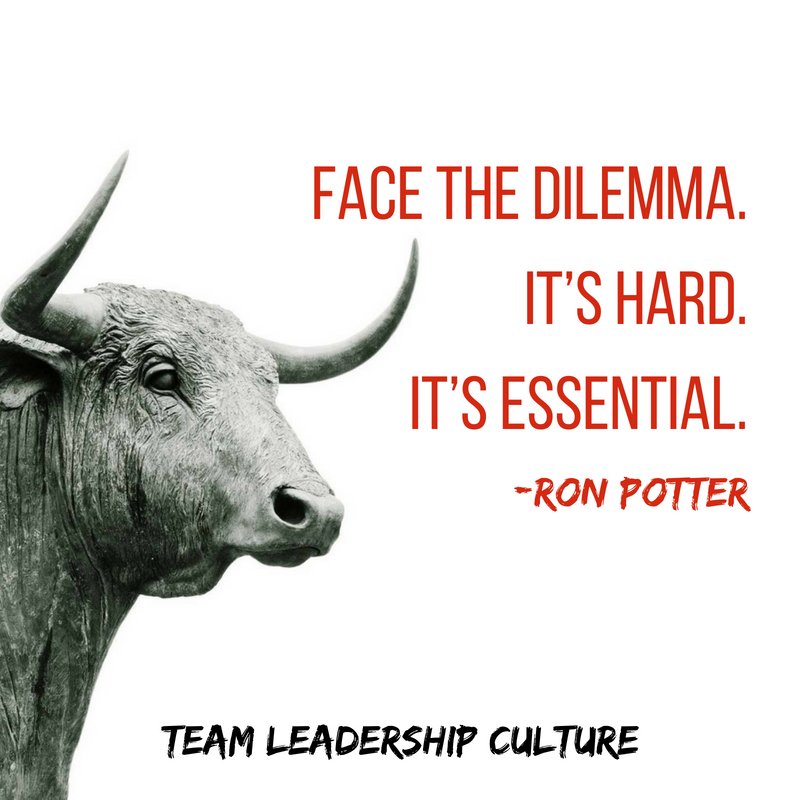
Dilemma comes from the word delaminate. This is the same root word that describes the laminated horns of a bull. Thus, the old adage, “On the horns of a dilemma.”

The idea here is that you need to choose one direction or the other. Both are essential. You just don’t have the resources to do both.

The choices may be about faster, cheaper, better. They may be about markets or customers or technology or cannibalizing your business with a better or newer product. Whatever the issue, you’re faced with deciding between two good choices or two bad choices. The ancients would say “Either way, you will get gored!”

Issues of Leadership

These are the issues of leadership: Dilemmas.

  • If you’re not dealing with dilemma’s, you’re managing, not leading.
  • If you’re not dealing with dilemma’s, you’re not being realistic about your marketplace or your competitors.
  • If you’re not dealing with dilemma’s, you’re avoiding the conflict that will arise when you do face them.

And if you’re not identifying the dilemmas you face and building a team that works through the dilemma to give direction to your managers and your company, you’ve abdicated the role of leadership.

Step up. Face the dilemma. It’s hard. It’s essential. Be a leader!

Dilemma quote

0 comments
1 FacebookTwitterEmail
Caring in Action: Communication
BlogCaring in ActionTrust Me

Caring in Action: Communication

by Ron Potter July 30, 2018

Caring becomes real to another person only when some action occurs. I believe that communication, confrontation, and challenge are three of the best ways a leader puts “feet” to true caring.

Over the next few weeks, we’ll unpack each of these aspects of caring and will start this week with communication.

Communication

The groundbreaking book In Search of Excellence stressed the concept known as MBWA, “management by walking around.” The concept is taken further in the book A Passion for Excellence:

How good are you? No better than your people and their commitment and participation in the business as full partners, and as business people. The fact that you get them all together to share whatever—results, experiences, recent small successes and the like—at least once every couple of weeks seems to us to be a small price indeed to pay for that commitment and sense of teamwork and family. The “return on investment” is probably far and away the best of any program in the organization.

MBWA stresses getting out of our individual comfort zones and getting to know other people. Whether you attend company-wide meetings or individual private sessions, the lesson is clear: Get out of your office and communicate with your people.

We tend to assume that communication is merely the process of delivering information from one person to another. However, it is much more than just good delivery. Pat Williams writes,

Communication is a process by which we build relationships and trust, share meaning and values and feelings, and transcend the aloneness and isolation of being distinct, individual souls. Communication is not just a data dump. Communication is connection.

How we express ourselves positively or negatively affects our listeners. The message intertwines with the messenger. More sobering is the fact that listeners may never hear our message because it is not in a form they appreciate.

Communication means being connected with your people. It means getting out of your office into their offices and workspaces.

Next week we’ll continue to work through caring in action by exploring confrontation.


0 comments
0 FacebookTwitterEmail
BlogLeadership

Leadership Transitions

by Ron Potter July 26, 2018

If you think you can be a member of the leadership team by representing and defending your function, you don’t know what it means to be a member of the leadership team. You really don’t get it.

I think this might be one of the toughest life transitions I’ve seen people go through. Some of the transitions have been well documented through the years and are observable.

Doer to Manager

The first transition in our career tends to be from being a doer to a manager. A manager teaches, moves from empowerment to delegation, grows people, increases their ability to influence, helps them learn. A good manager is very hands-on, growing the people and teaching them basic aspects of the work to be done.

Manager to Leader

The second transition is one that I’ve observed and coached people through for many years. The reason that it sometimes requires a coach is that it is a difficult transition, one that many people never successfully get all the way through. After you’ve been that manager who has experienced some success, you’re now transitioning from being a manager to a leader. You’re now leading managers. You’re not managing doers anymore.

You’re moving more from a teaching mode to a guiding mode. You’re leading is helping managers to also become leaders. This one is particularly difficult because it seems to be the end of the period of your career where we get rewarded for actually getting things done and accomplishing things. People who reach this level have been rewarded consistently through pay, bonuses, and recognition for accomplishing the work. Moving to a leadership role means that you let go of that hands-on application of getting the work done. It means that you need to trust the people around you who report to you to get the work done. You can’t jump in and do it yourself when they fail. You actually have to let them fail to do this. It can be a very tough transition and one that only a percentage of people seem to make through the years.

Leader to Member of Leadership Team

I don’t think we’ve talked about this transition much. I haven’t seen much written on it. I’ve certainly experienced it myself but began recognizing the symptoms only a few years ago. Moving from being a leader, even a solid, well-respected, effective leader, to a member of a leadership team. This move emphasizes collaboration. It’s focused more on the company, or the overall division, not necessarily on functions. It means that you’re faced with dilemmas.

I recently wrote a blog post about bioscience describing why organizations don’t work. It’s because we seldom realize that we need to sub-optimize functions within the overall organization. This is one of the more difficult dilemmas you will face. Making the whole organization work often requires that parts of the organization operate at suboptimal levels for a season. Maybe even the part that you run.

It requires taking off your function hat and putting on your corporate hat. You may be sitting on the CEO’s leadership team, you may be representing finance, or operations, or HR, or transportation, or manufacturing, or information technology, whatever it is that you run as a member of the organization. It’s very difficult to let go, take off your function hat and put on your corporate hat. But, if the leadership team is functioning well, it’s your job to help them make decisions that may cause you to ratchet back your individual and your team’s success over a period for the success of the whole.

This transition to becoming a member of the leadership team may be the most difficult one to make. Few people will get the chance to even try. If you’re one of the fortunate few, don’t sabotage your (and the team’s) success by letting your ego get in the way of the team’s success. Becoming a great team member on a team doing great things brings the highest level of happiness. It’s really a kick!

0 comments
0 FacebookTwitterEmail
BlogTeam

Dream Team

by Ron Potter July 19, 2018

Do you love the dream or do you love the team?

There’s a very famous quote from Dietrich Bonhoeffer, a survivor of the Holocaust. His quote says,

He who loves the dream of what he wants his group to be more than he loves the members destroys the group.

That may take a while to sink in, but the power of that quote is incredible to me. As I work with leadership teams, there’s always a great vision, a great desire, tremendous amounts of energy, a willingness to go above and beyond the call of duty, to achieve the dream. The dream is always out there.

It doesn’t make any difference which industry I’m working in. It can be the food industry, the pharmaceutical industry, the automotive industry, the transportation industry. But it’s this image of the dream of what we’re going to do together that continues to propel the leadership team.

However, often the people on the team are ignored, not given credit, not listened to, and in some cases, even sacrificed to the altar of the dream. Bonhoeffer tells us that he who loves the dream of what he wants his group to be, more than he loves the members, destroys the group.

If we don’t build strong respectful, may I use the word “loving”, relationships on our leadership team, we love the dream more than we love the members.

The dream always seems to be the focus. It’s couched in words like:

  • Strategy
  • Vision
  • Next quarter’s goals
  • Initiatives for this year

but it’s always the task in front of them.

When I’m working with a team I’ll say to them “We’ll talk about your dreams (or any one of those words that describe it) later, but first, we’re going talk about the people. We’re going to talk about

  • who we are
  • what we contribute
  • what our individual dreams are
  • where we’re going together
  • how we’re going get there together.

Without fail, when we get to the strategy/vision/task/dream portion of the session, it always goes much better when we’ve spent the time to build the fabric of the team.

Do you love the dream of what you want the team to be more than the people on the team? You’re going to be disappointed.

Love the people of the team. Build the fabric of the team. Many of my clients refer to this as team building. I don’t believe it’s team building. I believe it’s building team! You’ll be happier and more productive in the end.

0 comments
0 FacebookTwitterEmail
Gauging Understanding
BlogCulture

Qualities That Demonstrate Caring: Understanding

by Ron Potter July 16, 2018

We need to be acutely aware of other people’s needs, focus, dreams, and abilities before we can help them achieve.

For years the late cartoonist Charles Schulz delighted us as his Peanuts characters Charlie Brown, Linus, and even Snoopy provided a window into the complex (and funny) realm of human relations.

Lucy, the extroverted big sister of Linus, was no exception. Her love affair with the Beethoven-loving Schroeder is legendary. Often we see Lucy stretched out by Schroeder’s piano, watching him with longing eyes. Or she is asking a question or demanding his attention in some other way. Schroeder is oblivious to Lucy, so she tries harder and harder to win his heart. In the end, nothing works. Lucy usually loses her temper and pouts, once again the frustrated lover.

What Lucy never gets is how a change in her approach might improve her chances at winning Schroeder’s attention. Lucy’s entire focus is on her needs, not Schroeder’s. Every attempt to secure the heart of the piano genius is from her perspective, not his. Her compassion is entirely self-focused and has little or nothing to do with him and his needs. No matter how bold or romantic she is, Lucy never gets close to Schroeder because she never learns to first understand him.

Increased understanding of others usually leads to better relationships. Our frame of reference becomes their needs, not our own. It becomes a habit to seek to understand our bosses, our direct-reports, and our peers. This understanding is not developed for manipulative purposes. It is an attempt to help people grow and develop by first seeking to understand them—their motives, needs, and styles. Once we understand others and their individual preferences, we can better communicate with them, train them, and lead them.

Abraham Lincoln was a master at this. In 1864 the New York Herald explained how Lincoln was able to overcome the difficulties of guiding the nation during the Civil War—“Plain common sense, a kindly disposition, a straight forward purpose, and a shrewd perception of the ins and outs of poor, weak human nature.”

Lincoln was a master at getting out to meet and know the people—from generals to office workers: “Lincoln gained commitment and respect from his people because he was willing to take time out from his busy schedule to hear what his people had to say.” From this information, Lincoln came to understand his people. From this understanding, he motivated them, challenged them, and moved them to achieve.

It is always interesting, upon entering an airplane, to look into the cockpit and see all those dials and gauges. Each one has a purpose. Many help properly guide the aircraft to its final destination. If the pilots don’t monitor the right instruments, they won’t have a clear picture of the flight, where they are going, how fast they are traveling, how high they are flying, or even if the craft is right side up.

Similarly, if we do not read all the “gauges” of other people, we will be forced to guess what their behavior and words really mean. Learning to read gauges gives you the ability to understand and respond to others based on their needs and frames of reference.

0 comments
0 FacebookTwitterEmail
Are you believable?
BlogLeadership

Believability: Do you have it?

by Ron Potter July 12, 2018

Believability

One of the books I’ve read recently is Principles: Life and Work by Ray Dalio.

Ray shares many of the characteristics that have helped him build companies through the years. One of the characteristics he talks about believability. While he asserts everyone has a say and it should be respected, some people tend to be more believable than others. Within Ray’s organization, people have a believability rating. The rating is based on things such as:

  • Are they an expert in the field?
  • Do they know what they’re talking about?
  • What’s their track record been like?

Measuring Believability?

When I began to think about this word, believability, I had some difficulty thinking about the teams I work figuring out the criteria that I would use to determine their believability. As I tried to think about how to measure believability I began thinking about a very old principle, one I talk about in my book, Trust Me, that seemed to be interchangeable with this idea of believability. That principle is integrity.

Integrity

People seem to innately know whether you have integrity or not. You need integrity to lead people. Without integrity, you have very little ability to influence people.

If I believe you are a person of high integrity, then I’m willing to be influenced by what you say, believe and share with me. However, if I believe you happen to be a person of low integrity, I have absolutely no interest in being influenced by you. Leadership is only influence. If you lose your integrity, you lose your ability to influence. Therefore, you lose your ability to lead.

Maybe this is the principle that Ray is getting at when he talks about believability. Does it correlate with integrity? I think so. We’ve been influenced by people who are non-experts in a field simply because they are people of high integrity. So, pay attention to your integrity. Don’t lose that.

Measuring Integrity

One of the simplest definitions I’ve seen for the word and concept of integrity is: “Are you always the same person regardless of circumstances.”

  • Are you the same person talking to your boss as you are talking to a server in a restaurant?
  • Do you treat your employees just as you expect to be treated by your boss?
  • Are you the same person at work as you are on the golf course?

If you sustain your integrity, you sustain your believability, and you increase your ability to influence and lead.

Believability

0 comments
0 FacebookTwitterEmail
Team Exercise
BlogTeam

Focus Together: An Exercise to Build Individual and Team Strength

by Ron Potter July 9, 2018

Looking to determine the passions and pitfalls of your team? Here is a team exercise I have used to help teams establish their focus and improve communication.

The Core Qualities Team Exercise

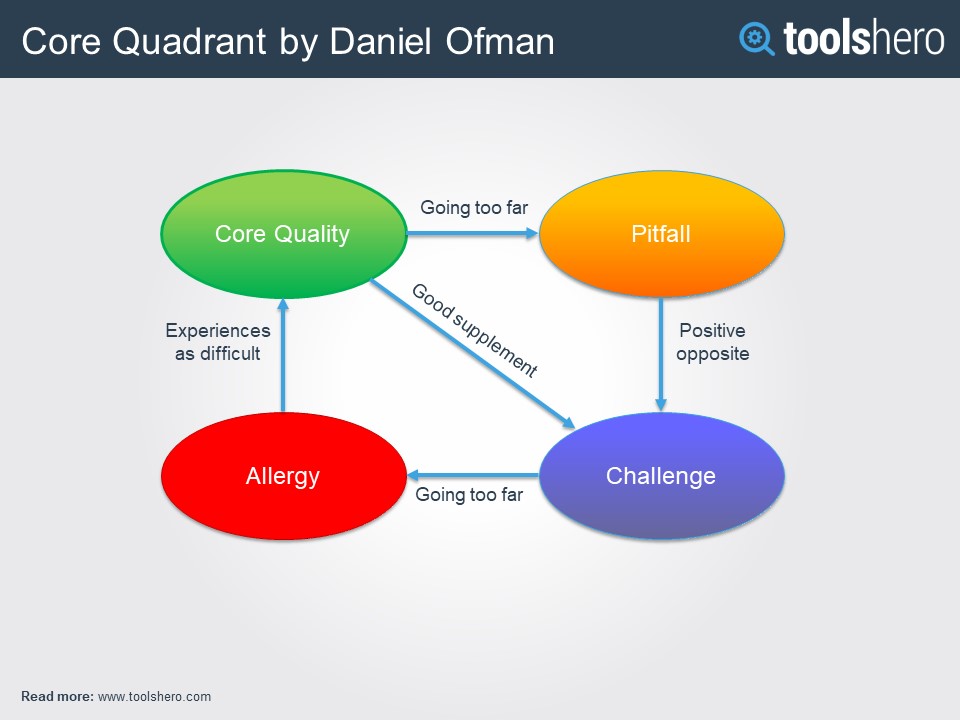
The following chart, developed by Daniel Ofman, and the corresponding exercise have been very successful in helping leaders identify core qualities (such as passion) and work through the pitfalls, challenges, and reactions to those core qualities. This team exercise is an effective way to help leaders examine themselves and then better understand how to maximize their core qualities. I have found that the exercise works best when done with a team.

The Core Qualities Quadrant

Image courtesy of toolshero.com

Step 1: Core Quality

Identify all the aspects of a specific core quality. For example, if passion is one of your core qualities, you may describe it as exciting, adds energy, fires everyone up, contagious, overcomes obstacles, sees how things could be, and so on. Select no more than one or two core qualities to examine. This step seeks to focus on your best core qualities.

Step 2: Pitfalls

What happens when you get too much of a good thing? As is true for almost everyone, your strengths can become your Achilles heel. For example, what happens if you have too much passion? You could be driven, have tunnel vision, avoid reality, not accept failure or shortcomings, shy away from challenges, and so on. Therefore, we list all the pitfalls of passion in this step.

Step 3: Challenges

What are some positive opposites of the pitfalls of your core quality? What are some positive actions you can take
to avoid these pitfalls? For example, to address some of the pitfalls we listed above, you could ask a person or a team to function as a sounding board for you, setting specified times to check the reality of your situation. You could ask for and be open to challenges, or you could have another person or the whole team help you place your passion in the big picture of the organization. Look for positive opposites—ways to challenge and avoid the pitfalls and help yourself stay focused.

Step 4: Reaction

What happens when you carry efforts to challenge your pitfalls too far? You may become discouraged and back away from your core quality. One reaction might be to not share your passion or to share it only with those who will not pose any challenges. Defensiveness or withdrawal are other reactions. This step will help you recognize your reactions and work to overcome your natural tendency to recoil under pressure.

A middle manager I know recently shared her concern with her supervisor about a program he wanted but that she believed might negatively impact the organization financially. She is a good manager and personally takes budgets and sales quotas to heart; it is her passion to hit the numbers every month. She also takes her job seriously and does not hesitate to speak up. In response to her criticism, the CEO pulled her aside and led her to believe that she was wrong in what she was saying. Her reaction to this confrontation was to say, “I’ll just keep my mouth shut from now on!” Finding her passion threatened, she became discouraged by the CEO’s remarks and wanted to avoid future confrontation. This woman’s manager needs help finding some positive opposites to her reaction that will lead her back to her core quality.

The goal of this exercise is to help all team members stay in their positive balance, bouncing between their core qualities and their challenges rather than falling into the negative pattern of bouncing between their pitfalls and their reactions.

You can see from the arrows how this can happen. When played out in real-life situations, this chart is not a circle, but rather we move from corner to corner, either bouncing between our core qualities and challenges or bouncing between our pitfalls and reactions.

Finally, we draw your attention to the arrows between the boxes labeled “Too Much of a Good Thing.” Notice that too much of the core quality leads to pitfalls, and too much working on the challenges leads to reactions. In either case, being out of balance leads to wrong behavior. Too much of anything leads us to a point of concern.

I hope this team exercise is an effective way to help leaders on your staff examine themselves and better understand how to maximize their core qualities as well as the qualities of their teams.

0 comments
1 FacebookTwitterEmail
BlogTeam

The Power of Nutmeg

by Ron Potter July 5, 2018

Because my wife is of Dutch heritage, we have spent time exploring her ancestry back to the Netherlands. Her family was a part of New Amsterdam which eventually became Manhattan. A distant family member suggested I read a book titled The Island at the Center of the World. Fascinating.

Here is a description from Goodreads that will give you a small understanding of the scope of the book and Impact of New Amsterdam on New York and America of today.

When the British wrested New Amsterdam from the Dutch in 1664, the truth about its thriving, polyglot society began to disappear into myths about an island purchased for 24 dollars and a cartoonish peg-legged governor. But the story of the Dutch colony of New Netherland was merely lost, not destroyed: 12,000 pages of its records–recently declared a national treasure–are now being translated. Drawing on this remarkable archive, Russell Shorto has created a gripping narrative–a story of global sweep centered on a wilderness called Manhattan–that transforms our understanding of early America.

The Dutch colony pre-dated the “original” thirteen colonies, yet it seems strikingly familiar. Its capital was cosmopolitan and multi-ethnic, and its citizens valued free trade, individual rights, and religious freedom. Their champion was a progressive, young lawyer named Adriaen van der Donck, who emerges in these pages as a forgotten American patriot and whose political vision brought him into conflict with Peter Stuyvesant, the autocratic director of the Dutch colony. The struggle between these two strong-willed men laid the foundation for New York City and helped shape American culture. The Island at the Center of the World uncovers a lost world and offers a surprising new perspective on our own.

Upon reading this book you begin to realize that many of the concepts that America is built upon came from the early Dutch colony, not completely from the English colonies that came later.

But, knowing what New York and America are worth today or back in the mid-1660’s a very powerful question begins to emerge “Why did the Dutch give up Manhattan without firing a shot?”

The answer to that question is Nutmeg!

The most expensive spice in the world at the time was nutmeg. It cost more per ounce than gold. The Dutch wanted the nutmeg trade and were willing to give New Netherland including New Amsterdam to the English in trade for the small Polynesian Island of Run.

Today that trade looks absolutely nuts. The wealth of America could have been a foundation for the Dutch and we would be closer to the Netherlands today than England. You’ll have trouble finding the Island of Run without Google help.

The point is that at the time, this was a good trade. We didn’t quite see the total future and value of the new world, but the value of Nutmeg was well established. It was a good deal. The world economy and shipping was driven mainly by spices in the 1600 and 1700’s. Filling one ship with Nutmeg at over thirteen dollars per ounce was a tremendous economic driver. Manhattan for the Island of Run was a very good deal.

Lesson learned? Don’t judge decisions made in the past by the conditions that exist today. You will falsely accuse the decision makers of making bad, wrong or stupid decisions. Nothing may have been farther from the truth.

One of the reasons many teams and corporations aren’t good at decision making today is caused by the second-guessing of decisions made in the past.  Learn form the past, don’t second guess the past.

0 comments
0 FacebookTwitterEmail
BlogTrust Me

Getting Effective Feedback

by Ron Potter July 2, 2018

Can your team speak freely?

Leadership today is all about two words: It’s all about truth and trust.

When they trust you, you’ll get truth. And if you get truth, you get speed. If you get speed, you’re going to act. That’s how it works.

You and others are willing to work long and hard to accomplish goals. However, as we’ve seen from the stories in recent posts, our efforts can become very scattered and focused on the “urgent.” We need to build accurate, open, reliable feedback systems.

A team leader needs to create a learning environment in which every team member is appreciated, listened to, and respected. In this kind of environment, the opinions of team members are fully explored and understood and are incorporated into the decision-making process. The team actively learns from all members who express their positions and opinions, and as a result, the team is stronger and more efficient.

In the end it will be the ability to endure through the challenges, criticisms, and doubts that distinguishes the great leaders. But if you have staked your reputation on a wrong or unachievable goal, enduring through the challenges will only take your team or organization down the wrong path. What keeps you from that wrong path is good solid feedback. But good solid feedback is hard to come by, especially the higher you climb in an organization.

The power of effective feedback

People don’t like to give the boss bad news or news that doesn’t agree with the boss’s stated position. But without it comes only failure.

Effective Feedback. It’s not just something you ask for. It’s a cherished gift. It’s a wonderful reward for building a trusting organization or team.

An effective feedback apparatus starts with humility. Humble leaders create an atmosphere where feedback from others is desired and honestly requested. Leaders who are focused on growing their people build that growth on feedback. When people know that a leader is committed and wants honest feedback to help reach stated goals, they are more likely to provide the open and honest feedback required. Compassion, integrity, peacemaking—upcoming chapters that will all lead to an atmosphere and culture that is open to and thrives on honest and timely feedback.

0 comments
0 FacebookTwitterEmail
BlogCulture

What color was that book?

by Ron Potter June 28, 2018

My wife has an interest in home decorating ideas and shares many of them with me.

One of the interesting trends I’ve seen lately is bookshelves. How do you arrange your books? Of the three methods I’ve seen, two of them seem crazy to me and one of them I just don’t understand. The two that seem crazy are:

  1. Wrap all your books in plain brown paper and put them on the shelf to give them a uniformed look. Finding a book is obviously not the point. It’s simply using books as a decorative tool. I don’t think of books that way.
  2. Turn your books around and put the binder to the back and leave the ends of the pages facing out. Once again, it gives an interesting aesthetic and visual effect of different paper textures, thickness, and colors, but why are you storing books if you don’t use the books, trigger a memory from the books, or go back to a book? Again, that just seems crazy to me.

The third one, I just didn’t understand, but I’ve experienced some interesting learning.

  1. Arrange your book by the color of its cover.
    All the blue books are in one area of your bookshelf, all of the green books are in another area of your bookshelf, all the yellow books are in another area of your bookshelf. Again, it adds some architectural texture and color to the room, but at least you can see the spine of the book and read what the book is about. But for me, I would look at that and say, “I can’t find anything. How would I find a book on the shelf?” I tend to arrange mine by title or subject matter so that I can go back to them later.

Recently we visited one of our daughter’s homes. She has an artistic mind and taste. Her bookshelves were arranged by color. I had to admit that it looked very nice, but when she and I had a chance to sit down and talk one evening, I admitted to her that I couldn’t find anything on that bookshelf. “Why do you choose to arrange it by color?” Her answer to me was that “When I think about a book, the first thing I remember is its color, it helps me find the book quicker.” I had never thought about that.

I spent a day with a colleague the other day who is just tremendously successful and respected. One of the conversations we had was about certain books we had read, and I almost had to chuckle, when every time I would bring up a book he would say, “Did that book have a green cover with yellow writing?” Or, “Was that a blue book?” Or, “Was that the black book with the gold print on it?” For one of them, I had to say, “I believe there were two editions. One of them was green and one of them was black with gold.” But that helped him recall a particular book.

The point here is, that we all recall things in different ways and for very different reasons. In general, the business world assumes, and I want to emphasize the assumes, that we recall things through rational logic. But it doesn’t happen that way. To build great teams we must understand and honor what triggers people’s thought and recall. We must allow people to throw out things like, “I think of this in that way,” Or, “I recall this because of that color or that experience or that situation.” Some will think logically and rationally, but not everyone does and great teams honor that. They begin to understand that even the best of people recall and think about things in very different ways.

Accepting the differences opens the door for great dialogue on very tough issues. When we begin to see the whole kaleidoscope of how we see

  • Situations
  • People
  • the future or
  • what’s going to work and what isn’t

we give ourselves a chance to work toward unity and commitment. Unity and commitment to decisions are two of the hallmarks of great teams.

I’ll probably share with you a blog post soon about the value of nutmeg. That doesn’t mean anything to any of us, but it’s a very powerful lesson in life.

So, as you’re building a great team, make sure you completely honor the fact that different, very highly-skilled, very intelligent people all recall and think about things in different ways. This is what makes for robust teams and robust dialogue.

0 comments
0 FacebookTwitterEmail
Newer Posts
Older Posts
  • Facebook
  • Twitter
  • Linkedin
  • Rss
  • About This Site
  • About
    • Clients
  • Services
  • Resources
    • Trust Me
    • Short Book Reviews
  • Contact

About this Site | © 2024 Team Leadership Culture | platform by Apricot Services


Back To Top
Team Leadership Culture
  • Team
  • Leadership
  • Culture
  • Myers-Briggs
  • Trust Me
  • Short Book Reviews