
Team Leadership Culture
  • Team
  • Leadership
  • Culture
  • Myers-Briggs
  • Trust Me
  • Short Book Reviews
Top Posts
Obituary
REPOST: Four Functions, Three Rules
ROUNDUP: The Rise of AI
REPOST: Facing Adversity Series
ROUNDUP: Curiousity
ROUNDUP: Deep Work
REPOST: Character vs. Competence
REPOST: Opposite of Victim
REPOST: Listening With the Intent to Understand
REPOST: Performance vs Trust
  • About
  • Services
  • Resources
    • Trust Me
    • Short Book Reviews
  • Contact

Team Leadership Culture

  • Team
  • Leadership
  • Culture
  • Myers-Briggs
  • Trust Me
  • Short Book Reviews
Category:

Blog

BlogTrust Me

Energizing the Team with Vision

by Ron Potter June 25, 2018

People are hungry to be led and will gravitate toward leaders who have a clearly communicated vision. Knowing “why we do these things around here” helps put management’s expectations for individuals and teams into a meaningful context.

What a well-communicated vision can do

Authors James Kouzes and Barry Posner found that “when leaders effectively communicate a vision—whether it’s to one person, a small group, or a large organization—that vision has very potent effects. We’ve found that when leaders clearly articulate their vision for the organization, constituents report significantly higher levels of the following:

  • Job satisfaction
  • Motivation
  • Commitment
  • Loyalty
  • Esprit de corps
  • Clarity about the organization’s values
  • Pride in the organization
  • Organizational productivity

Clearly, teaching others about the vision produces powerful results.”

Implementing your communicated vision

In order to implement a communicated vision, leaders need to encourage clear buy-in from the people. This requires moving beyond communication to collaboration. The goal is to develop a supportive environment and bring along other people with differing talents and abilities. It also means that when the followers truly understand the vision, the leader needs to step aside and let them do the work to “produce” the vision. The leader needs to give them the authority and responsibility to do the work necessary in order to bring his or her vision to fruition.

I witnessed a meeting recently in which the leader brought together a crossfunctional group to brainstorm some marketing campaign ideas for the company. People from different departments assembled and were led through a planned exercise on corporate marketing focus for the following year. The best idea came from a person far removed from the marketing department. She quite innocently blurted out just the right direction and even suggested a great theme for the entire campaign.

If the leaders of this organization had simply called together the “marketing types,” they would have missed a tremendous idea. Or if the leader had done the work alone and not opened it up to input from others, he might not have secured the necessary buy-in from the staff to implement the project. Studies show that when people understand the values and are part of the vision and decision-making process, they can better handle conflicting demands of work and higher levels of stress.

People want the best in themselves called out. They will rally around a communicated vision and work hard to support it. The vision also establishes a foundation of shared commitment and focus if and when times get rough.

A clear vision also establishes a foundation of shared commitment and focus when times get rough.

0 comments
0 FacebookTwitterEmail
BlogTrust Me

Team Time Management

by Ron Potter June 18, 2018

While consulting with one of a client organization on leadership matters, I kept hearing from the high-level executive team that they were all averaging more than eighty hours a week. During the training with this group, the topic of the heavy work schedule kept surfacing.

I decided to put what we were doing on pause and take a closer look. Some questions needed answering: First, how could these executives keep up this schedule without destroying themselves, their families, and their teams? Second, with such demands on their time, how would they be able to change ingrained habits and actually start doing this “leadership thing” that they knew was important, but they never seemed able to focus on long enough to accomplish? Would our recommendations, if followed, now cause them to have to work ninety hours per week?

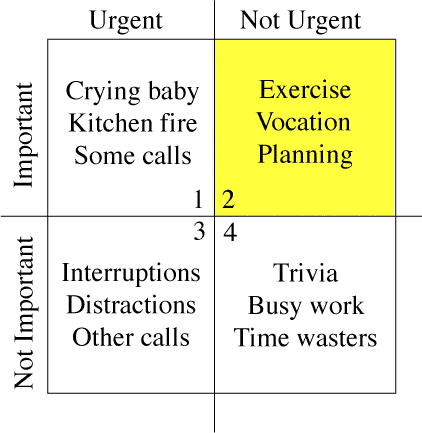
To get hard data on how these executives were allocating their time resources, we decided to use the Stephen Covey view of time management found in his book The 7 Habits of Highly Effective People. Covey’s Time Management Matrix shows four categories of activities:

I asked the team to spend two weeks tracking their time and scrupulously recording what they were doing during these 80-hour marathons. I tallied the results and created a page on a flip chart for each person, cataloging that 8 of their 80 hours went to task A, 6 hours went to task B, and so on. All 160 hours were accounted for in this way.

Covey's Time Management Matrix

Time Management Matrix from 7 Habits of Highly Effective People

The group assembled to hear the results. I wish there was a videotape of the assorted jaw-dropping responses I observed as I first revealed individual patterns and then moved on through a discussion process for the entire group. It was interesting and a bit entertaining when one person would identify an item as Quadrant III (urgent, but not important) and someone else would say, “Time out! If you don’t do that task for me, I can’t get my work done (Quadrant I)!” It took a great deal of negotiation to reach a team consensus on which activities belonged in which quadrants. However, through those negotiations, we discovered just exactly what each person needed.

In many cases one person or team was generating an entire report that took a great deal of time, while the person who needed the data might use only a single crucial piece of data from the entire report. Once we determined that the one piece of data could be generated easily and, in many cases, could be retrieved on demand by the recipient from a database, a gigantic amount of busywork was eliminated.

After completing the negotiations over quadrant assignments, we added up all the hours and determined that about 20 percent of the hours fell in Quadrants I and II (the categories that really matter if you want to focus the team), while 80 percent fell in the less important Quadrant III.

You can imagine the stunned silence that settled like a black cloud in the room. Finally one executive said, “You mean we accomplished all of our important work in sixteen hours and the other sixty-four hours each week were spent on busywork?” The answer was yes. More silence followed.

How had this bright, talented, and obviously hard working “band” gotten so out of tune, so unbalanced? For one thing, they had never sat down together for this kind of discussion and negotiation. The positive result was that they eliminated a tremendous amount of busywork right on the spot. As a team, they came to grips with the focus-destroying enemy called “the tyranny of the urgent.”

If I stopped by your place of business and did the same exercise, what might the results be? Have you and your team identified the important versus the urgent? Do you spend your time and energy on the important?

Time Management Quote

0 comments
0 FacebookTwitterEmail
BlogTeam

Are you just a Big Splash?

by Ron Potter June 14, 2018

As an engineer, I learned about laminar flow. Let’s take the example of water for a minute. A lot of engineering science goes into what’s called laminar flow, which means aligning all the molecules of water in the same direction. We know from our science work in high school that water is made up of H2O, two hydrogens, and one oxygen molecule. When the engineers start filtering and aligning and pushing each one of these molecules in precisely the same direction, that’s known as laminar flow. Water in laminar flow is incredibly powerful. It can cut through solid steel.  If it doesn’t quite achieve laminar flow, all it does is splash off the surface because there’s no alignment of the molecules. Is your team able to cut through the toughest issues or does it just splash and get everyone wet?

Once again I recently heard a CEO say,

Well, that’s not true, but that’s their perception.”

Implied in that statement is that he, and maybe he alone, knows the truth. Those other poor, well-meaning souls only have their perception. Unfortunately, many people believe their perception is the truth. Every day, more brain research is showing us that what we see and hear is processed through multiple brain centers dealing with memories, beliefs, emotions, and others before the image, or the audio file is stored in our memory. That means from the time we observe something through sight or sound, it’s completely processed in our brain based on who we are before the memory is stored in our brain.

Unfortunately, we think of our memory as if it were a computer hard drive. It’s a poor analogy. With a hard drive, we can go back several years later and retrieve the data that was placed on the hard drive, and it’s exactly the same data that was initially stored. But when we retrieve data from our brain, it has been constantly modified before placing in memory. We have further learned that even after a memory has been placed in our brain, it is continually being modified with every new experience from the moment it was initially stored. We don’t have reality in our brain. We only have our perception, and even that is being continually modified.

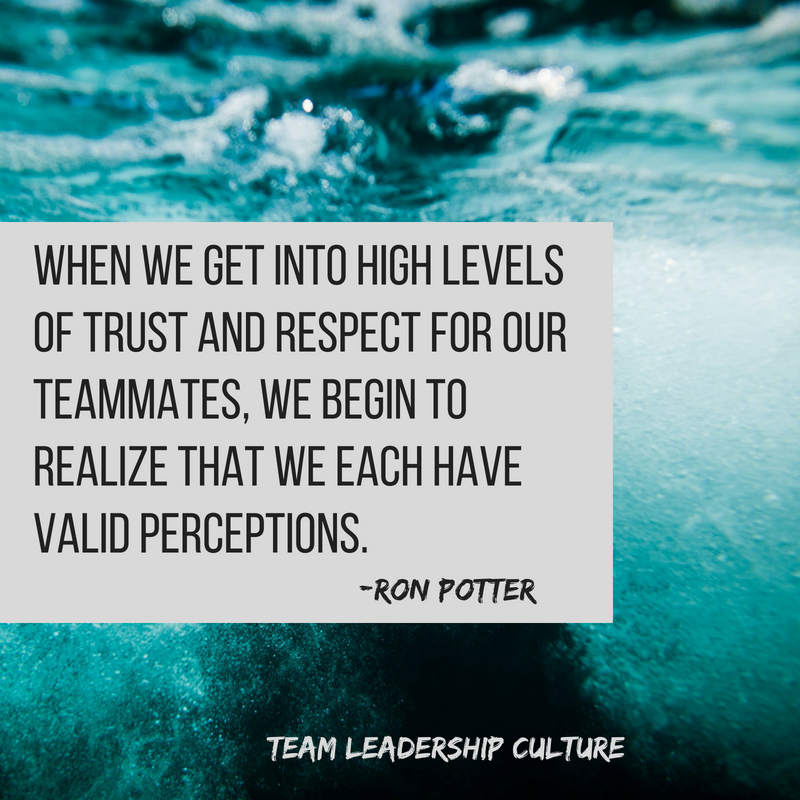
When we get into high levels of trust and respect for our teammates, we begin to realize that we each have valid perceptions, and our jobs as members of the leadership team are to form our collective reality from the multiple perceptions. We do this, so we can align and move forward together. We have different perspectives. But, we need to build a valid ‘reality’ of our perceptions so that we can move forward together. Without it, we will continue to move in different directions, diluting, diffusing our energy and trust, and creating nothing more than a big splash. When we line up all the “molecules” of our perceptions we begin to generate some real power.

Perception Quote

0 comments
0 FacebookTwitterEmail
BlogTrust Me

Achievement-Motivated Leaders

by Ron Potter June 11, 2018

We recently discussed leaders motivated by passion. Along with passion, a desire to achieve motivates a leader to a higher level of focus.

I have concluded that leaders with an achievement-motivated style (balanced by humility) have the most constructive approach to work. Typically, they do not waste time on projects or matters outside their vision. They determine what is important, that “something great,” and they seek to achieve it.

For more than twenty years, David C. McClelland and his associates at Harvard University studied people who had the urge to achieve.

McClelland’s research led him to believe that the need for achievement is a distinct human motive that can be distinguished from other needs. [His experiment involved asking participants] to throw rings over a peg from any distance they chose. Most people tended to throw at random—now close, now far away; but individuals with a high need for achievement seemed carefully to measure where they were most likely to get a sense of mastery—not too close to make the task ridiculously easy or too far away to make it impossible. They set moderately difficult but potentially achievable goals.

I’ve determined, based on our experience, that achievable goals are those with a 70 to 80 percent likelihood of success.

McClelland maintains [that]…achievement-motivated people are not gamblers. They prefer to work on a problem rather than leave the outcome to chance.… Achievement-motivated people take the middle ground, preferring a moderate degree of risk because they feel their efforts and abilities will probably influence the outcome. In business, this aggressive realism is the mark of the successful entrepreneur.…

You can read more from McClelland’s theory here.

Another characteristic of achievement-motivated people is that they seem to be more concerned with personal achievement than with the rewards of success. They do not reject rewards, but the rewards are not as essential as the accomplishment itself. They get a bigger “kick” out of winning or solving a difficult problem than they get from any money or praise they receive.

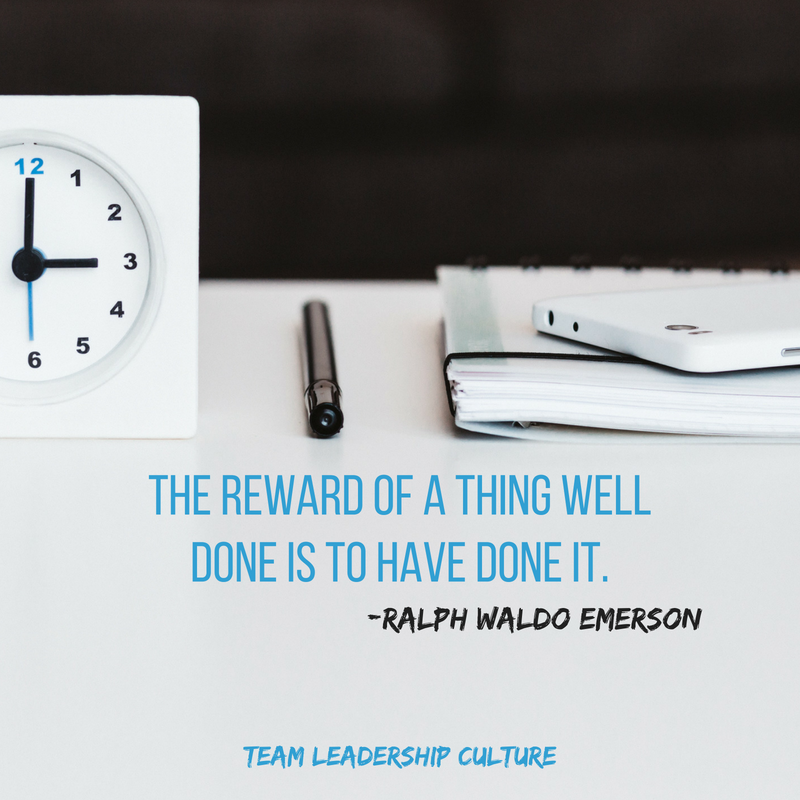
Ralph Waldo Emerson said, “The reward of a thing well done is to have done it.” Every January millions of people watch the Super Bowl. During the awards ceremony after the game, we see players with big smiles. What are they shouting about? Not about money or fame, but about the ring. Each player on the winning team gets a championship ring—a symbol of reaching the pinnacle of the sport. Nothing else compares to having that ring. It is proof of the ultimate achievement in football. That’s what motivates an achievement-oriented person.

Lastly, achievement-motivated people need feedback. They seek situations in which they get concrete feedback that they define as job-relevant. In other words, they want to know the score.

People with a high need for achievement get ahead because, as individuals, they are producers. They get things done.

Sometimes, however, when they are promoted, when their success depends not only on their own work but on the activities of others, they may become less effective. Since they are highly job-oriented and work to their capacity, they tend to expect others to do the same. As a result, they may lack the interpersonal skills (I refer to this as the encouragement or humility leadership style) and patience necessary for being effective managers of people who are not as achievement-motivated.

Achievement-Motivated Leaders

0 comments
0 FacebookTwitterEmail
BlogCulture

ABC or DEF. Which Grade do you receive?

by Ron Potter June 7, 2018

Based on our grades from school most of us are going to think that ABC is probably the place we want to be. However, that does not apply to this set of circumstances. In this case, I define ABC as Always Blaming and Complaining.

ABC.

What do you hear from the ABC crowd? Blaming.

  • blaming others
  • blaming circumstances
  • blaming family situations
  • blaming traffic situations.

Plenty of blame to go around. They never seem to hold themselves unaccountable.

Along with blaming, complaining is a very close relative. Complaining about the circumstances that they seem to have no control over.

One of my favorite adages through the years is something called The Serenity Prayer.

“God grant me the serenity to accept the things I cannot change, the courage to change the things I can, and the wisdom to know the difference.”

With the complainers, everything seems to fall into the “I cannot change” category but there is no serenity. There is a lack of courage to identify and change the things that are possible to change.

In many cases, they seem to want to accomplish great things or tackle some new entrepreneurial endeavor. But the first thing out of their mouth is complaining about why that’s not going to happen.

  • Government regulations are going to keep them from succeeding
  • Nobody will listen to them
  • Investors won’t invest in them

Always blaming and complaining is not where you want to be.

DEF.

DEF stands for Dependable, Effective, and Friendly.

Being dependable means doing the things that you have committed to do. It has as much to do with integrity as it does anything else.

  • When you commit to something
  • When you agree to something
  • When you say you will do something

Do it!

Can people depend on you? People figure that out quickly. If they can’t depend on you:

  • They’ll stop turning to you
  • You’ll do less and less work over the time (becoming expendable)
  • Those who are dependable get more and more assigned to them because they can be counted on.
  • Over time, this causes great disruption within organizations.

Are you effective? We all tackle our work, both individually and in teams, but how effective are you?

All kinds of issues can come into play here. One is perfectionism.

Do you have to have everything absolutely perfect? Does everything have to be perfect before you release it? Perfectionism usually gets to a self-esteem issue and really doesn’t do the organization any good. Do the work that you need to do. Figure out what’s important. Stay focused on those key important issues and be effective at what you accomplish.

Friendly. This may sound a little out of place here, but one interesting experiment I run with teams is titled The Perception Exercise.

I share one list of characteristics with half the team and another list with the other half. Once they’ve each observed their list, and understood it, I start asking them about the characteristics of this individual.

  • Are they dependable?
  • Are they effective?
  • Are they honest?
  • Are they trustworthy?
  • Will they be successful in life?
  • Do you want them on your team?

And one half of the team typically scores that individual much lower than the other half. The interesting difference is that the lists are identical in terms of characteristics, except for one word.

One list contains the word warm. “This tends to be a warm individual.”

The other list contains the word cold. “This tends to be a cold individual.”

Those two words, whether we perceive the person to be warm or cold, friendly or not, shapes our whole view of their performance, contribution and future success. We even decide if we want them as part of our team or not. Psychologists tell us that we will make a warm or cold judgment in the first 15 seconds of meeting a person.

Sometimes it’s very difficult to figure out where we are ourselves, and we need to get some feedback on this. But quite honestly, I believe that if you are very thoughtful, intentful and honest with yourself, you can decide whether you fall more on the ABC side or the DEF side. Keep in mind that if you fall on the ABC, always blaming and complaining, you may be attempting to avoid some immediate pain, but in the long term, none of that will lead to success or happiness in your life. However, if you’re one of those people who fall on the DEF side of the scale, dependable, effective, friendly, we can predict with good accuracy much more long-term happiness and success and productivity in your life.

Give yourself a grade, see where you come out on this one.

0 comments
0 FacebookTwitterEmail
BlogTrust Me

Passionately-Focused Leaders

by Ron Potter June 4, 2018

Staying focused is virtually impossible without passion. Passion is a craving deep within us, that yearning for something we feel we just must have. It surfaces in a multitude of ways. For example, consider the story of Patrick (Pádraic) Henry Pearse.

Headmaster at St. Edna’s, a small private college south of Dublin, Pearse’s passion was Ireland’s heritage, something he feared was being destroyed by the domination of the English.

Pearse was by nature a gentle man who could never harm even the smallest creature. He had spent his life helping his students understand and pursue their own big dreams. Pearse certainly was not considered a militant or a revolutionary. Yet he was driven by his passion for Ireland.

No longer able to watch the nation’s language, culture, and history eroding, he felt it was time “to pursue his own great goals that, in his words, ‘were dreamed in the heart and that only the heart could hold.’ ”4

He embraced the cause to reclaim Ireland and within a year was a leader of the Easter Rising, the Irish rebellion of 1916. After days of intense fighting, the British army defeated the revolutionaries, and on May 3, 1916, Pearse and others were executed in a jail in Dublin. The British leaders mistakenly thought this would put an end to the rebellion. But they did not understand the power of a person’s passion, as people across Ireland embraced Pearse’s ideas for saving Ireland and dreaming big dreams.

In 1921, Ireland declared freedom from England, and Pearse’s passion and dreams for the Irish culture came to fruition. Pádraic Henry Pearse’s passion ultimately forced a nation to find itself.

Finding our passion includes dreaming big. Ask yourself some questions:

  • What is my burning passion?
  • What work do I find absorbing, involving, engrossing?
  • What mission in life absolutely absorbs me?
  • What is my distinctive skill?

Answers to questions like these will point you to your passion.

A friend of mine, the late Leonard Shatzkin, had a passion for mathematics that helped him become a pioneer in understanding the technicalities of inventory management. He developed a model of inventory control using linear regression that proved to be revolutionary for two companies he headed. But his passion didn’t just stop with benefits for his own organizations. Leonard then devoted the rest of his professional career to telling anyone who would listen about maximizing return on investment and minimizing overstocks.

That’s what passion is like; one way or another it demands expression. Even after his death, the effects of Leonard’s passion live on. His ideas and systems serve many individuals and organizations well.

Too often we allow old habits, the rigors of everyday life, and our ongoing fears or frustrations to impede our passion. We are cautioned by friends: “Don’t be so idealistic.” “Don’t be so daring.” “What if you fail?” These kinds of comments can shrink our passion so that we settle for working in fields away from our passion. We abandon it, we make do, and we play it safe.

Just as a mighty river needs a channel, passion needs a channel and a goal. Without such restraint, the result is a flood, a natural disaster. You need to make certain that you control your passion, not the other way around.

0 comments
0 FacebookTwitterEmail
BlogCulture

The Machines won’t stand a chance!

by Ron Potter May 31, 2018

Earlier this year I reviewed the book Only Humans Nee Apply. The question raised by the book is:

How do we as humans survive in this incredible technology, robotic age that we’re now entering?

One way to look at history is through the “ages” that have been identified.

  • The Agricultural Age
  • The Industrial Age
  • The Information Age
  • The Technology Age

The Agriculture Age and Industrial Age are well documented and understood. One important thing to remember is the workers at the center of those ages were essentially the upper-middle class of the day.

The landowner or industry owners were the wealthy of that era, but the agricultural and industrial workers were the upper middle class of the day.

The steam engine brought an end to the industrial age when factory workers began making more money. The industrial age ended in September 2007 when the United Auto Workers wages dropped from $60/hour to $20/hour. Industrial workers could no longer make upper-middle class wages.

But when did the information age end? By some measures, it ended 50 years ago. We just haven’t noticed yet.

The Next Age

The next age has gone by different identifies. The Conceptional Age. The Creative Age.

What we know for sure is that we’re entering a new phase where the technology is finally hitting its stride and doing many things that the information or knowledge workers used to do. Several of our major colleges today employ sports writing “robots”. Plug in the stats from the game and the computer writes the sports story.

In his book, Only Humans Need to Apply, Tom Davenport talks about the different ways humans will survive and thrive in this machine age.

  • You can become a machine maintenance person, a technician. Machines will always need maintenance and repair.
  • You can use the machine to augment what you do. My first example of this was using spreadsheets. Spreadsheets began to augment what I did as an engineer. The problem with allowing machines to augment what you do is they quickly get smart enough to take over what you do.

Davenport says our best chance is to augment what the machines can do. How do we begin to use that technology and apply our creativeness? The one aspect that machines haven’t mastered is being creative (so far). How do we begin to apply creativity in ways that machines would never think doing? This is how humans will survive in the technology age.

Augmenting Teams

But, I believe our greatest augmentation opportunities lie in teams, not technology. We need to think about our teams in a similar way. How do we augment each other? If we don’t, we’re not gaining the incredible power of teams. We’re just a group of individuals working together. But in the same way, we think about augmenting machines, we can augment what each other do. By doing so we’re creating a team that can go far beyond even what the best individual on the team can do.

This idea of augmenting each other means we’re required to know each other not as human doings, not as what we do or how we do it but as human beings.

  • Who are we?
  • How do we think?
  • What are our beliefs and assumptions?
  • What are the values that we hold?
  • How are we going to face difficulties together?

This is where growth happens when we’re faced with difficult situations. Teams that learn to augment each other, that function better as a team than as a group of individuals. These are the teams that will be extremely successful in the future. In fact, my belief is that if teams fully augment each other as human beings, the machines won’t have a chance.

1 comment
0 FacebookTwitterEmail
BlogLeadership

Innovation: hovering for takeoff or collapsed?

by Ron Potter May 24, 2018

Current Excitement

Three months ago, she had been excited. This was the opportunity she had been working toward since she joined the company three years ago. Meaningful work is one of the more joyous things you can experience. She didn’t want this job because of its prestige or high pay. She wanted this job because it was meaningful to her, her colleagues and clients.

How it Started

When I talked with her three months ago she was riding high. She explained that when she joined the company she had been hired for her skill set and outstanding success in her last assignment. But before she even joined the company she explained to the CEO that this was not her dream job. She would certainly do the job and do it well but in the end, she wanted a different assignment that was more meaningful to her.

Over the three years, she did indeed do the job well. She built a great team and was recognized beyond her company as an outstanding contributor to the industry. And while she enjoyed the work and found great satisfaction in building and growing a great team, she continued to remind the CEO on an annual basis that she was still interested in the job that was more meaningful to her. And now she had it.

Takeoff

She was filled with new energy and new excitement and explained all the things she wanted to accomplish in the new role. Many of them had never even been tried by the company. The breadth and depth of her vision were overwhelming when she explained all the things she wanted to build. I was wondering how any superhuman could possibly accomplish that much.

Collapsed

But now! Have you ever seen a large hot air balloon being deflated? The beautiful, magnificent structure stories high into the sky with a buoyancy that leaves it hovering just above the earth defying gravity. But an instant later the entire structure has gone cold, collapsed to the ground with a heavy thud and lies there motionless and useless on the ground. That was what today’s phone call felt like.

She had just come out of a budget meeting where it was clear the company was not going to meet next year’s goals and drastic cuts needed to be made. In an instant, her carefully crafted team and the multiple goals that had been hovering above the ground, ready for takeoff were now lying on the ground with no visible means of support. Deflated!

Lean Times Require Focus and Innovation

Times of plenty can destroy one of the greatest assets of leadership teams: good decision making. We’ve discussed this in other blog posts, but the concept is always worth reinforcing. The word decide (de-cide) means figure out what to kill or stop doing. In times of plenty, leaders seldom have the spirit or inclination to say “no”. Good deciding means to be clear about what you’re saying “no” to.

The other concept we began to talk about in her time of deflation was innovation and creativity. It has been well documented that the best innovation takes place when the boundaries are the tightest. Again, in times of plenty, it’s much easier to throw some ideas up on the board, try them all and see if any of them produce fruit. Not innovative! Innovation is about simplicity. Doing the most with the least. It’s those times when budget, time or resources are in extremely short supply when the best innovation happens. This was her time of opportunity. The budget was not just going to be tight, it was going to be slashed. She was going to be forced to say no to save that part that absolutely required a yes. And even the items that received the yes would need to be accomplished in the highest quality and the most elegantly simple way possible. Now was the time for true innovation.

Have you figured out how to say no? Have you absolutely insisted that things get accomplish in the most elegant, simple form possible? At some point, you will likely be forced to accomplish those tasks. You might as well get started now. Learn to say no. Do everything as elegantly as possible.

0 comments
0 FacebookTwitterEmail
BlogCulture

TV or Reading

by Ron Potter May 10, 2018

A few years ago, I became hooked on a TV series. Over time I judged it to be the best written and acted series I had ever seen. Because of the magic of Netflix, Amazon, and others, it’s now easy to go back to previous shows and watch them again as I have been doing lately. I’m not going to say which one it was because everyone has different taste in entertainment and I’m not trying to promote mine. I’m just saying that well-written TV can and does capture my attention.

However, I stopped watching TV news years ago and feel much happier avoiding it. And nothing really changes if I watch it or not.

I’m also a reader. I wasn’t always a reader but have become an avid reader. I read non-fiction material in the morning (related to my work or interests) and fiction at night (for the fun of it).

I’m often asked how I’m able to read so many books in a year. The short answer is less TV, more books.

My favorite blogger is Shane Parrish at Farnam Street Blog. I credit Shane with increasing my interest in reading because I was fascinated by how much he reads and how much he is constantly learning. Shane writes: “Newspapers are focused on things that change. You can’t run fast enough to keep up with this world and yet while you may think it’s valuable, the information you receive is full of noise. Farnam Street focuses on helping you learn things that don’t change over time — It’s an investment. What you learn today becomes the scaffolding to solving tomorrow’s problem.” While his quote is focused on newspapers and not TV, I believe it applies to TV news as well.

My interest has also been sparked by what we’re learning in the field of brain science about the impact of TV versus reading. In general, we’ve come to think of TV as bad and Reading as good. However, sometimes I watch TV in the form of movies or documentaries about the books I’ve also read. One such example is a book titled “Boys in the Boat” about the rowing crew from Washington that competed in the 1936 Olympics. PBS also did a documentary called “The Boys of ‘36”. I enjoyed both but is one form better for me than the other?

Brain research tells us that the more hours of TV watched:

  • Increases aggression levels
  • Decreases verbal reasoning
  • Lowers communication levels with others
  • Increases risk of Alzheimer’s

The more reading we do:

  • Increases brain connectivity related to language
  • Increases alertness
  • Delays cognitive decline
  • Decreases risk of Alzheimer’s
  • Increases communication levels
  • Reduces stress levels

Why?

TV is passive, fast-paced and shallow (not enough time for details).

Reading allows for more depth and at the same time forces the use of imaginations!

Read more. Watch less. It’s healthier.

1 comment
0 FacebookTwitterEmail
BlogTrust Me

How Focused is Your Energy?

by Ron Potter May 7, 2018

The sun is a powerful source of light as well as energy. Every hour of every day the sun showers the earth with millions, if not billions, of kilowatts of energy. We can, however, actually tame the sun’s power. With sunglasses and sunscreen, the sun’s power is diffused, and we can be out in it with little or no negative effects.

A laser, by contrast, is a weak source of light and energy. A laser takes a few watts of energy and focuses them into a stream of light. This light, however, can cut through steel or perform microsurgery on our eyes. A laser light is a powerful tool when it is correctly focused.

Leaders cease to be powerful tools when they are out of focus and their energy is dispersed rather than targeted.

Rather than resembling a laser, too often we seem like the sun, just going up and down, splashing our energy anywhere and everywhere.

David Allen, one of the world’s most influential thinkers on personal productivity, argues that the challenge is not managing our time, but managing our focus. He believes that with all that is being thrown at leaders, they lose their ability to respond. However, he is quick to add that most leaders create the speed of it all because we allow all that stuff to enter into our lives.

What happens to our energy? Allen says,

If you allow too much dross to accumulate in your “10 acres”—in other words, if you allow too many things that represent undecided, untracked, unmanaged agreements with yourself and with others to gather in your personal space—that will start to weigh on you. It will dull your effectiveness.

Not only will your effectiveness be dulled but so will your power. Instead of being like a steel-cutting laser, you will be like the sun, putting out energy with no focus. There needs to be focus because life is not just about running faster or putting out more energy.

With so much going on around leaders, focus may seem impossible or improbable to achieve. Employees, phones, pagers, e-mail, cell phones, problems, crises, home, family, boards of directors, and other people or things demand so much. We tend to spend our time managing the tyranny of the urgent rather than concentrating our efforts on the relevant and important things that make or break an organization.

So what should we do? Is it possible to better focus your focus?

I have found that two personal qualities combine optimally to create a leader of highly developed focus: passion and achievement. These form the boundaries of focus.


0 comments
0 FacebookTwitterEmail
BlogCulture

What’s your Therefore there for?

by Ron Potter May 3, 2018

The word therefore has only been used in its current form for around 200 years. It’s a relatively new word in our language.

In the original old English, it meant: for that or by reason of that. Or it could be understood to mean “in consequence of that.”

The question is “What is that?”

We all too often give our reason for something without ever explaining what that reason is based upon.

By reason of that

In consequence of that

One of the practices I find myself talking to corporate teams about is conducting good dialogue. Good dialogue begins with clearly stating the “that” which your argument or conclusions are based upon.

Peter Senge wrote the book The 5th Discipline in 1990. In my experience with corporate clients, it was one of the most impactful books written at the time. Every client I worked with during the late 90’s and early 2000’s was anxious to show me what they were doing with systems thinking (the point of Senge’s book) and re-engineering projects to rethink how they were approaching their work. The book itself was over 400 pages long and my personal notes of highlights were nearly 40 pages. That means I highlighted nearly 10% of all the words written. It was impactful thinking!

One of the basic mental models in the book was Triple Loop Learning. It is most often attributed to Chris Argyris who was a colleague of Senge. In this model, they helped us understand that until we get at the beliefs and assumptions that drive our reasoning we will never actually learn or will always fall short of accomplishing major change efforts. Beliefs and assumptions will always overrule systems, policies, procedures, and processes.

Teams that get good at starting with beliefs and assumptions of each team member find renewed understanding and respect for each other and make great strides accomplishing great things beyond what one individual could accomplish.

In my experience, if you were to watch high performing teams from behind a soundproof glass, you would think they were at each other’s throats. They seem to be aggressively going at each other and getting in each other’s face. But, if you removed the glass and began to hear the discussions, you would be aware that they want to understand each other so deeply that they are aggressively going after the beliefs, assumptions, backgrounds, experiences that support everyone’s starting points when dealing with a difficult issue. By understanding beliefs and assumptions, the team is better at solving problems and reaching a committed solution they all will back and support.

So, what is your therefore there for? If you can’t share what you believe without condemnation, ridicule or repercussions your “therefore” conclusions, suggestions or directions will never be understood or respected. Build great teams that can openly share Beliefs and Assumptions so that “therefore” is understood and respected.

0 comments
0 FacebookTwitterEmail
BlogTeam

How to Focus on Your Passion

by Ron Potter April 30, 2018

Staying focused is virtually impossible without passion. So how do you identify and capitalize on your passion in the leadership setting?

Passion is a craving deep within us, that yearning for something we feel we just must have. It surfaces in a multitude of ways. For example, consider the story of Patrick (Pádraic) Henry Pearse.

Headmaster at St. Edna’s, a small private college south of Dublin, Pearse’s passion was Ireland’s heritage, something he feared was being destroyed by the domination of the English.

Pearse was by nature a gentle man who could never harm even the smallest creature. He had spent his life helping his students understand and pursue their own big dreams. Pearse certainly was not considered a militant or a revolutionary. Yet he was driven by his passion for Ireland.

No longer able to watch the nation’s language, culture, and history eroding, he felt it was time “to pursue his own great goals that, in his words, ‘were dreamed in the heart and that only the heart could hold.’ ”

He embraced the cause to reclaim Ireland and within a year was a leader of the Easter Rising, the Irish rebellion of 1916. After days of intense fighting, the British army defeated the revolutionaries, and on May 3, 1916, Pearse and others were executed in a jail in Dublin. The British leaders mistakenly thought this would put an end to the rebellion. But they did not understand the power of a person’s passion, as people across Ireland embraced Pearse’s ideas for saving Ireland and dreaming big dreams.

In 1921, Ireland declared freedom from England, and Pearse’s passion and dreams for the Irish culture came to fruition. Pádraic Henry Pearse’s passion ultimately forced a nation to find itself.

Finding our passion includes dreaming big. Ask yourself some questions:

  • What is my burning passion?
  • What work do I find absorbing, involving, engrossing?
  • What mission in life absolutely absorbs me?
  • What is my distinctive skill?

Answers to questions like these will point you to your passion.

0 comments
0 FacebookTwitterEmail
Newer Posts
Older Posts
  • Facebook
  • Twitter
  • Linkedin
  • Rss
  • About This Site
  • About
    • Clients
  • Services
  • Resources
    • Trust Me
    • Short Book Reviews
  • Contact

About this Site | © 2024 Team Leadership Culture | platform by Apricot Services


Back To Top
Team Leadership Culture
  • Team
  • Leadership
  • Culture
  • Myers-Briggs
  • Trust Me
  • Short Book Reviews