
Team Leadership Culture
  • Team
  • Leadership
  • Culture
  • Myers-Briggs
  • Trust Me
  • Short Book Reviews
Top Posts
Obituary
REPOST: Four Functions, Three Rules
ROUNDUP: The Rise of AI
REPOST: Facing Adversity Series
ROUNDUP: Curiousity
ROUNDUP: Deep Work
REPOST: Character vs. Competence
REPOST: Opposite of Victim
REPOST: Listening With the Intent to Understand
REPOST: Performance vs Trust
  • About
  • Services
  • Resources
    • Trust Me
    • Short Book Reviews
  • Contact

Team Leadership Culture

  • Team
  • Leadership
  • Culture
  • Myers-Briggs
  • Trust Me
  • Short Book Reviews
Tag:

Leadership

BlogTrust Me

How Big is the Pie: Rewards of You-First Leadership

by Ron Potter October 8, 2018

The past couple weeks, we have discussed you-first leadership and the characteristics that make up that kind of leader.
Becoming a “you-first” leader may sound a bit like career suicide. Isn’t this just another way to get trampled while climbing the corporate ladder?

I would say that depends on your view of the pie.

Are you the kind of person who believes in the “fixed pie” view of the world? “There is only so much pie to go around, so if I don’t get mine first, there won’t be any left after everyone takes theirs.”

Or do you believe in an expanding pie? “If we all do a great job, there will be more than enough to go around for all of us.” “You first.”

The Sweet Rewards of You-First Leadership

There are actually great personal and professional rewards awaiting the person intent on taking care of the needs of others first. In the long run compassion, like humility, will be an asset that will propel you into being an admired leader, one whom others will follow. It will also provide you with a great deal of personal satisfaction and delight.

Having a “you-first” attitude will result in a new and better personal leadership paradigm. Instead of viewing employees and others as those in need of control and reshaping, you will move toward becoming a coach who provides people with honest feedback. You will create a safe environment in which people are free to share honestly about your programs, ideas, vision, and initiatives.

Another way to look at yourself and develop good habits is to examine whether you act as an old-style boss, or whether your actions (not intentions, but real actions) are directed toward empowering others.

Zig Ziglar has built a whole career based on the concept that to get everything you want you need to help other people get what they want. “You first.”

A you-first leadership style goes beyond humility. Humility says, “I’m no better than you; we are equally important.” A “you-first” attitude puts the other person out front.

Let’s Discuss

  • How much are your decisions driven by your own selfishness?
  • What are you trying to protect by not seeking a “you-first” style when you work with others?
  • Have you ever experienced personal satisfaction by putting another person first, placing their needs ahead of your own? Explain.

0 comments
0 FacebookTwitterEmail
BlogTrust Me

Leading Others By Putting Them First – Part II

by Ron Potter October 1, 2018

The “you-first” leader is the man or woman whose focus is on responding to the needs of employees, customers, and community before his or her own needs. Last week, we discussed the first three characteristics that help put those you lead first. This week we’ll continue with the last three.

Empathy

This is identifying with and understanding another’s situation, feelings, and motives. People need to know they are accepted and recognized for their special gifts and talents.

John was the head of a large entertainment company. He was concerned about everything but his employees and their needs. He lacked many of the qualifications of a great leader, but one of his most glaring deficiencies was empathy. Whenever an employee (executive, manager, or worker) expressed some personal problem or work-related difficulty, John would immediately take that as a cue to either go into his own personal problems or tell the employee, manager, or executive how deficient the person was in his or her job. John made a lot of money, so most employees could not imagine that he could have any of the same problems they experienced. That didn’t matter to John. He just went right into his monologue. Over time, he lost all of his good employees and leaders. The company, now a shadow of its former self, is simply “getting by.”

Healing

One of the greatest characteristics of a “you-first” leader is the ability to approach another person as a healer in a spirit of help and compassion.

When she first came to work, Diana was hardly a candidate for employee of the year. In fact, because she had made some terrible choices as a teenager, she was in pain and carrying a load of personal baggage. But the “you-first” manager she reported to sensed that beyond Diana’s broken spirit was a person loaded with raw talent and drive. But first some negatives needed attention. Diana had gaps in her formal training. So the manager worked with Diana on a plan to bring her to a place of peak performance. As she experienced some modest success early on and began getting rid of self-doubts and limiting habits, Diana blossomed. Soon her progress was exponential. Her manager tailored a bonus plan for Diana. She did so well that she outran the plan, creating a financial strain on the manager’s budget!

To this day Diana continues to thrive in both her professional and personal life. All of that started with a manager who could look beyond his own needs and place another person first. His commitment to healing opened the door for Diana to walk through and enjoy her job and her life.

Persuasion over power

Many times when a job is hard to do, poor leaders rely on sheer power rather than persuasion. The compassionate leader seeks to engage others rather than force compliance. There’s a desire to build consensus rather than use authoritarian power. Jesus told compelling stories called parables to help people see that what he was saying was not only different but also better for them. His disciples were confused. Why didn’t he just use his power and “force” people to believe? Jesus knew that he was much better off helping people understand through non-coercive means. With their consensus came the real power to accomplish something great. Power trips and plays deflate people and do not allow them to think for themselves.

This list of six characteristics of a “you-first” leader is by no means exhaustive, but each quality is fundamental if you want compassion to be a key component of your leadership style.

0 comments
0 FacebookTwitterEmail
BlogTrust Me

Leading Others By Putting Them First – Part I

by Ron Potter September 24, 2018

Are you a you-first leader? One way to find out is by asking the following questions:

Do others grow as individuals under your leadership? While benefiting from your compassion, do others become healthier, wiser, freer, more autonomous, and more likely themselves to develop a “you-first” attitude?

If you’re unsure, developing a few characteristics may bring about the fruit of you-first leadership on your team.

Commitment to the growth of people

In their book The Leadership Challenge, James Kouzes and Barry Posner write, “Any leadership practice that increases another’s sense of self-confidence, self-determination, and personal effectiveness makes that person more powerful and greatly enhances the possibility of success.”

A commitment to growing people is not a temporary fix, a quick solution to a problem, or a short-term shot in the arm that helps them only today. Commitment to growth is a long-term investment in other people. It increases their opportunities to grow, learn, and use what they have learned to its greatest benefit. When their growth multiplies, the organization’s growth and maturity multiplies.

Listening

What made a difference for me was when I finally grasped the concept of listening with the intent to understand. I had always listened with the intent to respond. The entire time I was listening, my mind was developing responses, recording counterpoints, cataloging quick points that I was sure the other person would find helpful when I responded. Listening with the intent to respond is not compassionate. It is not humble. It’s self-focused. Listening with the intent to understand is indeed focused on the other person.

As I work with leaders and spend time listening with the intent to understand, I’m amazed at how much they are willing to share with me when they know I fully intend not to just hear them but also to understand.

Awareness

Both self-awareness and general awareness direct leaders to better understand situations and people. Robert Greenleaf wrote,

Awareness is not a giver of solace—it is just the opposite. It is a disturber and an awakener. Able leaders are usually sharply awake and reasonably disturbed. They are not seekers after solace. They have their own inner serenity.

Awareness helps leaders discern how to properly put others first.


These first three. qualities of a you-first leader will certainly build up your team and create an others-focused team. Next week, we’ll discuss the next three qualities.

1 comment
0 FacebookTwitterEmail
BlogTrust Me

Compassion is Not Cheap

by Ron Potter September 17, 2018

Compassion is not easy or cheap. A leader who sincerely seeks to understand and care for others will pay a price. But the rewards are satisfying and great.

I want to examine compassion from the perspective of a “you-first” leader—the man or woman whose focus is on responding to the needs of employees, customers, and community before his or her own needs.

I urge you to be a person and leader known for radical acts of compassion. Here’s an incredible example:

It was 1944, and Bert Frizen was an infantryman on the front lines in Europe. American forces had advanced in the face of intermittent shelling and small-arms fire throughout the morning hours, but now all was quiet. His patrol reached the edge of a wooded area with an open field before them. Unknown to the Americans, a battery of Germans waited in a hedgerow about two hundred yards across the field.
Bert was one of two scouts who moved out into the clearing. Once he was halfway across the field, the remainder of his battalion followed. Suddenly, the Germans opened fire, and machine gun fire ripped into both of Bert’s legs. The American battalion withdrew into the woods for protection, while a rapid exchange of fire continued.
Bert lay helplessly in a small stream as shots volleyed overhead. There seemed to be no way out. To make matters worse, he now noticed that a German soldier was crawling toward him. Death appeared imminent; he closed his eyes and waited. To his surprise, a considerable period passed without the expected attack, so he ventured opening his eyes again. He was startled to see the German kneeling at his side, smiling. He then noticed that the shooting had stopped. Troops from both sides of the battlefield watched anxiously. Without any verbal exchange, this mysterious German reached down to lift Bert in his arms and proceeded to carry him to the safety of Bert’s comrades.
Having accomplished his self-appointed mission, and still without speaking a word, the German soldier turned and walked back across the field to his own troop. No one dared break the silence of this sacred moment. Moments later the cease-fire ended, but not before all those present had witnessed how one man risked everything for his enemy.

How would your business, your family, your community—our world—be better if more of these radical acts of compassion occurred on a daily basis?


We can respond with compassion to every person we encounter by thinking “you-first.” Jesus constantly demonstrated this approach with his team of disciples. Perhaps the most memorable example occurred shortly before his death when he got down on his knees and washed their feet. In this humbling act he demonstrated to them that even as their leader he desired to serve them. He wanted them to understand that in his view—the ultimate leader—the needs of others came first.


An entire, well-established management perspective has evolved from this concept of service to others. Robert K. Greenleaf first used the term servant leadership in a 1970 essay.


This is a very counterintuitive notion in my day when competition is fierce in nearly every area of life. You can’t “look out for number 1” and say “you-first” at the same time. To be a “you-first” leader feels like it costs at first, but is far valuable in the long run.

So then how do we learn to put others first?

0 comments
0 FacebookTwitterEmail
BlogTrust Me

What Does Spontaneous Compassion Look Like?

by Ron Potter August 27, 2018

We recently discussed that compassion can involve challenging others to attain high-quality results on projects that stretch them. Compassion is also a compelling conviction to care enough to become involved and help others by taking some action that will improve their lives or set them on a fresh course. Effective leaders act spontaneously with a true heart of compassion, caring for the person regardless of the consequences.

So what does that look like?

I observed a great instance of this very thing with a client. I was preparing for a webcast. While setting up the presentation, the IT expert helping set up the equipment and handling the technical details received a telephone call from one of his employees who was troubleshooting at another location. I learned that this employee was working on a crisis situation of great importance to her company.

Hearing just half of his conversation, I picked up that she was reporting on her progress in solving the problem. Later, when my technical helper gave me the details of the conversation, I learned that almost in passing she mentioned, “I have to check on my father. I think he had a heart attack or stroke or something.”

The man interrupted the conversation right then and said bluntly, “You need to go to your father.” He didn’t even ask, “Do you need to go to your father?” He just said, “You need to go to your father.”

The employee protested, “No, I’m not going to go until this is fixed.” Her boss just kept saying, “Get off the phone, get on a plane, and go to your father.”

I knew that this man might get into trouble for making that kind of decision; his employee was trying to solve a serious problem. But he insisted, and she went home.

I reached several conclusions from this leader’s act of spontaneous compassion: First, this woman will be one of his most loyal and productive employees from now on. Second, he did the right thing even though painful consequences might follow. A trusted leader acts like that. Finally, he showed a true heart of compassion. He decided to care for the person. In that moment when he had to make a choice, he understood and responded to the needs of the person, not just a valued cog in the company machine.

That’s what compassion is all about.

Heart of Compassion quote
0 comments
0 FacebookTwitterEmail
BlogCaring in ActionTrust Me

Caring in Action: Challenge

by Ron Potter August 13, 2018

Caring becomes real to another person only when some action occurs. I believe that communication, confrontation, and challenge are three of the best ways a leader puts “feet” to true caring.

Over the past few weeks, we’ve unpacked each of these aspects of caring and will conclude this week with challenge.

Challenge

An often overlooked aspect of compassion is the desire to help a person grow. Compassion includes challenging others to attain high-quality results on projects that stretch them. People need challenge in their lives, and leaders need to help their employees see the value of it not only for their own well-being but for the well-being of the organization as well.

This concept often reminds me of a story my co-writer Wayne would tell. Some years ago, he was asked to tackle an impossible task. He assumed leadership for a company division that had underperformed for several years. He inherited a group of salespeople whose only motivation was retirement. In addition, the division was overstocked with wrong inventory, and customer complaints were stacked high.

He rolled up my sleeves and began working to pull the department together. The first goal was the sales team. Together they worked out some new incentive programs and some additional benefits if sales quotas were met. Then they turned our attention to the customers, and, one by one, they solved their problems, creating a renewed commitment to service within the division. Next came sales and marketing strategies. With the team’s help, they launched a new marketing campaign that began to increase sales. They aggressively sold off the old inventory and partnered with a supplier to provide them with fresh stock from his facility. They were on a roll!

In three months sales and profits were up, and the crew (all but one stayed with the program) was happy and productive.

One day Wayne’s boss put his arm around his shoulders and asked him if he was aware that he had accomplished what many thought was impossible. His boss asked him what he had learned from the experience and told Wayne, “I’m sorry for all the extra work the last few months. I hope you understand—I did this to help you grow into a better manager.”

This man challenged Wayne to be better. His desire was to help him grow by throwing him into the middle of an almost impossible situation. Sure, the company prospered, but his goal also included Wayne’s personal growth and development.

How have you been challenged to grow? How might you challenge those who report to you to grow?

0 comments
0 FacebookTwitterEmail
BlogLeadership

Leadership Transitions

by Ron Potter July 26, 2018

If you think you can be a member of the leadership team by representing and defending your function, you don’t know what it means to be a member of the leadership team. You really don’t get it.

I think this might be one of the toughest life transitions I’ve seen people go through. Some of the transitions have been well documented through the years and are observable.

Doer to Manager

The first transition in our career tends to be from being a doer to a manager. A manager teaches, moves from empowerment to delegation, grows people, increases their ability to influence, helps them learn. A good manager is very hands-on, growing the people and teaching them basic aspects of the work to be done.

Manager to Leader

The second transition is one that I’ve observed and coached people through for many years. The reason that it sometimes requires a coach is that it is a difficult transition, one that many people never successfully get all the way through. After you’ve been that manager who has experienced some success, you’re now transitioning from being a manager to a leader. You’re now leading managers. You’re not managing doers anymore.

You’re moving more from a teaching mode to a guiding mode. You’re leading is helping managers to also become leaders. This one is particularly difficult because it seems to be the end of the period of your career where we get rewarded for actually getting things done and accomplishing things. People who reach this level have been rewarded consistently through pay, bonuses, and recognition for accomplishing the work. Moving to a leadership role means that you let go of that hands-on application of getting the work done. It means that you need to trust the people around you who report to you to get the work done. You can’t jump in and do it yourself when they fail. You actually have to let them fail to do this. It can be a very tough transition and one that only a percentage of people seem to make through the years.

Leader to Member of Leadership Team

I don’t think we’ve talked about this transition much. I haven’t seen much written on it. I’ve certainly experienced it myself but began recognizing the symptoms only a few years ago. Moving from being a leader, even a solid, well-respected, effective leader, to a member of a leadership team. This move emphasizes collaboration. It’s focused more on the company, or the overall division, not necessarily on functions. It means that you’re faced with dilemmas.

I recently wrote a blog post about bioscience describing why organizations don’t work. It’s because we seldom realize that we need to sub-optimize functions within the overall organization. This is one of the more difficult dilemmas you will face. Making the whole organization work often requires that parts of the organization operate at suboptimal levels for a season. Maybe even the part that you run.

It requires taking off your function hat and putting on your corporate hat. You may be sitting on the CEO’s leadership team, you may be representing finance, or operations, or HR, or transportation, or manufacturing, or information technology, whatever it is that you run as a member of the organization. It’s very difficult to let go, take off your function hat and put on your corporate hat. But, if the leadership team is functioning well, it’s your job to help them make decisions that may cause you to ratchet back your individual and your team’s success over a period for the success of the whole.

This transition to becoming a member of the leadership team may be the most difficult one to make. Few people will get the chance to even try. If you’re one of the fortunate few, don’t sabotage your (and the team’s) success by letting your ego get in the way of the team’s success. Becoming a great team member on a team doing great things brings the highest level of happiness. It’s really a kick!

0 comments
0 FacebookTwitterEmail
Are you believable?
BlogLeadership

Believability: Do you have it?

by Ron Potter July 12, 2018

Believability

One of the books I’ve read recently is Principles: Life and Work by Ray Dalio.

Ray shares many of the characteristics that have helped him build companies through the years. One of the characteristics he talks about believability. While he asserts everyone has a say and it should be respected, some people tend to be more believable than others. Within Ray’s organization, people have a believability rating. The rating is based on things such as:

  • Are they an expert in the field?
  • Do they know what they’re talking about?
  • What’s their track record been like?

Measuring Believability?

When I began to think about this word, believability, I had some difficulty thinking about the teams I work figuring out the criteria that I would use to determine their believability. As I tried to think about how to measure believability I began thinking about a very old principle, one I talk about in my book, Trust Me, that seemed to be interchangeable with this idea of believability. That principle is integrity.

Integrity

People seem to innately know whether you have integrity or not. You need integrity to lead people. Without integrity, you have very little ability to influence people.

If I believe you are a person of high integrity, then I’m willing to be influenced by what you say, believe and share with me. However, if I believe you happen to be a person of low integrity, I have absolutely no interest in being influenced by you. Leadership is only influence. If you lose your integrity, you lose your ability to influence. Therefore, you lose your ability to lead.

Maybe this is the principle that Ray is getting at when he talks about believability. Does it correlate with integrity? I think so. We’ve been influenced by people who are non-experts in a field simply because they are people of high integrity. So, pay attention to your integrity. Don’t lose that.

Measuring Integrity

One of the simplest definitions I’ve seen for the word and concept of integrity is: “Are you always the same person regardless of circumstances.”

  • Are you the same person talking to your boss as you are talking to a server in a restaurant?
  • Do you treat your employees just as you expect to be treated by your boss?
  • Are you the same person at work as you are on the golf course?

If you sustain your integrity, you sustain your believability, and you increase your ability to influence and lead.

Believability

0 comments
0 FacebookTwitterEmail
Team Exercise
BlogTeam

Focus Together: An Exercise to Build Individual and Team Strength

by Ron Potter July 9, 2018

Looking to determine the passions and pitfalls of your team? Here is a team exercise I have used to help teams establish their focus and improve communication.

The Core Qualities Team Exercise

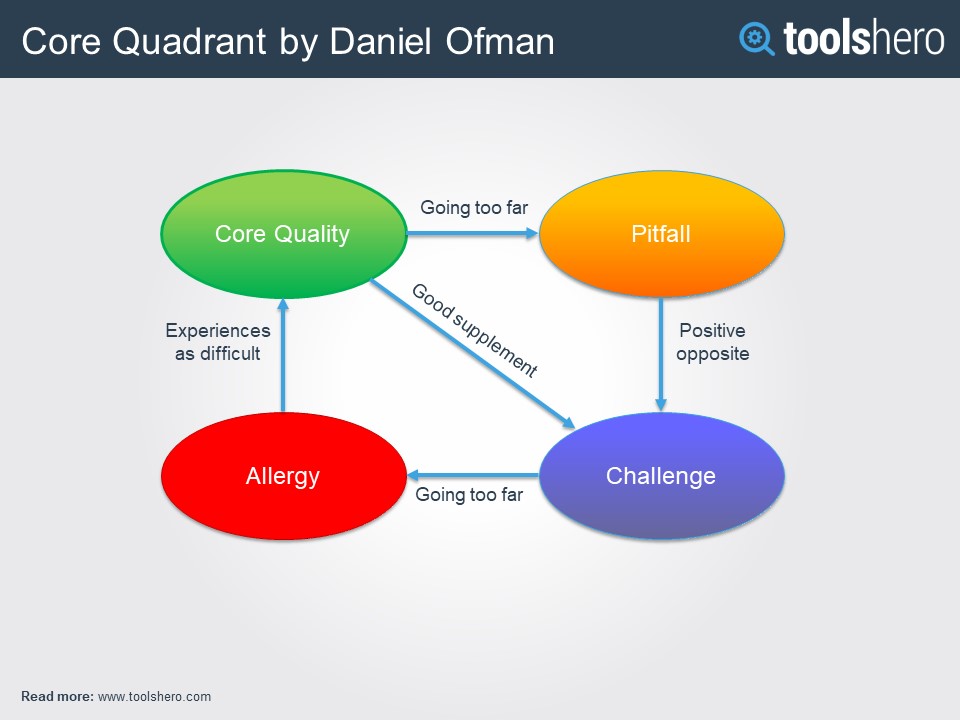
The following chart, developed by Daniel Ofman, and the corresponding exercise have been very successful in helping leaders identify core qualities (such as passion) and work through the pitfalls, challenges, and reactions to those core qualities. This team exercise is an effective way to help leaders examine themselves and then better understand how to maximize their core qualities. I have found that the exercise works best when done with a team.

The Core Qualities Quadrant

Image courtesy of toolshero.com

Step 1: Core Quality

Identify all the aspects of a specific core quality. For example, if passion is one of your core qualities, you may describe it as exciting, adds energy, fires everyone up, contagious, overcomes obstacles, sees how things could be, and so on. Select no more than one or two core qualities to examine. This step seeks to focus on your best core qualities.

Step 2: Pitfalls

What happens when you get too much of a good thing? As is true for almost everyone, your strengths can become your Achilles heel. For example, what happens if you have too much passion? You could be driven, have tunnel vision, avoid reality, not accept failure or shortcomings, shy away from challenges, and so on. Therefore, we list all the pitfalls of passion in this step.

Step 3: Challenges

What are some positive opposites of the pitfalls of your core quality? What are some positive actions you can take
to avoid these pitfalls? For example, to address some of the pitfalls we listed above, you could ask a person or a team to function as a sounding board for you, setting specified times to check the reality of your situation. You could ask for and be open to challenges, or you could have another person or the whole team help you place your passion in the big picture of the organization. Look for positive opposites—ways to challenge and avoid the pitfalls and help yourself stay focused.

Step 4: Reaction

What happens when you carry efforts to challenge your pitfalls too far? You may become discouraged and back away from your core quality. One reaction might be to not share your passion or to share it only with those who will not pose any challenges. Defensiveness or withdrawal are other reactions. This step will help you recognize your reactions and work to overcome your natural tendency to recoil under pressure.

A middle manager I know recently shared her concern with her supervisor about a program he wanted but that she believed might negatively impact the organization financially. She is a good manager and personally takes budgets and sales quotas to heart; it is her passion to hit the numbers every month. She also takes her job seriously and does not hesitate to speak up. In response to her criticism, the CEO pulled her aside and led her to believe that she was wrong in what she was saying. Her reaction to this confrontation was to say, “I’ll just keep my mouth shut from now on!” Finding her passion threatened, she became discouraged by the CEO’s remarks and wanted to avoid future confrontation. This woman’s manager needs help finding some positive opposites to her reaction that will lead her back to her core quality.

The goal of this exercise is to help all team members stay in their positive balance, bouncing between their core qualities and their challenges rather than falling into the negative pattern of bouncing between their pitfalls and their reactions.

You can see from the arrows how this can happen. When played out in real-life situations, this chart is not a circle, but rather we move from corner to corner, either bouncing between our core qualities and challenges or bouncing between our pitfalls and reactions.

Finally, we draw your attention to the arrows between the boxes labeled “Too Much of a Good Thing.” Notice that too much of the core quality leads to pitfalls, and too much working on the challenges leads to reactions. In either case, being out of balance leads to wrong behavior. Too much of anything leads us to a point of concern.

I hope this team exercise is an effective way to help leaders on your staff examine themselves and better understand how to maximize their core qualities as well as the qualities of their teams.

0 comments
1 FacebookTwitterEmail
BlogTrust Me

Getting Effective Feedback

by Ron Potter July 2, 2018

Can your team speak freely?

Leadership today is all about two words: It’s all about truth and trust.

When they trust you, you’ll get truth. And if you get truth, you get speed. If you get speed, you’re going to act. That’s how it works.

You and others are willing to work long and hard to accomplish goals. However, as we’ve seen from the stories in recent posts, our efforts can become very scattered and focused on the “urgent.” We need to build accurate, open, reliable feedback systems.

A team leader needs to create a learning environment in which every team member is appreciated, listened to, and respected. In this kind of environment, the opinions of team members are fully explored and understood and are incorporated into the decision-making process. The team actively learns from all members who express their positions and opinions, and as a result, the team is stronger and more efficient.

In the end it will be the ability to endure through the challenges, criticisms, and doubts that distinguishes the great leaders. But if you have staked your reputation on a wrong or unachievable goal, enduring through the challenges will only take your team or organization down the wrong path. What keeps you from that wrong path is good solid feedback. But good solid feedback is hard to come by, especially the higher you climb in an organization.

The power of effective feedback

People don’t like to give the boss bad news or news that doesn’t agree with the boss’s stated position. But without it comes only failure.

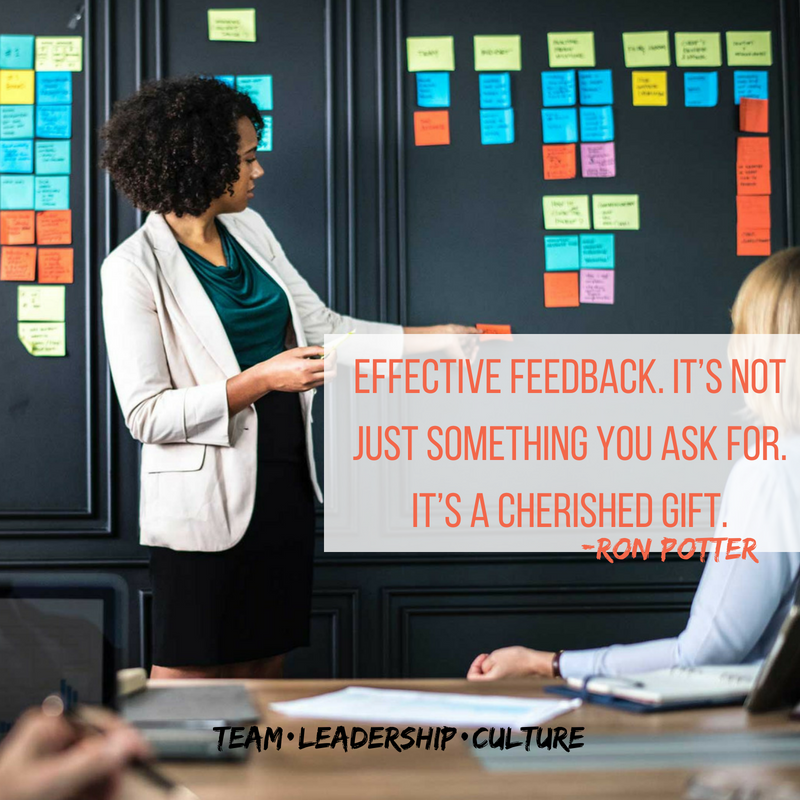
Effective Feedback. It’s not just something you ask for. It’s a cherished gift. It’s a wonderful reward for building a trusting organization or team.

An effective feedback apparatus starts with humility. Humble leaders create an atmosphere where feedback from others is desired and honestly requested. Leaders who are focused on growing their people build that growth on feedback. When people know that a leader is committed and wants honest feedback to help reach stated goals, they are more likely to provide the open and honest feedback required. Compassion, integrity, peacemaking—upcoming chapters that will all lead to an atmosphere and culture that is open to and thrives on honest and timely feedback.

0 comments
0 FacebookTwitterEmail
BlogTrust Me

Achievement-Motivated Leaders

by Ron Potter June 11, 2018

We recently discussed leaders motivated by passion. Along with passion, a desire to achieve motivates a leader to a higher level of focus.

I have concluded that leaders with an achievement-motivated style (balanced by humility) have the most constructive approach to work. Typically, they do not waste time on projects or matters outside their vision. They determine what is important, that “something great,” and they seek to achieve it.

For more than twenty years, David C. McClelland and his associates at Harvard University studied people who had the urge to achieve.

McClelland’s research led him to believe that the need for achievement is a distinct human motive that can be distinguished from other needs. [His experiment involved asking participants] to throw rings over a peg from any distance they chose. Most people tended to throw at random—now close, now far away; but individuals with a high need for achievement seemed carefully to measure where they were most likely to get a sense of mastery—not too close to make the task ridiculously easy or too far away to make it impossible. They set moderately difficult but potentially achievable goals.

I’ve determined, based on our experience, that achievable goals are those with a 70 to 80 percent likelihood of success.

McClelland maintains [that]…achievement-motivated people are not gamblers. They prefer to work on a problem rather than leave the outcome to chance.… Achievement-motivated people take the middle ground, preferring a moderate degree of risk because they feel their efforts and abilities will probably influence the outcome. In business, this aggressive realism is the mark of the successful entrepreneur.…

You can read more from McClelland’s theory here.

Another characteristic of achievement-motivated people is that they seem to be more concerned with personal achievement than with the rewards of success. They do not reject rewards, but the rewards are not as essential as the accomplishment itself. They get a bigger “kick” out of winning or solving a difficult problem than they get from any money or praise they receive.

Ralph Waldo Emerson said, “The reward of a thing well done is to have done it.” Every January millions of people watch the Super Bowl. During the awards ceremony after the game, we see players with big smiles. What are they shouting about? Not about money or fame, but about the ring. Each player on the winning team gets a championship ring—a symbol of reaching the pinnacle of the sport. Nothing else compares to having that ring. It is proof of the ultimate achievement in football. That’s what motivates an achievement-oriented person.

Lastly, achievement-motivated people need feedback. They seek situations in which they get concrete feedback that they define as job-relevant. In other words, they want to know the score.

People with a high need for achievement get ahead because, as individuals, they are producers. They get things done.

Sometimes, however, when they are promoted, when their success depends not only on their own work but on the activities of others, they may become less effective. Since they are highly job-oriented and work to their capacity, they tend to expect others to do the same. As a result, they may lack the interpersonal skills (I refer to this as the encouragement or humility leadership style) and patience necessary for being effective managers of people who are not as achievement-motivated.

Achievement-Motivated Leaders

0 comments
0 FacebookTwitterEmail
BlogTrust Me

How Focused is Your Energy?

by Ron Potter May 7, 2018

The sun is a powerful source of light as well as energy. Every hour of every day the sun showers the earth with millions, if not billions, of kilowatts of energy. We can, however, actually tame the sun’s power. With sunglasses and sunscreen, the sun’s power is diffused, and we can be out in it with little or no negative effects.

A laser, by contrast, is a weak source of light and energy. A laser takes a few watts of energy and focuses them into a stream of light. This light, however, can cut through steel or perform microsurgery on our eyes. A laser light is a powerful tool when it is correctly focused.

Leaders cease to be powerful tools when they are out of focus and their energy is dispersed rather than targeted.

Rather than resembling a laser, too often we seem like the sun, just going up and down, splashing our energy anywhere and everywhere.

David Allen, one of the world’s most influential thinkers on personal productivity, argues that the challenge is not managing our time, but managing our focus. He believes that with all that is being thrown at leaders, they lose their ability to respond. However, he is quick to add that most leaders create the speed of it all because we allow all that stuff to enter into our lives.

What happens to our energy? Allen says,

If you allow too much dross to accumulate in your “10 acres”—in other words, if you allow too many things that represent undecided, untracked, unmanaged agreements with yourself and with others to gather in your personal space—that will start to weigh on you. It will dull your effectiveness.

Not only will your effectiveness be dulled but so will your power. Instead of being like a steel-cutting laser, you will be like the sun, putting out energy with no focus. There needs to be focus because life is not just about running faster or putting out more energy.

With so much going on around leaders, focus may seem impossible or improbable to achieve. Employees, phones, pagers, e-mail, cell phones, problems, crises, home, family, boards of directors, and other people or things demand so much. We tend to spend our time managing the tyranny of the urgent rather than concentrating our efforts on the relevant and important things that make or break an organization.

So what should we do? Is it possible to better focus your focus?

I have found that two personal qualities combine optimally to create a leader of highly developed focus: passion and achievement. These form the boundaries of focus.


0 comments
0 FacebookTwitterEmail
Newer Posts
Older Posts
  • Facebook
  • Twitter
  • Linkedin
  • Rss
  • About This Site
  • About
    • Clients
  • Services
  • Resources
    • Trust Me
    • Short Book Reviews
  • Contact

About this Site | © 2024 Team Leadership Culture | platform by Apricot Services


Back To Top
Team Leadership Culture
  • Team
  • Leadership
  • Culture
  • Myers-Briggs
  • Trust Me
  • Short Book Reviews