
Team Leadership Culture
  • Team
  • Leadership
  • Culture
  • Myers-Briggs
  • Trust Me
  • Short Book Reviews
Top Posts
Obituary
REPOST: Four Functions, Three Rules
ROUNDUP: The Rise of AI
REPOST: Facing Adversity Series
ROUNDUP: Curiousity
ROUNDUP: Deep Work
REPOST: Character vs. Competence
REPOST: Opposite of Victim
REPOST: Listening With the Intent to Understand
REPOST: Performance vs Trust
  • About
  • Services
  • Resources
    • Trust Me
    • Short Book Reviews
  • Contact

Team Leadership Culture

  • Team
  • Leadership
  • Culture
  • Myers-Briggs
  • Trust Me
  • Short Book Reviews
Category:

Blog

BlogLeadership

Defeating Doubt, Arresting Avoidance

by Ron Potter September 19, 2016

“Holding the hill” when under fire can be a terrifying and lonely experience. A leader will face a long list of challenges, which, if not faced and disarmed, can turn the most competent person into a faltering coward. We have grouped these pitfalls to courage into two categories: doubt and avoidance.

Defeating Doubt

This foe of courageous leadership comes in a variety of flavors.

First, there are the personal doubts. We may doubt our abilities, our judgment, our talents, and even our faith. We look at a problem and cannot find a solution. We attempt to fix it but cannot. Doubt oozes into our minds, and we are frozen into inactivity.

Then there are the doubts about our teams or others we depend upon. Have you ever worked with people who are overwhelmed, stressed out, resistant to change, burned out, not working together, complainers, rumor spreaders, backstabbers, noncommunicators, whiners, stubborn hardheads, blamers, or unmotivated negative thinkers? When encountering such bad attitudes and behaviors that stall the progress of our teams, we are tempted to slide into despair, and our backbones turn to mush.

Next is doubt in the organization. We may see the company sliding down a hill to mediocre performance, abandoning the right values and a vibrant vision. It’s one thing to maintain your own personal courage in the place where you have influence. But it’s overwhelming to stand strong when the larger organization is waffling on its mission and embracing plans that seem doomed in the face of aggressive market competition. Your knees start to knock.

Also doubts may surface when organizational outsiders, like stockholders, start questioning our forecasts and plans.

To endure as a leader, you will have to disarm doubt with gritty courage.

Arresting Avoidance

Another courage-crippler is refusing to confront reality and act. If we employ avoidance tactics when we are tested and struggle, we will end up with even more frustration and trouble. We have seen organizations take giant steps to avoid any kind of pain and suffering. But the result is a dysfunctional organization, not a great company.

To quote Winston Churchill, “One ought never to turn one’s back on a threatened danger.… If you meet it promptly and without flinching, you will reduce the danger by half.” Avoidance confuses the entire organization. It causes “mental illness” in the company and on your team.

Avoidance-oriented people tend to move away from things that threaten them in order to protect themselves. Why? There are a number of reasons. Often it is due to excessive concern about embarrassment. We just don’t want to be embarrassed or, more often, to embarrass someone else. We hold back—we don’t tell the truth—and poor organizational or personal behaviors are perpetuated.

Fear is another culprit. Sometimes it just seems easier to run and hide. Maybe the issue will somehow just go away? That’s classic avoidance—a sign of cowardly leadership.

Another reason for avoiding problems can be oversensitivity to the feelings or opinions of others. We just don’t want to hurt anybody. The other person is so nice; why should she have her parade rained upon? Issues are circumvented, and facts are ignored. We avoid the short-term pain and inflict a longer-term problem within the team and the organization.

And then there is the old standby character quality that causes so many problems: unhealthy pride. Some of the people who are most adept at avoidance are very proud, especially if exploring the gory details of an organizational issue might make them look bad.

Leaders who develop a humble heart and a willingness to confront concerns do not allow pride to interfere. They are open to opportunities for self-growth because they are secure in who they are and are not preoccupied with themselves.

Avoidance holds back an organization whereas a commitment to improvement will positively influence your own development as well as the development of interpersonal relationships, teams, and overall company effectiveness.

It takes great courage to change a pattern of avoidance and seek instead to make improvements and overcome the pain or difficulty in making decisions, confronting people, or being overwhelmed by circumstances or self-doubt. It is not easy, but the benefits you will experience from making this change are far greater than the “benefits” of avoidance.

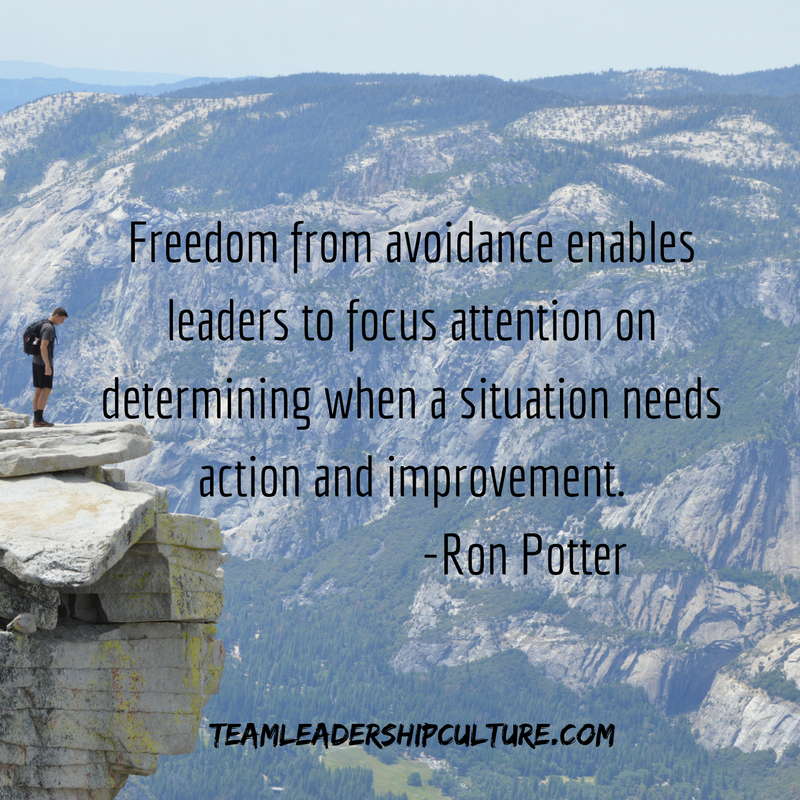
Freedom from avoidance enables leaders to focus attention on determining when a situation needs action and improvement.

team-leadership-culture-meme-8-1

0 comments
0 FacebookTwitterEmail
BlogMyers-Briggs

Myers-Briggs is a Crock

by Ron Potter September 15, 2016

This is the title of a Wall Street Journal article written by Steven Poole doing a book review of Dean Burnett’s new book Idiot Brain.  Actually Idiot Brain needs to become the title of a future blog as well.  I can’t wait to read his book.

But, is Myers-Briggs a crock?  Poole says that Burnett “eloquently dismantles some pop-psychology canards such as Myers-Briggs personality test, still a favored corporate tool.  “The tool is based on untested decades-old assumptions put together by enthusiastic amateurs, working from a single source.”

TRUE!

HOWEVER….

Why does it remain a favored corporate tool?  I don’t see many corporations these days spending money that they don’t believe provides any value.  No Myers-Briggs practitioner worth their salt ever claims the Myers-Briggs Type Indicator to be anything other than a great tool for understanding people.  We never claim it to be (or shouldn’t be making such claims) anything other than a model put together by two enthusiastic amateurs.

I had one experience when my client, a senior VP of a large pharmaceutical company, asked me to do some team building with her team.  One of her direct reports was a psychiatrist and ran the psychiatric department for the company.  When she heard that I was going to conduct a Myers-Briggs session she sent me a scathing email proclaiming many of the same issues as Burnett:

  • Invalidated testing
  • Decades old
  • Based on assumptions
  • Created by amateurs

My only answer to her was, “Humor me.  Your boss asked me to conduct the session.”  Well, after the session where the team seemed to learn a great deal about working better together, this same psychiatrist approached me very quietly, put her hand on my arm and spoke very softly into me ear saying, “Would you come run a session like this for my team, we could really use it.”

It’s a tool, a mental model.  One of my favorite bloggers is Shane Parish at Farnam Street.  In his Farnam Street Brain Food he often speaks of Mental Models.  This is how Shane puts it:

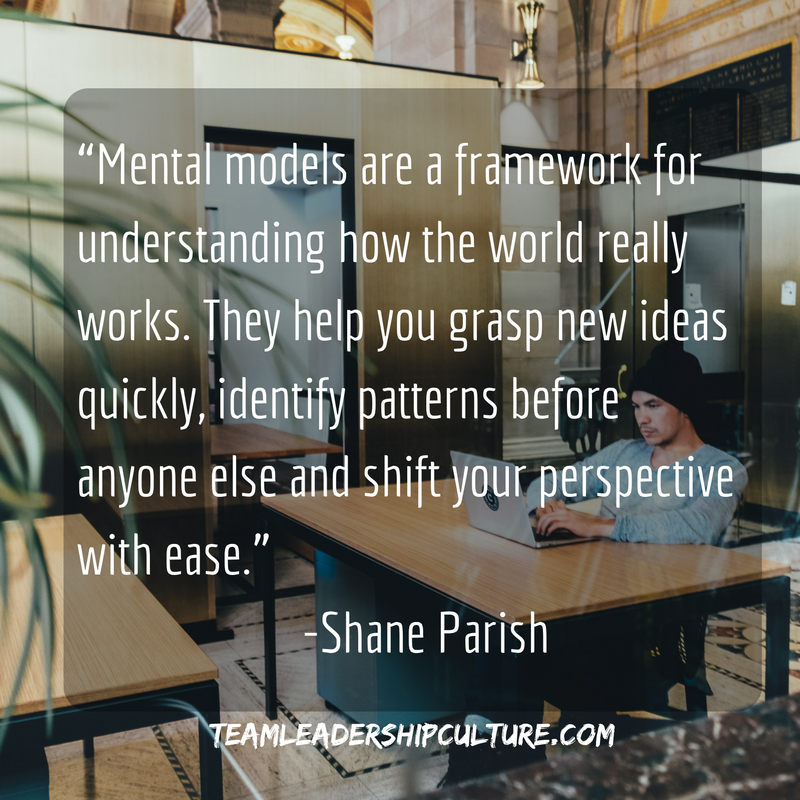
“Mental models are a framework for understanding how the world really works. They help you grasp new ideas quickly, identify patterns before anyone else and shift your perspective with ease.”

In my mind Myers-Briggs is simply one of these mental model tools.  I just conducted a session last week with about 20 participants.  As I walk through each process described in the model people always start laughing and enjoying themselves because they immediately see the examples in themselves and each other.  As Shane says, it’s a quick way of identifying patterns and shifting our perspective.  I’ve never finished a session without people telling me how much they learned and how they believe it can immediately help them negotiate their corporate, community and family relationships better.  Now that’s a useful tool, even if it was put together by a couple of enthusiastic amateurs.

team-leadership-culture-meme-8

0 comments
0 FacebookTwitterEmail
BlogTrust Me

Holding Strong

by Ron Potter September 12, 2016

For two years scientists sequestered themselves in an artificial environment called Biosphere. Inside their self-sustaining community, the Biospherians created a number of mini-environments, including a desert, a rain forest, even an ocean. Nearly every weather condition could be simulated except one, wind.

Over time the effects of their windless environment became apparent. A number of acacia trees bent over and even snapped. Without the stress of wind to strengthen the wood, the trunks grew weak and could not hold up their own weight.

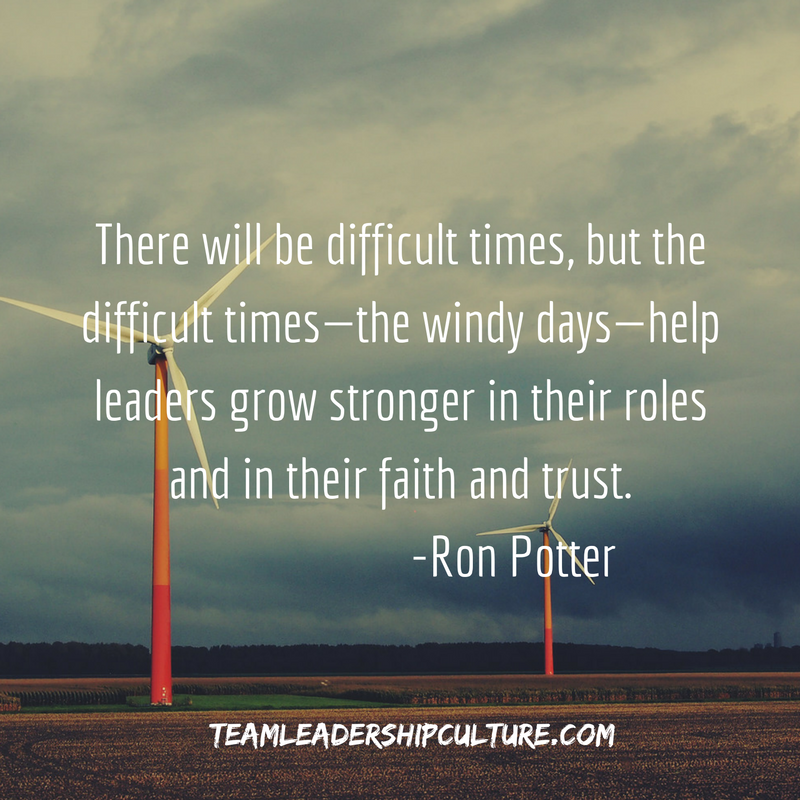
Holding strong and enduring as a leader requires some “wind.” Adversity gives leaders an opportunity to strengthen themselves, discover what they believe, and communicate their vision and values to other people. There will be difficult times, but the difficult times—the windy days—help leaders grow stronger in their roles and in their faith and trust.

Holding strong comes with the turf. If you are standing strong for values and vision and for being a better leader, you will experience persecution and times of discouragement, adversity, and frustration.

Holding strong is a process. This is when a mentor can be so helpful by coming alongside the leader and objectively pointing out ways and opportunities to hold strong over an extended period of time.

Holding strong is also a journey. Doing the right thing can be stressful, complicated, and time-consuming, but ultimately, it brings fulfillment. Leaders need to focus on the small victories gained along the way. The journey builds character and confidence. The journey is rewarded when a leader sees the growth of his or her people, the growth of the business, and the achievement of the task.

After a career working at several jobs (railroad fireman, insurance salesman, Ohio River steamboat operator, and tire salesman), a forty-year-old man began cooking for hungry travelers who came by his service station in Corbin, Kentucky. He didn’t have a restaurant, so he served his eager customers on his own dining table in the adjoining living quarters.

It wasn’t long before more and more people came by to sample his food, so he moved his business across the street to a motel and restaurant. There he spent nine years serving customers and perfecting his special recipe for fried chicken.

In the 1950s “progress” caused the new highway to run around Corbin, and the man’s business ended. By this time he had retired and was living on his monthly $105 Social Security check. He began going from restaurant to restaurant, cooking his famous chicken. If the owners liked the recipe, a handshake agreement gave the restaurant the recipe in exchange for a nickel for every chicken dinner sold.

By 1964 this little endeavor had become a sizable business. The man, Colonel Harland Sanders, had licensed over six hundred franchises to cook his tasty chicken recipe. Ready to retire again, he sold his interest for two million dollars and became a spokesperson for the company. “In 1976, an independent survey ranked the Colonel as the world’s second most recognizable celebrity.”

Colonel Sanders did not allow himself to be defeated. He held strong and was not overcome by discouragement. How can we develop a similar attitude toward adversity?

team-leadership-culture-meme-6-1

0 comments
0 FacebookTwitterEmail
BlogTrust Me

No Guts, No Glory

by Ron Potter August 29, 2016

A photo by Joshua Earle. unsplash.com/photos/Dwheufds6kQ

On October 29, 1941, as the world reeled from the onslaught of the Nazi regime in Europe and faced a looming threat from Japan, Winston Churchill was asked to speak at Harrow, his old school. Near the end of his two-page speech, Churchill spoke the now famous words:
“Never give in, never give in, never, never, never—in nothing, great or small, large or petty—never give in except to convictions of honour and good sense.”
Churchill had experienced many crushing setbacks throughout his life and political career, yet he refused to give up. He was a man of extreme courage and endurance.
When leaders make decisions, seek to expand an organization’s borders, or want to execute an innovative idea or create change, they will encounter opposition and face the great temptation to conform or quit. How can they resist and stand strong? How can they acquire the bulldog will of a Winston Churchill and never give up?
Endurance is the result of two foundational character qualities: courage and perseverance. Both are required of leaders seeking the trust of others.

Adversity and Discouragement

“A man stopped to watch a Little League baseball game. He asked one of the youngsters what the score was. ‘We’re losing 18-0’ was the answer.
‘Well,’ said the man. ‘I must say you don’t look discouraged.’
‘Discouraged?’ the boy said, puzzled. ‘Why should we be discouraged? We haven’t come to bat yet.’ ”
Discouraged? Hardly. The boy was holding strong to the hope that his team could overcome any deficit. He was holding strong to his convictions.
No matter what the source may be, discouragement and adversity have a purpose:

  • to deal with our pride
  • to get our attention
  • to get us to change our behavior
  • to prepare us for future service

There are some wrong responses to adversity and discouragement, and they cause bitterness, doubt, depression, and hopelessness. But holding strong produces some right responses:

  • We gain our team’s trust because our actions match our intentions.
  • We focus on seeing things through rather than abandoning our values or vision.
  • We rely on God for the ability to endure.

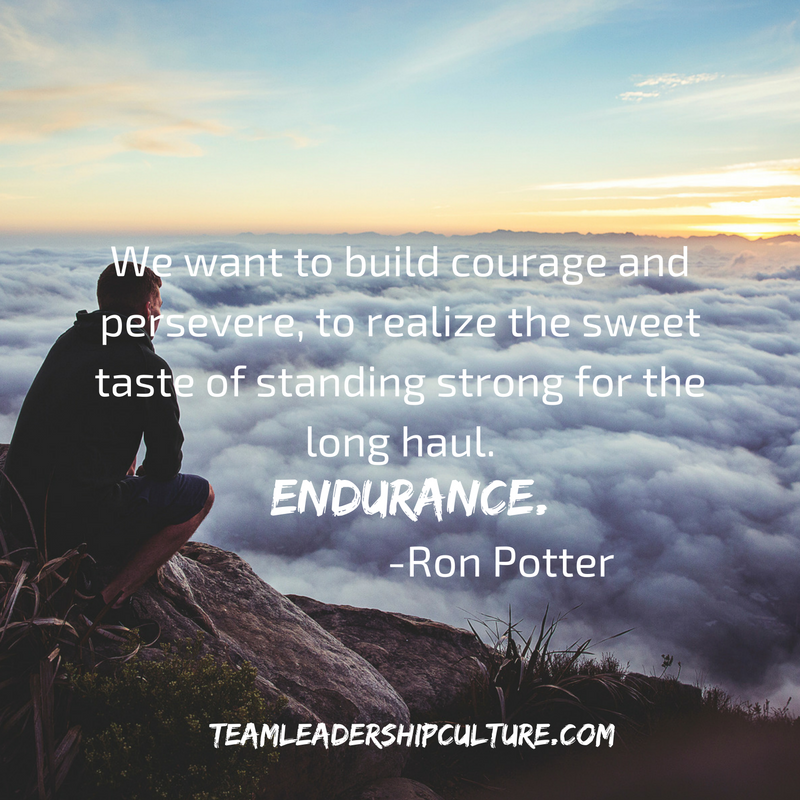
I want you to build courage and persevere, to realize the sweet taste of standing strong for the long haul. Endurance.

Team Leadership Culture Meme 5

2 comments
0 FacebookTwitterEmail
Absurd!BlogIn-Depth Book Reviews

Absurd!: PRAISE WILL GET YOU NOWHERE!

by Ron Potter August 18, 2016

I’m continuing my series on an in-depth look at a wonderful little book that’s twenty years old this year.  The title is Management of the Absurd by Richard Farson.  You may want to consider dropping back and reading the previous posts about ABSURD!  I think it will put each new one in great context.

photo-1416677357736-79cd2bce22c5

Praising People Does Not Motivate Them

Praise is very useful indeed as a lubricant to help keep our human relations in good working order.  For one thing, people expect it.  This is the one area where our author praises praise.  People do enjoy being appreciated and it does improve relationships.  But as a motivator, not so much.

One area in which we can really see and almost feel this principle at work is when the work of a high- status person is praised by a low-status person; it is often seen as presumptuous or even insulting.  We’ve all been there and cringed at the moment, thinking of the person providing the praise as really sucking up or being completely unaware of how inappropriate their praise is coming across.

In the opposite direction giving praise establishes the fact that the giver is in a position to sit in judgment of the receiver.  Receiving praise in this circumstance can feel very threatening or at a minimum very uncomfortable even if the praise is positive.  We get uncomfortable when we’re being judged; good or bad.

So how do we motivate if praise doesn’t work?  We take the time to get engaged.  We learn, listen, understand, ask useful or sometimes naïve questions to stimulate our thinking.  Our author says, “What really does release creativity and promote achievement is when a manager takes the time to get involved in the employee’s work – learning what direction the work is taking, the problems and possibilities it presents, the way the employee is dealing with the task.  But involvement is demanding and time-consuming, which probably explains why many manager resort to praise as a substitute, hoping that it will accomplish the same results.”

Learning, listening and sharing.  Dealing with the other person as a smart, whole, capable human being.  Now that’s motivating.  When someone cares enough to take the time to listen, learn and understand it really engages people.

Too many leaders are focused on “doing” rather than growing.  If you only use praise and criticism, you’ll find yourself falling farther and farther behind because you’ve not taken the time to connect with your people on a real human level by getting engaged with them and their work.  Don’t just praise, motivate!

0 comments
0 FacebookTwitterEmail
BlogTrust Me

Create a Learning Organization

by Ron Potter August 15, 2016
Processed with VSCOcam with m3 preset

A learning organization differs from the MBO (Management by Objective) type of organizational structure in fundamental ways. In a learning organization individuals are continually reinterpreting their world and their relationship to it.

A learning organization incorporates the practice of continually challenging its paradigms and accepted ways of doing things. Built into the organization is a system that allows for the institutional structures and routine models of action to be regularly questioned and transformed.

As Peter Senge defines it, a learning organization is an organizational structure in which “people continually expand their capacity to create the results they truly desire, where new and expansive patterns of thinking are nurtured, where collective aspiration is set free, and where people are continually learning how to learn together.”10 In this sense, a learning organization is an organization that is continually expanding its ability to create and re-create the very patterns and structures by which it operates.

At least that is the goal.

Unfortunately, what we have found in our work is that quick decision making has won. In many cases, leaders have abandoned the learning organization in favor of the quick-deciding organization.

In times of chaos, confusion, and change, peacemaking leaders need to focus attention on making sure their organizations are quick learning rather than quick deciding.

The fast-paced environment of product development, competition, and shareholder expectations has forced many organizations to adopt a quick-deciding mentality. In this model, a team (much like a football team needing to score before time expires in the fourth quarter) is in a hurry-up offense. The goal is to make decisions. But as Tom Peters correctly observes, “As competition around the world boils over as never before, firms caught with bloated staffs and dissipating strengths—from Silicon Valley to the Ruhr Valley in Germany—are looking for quick fixes. There are none.”

So how would a two-pillar, peacemaking leader respond?

The goal of the quick-learning team is to seek out and develop opinion rather than steamrolling over it or quickly mustering forces against it. Feedback is highly desired rather than feared.

In contrast, feedback is offensive when you are a quick-deciding team. You develop “sides” on all issues. The competition heats up. Winning at all costs is what counts.

Members of a quick-learning team are all on the same side of the fence, looking at an issue with differing opinions, experiences, and ideas.

Meeting agendas are often a surprising enemy. Leaders, staring at an agenda, feel compelled to make decisions within the time allotted. In most cases, true discussion of the issues and everyone’s opinions (the rooting-out process) is bypassed in favor of table talk that centers on implementation.

We suggest a meeting agenda that maps out what the team wants to learn about an issue. Learning should be the goal with good decisions the result. Remember that the goal is learning quickly and then making good decisions, not just deciding quickly.

“Patience,” said Saint Augustine, “is the companion of wisdom.” Problems and day-to-day crises test our wisdom and our ability to make decisions under pressure. Great leaders are people of patience and constant learning.

It is the leader’s job to pull everything together into a quick-learning rather than a quick-deciding environment. The leader holds the dialogue together and asks questions that are designed to help team members clearly communicate their information and thoughts about the agenda item. In this way, the meeting’s goal is met: quick learning—rather than quick deciding—for the purpose of making good decisions.

The leader needs to develop not only an inclusive mind-set but also one that honors people for who they are and what they bring to the process. Each person brings unique strengths and outlooks to the table.

0 comments
0 FacebookTwitterEmail
BlogTrust Me

Building Team Dynamics – Part II

by Ron Potter August 8, 2016

photo-1414265247351-4afd13a3b4e6

Last week, we began to unpack what builds up healthy team dynamics. You can read part I here. This week, we continue with part II.

Manage Conflict

In his book The Fellowship of the Ring, the first book in the series The Lord of the Rings, J. R. R. Tolkien describes the camaraderie of a diverse group banded together by a common cause. Called “the fellowship of the ring,” their quest is to destroy the power of the Dark Lord by destroying the ring in which that power resides. Though they differ in nearly every way—racially, physically, temperamentally—the fellowship is united in its opposition of the Dark Lord. In a section omitted in the movie, a heated conflict breaks out among the crusaders. Axes are drawn. Bows are bent. Harsh words are spoken. Disaster nearly strikes the small band. When peace finally prevails, a wise counselor observes, “Indeed in nothing is the power of the Dark Lord more clearly shown than in the estrangement that divides all those who still oppose him.”

Conflict causes estrangement within teams, even the best teams. Therefore, managing conflict is at the heart of the dilemma of the leader who has good relations with individual team members but cannot get the group to work together.

Rivalry causes division. Debate causes hurt feelings or a sense of not being heard or understood. How does a leader keep an aggressive person and a person who easily withdraws engaged?

Kenneth W. Thomas and Ralph H. Kilmann created the Conflict Mode Instrument, which is “designed to assess an individual’s behavior in conflict situations.” It measures people’s behavior along two basic dimensions: “(1) assertiveness—the extent to which an individual attempts to satisfy his or her concerns, and (2) cooperativeness—the extent to which an individual attempts to satisfy the other person’s concerns. These two dimensions of behavior can be used to identify five specific methods of dealing with conflicts.”7 The methods are described as follows:

  1. Avoiding—Low assertiveness and low cooperativeness. The goal is to delay.
  2. Competing—High assertiveness and low cooperativeness. The goal is to win.
  3. Accommodating—Low assertiveness and high cooperativeness. The goal is to yield.
  4. Compromising—Moderate assertiveness and moderate cooperativeness. The goal is to find a middle ground.
  5. Collaborating—High assertiveness and high cooperativeness. The goal is to find a win-win situation.8

Leaders need to use the peacemaking qualities defined by the two pillars of humility and endurance to bring conflict to the highest level of resolution: collaboration. The cooperative environment means “I need to be humble.” The assertive environment means “I need to endure.” The two pillars, taken together, cause people to listen, yet hold firm in solving conflict through collaboration. When collaborating, individuals seek to work with others to find a solution that satisfies all parties. It involves digging into hidden concerns, learning, and listening but not competing.

Treat Employees as Investors

It is interesting to watch privately held companies that seek to go public. They hire IPO (Initial Public Offerings) coaches who work hard with the CEO, CFO, and COO to train them to attract investors. They work with these leaders to help them say the right things in order to sell their companies. They teach them which messages work and which do not.

Our question: “Why don’t companies do the same thing with employees?”

If you do a quick study on employee relations over the last several decades, we think you will discover that how employees are viewed and described has moved along a continuum from workers to commodities to assets. We do not believe that referring to employees as “assets” is a satisfactory description because so many leaders look at assets as disposable or upgradable. Leaders and companies would be more successful in building organizations if they thought of their employees as “investors.”

Leaders need to give their people the same compelling we’re-a-great-company-and-here’s-why-and-where-we-are-going reasons for success that are promoted to IPO investors or current stockholders.

Leaders need to ask, “How can we get employees excited about what we are doing?” This approach is basic to team building and goes beyond vision and mission. It’s a way to engage the greatest resource of people—their energy!

Alan Loy McGinnis, in his book Bringing Out the Best in People, tells us, “Talk may be cheap, but the right use of words can generate in your followers a commodity impossible to buy…hearts on fire.”

Isn’t that what all leaders want—team members with hearts ablaze for the company’s vision and goals? The leaders certainly want investors who are loyal, happy, and motivated to give resources. Treating your employees as investors will produce similar results.

0 comments
0 FacebookTwitterEmail
BlogTrust Me

Building Team Dynamics – Part I

by Ron Potter August 1, 2016

photo-1454006639960-af9b6a303eae

Often, the basic question from leaders is reduced to “How do I build teams without blowing the place up?” Following are some suggestions.

Start with the “Two Pillars”

This book is centered on eight principles of successful leadership. What we call the “two pillars”—the key principles that support and are intertwined with the others—are humility and endurance. A leader who desires to build a great team must first become a leader of humility and endurance. Pride and despair always force leaders to choose incorrect methods and solutions.

It is difficult to build a team when you need to be the center of attention, the only voice, the only one with an idea, and the only one who can make a decision. It is also difficult to build a team when, at every sour turn, the team stumbles and fails or doesn’t learn from failure. Endurance means pushing through struggles together until the results are positive. Leaders, by the way they respond to crisis and chaos, often cause teams to quit sooner than necessary.

Michael Gershman, in his book Getting It Right the Second Time, squeezes forty-seven case studies into 256 pages. All teach one lesson: humility. And one credo: Try anything. Keep trying. Maybe you’ll get it right someday. Endurance.

The two pillars, humility and endurance, produce leaders who are ready to excite, energize, and develop teams.

Understand, Accept, and Communicate Change

The business world has begun to see the need for entirely new models of management in order to succeed in regaining and defending competitiveness in today’s world economy. The old paradigm of management that had guided the U.S. economy since the rise of the railroads and the large corporations of the Industrial Revolution no longer seems to work. Firms struggled to remake themselves in order to be competitive.

Today we live in a rapidly changing postindustrial society that is becoming increasingly complex and fluid. It is an environment that requires decision making and sometimes rapid change within organizations. Surviving and thriving in this rapidly changing landscape becomes a function of an organization’s ability to learn, grow, and break down institutional structures within the organization that impede growth. Organizations that are ideologically committed to growth and change will be at an advantage in the postindustrial era.

In his book Leading Change, John Kotter explains how leaders can effectively communicate change in their organizations. All of us at one time or another fully understand the confusion caused by change. Kotter writes,

Because the communication of vision [change] is often such a difficult activity, it can easily turn into a screeching, one-way broadcast in which useful feedback is ignored and employees are inadvertently made to feel unimportant. In highly successful change efforts, this rarely happens, because communication always becomes a two-way endeavor.

Even more important than two-way discussion are methods used to help people answer all the questions that occur during times of change and chaos. Clear, simple, often-repeated communication that comes from multiple sources and is inclusive of people’s opinions and fears is extremely helpful and productive.

0 comments
0 FacebookTwitterEmail
BlogCulture

Can Stupidity be Cured?

by Ron Potter July 28, 2016

photo-1428591850870-56971c19c3d9

Well, it’s not actually a disease so there is no cure.  However, there is an antidote.

I was with my oldest friend the other day.  We’ve known each other since we were born so there are some very old memories hanging around.

One of those memories involves an ancient dam that held back the river in the small town where we grew up.  One summer day as we were roaming through town looking for something interesting to do when we decided to work our way across this ancient dam.  There was a catwalk from one side of the river to the other but it was not reliable and certainly wasn’t fully in place across the entire river.  But we headed across anyway and either through bravery or stupidity (most like the later) we worked our way across some very precarious sections as we watched the water rapidly cross the top of the dam and cascade down to the river below.

When we returned home that evening the natural question first asked by our parents was “What have you been doing?” Probably because we were still a bit excited about accomplishing the goal, we freely told tales of conquering our fear and achieving the goal of crossing the river.  With open jaws and terrified looks on their faces one of the parents finally said “Did you ever stop to think?  Do you know how stupid that was?”  Well, there it was; both the disease of stupidity and the antidote of stopping to think.

But I was a young teenager at that point, certainly I’ve become wiser through the years.  But, it’s amazing to me how many corporate teams I work with seem to exhibit that same level of teenage stupidity, not stopping to think.

Because of the pace and globalization of today’s businesses, there it a belief that we must decide quickly in order to survive.  But quick deciding is a relic of the industrial age.  The banner of the industrial age is quicker, better, cheaper.  But that only works when your future is clearly defined and the path is known.  Then you can work harder and be smart enough to beat the competition by being quicker, better, cheaper.  But through the information age and in particular as we move into the conceptual age, we’re often trying to see around corners and over horizons.  This takes learning and working with perspectives.  Today we need to stop and think.  We need an attitude of quick learning leading to good decisions.

Quick learning environments require us to be open to perspectives and opposing thoughts and beliefs.  It takes a great team environment in order to work through opposing views and build to commitment of a unified direction.  It requires that we stop and think.

Move out of the quick deciding world and into the quick learning world.  You’ll make better decisions if you stop to think.

0 comments
0 FacebookTwitterEmail
BlogMyers-Briggs

Ancient Tales of Modern Day Woes

by Ron Potter July 25, 2016

photo-1456051580611-e193e8fb2cc9Long, long ago in a land far, far away I was summoned to the Court of the Farthing Orderer, better known as the office of the CFO.

Upon responding to the summons, the CFO looked at me long and hard for several minutes.  Finally speaking he said, “You dress funny.  All of us wear court garments of green and white but you are dressed in a strange combination of maize and blue.”  But that’s another story to be revisited after the fall jousting season.

Now this CFO was a bit portly and slightly balding, not a particularly striking figure.  However, he seemed to be very wise, was very good at ciphering and the other people of his court enjoyed working under his guidance.

“For what need have you summoned me?” I asked.

“One of my Knights,” the CFO responded. “I’m having a great difficulty understanding his speech.”

“Is he from a foreign land?” I asked.

“No,” responded the CFO. “He grew up in a court much like ours but in a smaller kingdom.”

“Is he performing poorly or not exhibiting the integrity of a Knight?”  I probed.

“Quite the opposite,” said the CFO. “He has performed extremely well over the few years he’s been here and the King is very pleased with his work.”

Humbly bowing to the CFO I said, “I’m sorry for my ignorance, sir, but I really don’t understand the problem.”

“The problem is,” responded the CFO. “I never know where he is or what dragon he is slaying or how that slaying is going to further protect the Kingdom.  I need better information to tell the King when he asks about the Knights exploits.”

“Alright, I need to talk with this Knight, where shall I find him?”

The CFO looked at me blankly and said, “Have you been listening to anything I’ve said?”

“Never mind,” I said. “I’ll find him.”

When I found our knight, I decided to take the direct route and said, “The CFO never knows where you are or what you’re doing, you need to communicate more.”

The Knight looked at me dumbfounded and said, “You’ve got to be jesting me!  I talk to the CFO all the time.”

  • In the morning before the court is even open I tell him about my long-range plans while we’re practicing our sword play.
  • When I pass him in the great corridor of the King, I give him a quick update on all fronts.
  • I’ll often whisper in his ear during the Great noon-time Feast.
  • Even while having an evening ale I’ll give him a quick update.

I talk with him all the time.  How could he need any more communication?”

And in that moment I saw the problem.  Long ago I learned from a certain seer from the land of MBTI that two particular types of people often have a difficult time communicating.  It seems that the CFO was an IS and the Knight was an EN.  Hmmm…. I thought, how can I get this IS and EN to better understand each other?

I suggested to our EN (Extraverted iNtuitive) Knight that he nail a one-page outline of his weeks slayings to the CFO’s door every Monday morning.

“But that’s so restrictive,” said the knight.  “How could I possibly convey all that’s going on in a one-page outline?”

“Humor me,” I said.

Three weeks later I asked the IS (Introverted Sensing) CFO, how are things going?

“Splendid!” were his words.  “I know exactly where our Knight is and what dragon he’s slaying.  The King and I are both very pleased.”

The moral of the story?  Even if you grew up and work in the same court together, don’t assume your communication is being understood.  Know enough about all of the “languages” being spoken and heard to assure good understanding and communication.

0 comments
0 FacebookTwitterEmail
BlogTrust Me

How Can We Work Together?

by Ron Potter July 18, 2016

photo-1465516001080-8d478e10a809
Leaders at all levels grapple with the challenge of getting people to pool their talents and work with, not against, one another.
Often frustrating to leaders is a team that consists entirely of “stars” who can’t or won’t play together as a team to “win the championship.” In an era of knowledge workers, leaders find themselves with nonfunctioning teams of all-stars who can easily undermine them. (Peter Drucker defines knowledge workers as those who “know more about their job than their boss does and in fact know more about their job than anybody else in the organization.”)
Chuck Daly, the first coach of America’s Dream Team, found himself needing to take basketball players like Michael Jordan, Magic Johnson, and Larry Bird and build a team of champions, not just a group of incredible superstars. Coach Daly used all his coaching experience, leadership ability, and basketball knowledge to mold this group of all-stars into a team.

You will see a team of professionals in the Olympics again,” said Daly. “But I don’t think you’ll see another team quite like this. This was a majestic team.

Coach Daly could not mold these incredibly talented basketball stars into the successful team they became by keeping the focus on himself. On the other hand, he could not surrender the basic basketball concepts he knew would help the team win a gold medal. He was a builder and a success at developing teams.
Teamwork doesn’t just happen. A winning team is not formed by a miracle of nature. You cannot just throw people together (even knowledge workers or pro basketball stars) and expect them to function as a high-performance team. It takes work. And at the core of team building is the desire to develop people and create a calm environment in which productive growth and seasoning can occur.
When leaders tolerate poor teams or even promote them through their own leadership style, organizations find themselves misaligned. Employees use this out-of-plumb structure just like children who play off each quibbling parent to get their own way. Leaders need to stop this behavior and get teams realigned. Leaders sometimes empower direct-reports to perform tasks or projects that are actually opposed to each other.
When team members come to me, they also have questions. Typically, the questions team members ask are about themselves: “How do I deal with difficult team members?” or “How do I get heard?” These are self-directed questions. The team members are concerned about themselves—getting heard, getting ahead, getting along, and getting their jobs done.
In most cases the leader has not developed the team to the point of understanding the full value of synergy. The team members do not understand that the sum of their collective output will be greater than the work they could do individually.
Worse, many executive teams are not convinced that synergy can happen at the leadership level.
It falls on leaders to get teams excited about working together—about creating synergy. Many of the team members’ questions and wants can be overcome when they feel the power of working together and achieving the goals of the team.

0 comments
0 FacebookTwitterEmail
Absurd!BlogIn-Depth Book Reviews

Absurd!: Active Listening Doesn’t Work

by Ron Potter July 15, 2016

photo-1454625191319-786c05137ef5Here’s what does work

I’m continuing my series on an in-depth look at a wonderful little book that’s twenty years old this year. The title is Management of the Absurd by Richard Farson. You may want to consider dropping back and reading the previous blogs about ABSURD! I think it will put each new one in great context.

Listening is More Difficult than Talking

I’ve never liked the concept of “Active Listening.” It seemed to me that people who were taught the technique simply repeated what they heard so that the speaker knew they had been understood. However, when you repeat back what you heard you sound like a parrot and aren’t really explaining how or what you heard based on what the speaker was trying to express.

One of Farson’s statements in this chapter really hit a cord with me: “Carl Rogers and I introduced the phrase “active listening” in 1955. I would not write such a piece today. The main reason is that I no longer believe that genuine listening should be reduced to a technique.” (Emphasis is mine)

I’ve always asked my clients (and myself): Are you listening with the intent to respond or are you listening with the intent to understand? If we’ll admit it, most of us listen with the intent to respond. I know I’m doing this most of the time. While the other person is speaking I’m creating my checklist:

  • I agree with that, I’ll reinforce it.
  • I don’t agree with that and here’s how I’ll counter it.
  • I can think of at least three points they haven’t even considered yet that I’ll point out as soon as they take a breath.
  • etc.

Rather than truly listening in an attempt to understand what the other person is trying to deeply express, we’re getting ready to either reinforce or counter in our own words, knowing that as soon as the other person hears our point of view, they’ll understand and agree with us.

Author Farson quickly counters that belief with “Research tells us that people are more likely to change when we reverse the flow of communication, that is, when people are not talked at but when they themselves have a chance to talk.” People are more likely to change when they have a chance to talk! Wow, there’s a paradigm shift for most of us. We don’t really convince other people, they convince themselves when we help them talk through the issue by listening and asking questions that demonstrate that we’re trying to understand!

Farson also points out that “Good listening is inordinately difficult, even for experienced listeners.” Listening takes a lot of energy. I don’t have the energy to stay in that mode all of the time, but when I do shift into my “listening to understand” mode it’s amazing how much people respond to that experience. I often spend several hours talking/listening one-on-one with my clients. If I’ve been in the right listening mode, many of them have said to me “You now know more about me than anyone.” That statement in itself is absurd but it’s amazing how different people feel when you actually listen to them.

While Farson makes many great points in this chapter, I want to close this blog on one particular thought that he put forth, “Listening to others means having to be alert to one’s own defensiveness, to one’s impulse to want to change others. That requires a level of self-awareness, even self-criticism that is often not easy to endure.” Listening requires humility. When we really listen we have to question our own understand and perspective on an issue. We may even begin to change our own mind. So while research says that people change when you give them a chance to talk, be aware that you yourself may change by being a better listener. Win-win.

1 comment
1 FacebookTwitterEmail
Newer Posts
Older Posts
  • Facebook
  • Twitter
  • Linkedin
  • Rss
  • About This Site
  • About
    • Clients
  • Services
  • Resources
    • Trust Me
    • Short Book Reviews
  • Contact

About this Site | © 2024 Team Leadership Culture | platform by Apricot Services


Back To Top
Team Leadership Culture
  • Team
  • Leadership
  • Culture
  • Myers-Briggs
  • Trust Me
  • Short Book Reviews