

Team Leadership Culture
  • Team
  • Leadership
  • Culture
  • Myers-Briggs
  • Trust Me
  • Short Book Reviews
Top Posts
Obituary
REPOST: Four Functions, Three Rules
ROUNDUP: The Rise of AI
REPOST: Facing Adversity Series
ROUNDUP: Curiousity
ROUNDUP: Deep Work
REPOST: Character vs. Competence
REPOST: Opposite of Victim
REPOST: Listening With the Intent to Understand
REPOST: Performance vs Trust
  • About
  • Services
  • Resources
    • Trust Me
    • Short Book Reviews
  • Contact

Team Leadership Culture

  • Team
  • Leadership
  • Culture
  • Myers-Briggs
  • Trust Me
  • Short Book Reviews
Category:

Blog

BlogLeadership

You’re About to Get Fired

by Ron Potter May 25, 2017

Clients have asked me to deliver that message. I’m often seen as the last chance to correct a leadership issue that has derailed a leader. On one hand, they see me as an investment in trying to save the leader. On the other hand, they’re hiring me to deliver the message that wasn’t heard: “Either change or lose your job.”

A few times I’ve had the opportunity to look back over several performance reviews. I’ve found it fascinating that the issue is always there, in writing, in past reviews. Why wasn’t the message heard?

“Why hasn’t anyone told me this before?” This is the response that I always hear. They just heard from me that they may lose their job and they’re shocked. “Nobody ever told them before!” When I point out that I see the issue in their performance reviews they still seemed shocked. “Yes, it’s there, but I didn’t know it was that bad.”

Bill Benjamin with IHHP speaks to this issue in a course called “Difficult Conversations” as part of “the Performing Under Pressure series”.

Here is a distinct pattern we see over and over again in the leadership development training programs we run: when leaders face a difficult conversation, a feedback conversation or a performance review, most cover 85, 90 or 92% of the content of what they want to say in the conversation, but a funny thing happens when they get to the more difficult part of the conversation, what we call the Last 8%. When they hit this part of the conversation—where there are consequences to what they are saying—they start to notice that the other person is becoming more anxious and (because emotions are infectious) they themselves become more anxious.

It is at this stage when many, out of anxiety, avoid the last 8% of the conversation and never tell the other person the entire feedback they have for them. The conversation ends and both individuals leave thinking they had the full conversation. Of course, they never did.

Yet neither fully comprehends it. First, the person on the receiving end can’t read the leaders mind and so walks away thinking they had the full conversation. The leader thinks they talked about most of what they wanted to talk about and deludes themselves into thinking they had the full conversation.

That description of the missing 8% explained a lot. The leader would always say to me, “Of course I talked to them about the issue. I made it very clear they needed to correct this.” The receiver would always say to me, “Why didn’t anyone tell me this before? Why didn’t they make it clear to me?”

The last 8%. Are you finishing your conversations? Are you pushing through to the end? Does the other person understand? Just because you said it doesn’t mean you communicated it. Did the other person hear you? Do they understand the gravity of the situation?

By not finishing the feedback you may be avoiding pain and suffering at the moment. But the future pain and suffering far outweigh avoidance. Avoidance of pain and suffering leads to mental illness. That’s what Dr. Scott Peck taught us in his book The Road Less Traveled.

Don’t avoid. Persevere.
0 comments
1 FacebookTwitterEmail
BlogCulture

Would you make a good spy?

by Ron Potter May 22, 2017

I love spy novels!

One of the abilities that the good spy’s (at least the ones in novels) have is the ability to read micro expressions. Is the other person telling the truth or not?

This is not a novelist fantasy. There seems to be an actual science behind the idea of micro expressions. Following is the official definition:

Micro expressions are the rapid movements of facial muscles which show underlying emotions.

There are seven universal micro expressions:

  • Disgust
  • Anger
  • Fear
  • Sadness
  • Happiness
  • Surprise, and
  • Contempt

We all believe we can pick up on some of these clues in others. People who are good actors have learned to express these facial emotions as well. I’m impressed by that actor who, without words, can express that message of fear or contempt or disgust. But, the idea of micro expressions is that they happen quickly and we don’t have the ability to conceal them.

But here’s the bigger question. Do we have the ability to conceal our own micro expressions from ourselves? Or do we ever take the time to learn from our own micro expressions?

Dr. Hank Weisinger co-authored the book Performing Under Pressure. On his blog he discusses making better decisions.

WATCH YOUR FACIAL EXPRESSIONS

Use your facial expressions when making an important decision. Emotions are directly linked to facial expressions. Before an important decision, stand in front of a mirror and think of the decision you are to make. Does your face show fear, anger, happiness, anxiety? If your face does not look happy or satisfied when you think about the decision you are to make, you better think twice, because you will be ignoring your instincts.

Dr. Weisinger is not talking about being a good spy to understand other people. He’s saying look in the mirror. What do you see? Are your own micro expressions revealing what your emotions?

Corporations have promoted the idea that decisions must be rational and fact-based. That’s true, but brain science is telling us that we make decisions based on our values and emotions. We then justify decisions based on rational facts (at least the ones we chose to support our beliefs).

Would you make a good spy? Do you even understand yourself? Get to know your micro expressions. Pay attention to your emotions. Your decisions are not separated from your emotions. They’re all tied up together. You make better decisions when you include them in the process.

0 comments
0 FacebookTwitterEmail
BlogCulture

Are you an Addict?

by Ron Potter May 18, 2017

From Wikipedia:

“Addiction is a brain disorder characterized by compulsive engagement in rewarding stimuli, despite adverse consequences.”

The two properties that characterize all addictive stimuli:

  • reinforcing (repeated exposure) and
  • intrinsically rewarding (it feels good)

Habits and patterns associated with addiction are typically characterized by:

  • immediate gratification (short-term reward), coupled with
  • delayed deleterious effects (long-term costs).

Addictions that come to mind:

  • alcohol
  • accountability
  • cocaine
  • dedication
  • nicotine
  • productivity
  • food
  • gambling
  • sex

Whoa! Back up the truck! Did I include accountability, dedication, and productivity in that list of addictions? Those are the positive terms we use in the business world. But they can become as addictive as the traditional addiction list.

One of the more profound concepts hitting the top of reading lists today is Deep Work. Isolating the time needed to be productive. The reason that it’s receiving attention is that we have so little opportunity to experience it. But, those who do carve out the deep work time are beginning to get labeled as superstars.

What’s preventing us from getting into deep work? Back to the definition of Addiction at the top:

A brain disorder characterized by compulsive engagement in rewarding stimuli, despite adverse consequences. Compulsive: irresistible interesting or exciting; compelling.

Can’t get through that meeting without checking your phone?

Can’t stand to be out of touch 24/7?

Getting distracted by many commitments?

Never learning to say No to any request?

Making quick decisions rather than taking the time to learn and understand?

Many of these behaviors get labeled as accountable, dedication, productive. But when they become compulsive, they have long-term adverse consequences.

  • Burnout
  • Stress
  • Destroyed or damaged health and relationships.

And, by its nature, the longer you feed the monster, the harder it is to return to healthy behavior.

Remember the old TV commercial that said “This is your brain. This is your brain on drugs.” You can imagine the images that went along with the words.

In today’s world, we need to change the paradigm to “This is your brain. This is your brain suffering from addiction.” It doesn’t make any difference what the drug is. It’s addiction that destroys your brain.

0 comments
0 FacebookTwitterEmail
BlogTrust Me

Seeking Greatness in Others

by Ron Potter May 15, 2017

A humble leader—one not caught up constantly in personal needs—is able to explore, develop, and encourage the strengths in others. A humble leader wants to create a company of giants, to help people become “bigger” than they ever dreamed possible.

It can be positively exhilarating to learn what qualities the creator has “hard-wired” into others. Many times a humble leader discovers strengths in his or her coworkers that even they have failed to detect. Sometimes you just don’t know what precious gems are buried beneath the surface of another human being.

Finding Diamonds in the Rough

Many leaders focus on people’s weaknesses. They are always trying to “fix” someone. They fail to recognize potential and help people develop a path for personal success and reward.

Each person with whom a leader works has hidden gifts and talents. We need to help them uncover, develop, and use those talents. Humble leaders relish the idea of helping people find their unique niche. They enjoy moving people along to bigger and better things. They celebrate the victories and provide encouragement when their people are discouraged or fearful of moving ahead.

Simple, but powerful ways to do this include:

Assume the best of others

Leaders who expect the best of others exert a powerful influence. Many times leaders get caught in the trap of judging others. They measure, categorize, and classify people and the jobs they perform. assume and reward the best. It helps leaders not make rigid rules that hold down employees who want to soar.

Learn to listen

Being quick to listen implies that a leader is paying attention, that he or she is not distracted but is actively hearing what the other person is saying. A humble leader listens with the intent of understanding rather than responding.

Admit your mistakes

Humble, open leaders show vulnerability. And nothing demonstrates vulnerability quite like admitting mistakes. “I was wrong” is difficult to say, but it is one of the most freeing and powerful statements a leader can make. Admitting your mistakes allows others on the team to relax and admit their mistakes.

0 comments
0 FacebookTwitterEmail
BlogCulture

How accurate is your Bullshit Detector?

by Ron Potter May 11, 2017

I had just finished writing my blog post “Are you a Fighter Pilot?” The close of that blog says

“Did you stop to think?” was a question I often heard from my parents. As a teenager, I thought that was just the stock response for when I did something stupid. I didn’t realize at the time it was a recipe to avoid being stupid as an adult.

Stop multitasking. Stop to think!

The next thing I read was about a study titled “On the reception and detection of pseudo-profound bullshit.” Don’t you just love it when researchers speak in plain language? In other words, how accurate is your bullshit detector?

The scientist ran statements through something called a “New Age Bullshit Generator”. These generated phrases that seemed plausible but were a stream of buzzwords. They questioned hundreds of participants to see how profound they found the statements. All too many of them found the statements quite profound.

The conclusion of the researchers was that it may have been a “lack of critical thinking.” Really? The lack of critical thinking may lead to buzzword statements sounding profound? If I think about it I would agree with that statement. It seems to be profound.

Critical thinking requires critical questioning. There are many good models for critical questions. (I can recommend A more beautiful question by Warren Berger). Here are a few aspects of questioning to think about:

  • Evidence: is it valid? What’s the source? Is it meaningful or profound bullshit?
  • Perspective: Would this look different from a different perspective?
  • Pattern: Does this fit a meaningful pattern?
  • Relevance: So what?

Just because it sounds profound, don’t just nod your head and keep going. Get curious.

Try asking the 5 Whys? Here’s a simple example from Wikipedia on the 5 Whys.

Problem: The vehicle will not start.

1st Why? – The battery is dead. Solution: replace the battery.

2nd Why? – The alternator is not functioning. Solution: replace the alternator.

3rd Why? – The alternator belt has broken. Solution: replace the belt.

4th Why? – The alternator belt was well beyond its useful service life and not replaced. Leading to the root cause.

5th Why? – The vehicle was not maintained according to the recommended service schedule. Root cause!

How many times have your replaced the battery after the first Why? Did you stop to think? Did you get curious? Did you ask a few more Why?”

“Did you stop to think?” was a question I often heard from my parents. As a teenager, I thought that was just the stock response for when I did something stupid. I didn’t realize at the time it was a recipe to avoid being stupid as an adult.

Stop to think!

0 comments
0 FacebookTwitterEmail
Absurd!BlogIn-Depth Book Reviews

Absurd!: Lost Causes are the Only Ones Worth Fighting For

by Ron Potter May 8, 2017

“Whenever I have the arrogance or audacity to believe that I can reform people, I get nowhere. But when I fundamentally recognize that I cannot possibly accomplish those reforms, I can move ahead with a more humble posture and, paradoxically, perhaps then there is a chance that the situation can change. The absurd lesson is to recognize that it is a lost cause and work on it anyway.”

“They make me so mad.”

“I can’t do anything because of them.”

“They’re the reason I haven’t been able to get that promotion.”

Heard these? Spoken these? It’s absurd to think you can change someone. The only person you even have a chance of changing (and sometimes that’s a slim chance) is yourself.

It’s absurd to think that just because you change, the other person will change also. Change anyway! Become a better person. Develop into a better leader, follower, team member. As Farson says, it’s the only game in town. We spend so much energy on wanting, expecting, trying to change other people. “I’ll forgive them when they apologize to me.” Forgiveness is not conditional. Forgiveness is something you do for yourself.

Let me close this series on that most delightful small book, “Absurd” with our authors own words:

“If absurdity is ubiquitous, if the most important goals are lost causes, why do we keep playing this absurd game? We play it because it is the only game in town. Of course it is absurd. Of course it is only a game. But it is a game well worth playing – and worth playing well.”

And finally, maybe the best quote in the book “My Advice is Don’t Take My Advice.”

I wouldn’t do any good anyway. My advice won’t change your thinking. Only your own advice will change how you view the world. Advise wisely.

I’m continuing my series on an in-depth look at a wonderful little book that’s twenty years old this year. The title is Management of the Absurd by Richard Farson. You may want to consider dropping back and reading the previous blog posts about ABSURD! I think it will put each new one in great context.

0 comments
0 FacebookTwitterEmail
BlogCulture

OH NO, a LION!

by Ron Potter May 5, 2017

One of my morning reads offered advice on managing stress. It suggested listing stressful situations survived in the past. Learn from them for dealing with stress in the future.

That’s good advice but the first thing that came to my mind was the tremendous auto accident I survived years ago. I couldn’t think of anything I could have done to survive. One solution was to avoid being in that spot at that moment. But I wasn’t sure how I could have managed that.

I also read a chapter or two of my lasted book quest. This morning I was reading, “Why Zebras Don’t Get Ulcers: The Acclaimed Guide to Stress, Stress-Related Diseases, and Coping” by Robert M. Sapolsky.

The line that got me laughing this morning was “It’s one of those unexpected emergencies: you’re walking down the street, on your way to meet a friend for dinner. You’re already thinking about what you’d like to eat, savoring your hunger. Come around the corner and—oh no, a lion!”

OH NO, a LION! Now that I can relate to. Some days seemed to be filled with lions around every corner. These funny stories, help us understand our stress response system. Understanding is the first step in conquering an issue. Good read.

Performing under Pressure is another book I’ve referred to many times. The authors, Hendrie Weisinger, and J. P. Pawliw-Fry do a great job of separating stress and from pressure. They offer good advice on dealing with pressure. Their point is to put on your COTE of Armor.

  • Confidence
  • Optimism
  • Tenacity
  • Enthusiasm

Tenacity includes Goals, Focus, and New Perspectives among other key issues.

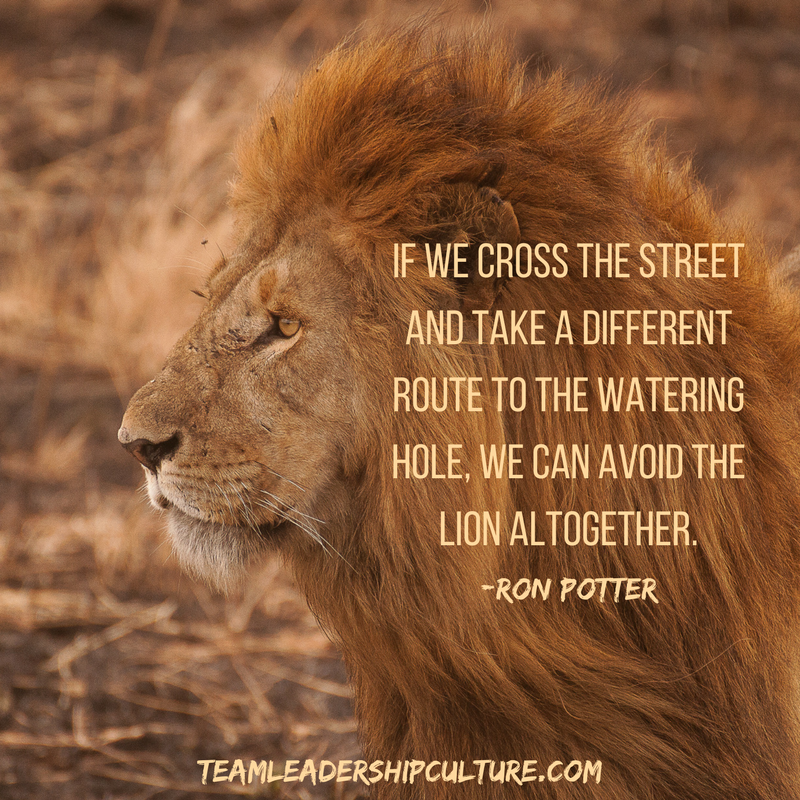
Goals! It seems that when we turn the corner and are facing the lion, our current goals fly out the window. When confronted with a lion, staying focused on your goals reduces stress-related diseases. Our instinct is to run when facing a lion. But maybe we should grab our knife and let out with our best Tarzan scream and go straight at it. If we notice the lion is feasting on its previous prey it has no interest in attacking us. Relax. If we cross the street and take a different route to the watering hole, we can avoid the lion altogether.

Notice how many times the lion prevents you from achieving your goals today.

Is the lion real or imagined?

Is there a way around the lion?

Should you go directly at the lion?

Rather than remembering that car accident, try sticking tenaciously to your goals. You may avoid the lion and reduce some of those stress-related diseases.

0 comments
0 FacebookTwitterEmail
BlogDecision Making with Myers-BriggsMyers-Briggs

Decision Making with Myers-Briggs – Part III

by Ron Potter May 1, 2017

This is the third in a Myer-Briggs series on Decision Making. Over the first two blog posts we looked at the Perceiving Function (how people take in information), and the Judging Function (how people make sense of what they perceive). This blog post will be focused on how we put it all together in the Decision-Making Process.

Background

Carl Jung was the famous psychiatrist who broke with Sigmund Freud. While Freud seemed to study what was wrong with us as human beings, Jung thought it better to study what was right and natural about us humans and what we could learn about ourselves with the proper framework. His work on Psychological Types led Myers and Briggs to put together their framework for understanding how we work.

Of the four functions pairs (making up the 16 possible archetypes) Jung and Myers-Briggs believed that the middle two were used in our decision-making process. It’s important to understand how these two functions work and in which order to under our and others decision-making process.

The simple concept is that we spend our days cycling between perceiving (observing what’s going on around us) and making judgments (decisions) based on that observation. A simple example is that when we’re leaving the house in the morning we look out the window and notice (perceive) that it’s raining. We then judge the situation to require (decide) to take an umbrella.

Depending on your personal type, one of the four function, Sensing, iNtuition, Thinking or Feeling is your primary function. If you’re going to make a decision you will need your primary function satisfied. My primary function is Thinking. If the answer does not look logical to me, I would (can’t) make the decision. Even more important to corporate teams or leadership, if my primary function is not satisfied, I will not commit to a decision. I may comply with it, but I will not make a full commitment to the decision. One of the most destructive events with teams is when people give compliance to a decision during a team meeting but it becomes obvious they are not committed to the decision in the long run.

Reaching Decisions and Commitments

Every person must have their primary function fully satisfied in order to make a decision or commit to a decision. Further, if their secondary function can also be satisfied, that’s all they need. They will now be onboard.

The problem is the facilitator, leader, decision maker always knows which two functions they need satisfied in order to commit to a decision, either consciously or subconsciously. Therefore, they direct the conversation to cover their two needed functions. Maybe it’s Sensing, getting all of the facts on the table, followed by Thinking, putting them into a logical order. That works great for that person and other ST’s on the team but for those who rely on N and/or F, all of the conversation sounded like the adults speaking in the Peanuts cartoons: Wha, wha wha. It’s like an English speaker sitting on a team of Chinese speakers listening to a language that is not understood at all until the question is put forth in English; “Are you ready to decide now?”

The Key

The key to reaching a decision or commitment on a team of diverse types is to take the time to speak in everyone’s language.

Sensing

Ask and answer the Sensing questions: What do we know about the situation? What are the facts? Do we have all the facts? What have we done so far and what were the results? What do we need to accomplish next?

iNtuition

Ask and answer iNtuitive questions: Where are we trying to go? What should the end results be? What other possibilities could we consider? What does the data seem to imply?

Thinking

Ask and answer Thinking questions: Is there a logical conclusion? Can we list the pros and cons of each option? Do we know what the costs of each option are? Can we put priorities to each possible outcome?

Feeling

Ask and answer Feeling questions: Do these answers support or violate our values? How will people (ours, customers, vendors, etc) react to the outcome? Who will commit to putting in the sacrifice needed to accomplish these goals?

Balance, balance, balance

It’s only when each of the four function is given equal time, honor and trust that we can count on getting to a committed answer and a team that acts in an aligned and committed manner.

Learn to cycle through these four functions and keep cycling until everyone is onboard and committed to the decision. You’ll be amazed at the power of an aligned and committed team.

0 comments
0 FacebookTwitterEmail
BlogCulture

Are you a Fighter Pilot?

by Ron Potter April 27, 2017

There are many outstanding characteristics associated with fighter pilots: Confidence, Intelligence, Assertiveness, Self-Discipline, Trustworthiness, Decisiveness, Dedication and others. But, the one characteristic that appears only on the list of fighter pilots is multitasking. Notice that I said “only” on the list of fighter pilots.

Many studies have confirmed that the only group of people who are good at multitasking are highly trained and skilled fighter pilots. And it’s not really the skill that makes the difference, it’s the highly-trained component. Through hours of dedicated and focused training, pilots learn to multitask effectively. The rest of us never put in the time, training and effort to become good at multitasking. But that doesn’t seem to stop us from trying.

A recent study by researchers at Stanford attempted to identify why the current generation of college students seemed to be better at multitasking than previous generations. Researchers are thrilled when their studies identify a single prominent reason for their complex research question. This study concluded with one of those Eureka moments.

What is the clear reason for current student’s ability to multitask better? They don’t! They suck at it. They’re actually promoting damaging effects.

The finding: Their ability to multitask diminishes over time. They also lose ground on other abilities. Multitasking leads to stupidity. That’s not what the study concluded but it seems like a logical conclusion to me.

Research seems to be flying at us from all directions to stop the multitasking. It doesn’t help us think. It doesn’t help us be productive. It doesn’t help us keep on top of things. It diminishes our ability to do all those things and more.

Deep work. Times of silence. Shut out the world. Get into deep thought. These are the things that help us be more productive and happier. But these take discipline, grit, determination, resolve.

Are you a fighter pilot? Are you trying to multitask like one? If so, your hurting your chances for success.

Carve out that time. Get away from the activity. Turn off the electronics (or at least stick them under a pillow or in a drawer). Get into some deep thought. If you haven’t thought about it (really thought about it) you’re not allowed to express an opinion. Our world is being buffeted by thoughtless opinions. The more multitasking we do the more thoughtless the opinions. Stop and think.

“Did you stop to think?” was a question I often heard from my parents. As a teenager, I thought that was just the stock response for when I did something stupid. I didn’t realize at the time it was a recipe to avoid being stupid as an adult.

Stop multitasking. Stop to think!

0 comments
0 FacebookTwitterEmail
Absurd!BlogIn-Depth Book Reviews

Absurd!: To Be a Professional One Must be an Amateur

by Ron Potter April 24, 2017

Amateur stems from the Latin word amator, which means “lover,” Amateurs do what they do out of love. Love is fundamental to good leadership because leadership is all about caring.

Aristotle spoke of Love as being one of the key elements to the highest level of happiness. His other words included at that level are Trust, Beauty, and Unity. All traits of great teams. Great leaders care for their people. Farson says “Indeed, caring is the basis for community, and the first job of the leader is to build community, a deep feeling of unity, a fellowship. Community is one of the most powerful yet most fragile concepts in the building of organizations.”

I’m afraid the lovers of the arts would never understand or agree that leadership would fall into the same category as a great symphony or painting, but I’ve experienced that kind of joy when great teams really get on a roll. “Management and leadership are high arts. When they are working well, they compare favorably to the other great aesthetic moments of our lives, to symphonies and sunsets.”

Leaders like to think of themselves as professional and indeed they are. “But the amateur performs work out of love, out of sensuous pleasure in the act of accomplishment, in the creation of community, in the bonds of compassion that unite.”

Great teams are built with great leaders based on the highest level of happiness: Truth, Love, Beauty and Unity. Aristotle may not have been thinking about our corporate leadership teams of today when he explained the four levels of happiness. But our nation’s founding fathers knew it was relevant when they declared in our Declaration of Independence that we find life, liberty and the “pursuit of happiness” to be our unalienable Rights.

What will you do to be an amateur today?

I’m continuing my series on an in-depth look at a wonderful little book that’s twenty years old this year. The title is Management of the Absurd by Richard Farson. You may want to consider dropping back and reading the previous blog posts about ABSURD! I think it will put each new one in great context.

0 comments
0 FacebookTwitterEmail
BlogCulture

I had a great day today… I got criticized

by Ron Potter April 20, 2017

Accept criticismThose are the words of Dr. Hank Weisinger co-author of the book Performing Under Pressure. On his blog, he writes about dealing with pressure by dealing with criticism.

When receiving criticism, we experience emotion. Emotions such as:

  • feeling hurt
  • anger
  • dejection
  • disappointment
  • resentfulness

These and other emotions are natural. But, if we’re good at evaluating our emotions we will be better at dealing with the pressure.

Dr. Weisinger suggests 4 steps to deal with criticism more productively.

Increase your receptivity to criticism

You can’t use criticism to your advantage if you are not going to at least listen to it. Align your definition of criticism with its historical helpful intent by programming yourself with the thought “criticism is information that can help me grow.” The more you internalize this thought, the less likely you will respond to criticism with defensiveness, anger, and hurt.

Appraise the criticism

Being receptive to criticism gives you the opportunity to evaluate what you are being told and to decide whether it is in your best interest to act upon it. High performers use multiple criteria to help them decide:

  • How important is the information to my life/job?
  • Is the source of the criticism credible?
  • Do other people agree with the criticism?
  • How much effort is required to respond productively?
  • What are the benefits to me?

The real value in appraising the criticism using these criteria is that it slows down your response and minimizes the chances that you will dismiss criticism impulsively when it fact, it could be very helpful.

Acknowledge your appraisal

High performers show respect and appreciation to their critics by sharing how they evaluated the criticism provided. This often leads to a productive exchange of viewpoints, and often in the case of high performers, new insights are gleaned that lead him or her to agree with their critic.

Take action

What if the criticism is valid —it’s in your best interest to act upon it? If this is the case, high performers distinguish themselves by taking steps to make sure they make the necessary changes/improvements that the criticism demands.

I’ve referred to Dr. Weisinger’s book often when helping clients deal with pressure. Dealing with criticism reduces the pressure and helps us become better leaders.

Enjoy your day. Enjoy the criticism.

0 comments
0 FacebookTwitterEmail
BlogDecision Making with Myers-BriggsMyers-Briggs

Decision Making with Myers-Briggs – Part II

by Ron Potter April 13, 2017

This post is the second in a Myer-Briggs series on Decision Making. Over three blogs we’ll look at the Perceiving Function (how people take in information), the Judging Function (how people make sense of what they perceive) and finally the Decision-Making Process.

Background

Carl Jung was the famous psychiatrist who broke with Sigmund Freud. While Freud seemed to study what was wrong with us as human beings, Jung thought it better to study what was right and natural about us humans and what we could learn about ourselves with the proper framework. His work on Psychological Types led Myers and Briggs to put together their framework for understanding how we work.

Of the four functions pairs (making up the 16 possible archetypes) Jung and Myers-Briggs believed that the middle two were used in our decision-making process. It’s important to understand how these two functions work and in which order to under our and others decision-making process.

The simple concept is that we spend our days cycling between perceiving (observing what’s going on around us) and making judgments (decisions) based on that observation. A simple example is that when we’re leaving the house in the morning we look out the window and notice (perceive) that it’s raining. We then judge the situation to require (decide) to take an umbrella.

Judging

In this post, we’ll look at the Judging function. We looked at the Perceiving function earlier. We’ll finish the series with a Decision Process post.

How do you Judge what you have perceived about the world around you? Don’t think of this word as the negative form of “Judgement”. You’re not being a judgmental person. Myers-Briggs calls this your Deciding function. Once you’ve taken in information with your Perceiving function (previous blog), how do you then finally decide?

Thinking

The thinking function is driven mostly by logic. Add it up, pros and cons, bottom line; there’s your answer.

Feeling

The Feeling function is driven mostly by values. “I see your logic and may even concede that it’s correct, but who cares?” How will this logical answer affect our people, our customers, our vendors? Does it reflect our values?

It’s important to note that this is not feelings of emotion, though it’s often mistaken for that. It’s more a question of values and how people will be affected.

Both Thinking and Feeling functions are valid. I’m always emphasizing balance when I conduct Myers-Briggs sessions. Balance, balance, balance. It’s best when we can depend on and blend both functions. We’ll get into trouble relying too much on one or the other. Therefore, I like to use Myers-Briggs with teams. It’ easier for a team to balance functions when we have a mixture of both types on the team.

I often run a little experiment with my leadership teams. At one point I’ll ask the team what they “think” about moving forward. If I ask a thinking-preferenced person, I’ll often get a fairly robust answer. Something like; “I think we should take steps one, two and three which will lead us to a decision point about which way we should proceed after that.” As I work my way around the room and ask the same “thinking” question of a feeling-preferenced person, I’ll get a less robust answer. Something like “The logic in the previous answer looks correct. I could probably support that answer.”

But, a little later, I’ll ask the same question but I’ll speak of it in Feeling terms; “What do you “feel” we do about moving forward. The thinking-preferenced person doesn’t understand the difference in the question. Their response will be something like “I just told you what I “thought” a minute ago. But if I ask the feeling question of a feeling-preferenced person, I often get a more robust answer. “I think the logic is correct and we could defend it. But do any of you understand how upset our customers are going to be with that decision? I fear we’ll lose a percentage of our customer base that we’ll never get back!” Was it a logic answer? No. Was it a powerful answer? Indeed. In fact, it will likely change the team answer.

Like our Sensing and iNtuitive types, Thinking types are no less feeling than Feeling types. And Feeling types are no less logical than Thinking types. But, decisions will be driven by the preferred type. We need to address both to reach balanced conclusions.

The best answer is a balanced one. Weigh and compare the thinking attention to logic with the feeling attention to values and impact. It often takes a partnership or team to do this well.

0 comments
0 FacebookTwitterEmail
Newer Posts
Older Posts
  • Facebook
  • Twitter
  • Linkedin
  • Rss
  • About This Site
  • About
    • Clients
  • Services
  • Resources
    • Trust Me
    • Short Book Reviews
  • Contact

About this Site | © 2024 Team Leadership Culture | platform by Apricot Services


Back To Top
Team Leadership Culture
  • Team
  • Leadership
  • Culture
  • Myers-Briggs
  • Trust Me
  • Short Book Reviews