

Team Leadership Culture
  • Team
  • Leadership
  • Culture
  • Myers-Briggs
  • Trust Me
  • Short Book Reviews
Top Posts
Obituary
REPOST: Four Functions, Three Rules
ROUNDUP: The Rise of AI
REPOST: Facing Adversity Series
ROUNDUP: Curiousity
ROUNDUP: Deep Work
REPOST: Character vs. Competence
REPOST: Opposite of Victim
REPOST: Listening With the Intent to Understand
REPOST: Performance vs Trust
  • About
  • Services
  • Resources
    • Trust Me
    • Short Book Reviews
  • Contact

Team Leadership Culture

  • Team
  • Leadership
  • Culture
  • Myers-Briggs
  • Trust Me
  • Short Book Reviews
Author

Ron Potter

Ron Potter

BlogLeadership

How to put your audience asleep in one easy step

by Ron Potter February 24, 2017

Over the last few weeks with different clients from different industries I’ve suffered through similar and equally bad presentations. The presenters themselves were not bad or boring. Quite the contrary, they were highly competent and enthusiastic about their topic. But they all made one fatal flaw. They used Docuslides instead of presentation slides.

Docuslides are documents but they’re thrown up on the screen for a presentation. You’ve all seen them. They usually include some form of the following:

  • Title
  • Sub-Title
  • Four to six boxes with headings and either four bullet items each or a full paragraph of information.
  • Or worse, the four to six boxes are down the left side of the slide with a chart on the right side with all the same words arranged into some sort of graph or icon.
  • Plus, all of the bullet items or paragraphs are down to 12 point font or less to fit everything in.

Document! Handout. Pamphlets. Anything but slides.

I’m not the best presenter in the world, Steve Jobs may hold that title. But I do spend my days attempting to get concepts and ideas across to my audience of corporate leaders in a way that is remembered after they walk out of our session. When I’m at my best I follow three simple steps for slide preparation.

Step One

Capture all of my thoughts and ideas onto as many slides as it takes. Put some organization to the slides as I create them but the main point is to capture all of my thoughts in as many words at it takes. These slides are a little rougher in format but they look similar to the docuslides that I often see.

Step Two

Eliminate 90% of the words. Boil down what I’m trying to say to a few, very clear descriptive words. I should be able to put these in a fairly large font (24 point) and it shouldn’t clutter the slide.

Step Three

Move the words currently on the page to the note section of the slide (which the viewer never sees) and replace the few words with a single word, icon, image or short video. Something that makes a clear visual image of your main point. Large font, easy to see from the back of the room. No doubt about what the word or image is. When half the audience has gotten out of their seats and are standing along the side of the conference room so they can get close enough to the screen to read the words, you know you’ve completely failed as a world class presenter.

I remember reading a quote from a Silicon Valley investor that went something like this: If you cannot describe what you do in ten words or less, I’m not investing, I’m not interested, I’m not buying. When you’re in front of an audience with a slide presentation, you’re selling. It may be an idea or presenting your case for a decision but you’re selling and you need your audience to buy. If you can’t do it in ten words or less, they’re not going to buy.

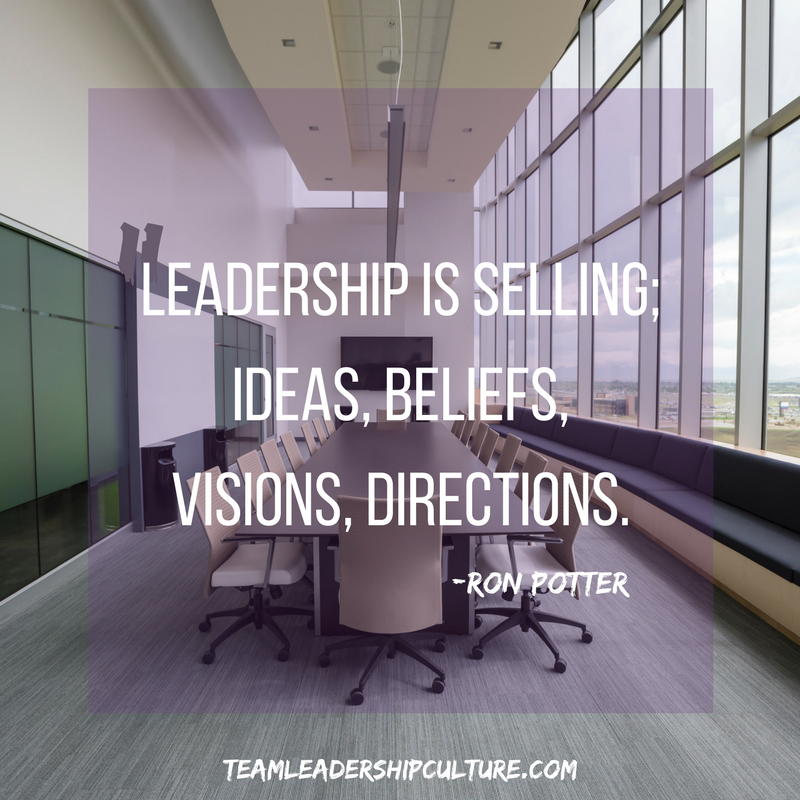
Get rid of the docuslides. Get better at presenting. Leadership is selling; ideas, beliefs, visions, directions. Work at presenting with as few words as possible.

0 comments
0 FacebookTwitterEmail
Absurd!BlogIn-Depth Book Reviews

Absurd!: Planning is an ineffective Way to Bring about Change

by Ron Potter February 20, 2017

Farson gets right to the point when he says “Planning is built upon the flawed idea that it is possible to predict the future. Yet the future almost always takes us by surprise. Since there is simply no good way to predict future events, there is no sure way to plan for them.”

Study after study indicates what human beings are terrible at predicting the future. While our weather forecasts are getting better and better with technology, I still haven’t met anyone who trusts the forecast beyond the next couple of hours. I had to laugh this morning when watching Mike and Mike on ESPN. They were broadcasting from an outdoor location and complaining about not being dressed adequately because their weather apps had been wrong. We’re good at predicting rain when we’re getting wet.

Farson reinforces this idea: “By and large, organizations are simply not good at changing themselves. They change more often as a result of invasion from the outside or rebellion from the inside, less so as a result of planning.” It’s easier to plan for change when the barbarians are at the door.

So, do we abandon planning? No, planning is important to make sure everyone is on the same page and doing things as expected. But, we must compliment planning with scenarios. Planning is developing answers. Scenarios are created by asking questions. “What if” questions. What if a new competitor invades our space? What if we no longer have access to that material? What if our customers taste changes? I find that when teams and companies do adequate scenario planning, they’re better able to handle the changes that the future throws at them. When a change occurs, they have the sense that they had talked about that (or some form of it) and therefore are more equipped to handle the change. Farson says “At best, planning becomes a form of anticipatory, strategic thinking – the basis for organizational flexibility and readiness. That may be the most it can offer, but that’s a lot.”

It is a lot. It helps to react more quickly and be less shocked or depressed when the change does occur.

However, one scenario that I seldom see teams tossing on the table is one of great success. What happens if we’re more successful than we anticipate? I remember a TV commercial a few years ago of a small startup company gathering around their newly launched website to see if they get any orders for their new product. As the first order hits there is relief on their face. As ten orders hit smiles appear. As a hundred orders appear cheering breaks out. But as the orders continue to climb into the thousands and tens of thousands, a look of complete horror darkens their faces. They didn’t plan for greater than expected success.

Planning is good but inadequate. Add scenarios. What could (and will) go wrong? What happens if we’re extremely successful? You’ll be better equipped to deal with the future.

I’m continuing my series on an in-depth look at a wonderful little book that’s twenty years old this year. The title is Management of the Absurd by Richard Farson. You may want to consider dropping back and reading the previous blog posts about ABSURD! I think it will put each new one in great context.

0 comments
0 FacebookTwitterEmail
BlogLeadership

One Key Element to Success

by Ron Potter February 16, 2017

Everyone needs a good coachYour Real Value

We had just finished a global conference. The forty plus leaders from three continents had left and were headed back to their different parts of the world. The CEO and I were relaxing in his office recounting the lessons learned from the session. His words to me went something like this:

  • We’ve developed a leadership team that is doing some astounding things. I have never experienced a team working at this level.
  • I’ve learned so much about leadership over the last couple of years. It’s amazing how differently I now think about leadership compared to what I thought I should be doing earlier in my career.
  • This global culture that we’ve built is going to help us weather almost any foreseeable storm. We could be in better shape.

At this point, I have to admit that I was feeling pretty good about myself and the work we had done together. He had just hit the three main function of my company: Team, Leadership, Culture. I must be doing something right. But then he said something that really shook me. He said, “But your real value is…” I had no ideas what he was about to say. What else was there beyond Team, Leadership and Culture? He continued, your real value is when we just sit and talk like this. At that moment I understood the value of executive coaching.

When You’re Already the Best

Years ago, I had an opportunity to visit the Colonial Golf Tournament in Fort Worth, Texas. I had chosen to walk the course with a few of the players rather than stay in one location.

Tom Watson was at the top of his game during those years. He may have been the best player at the time. Certainly nobody knew more about the game of golf or his personal golf game than Tom Watson. He is a real student of the game. Toward the end of his round I noticed that he began to lose his drives to the left.

On the 18th tee his hook was so pronounced that he almost hit it in the water down the left side. He finished his round very calmly, but as he was exiting the 18th green I noticed that he looked very directly at one person and seemed to nod his head as if saying, “Come with me!” It turned out to be his swing coach and they headed off to the practice tee.

As I observed from a distance (I could not hear their words) Tom had lost that calm demeanor and was franticly motioning to his coach that something had gone dramatically wrong with his golf swing. As his coach calmed him back down and suggested he try a couple of minor corrections, his practice drives began to sail long and true. With a smile of contentment, he hit drive after drive right down the middle. Even though he may have been the best in the world at that point, he still needed a coach to help him correct minor flaws that had creeped into his game.

Are You Selling Drugs?

Those words were asked of me a little too seriously by and Executive Admin that I had come to know. My slightly shocked response was, “Of course not!”, why would she ask? She told me that her CEO never gave more than an hour of his schedule to anyone. Yet, when I showed up once a month he would clear his calendar for an entire afternoon and she would hear us in his office talking and laughing for many hours.

Was I selling drugs? Not the pharmaceutical kind but yes, I was providing the CEO with something that helped him deal with his stressful and complex business life. Time to think, talk, and ask questions with a trusted coach.

Reboot Your Heart and Mind

Rich Karlgaard is one of the authors that I like to read. Last year he wrote one of his regular contribution articles to Forbes magazine with the above title. He was speaking of Bill Campbell, one of the Silicon Valley legends that had recently passed away. Bill was a successful leader in his own right but Rich was explaining that he would be remembered most as a great coach to several of the valleys biggest names. This role of being a sounding board, a safe listener, a wise counsel is present in the lives of many successful leaders.

Have you found this person(s) in your life? Are you even looking? Are you serving that role for other people? Listening, sharing and asking meaningful questions. We all need coaches.

0 comments
0 FacebookTwitterEmail
Absurd!BlogIn-Depth Book Reviews

Absurd!: Everything We Try Works, and Nothing Works

by Ron Potter February 13, 2017

I can’t tell you how many times in my life someone has asked me “Have you lost some weight?” I used to proudly respond “Yes, I’ve lost 15 pounds recently.” However, after a lifetime of losing that same 15 pounds many times, I’m not so proud of the accomplishment anymore. The difficulty is losing the remaining 25 and keeping it all off. That takes a lifestyle change, not a diet. Ugh!!

Farson, our author says, “People can make lasting changes in themselves only through a commitment to a continuing discipline. For example, crash diets don’t work, but a permanent modification in one’s eating habits do. Visits to spas don’t work but the daily practice of exercising stretching, or weight lifting does.” He goes on to say, “The same is true in management. Lasting change comes only from the adoption of sound management principles that are practiced on a continuing basis. There are no quick fixes.”

How long have you stuck with the commitment to make the necessary changes? Three months? Six months? One year? Many years?

I will usually lose that 15 pounds in three or four months. But where is my weight a year later? That’s the true test.

In my consulting practice, I find that Leadership and Team Building changes follow a similar pattern. Even if the individual or team begin a new healthier approach to leading and teaming, it takes about six months of consistent new behavior before others will give them the benefit of the doubt. If there is a failure or setback any time during that first six months, the reaction by others tends to be “See, same old behavior. They didn’t truly change.” Unfortunately, the six-month clock starts over again and people only seem to grant so many “resets” before they solidify their perception that the changes will never be real.

After six months of consistent new behavior, I find that people will at least grant benefit of doubt. If there is a setback in the second six months’ people seem to say, “They’ve been pretty good at the change so far, let’s see if this is a momentary setback or a failure.” If the new behavior remains through the second six-month period, I find that most people don’t remember the old behavior or that it was ever a problem. The individual or team has accomplished the daily practice of exercising stretching, or weight lifting required to make permanent change.

People and teams can change. I have the data and experience to prove it. But it takes long-term commitment and dedication. Try it, you’ll like it.

This post is a continuation of my series on an in-depth look at a wonderful little book that’s twenty years old this year. The title is Management of the Absurd by Richard Farson. You may want to consider dropping back and reading the previous blog posts about ABSURD! I think it will put each new one in great context.

0 comments
0 FacebookTwitterEmail
BlogCulture

Flow

by Ron Potter February 9, 2017

Daniel Pink spoke often of getting into the flow in his book Drive. You know you’ve been in flow when you look up and you’ve completely lost track of time. You’re so engaged in your work that time is not a consideration. You’re in the flow.

Even though I experience it on a regular basis I hadn’t heard the word recently until an article by Srinivas Rao titled “What it takes to lead an extremely high flow life” caught my eye. The hints that it took to get into high flow included:

  • Avoid Interruptions
  • Work for long enough to get into flow
  • Do deep work

Sounds simple enough. Every team I work with lately is telling me how wonderful it is to avoid the interruptions of their daily routines. Avoiding the interruptions rewards them with the time they need to really get into some deep work. NOT!

Every team I’m engaged with is asking me to help them with the stress and pressure of their business lives. I’m observing mental stress, emotional stress, and physical stress. People are getting sick, losing touch with their family and friends and feeling that they never have enough time to get into the work that they’re good at, enjoy and have been hired to accomplish.

Why have we allowed these things to happen to us? Everybody seems to understand that it’s happening and it’s destructive but there seems to be a sense of helplessness to get out of the tornado, plant your feet on the ground and get some work done. Why?

I believe one of the reasons (maybe the main one) is that we’ve lost our ability to say No! I just finished reading “The Power of a Positive No”. It’s good to understand why we’re hesitant to say No. The book offers what it calls the Three-A Trap:

  • Accommodate: We say yes when we want to say no.
  • Attack: We say no poorly
  • Avoid: We say nothing at all

And The Combination is the deadly mix of all three. Our reasons for not saying No are powerful; I don’t want to lose my job, I don’t want to damage our relationship, I don’t want to look ignorant, and the list goes on. But what are we doing by not saying No? Destruction and falling short of our goals. Not good things.

The simple word decide can be an answer. Think of all the words you know that end in “cide”. Cide in Latin means “put to death”. When we decide, we’re not supposed to keep saying yes to everything. We’re supposed to declare what we’re not going to do so that we can accomplish the important things.

Have you decided what you’re not going to do today? It’s the only way to get into deep work and flow. Enjoy the journey.

0 comments
0 FacebookTwitterEmail
Rocket feedback systems
Absurd!BlogIn-Depth Book Reviews

Absurd!: We Want Not What We are Missing, but More of What We Already Have

by Ron Potter February 6, 2017

Rocket feedback systemsFeedback. That word alone strikes fear in some and appreciation in others. The word was originally coined during the early days of rocketry. When the rocket scientist pioneers were trying to figure out how to design, build and fly rockets, they quickly found that they could generate enough thrust to make the rockets fly. What they couldn’t do was hit a target. They had to spend more time and brain power developing what they termed “feedback systems” so they could adjust the thrusters to hit the desired target.

If you look around any corporate team, thrust is not usually the problem. There is enough education, experience and drive to accomplish almost any goal. The problem is aligning all of that thrust to hit the desired target. Feedback is needed.

So why do we resist or ignore feedback? Farson tells us “One study shows that people wanted for themselves not something that was missing in them and that others might think important to them to have – but more of what was already their special attribute. When people described what they wanted for themselves, they seldom mentioned qualities that others would later suggest were missing from their personality or performance.”

Leadership teams are filled with people who have been good at what they do. It’s their expertise, knowledge, and productivity that has rewarded them through the years and brought them to a leadership role. The problem is that leadership requires trust, influence, and alignment of goals. Farson puts it this way “The difficulty for all of us is that our absorption with what we do well may blind us to what will enable us to do even better.   The particular challenge for managers is to remain mindful that organizations can set themselves up for trouble when they rely solely on the things they are already doing well and fail to see what they really need to do.”

We seldom need feedback on our technical skills or expertise. We need feedback to get better at leadership which includes building trust, aligning goals and creating a commitment to the overall good of the team and company.

Feedback is required to hit a target. What’s your target? Are you soliciting the needed feedback?

I’m continuing my series on an in-depth look at a wonderful little book that’s twenty years old this year. The title is Management of the Absurd by Richard Farson. You may want to consider dropping back and reading the previous blog posts about ABSURD! I think it will put each new one in great context.

0 comments
0 FacebookTwitterEmail
Conversation Interpretation
BlogCulture

Assuming Positive Intent

by Ron Potter February 2, 2017

Conversation InterpretationThis has been a stalwart statement in many corporate environments for many years. It’s written on many walls as part of the values list that many corporations generate. It’s spoken often. Assume Positive Intent! It’s just seldom followed.

Why do we have so much difficulty assuming positive intent? I have some theories and even some science that explains why our brain often has difficulty assuming the best. What is clear, it’s a vicious, self-fulfilling prophecy. Once we believe we experienced bad intend, that belief system continues to reinforce the perception by filtering behaviors and circumstances from that point of view. It’s known as confirmation bias. Every behavior begins to confirm our bias.

The Most Respectful Interpretation

My favorite blogger, Shane Parrish of Farnam Street blog speaks to this concept when he references Brene Brown. Brown speaks of Dr. Jean Kantambu Latting, a professor at University of Houston. Dr. Latting says “What is the most generous assumption you can make about this person’s intentions or what this person said?” Notice what the question changes. We are no longer trying to assume positive intent, especially when we don’t assume it in the first place. We are now asking ourselves a question. What will we do? What is the most generous assumption we can make?

Our first reaction probably doesn’t reflect much generosity. But that’s the point. If you’re not being generous, you’re not answering the question. Take a deep breath, let you anger subside and ask yourself again, what is the most generous assumption you can make? While you may not be feeling generous, the question is still asking you to be generous in your assumption. “Well, to be generous I might assume that they had a family emergency and therefore couldn’t respond to me when I needed it.” A family emergency? I hope everything is OK. Now you’re even feeling generous, not just acting generous. How do you think the other person would respond if you expressed genuine concern about their well-being as you inquire once again about your need?

What is you most respectful interpretation? It can change the dynamics completely.

0 comments
0 FacebookTwitterEmail
Short Book Reviews

How to Fly a Horse

by Ron Potter February 1, 2017

Ron’s Short Review: Debunking the myth that creativity is somehow related to genius and comes to you in a flash. It doesn’t. Like anything else, it takes hard work, dedication and commitment. Ashton gives some great practical advice and stories.

0 comments
0 FacebookTwitterEmail
Absurd!BlogIn-Depth Book Reviews

Absurd!: We Think We Want Creativity or Change, but We Really Don’t

by Ron Potter January 30, 2017

Clients often ask me to come in and help them with their creativity. The market place is changing, new more nimble competitors are popping up. Their clients are asking for a more creative approach (although that is usually a code word for reducing prices). The leaders are asking every team to think and act more creatively.

However, my first words to the team under the creative pressure is that your leaders are using the word “creative” but they don’t really want that. They’ll resist your ideas every time. What they are really asking is to be more innovative. I’ll go into the difference of those words in a minute but it needs to be said here that the real need may indeed be creativity, it’s just that the leaders will still resist anything beyond innovation.

Creativity and Innovation: What’s the Difference?

I first learned about the difference between these words from Larry Bossidy and Ram Charan in their book Execution. Creativity is blue sky, it’s outside the normal boundaries, it’s breaking the rules. Innovation is executing what you do well faster than the competition. Regardless of the words used, corporate leaders are usually (not always) looking for better, faster execution, not untried, unproven, rule-breaking creativity.

The “Problem” with Creativity

Our author Farson says “Creative ideas are relatively easy to elicit. To implement an idea is a tougher task. The fundamental problem with creativity is that every new idea requires the manager and the workforce to undergo significant change. Real creativity always violates the rules. That is why it is so unmanageable and that is why, in most organizations, when we say we desire creativity we really mean manageable creativity. We don’t mean raw, dramatic, radical creativity that requires us to change.”

I think manageable creativity is what Bossidy and Charan were talking about when they defined innovation. The challenge for all corporate leaders is to be clear about what is needed and what the team is being asked to accomplish. If it’s innovation, then clearly define what part of the system you’re trying to simplify and execute faster. If it’s true creativity, then the leaders must start thinking more creatively themselves. And creativity always requires letting go of control. That’s a tough one for corporate leaders.

History has shown us that true creativity usually happens in small autonomous groups. Think skunk works. Farson says “When a company wants to stimulate creativity, it may need to organize quite differently. Companies have learned that scale is the enemy of creativity and are finding ways to break into smaller more flexible units.”

Skunkworks require a great deal of risk tolerance. But the alternative may be fatal. If you truly need creativity to survive, take the risk.

This post is a continuation of my series on an in-depth look at a wonderful little book that’s twenty years old this year. The title is Management of the Absurd by Richard Farson. You may want to consider dropping back and reading the previous blog posts about ABSURD! I think it will put each new one in great context.

0 comments
0 FacebookTwitterEmail
BlogCulture

How Being Pretty Good Leads to Great Success

by Ron Potter January 26, 2017

I came across an old article by Scott Adams, the creator of Dilbert, talking about career success. It’s hard to take Adams seriously on any topic if you’ve read any of his Dilbert cartoons but he seems to be quite serious on this advice and I think it’s pretty sound.

He says: If you want an average successful life, it doesn’t take much planning. Just stay out of trouble, go to school, and apply for jobs you might like. But, if you want something extraordinary, you have two paths:

  1. Become the best at one specific thing.
  2. Become very good (top 25%) at two or more things.

Yes, Scott said very good and I said pretty good but I think you can put the top 25% in either category.

He also goes on to say don’t try path # 1, it’s way too difficult and takes way too much sacrifice. But, path number # 2 is within most people’s reach.

I am often struck by how many people seem to fall into the “it doesn’t take much planning” part of average success. “I didn’t really plan for any of this, it just seemed to happen” is a story line I hear. But it doesn’t take too much planning to push toward the extraordinary as Scott defines it.

Try this exercise and don’t be shy, you don’t really have to write down your assessment in a blog where people will see it: What would I consider the few areas where I would place myself in the top 25% of anything?

This caused some reflection on my part.

  • I read a lot. I have no idea if I’m in the top 25% but it does seem to be more than average (See my post on Read your way to success)
  • I get to talk with lots of leaders in lots of industries. Most consultants will be high on this one but I find it to be really useful for cross pollination of ideas.
  • I have no fear of working in front of a group of people (probably out of shear ignorance)
  • And, I can’t really think of anything else I would claim to be in the top 25%.

So, what does all this prove? You don’t have to be really good at anything and the things that you are somewhat good at don’t have to be very spectacular. Just as Scott says, just be in the top 25% in two or more areas and you’ll experience something above average success. No joke, I think he’s right.

But, there are two key premises to his statement: Be pretty good at two or more things and plan! It doesn’t happen without planning.

What are your two areas? Are you getting better at each one of them? Are you trying to add a third? What’s your plan? Plans are not about yesterday. Plans are about what comes next. What will you do different tomorrow to begin building for an extraordinary future?

0 comments
0 FacebookTwitterEmail
Become a Better Learner: Review
BlogCultureThree Steps to Become the Best Learner

Three Steps to Become the Best Learner – Part II

by Ron Potter January 23, 2017

Become a Better Learner: ReviewKnowing something is different than knowing the name of something.

Shane Parrish of Farnam Street Blog spoke of this concept from Richard Feynman, the Nobel winning Physicist.

Feynman said that his technique would ensure that he understood something better than everyone else. It helped him learn everything deeper and faster.

In a previous post we talked about Step 1: Teach it to a child. Feynman’s second step is Review

Step 2: Review

In step one, you will inevitably encounter gaps in your knowledge where you’re forgetting something important, are not able to explain it, or simply have trouble connecting an important concept.

This is invaluable feedback because you’ve discovered the edge of your knowledge. Competence is knowing the limit of your abilities, and you’ve just identified one!

I want to key in on one word that Feynman uses here, feedback. This word has its beginnings in the early days of rocketry. When the scientist were developing the first rockets near the end of World War II, they discovered early they could develop a rocket with enough thrust to reach a target. Thrust was not the problem.

The problem was they couldn’t actually hit a target even tough they had enough thrust to reach the target. They then had to spend more brain power, money and time to develop a process they described by coining the word, feedback.

Thrust is not the issue in learning. What you need is feedback from other minds. It works best when you inquire expert minds and more importantly when you inquire novice minds. Experts will ask great questions but experts also make too many assumptions. Novice minds have no such assumptions and will often ask more intriguing and difficult questions.

Review in your own mind. Review with experts. Review with novice minds. The important part is to make no assumptions. I’m reminded of a saying that my high school physics teacher was fond of using, “Assume makes and ‘a**’ out of ‘u’ and ‘me’.”

Reviewing means questioning all of your assumptions.

0 comments
0 FacebookTwitterEmail
BlogCulture

No!: The key to success

by Ron Potter January 19, 2017

You’ll be seeing a few posts from me around the concept of a good No. It’s critical to decision making, prioritizing and a general sense of wellbeing.

Today I want to pick up on a blog post written by Gustavo Razzetti, MD. His post is titled “How to Focus on What Really Matters to You.” His six step process is:

  1. Write down 10-20 things that you want to achieve.
  2. Divide your goals in three groups:
    1. Group 1: most critical
    2. Group 2: doubts and not sure how critical they are
    3. Group 3: can live with or live without
  3. Eliminate Group 3 and all its content
  4. Take a stand with Group 2. Eliminate those closest to Group 3. Move those that really matter to Group 1.
  5. Rank the items in Group 1. Make time for those that really matter
  6. Accomplish or initiate the top 3 priorities next month.

This is a pretty good list in a pretty good order. But the key to it is right in the heart, steps 3 and 4.

Eliminate Group 3 and all of its content! You need to De-Cide what’s important.

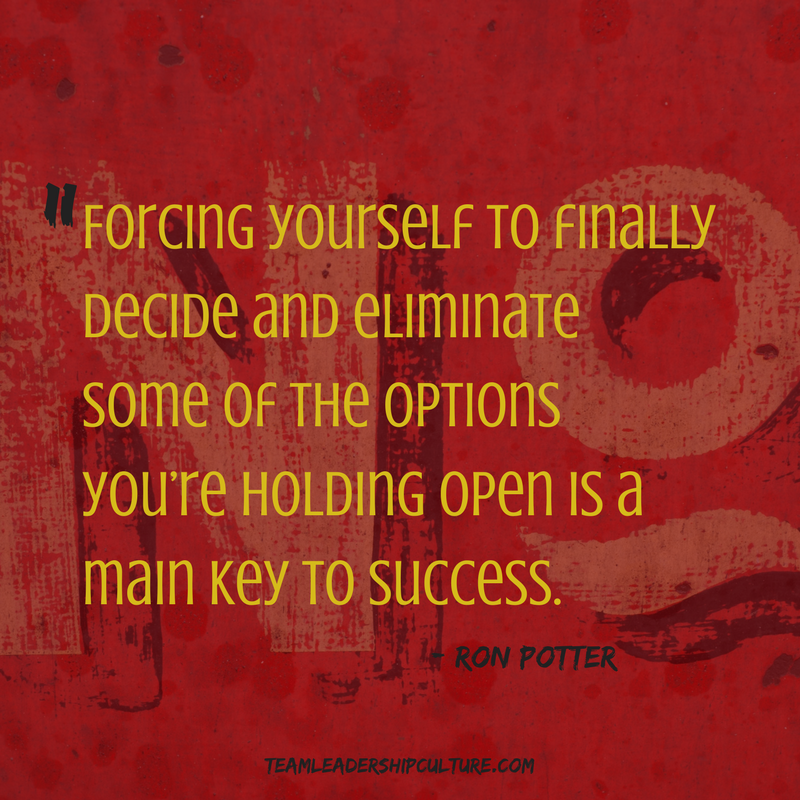
The word decide doesn’t mean figure out what you’re supposed to do, it means to figure out what you’re NOT supposed to do. It means to figure out what to kill.  Forcing yourself to finally decide and eliminate some of the options that you’re holding open is a main key to success.

Step 4 continues the same process but gets even tougher because these are items that you have doubts about or are not sure. There’s a fear of letting go of something that might be valuable to you in the future. Let it go!

The other key to the list is step 6. Start now. Do it this month. Don’t delay any more.

An old Chinese proverb says that “The best time to plant a tree is 20 years ago.” But the real power of the proverb is in the second sentence, “The second-best time is today.” Plan the 3 priorities you’re going to tackle next month. Then plan which one you will do in a given week. Then plan which day of that week you’ll set aside time to accomplish your goal. Put it on your calendar and when other demands pop up, simply say “Sorry, I’m already scheduled for that time. Let’s find another option.” Enjoy your new found success.

0 comments
0 FacebookTwitterEmail
Newer Posts
Older Posts
  • Facebook
  • Twitter
  • Linkedin
  • Rss
  • About This Site
  • About
    • Clients
  • Services
  • Resources
    • Trust Me
    • Short Book Reviews
  • Contact

About this Site | © 2024 Team Leadership Culture | platform by Apricot Services


Back To Top
Team Leadership Culture
  • Team
  • Leadership
  • Culture
  • Myers-Briggs
  • Trust Me
  • Short Book Reviews