
Team Leadership Culture
  • Team
  • Leadership
  • Culture
  • Myers-Briggs
  • Trust Me
  • Short Book Reviews
Top Posts
Obituary
REPOST: Four Functions, Three Rules
ROUNDUP: The Rise of AI
REPOST: Facing Adversity Series
ROUNDUP: Curiousity
ROUNDUP: Deep Work
REPOST: Character vs. Competence
REPOST: Opposite of Victim
REPOST: Listening With the Intent to Understand
REPOST: Performance vs Trust
  • About
  • Services
  • Resources
    • Trust Me
    • Short Book Reviews
  • Contact

Team Leadership Culture

  • Team
  • Leadership
  • Culture
  • Myers-Briggs
  • Trust Me
  • Short Book Reviews
Tag:

Success

BlogLeadership

Humility (AGAIN!)

by Ron Potter June 21, 2010

A few weeks ago IBM’s Institute for Business Value released the results of a survey they had conducted with 1,500 CEO’s across 60 nations and 30 industries. They asked these CEO’s from both the corporate and public sector to identify the one leadership competency they valued above all others. Here is the rank order of the results:

• A photo by Kelly Sikkema. unsplash.com/photos/KkDWcP7gYXECreativity

• Integrity
• Global Thinking
• Influence
• Openness
• Dedication
• Focus on sustainability
• Humility
• Fairness

Within days a colleague (thanks Chris) sent me an email asking what I thought about the ranking (knowing my belief that humility should carry a very high ranking). My reaction was that you can’t enjoy the top seven without first having humility.

It’s likely that their understanding of humility is probably skewed. From our book “Trust Me”, Wayne and I make these points about humility:

• Being humble and teachable means learning to trust others and their opinions and instincts.
• It means listening with the intent of learning instead of simply responding.
• It means seeking personal development from every situation, experience (both good and bad), and transaction.

I don’t think it takes a lot of imagination to see how humility is the basic foundation for achieving nearly every one of the competencies listed higher on the list.

Humility still rules.
0 comments
0 FacebookTwitterEmail
BlogWork-Life Balance

Work-Life Balance – Time Management

by Ron Potter February 2, 2010

Why are so many feeling that our Work-Life Balance is out of whack? In this series, I will explore four categories of issues that contribute to the feeling (and actuality):

  • Connectedness 24/7
  • Email Boundaries
  • Time Management (Quadrant II)
  • Transition and Transformation

Several years ago I learned some very interesting lessons about time management. I was working with a high level leadership team, all vice-presidents and above. While we were offsite spending time on leadership development issues one of the VP’s on the team finally stopped the process and said something like the following:

“Ron, we think all of these leadership issues you’re trying to teach us are wonderful and important, but until you help us with our time management problems, we can’t even think about putting more effort into improving our leadership skills. We’re all working at least 60 hours a week as it is. We’re destroying our health and our families. Help us with our time management first and then we’ll be ready to learn new leadership skills from you.”

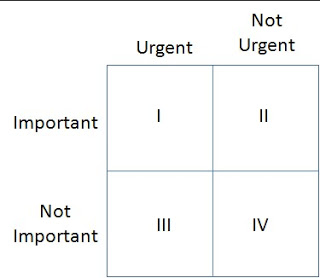
He was right. They were worn out and suffering. I turned to a time management model put forth by Steven Covey in his book The 7 Habits of Highly Effective People: Powerful Lessons in Personal Change. In that book, Mr. Covey indicated that all of our time fits into quadrants of a two-by-two grid.

Quadrant II Frame

His premise was that once we fulfill all of the tasks in Quadrant I (both urgent and important) we tend to go on to tasks that fall primarily in Quadrant III (Urgent but not necessarily important).

I sent the team off to record where all of their time went over the next two weeks. When they returned with the record of approximately 120 hours each had expended over the last two weeks, we listed every activity for each participant on a flip chart and posted it on the wall. Then we went through a very interesting exercise. Line-item by line-item we went through each chart and identified into which quadrant it should be placed. A very interesting pattern began to emerge. On several of the line-items, the owner of the sheet would say that he/she had spend a number of hours producing a particular report (as an example) that was urgent but not important and they intended to stop performing that task in the future. However, once stated, there always seemed to be a challenge from the room. Someone would say, “If you don’t produce that report, I can’t get my job done. It must be placed in the important row.”

But, when we began to look into what data in the report was required, there often seemed to be a simple solution to the second persons needs that still eliminated the effort needed to produce the report (it’s on the web site, a quick email, it can be found in another location, etc.) The problem was solved and the bulk of the work eliminated.

Once we completed all of the “negotiations” around the room and everyone had agreed on the quadrants into which all work had been placed, a horrifying statistic emerged. Only 20% of all the work fell into the “Important” row. One VP hung his head and said:

“Do you mean to tell me that I just spend 24 hours of meaningful work over the last two weeks and all the rest was just thrashing?”

I’m afraid so.

The lessons that I have learned from this experience (conducted now several times) include:

  • It’s difficult (impossible) to determine on your own how much of your work falls into which quadrants. There is always someone else that needs to be brought into the negotiations.
  • It takes team support to stick with the decisions. Even after everyone agrees that you have some quadrant III work that can be dropped, there will be those who still want you to do it. It takes a team to help you say “no”.
  • If more than 70% of your work falls into quadrant I (both urgent and important), you’re headed for burn out and failure somewhere down the line because you are not doing enough important but not urgent work (prevention, production capability, relationship building, big picture thinking, etc.)

The links in the post above are “affiliate links.” This means if you click on the link and purchase the item, I will receive an affiliate commission. Regardless, I only recommend products or services I use personally and believe will add value to my readers. I am disclosing this in accordance with the FTC’s 16 CFR, Part 255: “Guides Concerning the Use of Endorsements and Testimonials in Advertising.”

2 comments
0 FacebookTwitterEmail
BlogLeadership

Humility vs Hubris

by Ron Potter May 19, 2009
Image Source: Dennis Jarvis, Creative Commons

Image Source: Dennis Jarvis, Creative Commons

When I met with Wayne Hastings for the first time to discuss the writing of our book, Trust Me: developing a leadership style people will follow, I carried with me a research paper I had been reading that eventually became Jim Collins’ book, Good to Great. In his book Jim described what he termed a “Level 5” leadership style that was present every time a company went from being a good company to being a great company. The two pillars of that style were humility and a strong will to endure and succeed. Our book outlined 8 leadership principles that began with humility and ended with endurance, the same characteristics.

Jim is now publishing a new book titled How The Mighty Fall: And Why Some Companies Never Give In where he looks at the signs that we can detect that indicate a company may be on it’s way down from great to good (or worse).
What’s the number one sign? Hubris!

Hubris (/hju:bris/)

Excessive pride or self-confidence; arrogance
Overbearing pride or presumption; arrogance

Wikipedia says:

“It was also considered the greatest sin of the ancient Greek world because it was not only proof of excessive pride, but also resulted in violent acts by or to those involved.”

Humility: the first principle in great leadership
Hubris: the first step of the fall from glory

Are you a great listener?
Do you accept the brutal reality of your situation?
Do you have great faith in people?
Do you see it as your job to help everybody perform at their best or be in a place where they can be successful?
Or, do you believe you’re successful because you (and your team) have figured out the right way to do things. You’re smart. You know what you’re doing. Hubris?


The links in the post above are “affiliate links.” This means if you click on the link and purchase the item, I will receive an affiliate commission. Regardless, I only recommend products or services I use personally and believe will add value to my readers. I am disclosing this in accordance with the FTC’s 16 CFR, Part 255: “Guides Concerning the Use of Endorsements and Testimonials in Advertising.”

0 comments
0 FacebookTwitterEmail
Short Book Reviews

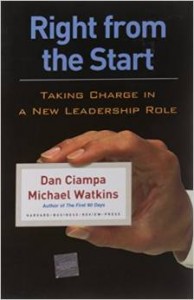
Right from the Start

by Ron Potter September 9, 2008

Right From The StartRon’s Short Review: Dan lays out a good plan for the first 100 days in a new job.
Amazon-Buy-Button

0 comments
0 FacebookTwitterEmail
Short Book Reviews

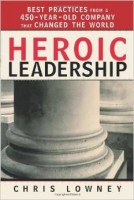
Heroic Leadership

by Ron Potter June 9, 2008

Heroic LeadershipRon’s Short Review: The Jesuits were formed at a time of new world markets, links between American, Europe and Asia and increased media systems.  Amazing transferable values contributed to their success.


Amazon-Buy-Buttonkindle-buy button

0 comments
0 FacebookTwitterEmail
Short Book Reviews

The Innovator’s Solution

by Ron Potter June 9, 2008

Innovator's SolutionRon’s Short Review: The whole concept of innovation is driving much of what companies are talking about.  Good view of what real innovation is and how to achieve it.
Amazon-Buy-Buttonkindle-buy button

0 comments
0 FacebookTwitterEmail
Short Book Reviews

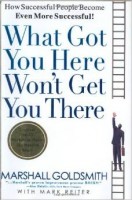
What Got You Here Won’t Get You There

by Ron Potter December 9, 2007

What Got You Here Won't Get You ThereRon’s Short Review: Making the shift from being a manager to being a leader takes different skills.
Amazon-Buy-Buttonkindle-buy button

0 comments
0 FacebookTwitterEmail
Short Book Reviews

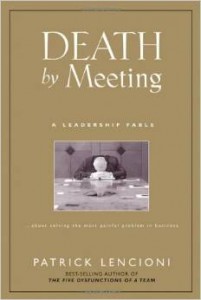
Death by Meeting

by Ron Potter November 9, 2007

Death by MeetingRon’s Short Review: This book may be better than his Five Dysfunctions of a Team.
Amazon-Buy-Buttonkindle-buy button

0 comments
0 FacebookTwitterEmail
Short Book Reviews

A Whole New Mind

by Ron Potter May 9, 2005

A Whole New MindRon’s Short Review: May be one of the most influential books (at least with my work and clients) in the last several years. The original subtitle of this book was “Moving from the Information Age to the Conceptual Age.” I liked this subtitle better because it really points out that all of us who have relied on being “Information Workers” over the last couple of decades had better quickly figure out how to survive in the “Conceptual Age” or lose our value.
Amazon-Buy-Buttonkindle-buy button

0 comments
0 FacebookTwitterEmail
Short Book Reviews

The World’s Most Powerful Leadership Principle

by Ron Potter December 9, 2004

World's Most Powerful Leadership PrincipleRon’s Short Review: Servant-Leadership IS at the heart of great leadership.
Amazon-Buy-Buttonkindle-buy button

1 comment
0 FacebookTwitterEmail
Short Book Reviews

The Five Dysfunctions of a Team

by Ron Potter October 9, 2003

Five Dysfunctions of a TeamRon’s Short Review: Maybe Lencioni’s best known book. You’ll find trust at the foundation.
Amazon-Buy-Buttonkindle-buy button

0 comments
0 FacebookTwitterEmail
Short Book Reviews

Change the World

by Ron Potter February 9, 2002

Ron’s Short Review: Quinn thinks and writes very deeply.

Amazon-Buy-Buttonkindle-buy button

0 comments
0 FacebookTwitterEmail
Newer Posts
Older Posts
  • Facebook
  • Twitter
  • Linkedin
  • Rss
  • About This Site
  • About
    • Clients
  • Services
  • Resources
    • Trust Me
    • Short Book Reviews
  • Contact

About this Site | © 2024 Team Leadership Culture | platform by Apricot Services


Back To Top
Team Leadership Culture
  • Team
  • Leadership
  • Culture
  • Myers-Briggs
  • Trust Me
  • Short Book Reviews
 

Loading Comments...