
Team Leadership Culture
  • Team
  • Leadership
  • Culture
  • Myers-Briggs
  • Trust Me
  • Short Book Reviews
Top Posts
Obituary
REPOST: Four Functions, Three Rules
ROUNDUP: The Rise of AI
REPOST: Facing Adversity Series
ROUNDUP: Curiousity
ROUNDUP: Deep Work
REPOST: Character vs. Competence
REPOST: Opposite of Victim
REPOST: Listening With the Intent to Understand
REPOST: Performance vs Trust
  • About
  • Services
  • Resources
    • Trust Me
    • Short Book Reviews
  • Contact

Team Leadership Culture

  • Team
  • Leadership
  • Culture
  • Myers-Briggs
  • Trust Me
  • Short Book Reviews
Tag:

Leadership

BlogCultureCulture Series

Culture – Involvement: Empowerment vs Delegation

by Ron Potter October 31, 2019

Empowerment vs. Delegation

Last week my blog post spoke of Empowerment in great cultures.  I need to take a short side trip here to talk about the differences between the words empowerment and delegation.  I’m not going to suggest that the words need to be used differently than they are today, that would be too large of a task.  But I believe it’s crucial that we understand the difference and also understand why one is required before you can accomplish the other.

These two words have become confused and misused in today’s language.  We currently view empowerment as a good thing and delegation as a bad thing.  I believe you need to empower before you delegate, and delegation is the higher form of the two words.

Let’s go back to the original definition of the two words and understand what they mean.

Empowerment

The dictionary says “To promote the self-actualization or influence of – make more confident – give someone a greater sense of confidence or self-esteem (Italics are mine)

Empowerment helps a person increase confidence, self-actualization, and self-esteem.  Empower is facilitated by allowing you to influence me on decisions and directions.  In other words, if I’ve Empowered you to run a portion of an organization, I will allow you to:

  • make all of your plans
  • run them by me to influence decisions to be made.

However, it’s still clear that the decisions are mine.

Advantages of Empowerment

There are a few advantages of using empowerment over a period of time:

  1. The individual grows and gets better as you question and learn the reasons for their planning and decision making
  2. You, the one granting empowerment, begin to learn how this particular person thinks and approaches issues.  It may be very different than you, but that doesn’t make it wrong.
  3. You may learn something along the way (see comments below about hiring experts)
  4. You gain a comfort level that the person is capable of tackling projects
Hiring the Expert

We often hire a person who is an expert in a particular area.  But, you must be very careful about how you grow and nurture that person.  If you start asking questions about how or why they reach a certain decision, their reaction might be:

  • Why am I being questioned?  I’m the expert.
  • Does this person trust me?
  • I can’t stand the “micromanagement” much more.  I may have made a mistake in taking this job.

When you hire an expert or someone with considerably more experience in an area than you possess, make sure you explain the reason for empowerment and when you expect to move up to Delegation.

Empowerment needs to take place in this situation for a couple of reasons:

  1. You need to learn and grow in this area.  This is the reason you hired an experienced expert.
  2. You need to know the key indicators of the job or project.  Is it going well?  Are we in trouble?  How will I know as soon as possible?  When do I need to explain a bigger picture or other influences where this person may not have an awareness?

If you let your “expert” know all of this ahead of time, they’ll be better equipped and more willing to answer your questions.

Delegate

The dictionary says, “Give a responsibility or task to somebody else – Assign responsibility or authority – Commit or entrust another.”

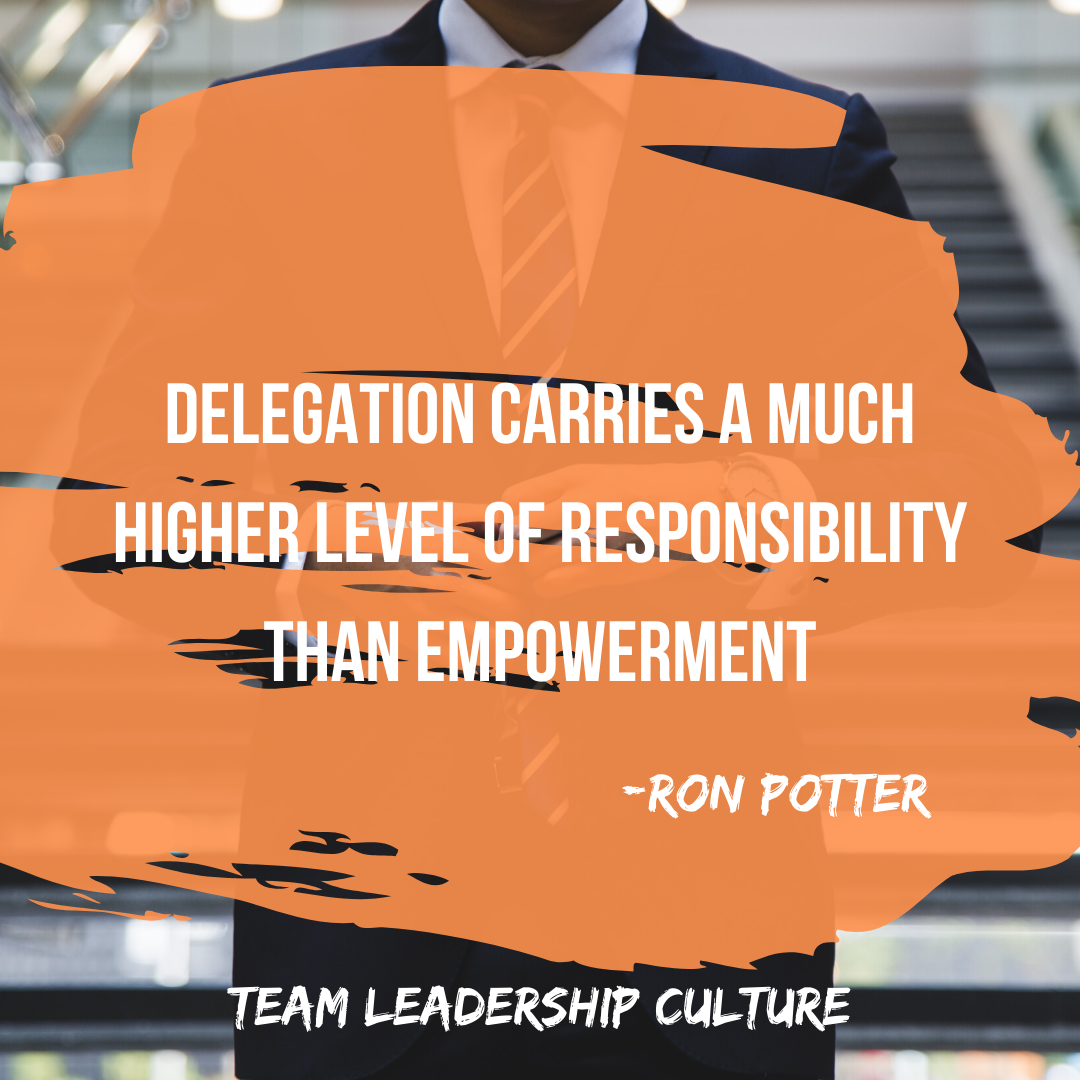
Delegation carries a much higher level of responsibility than empowerment.

In U.S. Embassies, the Ambassador is our official representative.  The Ambassador is our delegate.

I believe delegation is the higher state of the empowerment-delegation pair.  Delegation means you have been entrusted with a piece of the business to run as you see fit.  However, like a US Ambassador, regular check-ins are expected.  That is why we empower first so that key indicators can be understood and approved before the assignment is delegated.

Do they know the difference?

I’ve often asked leaders if they can tell me which direct reports are empowered and which they’ve delegated.  After understanding the definitions, they will tell me who they’ve delegated and who is still empowered.

My next question is, “Do your direct reports know if they’re empowered or delegated?”  The answer is usually no.  This causes confusion.  Each person is wondering why they are treated differently from another person.  One of the positive things I’ve seen happen when an explanation is made, the empowered quickly ask, “What do I need to do to have that delegated to me?”  This is the perfect question.

Misunderstood and timing

Because the original meaning of these words has been lost, I’ve seen managers and leaders assume that if they are going to empower someone, they should look the other way and let them do their thing.  That’s an abdication of leadership.  Leadership is still required in both empowerment and delegation.  Don’t sacrifice your role at the alter of empowerment.

The other issue is timing.  If you like having your direct reports continually in an empowered state, that is an indication that you’re letting your ego get in the way.  Delegation can be scary but is required for a healthy organization.  On the other hand, if you’re pretty good at getting people delegated (they’ll think of you as one of the best bosses they’ll ever have) and you still have someone in an empowered state even after a year of attempting delegation, you probably need to help that employee move elsewhere.  If they’re not willing or capable of accepting delegation, they may not be the right person for your organization.

Be Aware

Again, I’m not trying to change how language is used, but I do believe it’s important that you understand the differences to be effective.

The Denison Culture Survey (and almost everyone else) is using the word empowering.  The concept is correct.  Having people engaged, empowered, and taking responsibility for their work will have a positive impact on your organization.  Make it happen.
0 comments
0 FacebookTwitterEmail
BlogCultureCulture Series

Culture – People Quit Organizational Cultures!

by Ron Potter October 10, 2019

I read a recent blog by Christie Lindor.  The title of that post was

“People do not quit companies, managers, or leaders – they quit organizational cultures.  Here’s why.”

In her post, Christie wrote, “I had always believed that people quit leaders, not companies.”

I also believed that statement and observed it as well.  Christie then goes on to say

But then I realized that there is probably another way to look at it.  It is more than just leaders.  Organizational culture, in its simplest form, is an ecosystemic mashup of values, beliefs, underlying assumptions, symbols, rituals, attitudes, and behaviors shared by a group of employees and driven by leadership.” (Italics are mine)

While I don’t disagree with Christie, I think there are important distinctions.

Beliefs and Assumptions

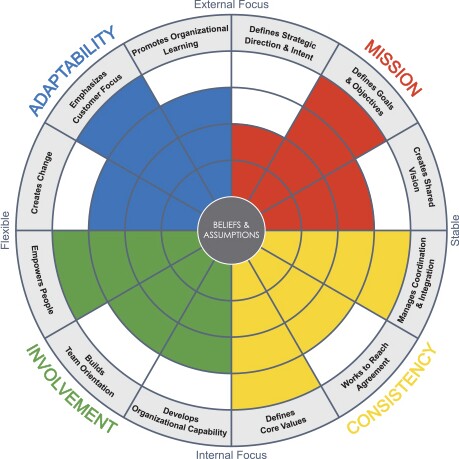
In the Denison Culture Survey chart, there is a center circle labeled “Beliefs and Assumptions”.  While that little center circle is often overlooked, Dr. Denison is making it clear that it’s a set of corporate beliefs and assumptions that drives the culture.

In my Culture Introduction blog post I stated:

What is Culture?

A dictionary definition says, “the set of shared attitudes, values, goals, and practices that characterizes an organization.”

We hear a lot about a corporate culture being toxic or exciting or silo-ed or productive.  But in my mind, many of those conditions have more to do with Teams and Leadership than they do with Culture.

    • If there is a toxic environment, that’s usually caused by poor leadership that is ego-driven rather than humbly driven.
    • Exciting environments come from leaders and teams developing people to face difficulties and obstacles in innovative thoughtful ways that utilize the skills and experiences present.
    • Silo-ed environments happen when teams are unable to work through their difference and reach a committed direction or approach.
    • Productive environments exist when teams learn how to elegantly use the resources they have to get the most out of an organization in a simple way.

Focusing on “culture” doesn’t cure any of the identified difficulties.  Building better teams and leadership improves those issues.

I believe Christie and I are saying the same thing.  However, I believe it’s important to distinguish between Team, Leadership, and Culture.  It’s difficult to correct issues of “Culture” without acknowledging that its Leadership and Teams that cause the Culture issues.


0 comments
0 FacebookTwitterEmail
BlogCultureCulture Series

Culture: Introduction

by Ron Potter July 18, 2019

What is Culture?

A dictionary definition says “the set of shared attitudes, values, goals, and practices that characterizes an organization.”

We hear a lot about a corporate culture being toxic or exciting or siloed or productive.  But in my mind, many of those conditions have more to do with Teams and Leadership than they do with Culture.

If there is a toxic environment, that’s usually caused by poor leadership that is ego driven rather than humbly driven.

Exciting environments come from leaders and teams developing people to face difficulties and obstacles in innovative thoughtful ways that utilize the skills and experiences present.

Siloed environments happen when teams are unable to work through their difference and reach a committed direction or approach.

Productive environments exist when teams learn how to elegantly use the resources they have to get the most out of an organization in a simple way.

Focusing on “culture” doesn’t cure any of the identified difficulties or enhance any of the identified strengths.  Building better teams and leadership improves those issues.

So what should be looked at when we think about and measure culture?

Culture Model

I first met Dan Denison many years ago when he was completing his research on corporate culture at the University of Michigan.  One of the things that caught my attention right from the start was Dan’s purpose in finding those items that can be measured on a survey that actually impact the bottom-line performance of an organization.  I knew that would catch the interest of every senior corporate leader I was working with.  They are very bottom-line focused.  If Dan could demonstrate that certain parts of the environment or culture actually had an effect on financial performance, I knew we had a winner.

From that initial work, Dan has gone on to be Professor of Management and Organization at IMD – International Institute of Management Development in Switzerland as well as found and become CEO of Denison Consulting in Ann Arbor, MI.  I would encourage you to visit his website at www.denisonconsulting.com.

The Denison model identifies four quadrants with three subsets each.  In this blog, I’ll introduce the four quadrants and then go on to explore each one in more detail over the next few months.

Four Quadrants of Corporate Cultures

Mission – Adaptability – Involvement – Consistency

Much of the wording you’ll see to describe each of these quadrants come directly from the Denison materials.  I trust Dan will see that as flattery and not plagiarism.

Mission

“Do we know where we are going?”

High performing organizations have a mission that tells employees why they are doing the work they do, and how the work they do each day contributes to the why.

Adaptability

“Are we listening to the marketplace?”

High performing organizations have the ability to perceive and respond to the environment, customers, and restructure and re-institutionalize behaviors and processes that allow them to adapt.

Involvement

“Are our people aligned and engaged?”

Highly involved organizations create a sense of ownership and responsibility.  Out of this sense of ownership grows a greater commitment to the organization and an increased capacity for autonomy.

Consistency

“Does our system create leverage?”

Consistency provides a central source of integration, coordination, and control, and helps organizations develop a set of systems that create an internal system of governance based on consensual support.

Schedule

Over the next several weeks I’ll break down each one of these four quadrants into their three subsets and share many experiences I’ve had through the years of companies that have improved over time.  Some of them have changed rapidly, others slowly but steadily and unfortunately some not at all.  But there always seemed to be reasons for the growth and development or lack thereof.  One thing that has been very clear, the growth and development that did or did not occur was caused by internal issues, not external environments.

Just as a reminder, these blogs will be our Thursday morning series.  Our Monday morning blogs will be less structured and disciplined and made up of issues and ideas that are striking me at the moment.

Thanks for coming along on this journey with me.  I’ve appreciated your loyalty and comments.  And don’t forget to share this connection with someone you know.  It will be more fun when we increase the size of our community.

0 comments
0 FacebookTwitterEmail
BlogLeadershipTeam

Team and Leadership: Summary

by Ron Potter July 15, 2019

Over the last several weeks we have been reviewing and expanding on the elements of a great team in our Thursday blog.  At the same time, our Monday blog has been exploring more detail on the elements of great leadership.  These are the first two legs of our Team Leadership Culture (TLC) model.

In general I believe it’s important to build a great team before working on leadership skills but in reality, it’s difficult to accomplish one without the other.  In many cases, they are tightly coupled and interdependent.

Today let’s review the elements of team and leadership and see how they fit together.

Elements of Team

Truth – Respect – Elegance – Commitment

Elements of Leadership

Humility – Development – Commitment – Focus
Compassion – Integrity – Peacemaking – Endurance

Interdependence

Let’s start with the elements of Team and look at the interdependence, overlap, and alignment with the Leadership elements.

Truth => Humility – Integrity – Peacemaking

To build a great team, members must be truthful with each other.  Truthfulness requires Humility, Integrity, and Peacemaking from the Leadership Skill List.

Humility

Humility has been misunderstood and misused in recent years.  Often people think of “turning the other cheek” or even being a “doormat” in order to be humble.  The original meaning of the word meant great power under complete control.  Humility doesn’t mean you’re powerless.  In fact quite the opposite.  It means that you have tremendous power.  Enough power to crush your opposition.  But when you’re humble, you choose not to use that power in a destructive way but to use the power for intense learning and curiosity.  Humble people may be the most powerful people in the room but are focused on individual and team learning through curiosity.  Humble people assume the other person may know something they don’t or have a very different perspective that’s worth learning.

Integrity

Integer also comes from the same root as integer.  It means whole, complete, sound and even incorruptible.  A person of high integrity is the same, complete, whole person no matter where they are or who they are with.  You can always trust they are and will be the same and say the same thing no matter what.  This is essential for the Truth required on teams as well as Commitment.  If you can’t trust that someone is genuine and has integrity, it’s difficult to get at the truth or sustain commitment.

Peacemaking

Peacemaking is also a word that we’ll see associated with Truth and Commitment.  Peacemaking is not the absence of conflict and different opinions.  Peacemaking understands that differences of opinion is natural for human-beings but has figured out a way to work through the differences and conflicts in a healthy productive way.

Respect => Humility, Development, Compassion and Integrity

Building and maintain respect with a team requires a leadership style built on humility, development, compassion, and integrity.

It’s important to note here that when I use the word leadership, I don’t mean the identified leader of the team.  I have observed people of all ranks and positions being leaders.  True leadership comes from your actions, not your position.

Humility and Integrity

We talked about humility and integrity in the Truth section above.  The same issues apply to Respect.

Development

From my book “Trust Me” development is described as “Leaders who accept the truth and train others to seize the benefits of adversity, loss, and change.  Growing people and giving them opportunities is one of the best ways to show respect.

Compassion

There have been a few clients through the years that didn’t believe compassion had anything to do with business.  In their minds, business was logical and should be dispassionate.

I’ve often used an old adage to counter that thinking:  “I don’t care how much you know until I know how much you care!”

When people feel like you care for them as a human being first, they feel trusted and respected.

Elegance => Commitment, Focus, Peacemaking

Commitment and Focus

I’ve combined these two but they do go together in many ways.  It requires a firm and aligned grip on the goal and purpose of the team to accomplish the required tasks in the simplest way with the least amount of friction.  Make the goals and purpose clear and then make sure everyone is committed.  This will eliminate much of the territorial behavior that happens with teams.

Focus is under attack more than any point in history.  All of our modern devices are determined to capture our focus thereby scattering our attention.  Our own egos also drive us to accomplish more things and be in more places than necessary or even possible.  Staying focused on the goal and purpose is the only way to keep things Elegant.

Peacemaking

Peacemaking was discussed above.  In making sure that things are accomplished in the simplest way possible, it will take a great deal of peacemaking to settle territorial disputes.

Commitment => Commitment, Peacemaking, Endurance

Commitment and Peacemaking

These two were also discussed above.  In terms of Team Commitment, it will take a strong commitment to the goal and purpose of the team.  It will also take a great Peacemaking/Decision-Making process.  Our earlier blog on Team Commitment talks about the process that provides a win-win environment which is essential to reach full commitment.

Endurance

I used the TREC (Truth, Respect, Elegance, Commitment) acronym because it looks and sounds like the word TREK.  A TREK is described as a long arduous journey.  Especially one involving difficulties and complex organization.  Building a great team is a long arduous journey.  It takes great leadership to deal with the difficulties and complex organizations.

Team and Leadership

That’s the summary of the first two elements of TLC, Team Leadership Culture.

  1. Build a great team
  2. Development great leadership skills
  3. Create the culture to achieve the goals and purpose

The Rest of the Year Adventure

Over the next several months we will be talking about Culture, the third leg of TLC.  We’ll be doing this in our Thursday morning blog posts.  Our Monday blogs have been dedicated to the Leadership aspect of TLC.  For the rest of this year, we’ll be using Monday’s to blog about things that provoke some thought.  These usually come from my daily experiences in life, what I observe in the world, an article or book that makes a point that I think should be shared.  They won’t happen like clockwork every Monday morning but simply when something strikes me as worthwhile.  Stay tuned.

0 comments
0 FacebookTwitterEmail
BlogTeamTeam Series

Team Elements – Commitment: Decision Process

by Ron Potter June 27, 2019

Understanding and using the right process is one key to decision making.  It also helps assure that you’ll reach full commitment to the decision rather than compliance.

There have been a number of decision types identified but one simple list includes:

  • Unilateral
  • Consultative
  • Consensus
  • Unanimous

Unanimous

Leave that to the courtroom.  It doesn’t really happen in a corporate environment.

Unilateral

This decision type has the advantages of speed, simplicity, and clarity.  However, it will waste a groups intelligence, invites resistance and lowers motivation.  It should be used when speed and time are paramount and there is a real danger in not making a decision immediately.  It can also be used when one person or team’s decision has little effect or impact on another person or team.

But the real cost of Unilateral decisions occurs with wasted time because of lack of clarity.  I have observed team time wasted by putting a “unilateral” decision on the agenda for a team meeting.  Unilateral decisions should be made and then the rest of the team informed.  Informing is more effective through other means (memos, emails, reports, etc) than making it a topic of a team meeting.  Once a decision hits the agenda, it is assumed or at least treated as if it is up for questioning, discussion or debate.  If a decision is unilateral, do not put it on the agenda!

Consensus

After observing and working with leadership teams for thirty years, I am convinced that business teams never make consensus decisions.  They may talk as if it was a consensus decision but most decisions are unilateral or consultative.  Don’t kid yourself.

There may be one or two decisions that must be made by consensus because they are so crucial to the future health and well being of the corporation but you cannot run a business by consensus.

Consultative

Almost all decisions are or should be consultative.  However, one major key to consultative decisions is that there is a clear decision owner.   I have seen hours wasted in team meetings trying to make a decision when the real issue that is being sorted out is who really owns the decision.  Unfortunately, that issue is either ignored or never stated out loud.  Consultative decisions must have a clear decision owner.  Sort that out first before you continue with the decision-making process.

The second most important aspect of good consultative decisions is a clear process.  The consultative decision leader or a good facilitator must help the team through a good process that includes more listening than talking.  One of the best processes to learn is the concept of Prudence.

Prudence

Prudence is one of those ancient words that doesn’t get much use today and most people would tell me that it doesn’t fit in today’s modern business world.  However, listen to the definition of Prudence:

“The perfected ability to make right decisions.”

As a leadership team, your goal is to perfect your ability to make “right” decisions!  Learn to follow the process of Prudence.

The Prudence process is described as Deliberate, Decide, Do.

  • Deliberate well.  Most teams either don’t do it well or skimp on the deliberation process in order to get to a quick decision.
  • Decide but be sure to use the proper decision type.
  • Do.  Execution of the decision will be much crisper, clearer and faster if the first two steps are properly followed.

Debate, Discuss, Dialogue

Deliberation can be in the form of debate, discussion or dialogue.  Let’s take a quick look at each:

  • Debate.  If you’ve ever been on a debate team you know that the goal is to win.  Often debaters are asked to take a position that they themselves don’t believe is true but the goal of winning remains.  Debate creates winners and losers.  Commitment will not be achieved when a portion of the team feels like they lost.
  • Discussion.  The idea of discussion may sound more civilized but the root word for discussion is the same root word for percussion.  In other words, he who can beat his drum the loudest will win the discussion.  Once again, discussion creates winners and losers.
  • Dialogue.  Dialogue is part of the Socratic method.  The Greek origins are “through discourse or talk.”  The Unabridged Dictionary says to “elicit a clear and consistent expression.”

Dialogue begins with eliciting, questioning, listening.  Everyone must be heard and understood.  (See my short book review of On Dialogue by David Bohm).

If you do a great job of deliberation, using dialogue, decisions will be made easier.  A decision will not only be made easier, but there will also be a full commitment to the decisions that are reached.  This happens even if individuals were opposed to the decision in the first place.  Dialogue works through those differences and allows teams to get beyond compliance with full commitment.

Once full commitment has been achieved, decision execution happens.  No revisiting.  No dragging of feet.  No sabotage.  Just clean, crisp execution.

Get to full commitment by identifying your decision type and using a good process to reach commitment!

0 comments
0 FacebookTwitterEmail
BlogTrust Me

Becoming a Trusted Leader

by Ron Potter June 24, 2019

Grasping leadership greatness starts by letting go:

If we do not let go, we make prisoners of ourselves.…

Let go of the strategies that have worked for us in the past…

Let go of our biases, the foundation of our illusions…

Let go of our grievances, the root source of victimhood…

Let go of our so-often-denied fear…”
—Gordon MacKenzie

Letting go is not a one-time deal. You must do it again and again and again.

Many of the most enduring ideas and values in our lives today have been shaped and molded by modern-day “blacksmiths.” Ancient or modern, the principles are the same: The blacksmith heats the iron at the forge, shapes it on his anvil, and cools it in the water.

The blacksmith heats the metal to prepare it for change. The trusted leader warms people to change through humility and compassion. The blacksmith hammers the metal to form a new shape. The trusted leader shapes an organization through commitment and focus. The blacksmith cools the metal to “settle” its strength. The trusted leader uses peacemaking to give the changed organization meaning and understanding. The forged metal, once cooled, becomes the powerful sword, the productive plow, or the beautiful wrought-iron gate.

By understanding the elements that build and destroy trust, effective leaders shape strong and productive organizations:

At the end of the same session when Jesus shared his Beatitudes with his followers—the ideas on which the eight attributes are based—he told an interesting story. Jesus said that if his team members would put what he had taught them into practice, their lives would be like a man who built his house on a solid rock foundation. No matter what kind of storm hit, Jesus promised that the house would stand. But if these men did not pay attention to the truth Jesus shared, their lives would be like the man who built his house on a foundation of shifting sand. When the storm hit that house, it would crumble and wash away.”

I believe the eight attributes of leadership will have that kind of effect on you. Allow them to permeate you from the inside out, and you will have a career—and a life—built on solid rock. You will be known as a person who can say with clear-eyed conviction, “Trust me.”

And others will follow.

0 comments
0 FacebookTwitterEmail
BlogTeamTeam Series

Team Elements – Commitment: Diversity

by Ron Potter June 20, 2019

We’re looking at the element of Commitment in our Truth, Respect, Elegance, Commitment (TREC) journey to great teams.

Last week we talked about the trust required in great teams.  Trust of purpose, leader, and team members.  In building that trust we must look at the diversity of thinking and points of view.

Word of Caution

During my career, I have been asked to either lead a “diversity” effort or coach the person who was leading the effort.   The first thing that struck me was that diversity was defined by outward appearance.  Race and gender were the two most common ones but any number of characteristics can be identified.

Inclusion, not Diversity

One of my first reactions was that it shouldn’t be called “Diversity training” it should be named “Inclusion training.”  Because the name identified it as diversity, it seemed like the curriculum was based on emphasizing the diversity rather than turning it to inclusion.

As I got to know the people who were to be part of the process, I noticed that two members thought similar to each other even though they were of a different race and gender.  While another pair almost never saw eye-to-eye even though they were the same race and gender.

Diversity of Thinking

Great teams have learned to respect different points of view and how to work with those differences as simply differences.  Not good or bad.  Not right or wrong.  Just differences.

In my car the other day, I heard an old song by Dave Mason that hits this one right on the head.  The words are:

There ain’t no good guy, there ain’t no bad guy
There’s only you and me and we just disagree

No good.  No bad.  Just disagreement.  Let’s start with the fact that we just see things differently.

Brain Science

Why is that?  Why can we observe the same thing and yet it seems like we see things differently?

One of the tools that have helped answer that question is the functional MRI (fMRI).  The MRI has been around for years but it simply took a snapshot.  The fMRI takes video!  We can actually see movement within the brain.

When our eyes observe an event, the image isn’t simply recorded on our brain and then stored on our “hard drive.”  There are two major flaws in believing that’s how we see the world around us.

Brain Processing Centers

First, are the known processing centers of our brain.

  • Values
  • Emotions
  • Goals
  • Beliefs
  • Ideas
  • Memories
  • Pain
  • Stress
  • Experiences

There are somewhere over twelve processing centers known today and many scientists believe there may be at least twice that many.

What we know from the fMRI is that when an image enters our eyeball and the optic nerve, it is split into at least 127 million bits of information and dispersed throughout the processing centers named above.  The image is then funneled through the ancient processing centers of motion detection and object recognition before being “reassembled” into coherent perception.

Think about that for a minute.  You and I can watch the same event.  But, because I have very different emotions, goals, beliefs, memories. etc. the image that is “reassembled” in my brain can and will be different from the image reassembled in your brain.  We see different things!

Courtroom judges will tell you that if two eyewitnesses tell the same story, the judge knows there has been collusion because “no two eyewitnesses ever see the same thing!”  We see things differently!  Just because someone has a whole different take on a situation don’t mean they’re not telling the “truth.”  “There ain’t no good guy, there ain’t no bad guy.  There’s only you and me and we just disagree.”

Memory is Not a Hard drive

Because we’ve been using personal computers now for several decades, we’ve come to think that our memory functions much the same as computer memory.  Nothing could be further from the truth.  When we enter data onto a computer storage device or in the cloud, we can depend on it to be exactly the same when we retrieve it in the future.  However, our human memory doesn’t work that way.  Not only is it modified by the processing centers that we just talked about, but new experiences are also constantly modifying our memory from the moment it’s stored.  Our memory is never an accurate representation of what was first stored in our brain.

Beliefs and Assumption

Because of this science-based understanding, we should start conversations about decisions and difficult topics by having everyone share their beliefs and assumptions.  They’re all valid.  It will help you understand where others are coming from.  It will help them understand your position.  It will actually give the team a great foundation to begin working toward a position of commitment.

Appreciate diverse thinking!  It’s powerful!  It gives us a broader range of perspectives and helps us move forward together.  Every point of view is an accurate one.

0 comments
0 FacebookTwitterEmail
BlogTrust Me

What Makes for a Great Leader: Two Pillars

by Ron Potter June 17, 2019

Over the last several years, investors suddenly began looking for CEOs who could shake things up and put an end to what was perceived as a business-as-usual approach. A new breed of corporate leader emerged: the charismatic CEO. A fervent and often irrational faith in the power of dynamic leaders became part of our culture.

Rakesh Khurana writes,

Faith is an invaluable, even indispensable gift in human affairs.… In the sphere of business, the faith of entrepreneurs, leaders, and ordinary employees in a company, a product, or an idea can unleash tremendous amounts of innovation and productivity. Yet today’s extraordinary trust in the power of the charismatic CEO resembles less a mature faith than it does a belief in magic. If, however, we are willing to begin rethinking our ideas about leadership, the age of faith can be followed by an era of faith and reason.

The adventure of looking for the charismatic leader sometimes asked us to turn our backs on attributes such as honesty, integrity, sensitivity, commitment, achievement, nurturing, trustworthiness, peacemaking, and courage.

But as Jim Collins explained so convincingly in his best-selling book Good to Great, it is the non-charismatic leader who seems to endure and shine in the long run. Collins writes:

Compared to high-profile leaders with big personalities who make headlines and become celebrities, the good-to-great leaders [leaders who have taken companies to unprecedented long-term growth] seem to have come from Mars. Self-effacing, quiet, reserved, even shy—these leaders are a paradoxical blend of personal humility and professional will. They are more like Lincoln and Socrates than Patton or Caesar.

In my book Trust Me, I outline eight attributes of a truly great leader. I refer to two of those attributes as the pillars: humility and endurance. Focusing on these two pillars is like so many things (golf included) that are both simple and complex. However, our experience tells us that great leaders allow these two attributes, whether natural or not, to strongly influence their leadership style. They learn how to overcome or “position” their natural tendencies. They let the two pillars “pull them through” their swing of everyday leadership and team building.

Great leaders seek to be humble people who lift up others and keep the spotlight on their companies, not themselves. They have a burning ambition to see tasks completed, and they balance that desire with a deep concern for the growth and development of people. They want to nurture relationships, help others flourish, and shove the fuss away from themselves.

Pressure and mounting fear can drive you away from the two pillars in order to succeed in the short run, but it will not last or create trust. It will only drive a wedge between you and the true success you can have as a leader who focuses on the two pillars and the other attributes.

Once again I want to remind you of the power contained in these qualities—and how the opposite qualities can destroy the great person you want to become and the great organization you want to lead.

We all have the ability to adapt these attributes to our particular leadership styles. You have the ability to start today. Why wait any longer?

0 comments
0 FacebookTwitterEmail
BlogTeamTeam Series

Team Elements – Commitment: Building Trust

by Ron Potter June 13, 2019

Building Commitment from Unity is the last element of our TREC to build a great team.  Remember that TREC is our acronym for:

  • Trust
  • Respect
  • Elegance
  • Commitment

Building Commitment requires the following three pieces:

  1. Trust in Purpose, Leader, and Team Colleagues
  2. Diverse Points of View
  3. Good Process

Purpose

Building Trust in the purpose of the team can sometimes be difficult.  Often team members don’t feel they have any power to set the purpose of the team or even tweak it slightly.  It seems to be dictated from on high.

It’s important to note that you always have a choice.

  • You can go along with the purpose even if you don’t believe it.
  • You can decide that the purpose of the team doesn’t align with your personal values or direction and make a move.
  • You can be a part of building a team that’s open to the discussion about the purpose of the team to help align it with personal and corporate goals.
Going Along

Going along, even when you don’t believe in the goal can be a dangerous route.  Going along will make it difficult getting out of bed in the morning and headed out to a job you don’t believe in.  Not speaking up when you don’t agree with the purpose and direction has been directly linked to some of the more horrific events in life.  Be very careful about making this choice, it will affect your well being and may affect the well being of others.

Make a Move

Making a move can also be a difficult decision.  The need for security plays a big part in our lives and making a move means leaving what we know, even if we’re uncomfortable and moving into the unknown.  The unknown is always scary.  However, I have seen this play out in my life and the lives of many of the people I’ve worked with through the years.  If you need to make that move, make it!  Dealing with the scariness of the unknown is much better in the end that living with the consequences of staying in a place that isn’t right for you.

Build a Great Team

Being part of a great team gives us much better options in life.  Building a great team starts with being able to speak the truth with each other.

All good teams start difficult discussions by being open to everyone’s beliefs and assumptions about the topic.  When we understand that we’re not necessarily speaking a “truth” but only our beliefs and assumptions based on our unique lifetime of experiences, it’s easier to state a position that may be very different from the expected purpose.

By starting with beliefs and assumptions, teams can often reach a unique solution that everyone sees as positive and leads to team commitment.  However, keep in mind that this process may lead you back to options one or two, going along or making a move.  I don’t believe going along is ever a good option but if it leads to the need to make a move, it will be much easier to accomplish and will happen with the support of many team members which will make the decision much easier to make and execute.

Trusted Leader

Having a trusted leader for the team is also key to developing commitment.  There are eight great attributes of trusted leaders but the first and most powerful one is Humility.  It almost seems like a paradox or dichotomy but humble leaders are very confident and have great self-esteem.  They just don’t wield either one of them like a sword.  They remain very open to listening and learning from anyone and any circumstance.  Research confirms time and time again, that the number one reason people leave a position is because of their boss.  If you’re the leader, develop into a trusted leader.  If you’re a team member, mentor your boss (mentors are not simply the older person).

Trusted Colleagues

Trusted colleagues possess two great qualities:  They are truthful and they are respectful.  This combination of truth and respect can be found throughout history and has a great biblical foundation.  This series of Team Building started with those two attributes, truth, and respect!

Committed

Teams must be committed to the purpose, the leader, and their colleagues in order to build great teams.  When you see it in action, there’s nothing quite like it.  And, there’s nothing more thrilling than being a part of it.  If you’re not experiencing that kind of joy in your life, figure out why you or others are not committed to the purpose, leader, and members of your team.  Today!

0 comments
0 FacebookTwitterEmail
BlogTrust Me

Golf and Preference

by Ron Potter June 10, 2019

Let’s talk about golf!

Golf is an enigma. (Now there’s a classic understatement!)

They say golf is like life, but don’t believe them. It’s more complicated than that.”
—Gardner Dickinson

The sport abounds with perplexity and paradox: fairway and rough, dry land and water, green and sand trap. And then there are all the complexities involving mind and body.

Golf and Hand-Preference

Most of us are born with an arm/hand preference. Some of us are right-handed; others are left-handed. Golf says, “Don’t use what comes naturally! Let your other hand (your out-of-preference side) pull the swing through the ball.”

For example, for many players their right hand is dominant in all other aspects of their lives. But in golf, if they allow the right hand to control their golf swing, the ball hooks—hello rough.

However, if they learn to use their left hand effectively—a new swing style—they will hit the ball straighter and have lower scores (which, of course, in golf is better).

So how is this relevant?

Isn’t that just like leadership? If we allow our dominant preferences to always be in control, we will often not have complete success. However, we can learn to adjust our style away from a dominant (and in some cases damaging) preference and become better leaders if we are willing to make some changes.

To be successful in golf, players need to learn how to overcome or “position” their natural tendencies (or preferences) in order to hit just the right shot.

This is also true with leadership. We look for and focus on our strengths, but we are better leaders when we also allow other qualities to develop and come to the forefront. For example, it is not natural for many of us to be humble team builders. It is much easier to strive for the attention of others and build a personal résumé, ignoring the team’s input and value.

The temptation will always be to head in the other direction—toward the dominant preferences inside us and on every side in our environment. But by intentional effort we can learn to be humble and at the same time increase our success as a leader.

0 comments
0 FacebookTwitterEmail
BlogTrust Me

Persist

by Ron Potter June 6, 2019

Whenever trouble comes your way, let it be an opportunity for joy. For when your faith is tested, your endurance has a chance to grow. So let it grow, for when your endurance is fully developed, you will be strong in character and ready for anything.”
—James 1:2-4, NLT

Why persist?

When leaders develop endurance or perseverance, they develop maturity—not only within themselves but also within their organizations and teams. Persistence breeds character as we stick to the task, bring others along with us, and develop an enduring organization. According to Julien Phillips and Allan Kennedy,

Success in instilling values appears to have had little to do with charismatic personality. Rather it derives from obvious, sincere, sustained personal commitment to the values the leaders sought to implant, coupled with extraordinary persistence in reinforcing those values.

Bringing Others Along

Leaders who persist understand the importance of bringing every part of the organization along with them. It is a time-consuming and focused activity that will eventually yield tremendous results in overall morale, productivity, and team/employee support.

A leader needs to understand that he or she may quite naturally have an easy time focusing on the future or on how the future will look when certain projects, tasks, or goals are completed. Others within their teams may not be able to clearly or easily see the future, or they may be naturally pessimistic about anything involving the future.

A leader needs the persistence to bring these people along—they are valuable to the team’s overall balance. They may simply need the leader to either ask them questions to propel them into the future or help them visualize steps to the future outcome.

0 comments
0 FacebookTwitterEmail
BlogLeadership

You can lead a horse to water but he doesn’t know your resume.

by Ron Potter May 30, 2019

I know, the actual quote says “You can lead a horse to water but you can’t make him drink.”  The essence of the proverb is that you can give someone an opportunity but you can’t force them to take it.

I’ve had a couple of horse-related experiences lately that got me thinking.

Equestrians

I have two granddaughters who are both equestrians.  I was watching one granddaughter take her horse through the paces in the arena and then cleaning and grooming him afterward.  During my time in the arena, I watched as she guided the horse through different patterns and speeds.  What amazed me was that I couldn’t discern what she was doing to get the horse to speed up, slow down, turn left or right.  It was almost as if the horse knew what to do and she was just along for the ride.

After her ride, she was washing, cooling down and grooming her horse.  Once again, I was amazed to see this petite young woman work around this half-ton animal with no concern for getting kicked, shoved or bitten.  You could see the complete trust between them.  So that was my first clue.  Trust!

After she released her horse to the pasture, I asked her how she got the horse to work through the different maneuvers without doing much in the saddle.  Her answer was simple.  “I just shift my weight and the horse knows that I want to do.”  Trust and understanding!

Dallas the Leadership Horse

An article appeared in the Wall Street Journal titled “How Dallas the Leadership Horse Glues Teams Back Together.”

The article was about a company called WorkHorse that hosts team-building workshops.  One story was of a team that was given the assignment to get the horses to move into a pre-defined circle in a certain amount of time.  After no success and with just three minutes to go in the exercise, one of the team members dispensed with the pleasantries, walked up to Dallas the Leadership Horse and began scolding him.  “Sometimes you have to do things you don’t want to do!” she said.  Then she leaned against him and started pushing.

Kristen de Marco who founded WorkHorse, says she’s seen this scenario play out before.  “Under pressure, some humans resort to treating equines like recalcitrant office workers, issuing orders, making threats, dangling incentives, even shoving them.  None of it works.”

She says that horses can sense when a stranger’s energy doesn’t feel genuine, or fails to line up with their body language, or conveys something other than trust and respect.  If you’re bossy, overconfident or inauthentic, horses just tune you out.  “They can’t read your resume.  They only care about who you are in the moment.”

Leadership and Teams

The bold emphasis in the previous paragraph is mine.  But look at the words.

  • Under pressure
  • Genuine
  • Trust and Respect
  • Who you are in the moment

They can’t read your resume!  They only care who you are in the moment.

This blog post was supposed to be a break from the Team outline that we’ve been working on since the first of the year.  But it seems to have fallen right back in step with the lessons we’ve been learning along the way.

Who are you in the moment? Genuine?  Authentic?  Trusting?  Respectful?

How are you treating the other person in the moment?  Being genuine and respectful is the only means by which leadership and teamwork are successful.

0 comments
0 FacebookTwitterEmail
Newer Posts
Older Posts
  • Facebook
  • Twitter
  • Linkedin
  • Rss
  • About This Site
  • About
    • Clients
  • Services
  • Resources
    • Trust Me
    • Short Book Reviews
  • Contact

About this Site | © 2024 Team Leadership Culture | platform by Apricot Services


Back To Top
Team Leadership Culture
  • Team
  • Leadership
  • Culture
  • Myers-Briggs
  • Trust Me
  • Short Book Reviews