
Team Leadership Culture
  • Team
  • Leadership
  • Culture
  • Myers-Briggs
  • Trust Me
  • Short Book Reviews
Top Posts
Obituary
REPOST: Four Functions, Three Rules
ROUNDUP: The Rise of AI
REPOST: Facing Adversity Series
ROUNDUP: Curiousity
ROUNDUP: Deep Work
REPOST: Character vs. Competence
REPOST: Opposite of Victim
REPOST: Listening With the Intent to Understand
REPOST: Performance vs Trust
  • About
  • Services
  • Resources
    • Trust Me
    • Short Book Reviews
  • Contact

Team Leadership Culture

  • Team
  • Leadership
  • Culture
  • Myers-Briggs
  • Trust Me
  • Short Book Reviews
Tag:

Corporate Culture

BlogTeam

Mentally Ill Teams

by Ron Potter May 27, 2016

photo-1422246358533-95dcd3d48961

“Life is difficult. This is a great truth, one of the greatest truths. It is a great truth because once we truly see this truth, we transcend it. Once we truly know that life is difficult – once we truly understand and accept it – then life is no longer difficult. Because once it is accepted, the fact that life is difficult no longer matters.”

These are the opening lines in M. Scott Peck’s book “The Road Less Traveled.”

Dr. Peck essentially spends the rest of his book explaining that:

“The attempt to avoid legitimate suffering lies at the root of all emotional illness.”

How many teams have you worked with a team that seems to exhibit emotional illness?  No one ever quite speaks the whole truth.  Taboo topics never seem to come out in the open except in those moments of complete frustration when someone just can’t take it anymore.  No decisions seem to get made or if they do they certainly don’t seem to stick.  One voice is always (or seems to think) they are the smartest voice in the room.  Another is so conflict averse that even the hint of disagreement will be taken “off line” to be fixed behind closed doors.

These are all signs of emotional illness and they are just as real in teams (maybe more so) than in individuals.  Note that Dr. Peck identifies the root cause as the attempt to avoid legitimate suffering.  Pay attention to the word attempt.  The effort really never does avoid the pain and suffering, it just attempts to avoid it.  And in fact by doing so it actually makes things worse because the suffering is never dealt with openly or cleanly and simply leads to more misunderstanding, conflict and hurt feelings.  The attempt to avoid the suffering simply causes more and deeper suffering.

Also note that he describes it as legitimate suffering.  As the opening sentence of his book says, “Life is difficult.”  Life is difficult.  People are difficult.  Teams are difficult.  Organizations are difficult.  The market place is difficult.  Customers and clients are difficult.

Yes, it’s all difficult.  Decisions are going to result in suffering.  It’s a dilemma.  It means a choice between equally unfavorable alternatives.  You’ve heard of being on the ‘horns of a dilemma.’  It refers to the two horns on a bull.  Both unfavorable alternatives.  You must choose one horn or the other but you’re going to get gored either way.  Life is difficult.  Most tough corporate and team decisions are dilemma’s.  Either alternative is equally unfavorable but you have to choose one and you’re going to get gored either way.

Trying to avoid the legitimate suffering from facing dilemma’s simply leads to emotional illness.  Don’t avoid it, face it, be open about it and deal with it.  Then take your medicine.  You and your team will be much healthier.
0 comments
0 FacebookTwitterEmail
Short Book Reviews

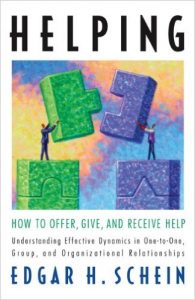
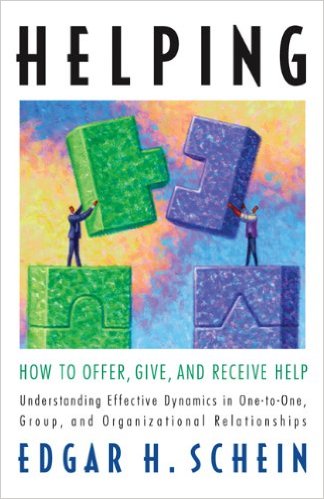
Helping

by Ron Potter May 3, 2016


Helping- How to Offer, Give, and Receive HelpRon’s Short Review:

I consider Edgar Schein one of the fathers of Organizational Culture thinking.  Read anything by Edgar and you’ll be learning something worthwhile.  In this simple book however, he gives some astounding advice on helping people in the most impactful way from your employee to your spouse to your child.  His framework of the roles of client and helper will quickly explain so much about why attempting to help sometimes works and sometimes doesn’t.
Amazon-Buy-Buttonkindle-buy button

0 comments
0 FacebookTwitterEmail
Short Book Reviews

How Adam Smith Can Change your Life

by Ron Potter March 31, 2016

How Adam Smith Can Change your LifeRon’s Short Review:

In this book Roberts demonstrates how Adam Smith (our first real economist) believed there were two main issues that drive a capitalistic system, to love and to be lovable. Amazing fit with the principles of leadership. Highly recommended.

Amazon-Buy-Buttonkindle-buy button

0 comments
0 FacebookTwitterEmail
BlogTeam

Aristotle Strikes Again

by Ron Potter March 24, 2016

photo-1431540015161-0bf868a2d407

As reported in the New York Times recently, Google embarked on an effort to build the perfect team. And as Google would be prone to do, they began to collect data in search of a pattern. As one participant stated, if anyone is good at recognizing patterns it’s Google. I don’t think there’s any argument about that.

However, after collecting data on hundreds of teams the first problem they ran into is that they couldn’t find a pattern. Or more accurately they found too many patterns which is just as much of a problem as finding none at all. So the search continued.

In the end they did find two very interesting correlations that seemed to be present on every good team. Not surprisingly those two elements were trust and respect. The two of them together formed an environment that has been labeled ‘psychological safety.’ If the team members feel psychologically safe because trust and respect has been built, the team will become a high performing team. (Tweet this)

Another pattern that began to emerge however was the productivity of these teams over multiple problems and projects. Teams that fell short on psychological safety didn’t seem to perform well at any kind of problem. Conversely, teams that exhibited psychological safety seemed to perform well no matter the nature of the problem. So the one element that people most often assume to be a needed ingredient, subject matter experts, didn’t seem to make any difference if there was no trust or respect.

Now, here’s the part I enjoyed. The internal name for the effort was called the Aristotle Project. One of the foundational structures that I always introduce to the teams I work with is Aristotle’s Levels of Happiness. The fourth and highest level describes the five things needed for great team work. In Aristotle’s word they include: Truth, Love, Purpose, Beauty and Unity. Every team needs a purpose but to accomplish that purpose they must be able to share and speak the truth, do it in a loving respectful way, in the most beautiful and elegant form possible and finally reaching a commitment of unity. Without those elements a psychologically safe environment doesn’t exist.

Although I’m glad they actually made the effort, had they simply started with what Aristotle knew they could have saved a lot of effort in figuring out what makes great teams.

0 comments
0 FacebookTwitterEmail
BlogMyers-Briggs

The Only Team I Ever Recommended Be Split Up

by Ron Potter February 8, 2016

Diversity

The best teams I’ve ever worked with have had a great deal of diversity of Myers-Briggs Type Indicator (MBTI) preferences on the team.  However, diversity alone is not enough to ensure a high performance team.  But, it is a great foundation.

photo-1453474473052-08cd150dfe87 (1)There has only been one time in my twenty-five plus years of Team and Leadership Consulting that I’ve recommended a team be split up and given other assignments.  That team of seven people were all resident in one particular Myers-Briggs Type Preference.  And while MBTI is certainly not the end-all measurement of team diversity, it produced a very discernable pattern.

THE answer to the question

I would find myself asking a question of one member of the team.  That member often would give me a very complete and articulate answer.  But then I would ask each of the other members if they agreed with the answer and the response was:

  • Yup,
  • Yup,
  • Yup,
  • Yup,
  • Yup,
  • Yup!

All of the other six members responding with a pleasant smile and a subtle nod of the head!

OK, let’s ask a different question: “Could we look at this question from a different perspective and maybe come up with a different answer?”

  • Nope,
  • Nope,
  • Nope,
  • Nope,
  • Nope,

All of the other six members responding with a pleasant smile and a subtle twist of the head!

Different Perspectives

Even when I tried some of the more off-the-wall approaches to perspective shifts:

“How would a gorilla solve this problem?

  • He would grab it by the head and beat it to death!
  • Yup,
  • Yup,
  • Yup,
  • Yup,
  • Yup,
  • Yup!

“How would a giraffe solve this problem?

  • He couldn’t. He’s not strong enough to beat it to death!
  • Nope,
  • Nope,
  • Nope,
  • Nope,
  • Nope,

Change of Scenery

After a few more tries at this I was finally convinced that the members of this team needed to be split up and combined with other people with different perspectives.  My assumption is that didn’t go well.  This team had been together for a long time and in the early days had been extremely productive at getting projects completed.  But the environment had changed and they not only needed to be good project managers, they needed to adapt to changing environments.  Most of them probably had a difficult time blending into teams that didn’t all think alike and in particular didn’t think like they did.

Diversity

Knowing your Myers-Briggs type is not about (or should not be about) what type preference you have and if that’s the “right” way to view the world or not.  The point is that there are 16 healthy type preferences that will each view the world slightly differently.  The point is to use the diversity for the betterment of the team.  You accomplish that be showing respect for and learning from each view point and then determining together the best route for the team to pursue.  Together!

2 comments
0 FacebookTwitterEmail
Happy Anniversary Team Leadership Culture
BlogCulture

Happy Anniversary

by Ron Potter December 31, 2015

Happy Anniversary Team Leadership Culture2015 is an anniversary year for me.  25 years in the consulting business, 15 of those years as Team Leadership Culture (TLC).

Someone suggested that I write the “25 things I’ve learned in 25 years!”  Sounds like a great idea.

#1 thing I’ve learned in 25 years of consulting:

Hit the Sweet Spot!

If you’re a golfer (or at least someone who enjoys the game regardless of skill level like I am), you know that when you hit the sweet spot of the club face, wonderful things happen.  The ball tends to sore long and straight and you’re usually rewarded by hitting at or near your target.  The other thing that golfers experience is that when you do hit the sweet spot, there is this wonderful feeling that it was almost effortless.  There was no clank of the club hitting the ball and no vibration sent up through the shaft upon impact.  Just a nice smooth striking of the ball in a pure form that feels wonderful.

Hitting the sweet spot in business is much the same.  It feels good, things seem to be working in harmony and we create a trajectory that tends to be long and straight.  Wonderful.

But the real question is “So, what is that sweet spot?”  To me it has become abundantly clear over the last 25 years.

That’s the sweet spot.

Again with the golf analogy: as I’ve observed my game through the years I began to realize that on my poor days I only have one (and sometimes none) aspect of my game working, driver, irons or putter.  On my good days I seem to have two of the three working.  But as I look back as my most successful rounds, all three aspects were working on that given day.  Business is much the same.

At every company I work with I can see patterns related to how many “cylinders” the company is hitting on.  As I’m writing this I can see very clearly in my mind one company in particular.  The individual leadership in many instances seems to be very solid and up to the challenge.  This company has a deep culture that has been in place for many years and drives their performance.  But as I look back over the years there seemed to be a particular turning point when team work began to fade.  Individual success, loyalty to a particular leader, unit and division success rather than whole company success began to be the measured standard.  Team work simply seemed to fade away over time.

In decades past it didn’t seem to make much difference.  Success always came.  Conditions in the market place could always be overcome or exploited.  They were the king of the hill and were reward for being on top.  But, in today’s fast paced, every changing world, companies are finding that they need to be quick and nimble.  Only team oriented companies can respond quickly with nimbleness.  Great leadership and deep cultures alone will not survive.  All three, Team, Leadership and Culture, are required to survive in today’s world.

Well, number one of the 25 things I’ve learned over 25 years seemed to come easily.  I’ll have to think about the next 24.  But as I do, I’ll share them with you.

2 comments
0 FacebookTwitterEmail
Short Book Reviews

Content Inc.

by Ron Potter December 26, 2015

Content IncRon’s Short Review: Written for entrepreneurs, but if any business doesn’t think they’re either in the entrepreneurial business or up against an entrepreneurial world, they haven’t been paying attention.

Amazon-Buy-Buttonkindle-buy button

0 comments
0 FacebookTwitterEmail
BlogQualities of a Caring LeaderTrust Me

Qualities of a Caring Leader: Understanding

by Ron Potter December 14, 2015
Source: Robert Couse-Baker, Creative Commons

Source: Robert Couse-Baker, Creative Commons

We need to be acutely aware of other people’s needs, focus, dreams, and abilities before we can help them achieve.

For years the late cartoonist Charles Schulz delighted us as his Peanuts characters Charlie Brown, Linus, and even Snoopy provided a window into the complex (and funny) realm of human relations.

Lucy, the extroverted big sister of Linus, was no exception. Her love affair with the Beethoven-loving Schroeder is legendary. Often we see Lucy stretched out by Schroeder’s piano, watching him with longing eyes. Or she is asking a question or demanding his attention in some other way. Schroeder is oblivious to Lucy, so she tries harder and harder to win his heart. In the end, nothing works. Lucy usually loses her temper and pouts, once again the frustrated lover.

What Lucy never gets is how a change in her approach might improve her chances at winning Schroeder’s attention. Lucy’s entire focus is on her needs, not Schroeder’s. Every attempt to secure the heart of the piano genius is from her perspective, not his. Her compassion is entirely self-focused and has little or nothing to do with him and his needs. No matter how bold or romantic she is, Lucy never gets close to Schroeder because she never learns to first understand him.

Increased understanding of others usually leads to better relationships. Our frame of reference becomes their needs, not our own. It becomes a habit to seek to understand our bosses, our direct-reports, and our peers. This understanding is not developed for manipulative purposes. It is an attempt to help people grow and develop by first seeking to understand them—their motives, needs, and styles. Once we understand others and their individual preferences, we can better communicate with them, train them, and lead them.

Abraham Lincoln was a master at this. In 1864 the New York Herald explained how Lincoln was able to overcome the difficulties of guiding the nation during the Civil War—“Plain common sense, a kindly disposition, a straight forward purpose, and a shrewd perception of the ins and outs of poor, weak human nature.”

Lincoln was a master at getting out to meet and know the people—from generals to office workers: “Lincoln gained commitment and respect from his people because he was willing to take time out from his busy schedule to hear what his people had to say.” From this information, Lincoln came to understand his people. From this understanding, he motivated them, challenged them, and moved them to achieve.

It is always interesting, upon entering an airplane, to look into the cockpit and see all those dials and gauges. Each one has a purpose. Many help properly guide the aircraft to its final destination. If the pilots don’t monitor the right instruments, they won’t have a clear picture of the flight, where they are going, how fast they are traveling, how high they are flying, or even if the craft is right side up.

Similarly, if we do not read all the “gauges” of other people, we will be forced to guess what their behavior and words really mean. Learning to read gauges gives you the ability to understand and respond to others based on their needs and frames of reference.

4 comments
0 FacebookTwitterEmail
Short Book Reviews

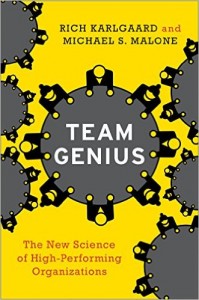
Team Genius

by Ron Potter December 1, 2015

Team GeniusRon’s Short Review: Rich Karlgaard has become one of my favorite authors.  He builds a great case for why the first word in the name of my company is Team.  Team, Leadership, Culture.  You need all three but it doesn’t work without Team.
Amazon-Buy-Buttonkindle-buy button

1 comment
0 FacebookTwitterEmail
Short Book Reviews

Patients Come Second

by Ron Potter October 28, 2015

pat com secRon’s Short Review: This book is very medical community centric but the point they make reinforces what we know from many other studies.  Focusing on your employees first, your customers (patients) second and your finances third is the best way to engage your employees to positively impact your customers and finances.
Amazon-Buy-Buttonkindle-buy button

0 comments
0 FacebookTwitterEmail
Short Book Reviews

Return on Character

by Ron Potter August 29, 2015

Return on CharacterRon’s Short Review: Kiel does a really good job of answering the age old question, “Is there any Return on Investment (“ROI”) from Character?  He makes a strong case that “ROC” may provide the greatest ROI of any factor.

Amazon-Buy-Buttonkindle-buy button

1 comment
0 FacebookTwitterEmail
BlogCulture

Be Bold, Buy a Toyota

by Ron Potter August 27, 2015
Image source: Daniel, Creative Commons

Image source: Daniel, Creative Commons

I had to chuckle when I heard this latest marketing campaign from Toyota.

Nothing against Toyota, I’ve owned a few and had good experiences. But it just seemed ironic to say, “Be bold! Buy the most mass produced car from the largest auto manufacturer in the world!”

I work for companies that have over 30,000 employees, over 100,000 and over 200,000. And when I’m at those companies I will hear and see slogans like:

  • Be bold
  • Take risk
  • Fail Frequently
  • Be innovative
  • We thrive on creativity

And that makes me chuckle as well.

Some well documented studies suggest that once organizations cross the 150 employee line, they become, by nature, more risk adverse as they seek and require more reliability and predictability. They achieve this through standardization which is the opposite of messy risk taking innovation and creativity. An organization of thirty, fifty, or one hundred thousand has a lot of people at lots of layers with veto power.

Build it and they will come

I’ve had the opportunity to work with at least four companies who were the largest in the world in their industry, and I’ve noticed one constant phenomenon regardless of the overall culture of the company: You can always find pockets of excellence. Somewhere a leader and team are building a great culture within their sphere of influence that is bold, innovative, growth oriented, respectful, fast failing—all the aspects that make a great and productive place to work.

Another observation is that good people are always scrambling to get into these teams, divisions, or groups. When you build a great culture, you’ll never be short on talent.

Be bold. Build that great team. Be that great leader. Create that great culture. It’s fun! It’s rewarding.

0 comments
0 FacebookTwitterEmail
Newer Posts
Older Posts
  • Facebook
  • Twitter
  • Linkedin
  • Rss
  • About This Site
  • About
    • Clients
  • Services
  • Resources
    • Trust Me
    • Short Book Reviews
  • Contact

About this Site | © 2024 Team Leadership Culture | platform by Apricot Services


Back To Top
Team Leadership Culture
  • Team
  • Leadership
  • Culture
  • Myers-Briggs
  • Trust Me
  • Short Book Reviews
 

Loading Comments...