Team Leadership Culture
  • Team
  • Leadership
  • Culture
  • Myers-Briggs
  • Trust Me
  • Short Book Reviews
Top Posts
Obituary
REPOST: Four Functions, Three Rules
ROUNDUP: The Rise of AI
REPOST: Facing Adversity Series
ROUNDUP: Curiousity
ROUNDUP: Deep Work
REPOST: Character vs. Competence
REPOST: Opposite of Victim
REPOST: Listening With the Intent to Understand
REPOST: Performance vs Trust
  • About
  • Services
  • Resources
    • Trust Me
    • Short Book Reviews
  • Contact

Team Leadership Culture

  • Team
  • Leadership
  • Culture
  • Myers-Briggs
  • Trust Me
  • Short Book Reviews
Category:

Blog

BlogMyers-BriggsMyers-Briggs In-Depth

Myers-Briggs In-Depth: Energizing: Extraversion vs Introversion – Part II

by Ron Potter March 2, 2015

MeyersBriggsIn-DepthIn part I of our discussion of Extraversion and Introversion I discussed the misunderstandings that can occur between the two. Today, I’ll unpack that further.

Meeting Phases – Balancing Extraversion and Introversion

All meetings in one form or another are made up of three stages:

  • Brainstorming Divergent Phase – Gathering of information, ideas, beliefs and assumptions. Wide open throw out any idea or concept, get it on the chart and we’ll see what sticks.
  • Prioritizing Convergent Phase – Here we begin to look for patterns, narrow down the focus, combine items, and see if there are some themes that will focus our further work.
  • Deciding Phase – Bring it to a conclusion. There’s a lot to understand about decision types and processes. When we get to this phase we’ll talk about balancing each of the four functions, not just the Energizing function.

Meetings may be constructed of all three phases in sequence or any given meeting may be dedicated to any one or two phases with the entire process playing out over several meetings. The point is to be very clear about which phase you’re in and balancing functions in each phase.

Photo Credit: Porsche Brosseau, Creative Commons

Brainstorming

The next time you start a brainstorming session (information gather divergent phase), notice the dynamics at work. If you start with a true blank slate (you’ve pulled up the flip chart and are standing there with pen in hand) you’ll notice that the first people to contribute ideas tend to be the Introverted crowd. Isn’t that interesting? If you’ve done your duty and put out an agenda with the topic to be discussed, the Introverts come to the meeting with some pre-thought ideas.

Agenda Timing

Ask an Introverted thinker when they like to receive an agenda.

  • The first answer is “well in advance.”
  • The second answer is “at least a day.”

Ask an Extraverted thinking when they look at an agenda.

  • The answer given most often is “On the way into the meeting.”

Extraverts just want to know what we’re going to talk about. Introverted thinkers want to think about what they’ll say.

Ebbs and Flows

As the brainstorming session gets underway the first few contributions to the list come from the Introverted thinkers but pretty soon enough ideas are getting recorded that trigger the Extraverted thinkers and now they begin to throw ideas out with such a pace that the Introverts have now gone quiet.

But two things must happen to keep things balanced:

  1. The Extraverts will eventually run out of ideas and now is the time to ask (and wait for) more ideas. It’s usually the Introverts that now have a chance to contribute further to the list.
  2. The Extraverts will begin to see patterns in the list and will want to and actually begin to move on to the prioritizing stage of the process.

You must stop this from happening and keep the focus on the generation of ideas for the brainstorming list.

Key to the Balancing Process

Now, here’s the key to the whole process, once all ideas have been gathered, ask the team to stop talking, pick up a pen and write down the three best ideas that they believe just came out of the brainstorming phase of the process.

If you could hear inside their heads you would hear the Introverted thinkers saying something like: “Finally, I’ve got a minute to think through this because I believe there were some brilliant ideas tossed out there. Let’s see, number one is obvious, number two is also very clear, there is actually a three and a four that can’t be missed but I think we can make that one a 2a.”

The Introverts just got more engaged in the process.

Meanwhile, notice the Extraverted thinkers writing down their three best ideas “quietly”. The conversation in their head would probably sound something like this:

“Let’s see, three best ideas? Well, the number one is quite obvious. Number two? Number two? Number two….. Where’s the coffee?” Pretty soon, the Extraverts are over at the coffee pot together.

Why? So they can talk. “Hey, what was your number two? Oh, yea, what a great idea. In fact if we combine that with item D, I think it could be an even better number two.”

The extraverts need to talk to keep their energy up to be able to answer the question, “What were the three best ideas to come out of the brainstorming?”

Ease into the Prioritizing Phase

Now, as you ease back into the meeting

  • get the Introverts head out of their lists and
  • get the Extraverts back from the coffee pot

you begin to ease back into an extraverted environment.

Go around the room and ask each person what their number one idea was. People are starting to talk again but it’s very structured and very controlled which allows the Introverts to further reflect and think about their list.

And the Extraverts are starting to hear other people’s ideas and you may even see them taking notes for when it gets to be their turn. And now, you’re off to the races. The Extraverts have gotten active again and the conversation is nonstop. Good. Both functions have had an opportunity to energize and get their thoughts on the board.

Now, just be careful to create the same “balancing act” between this prioritization portion of the meeting and the deciding portion of the meeting. The Extraverts will begin to talk about making a decision before the Introverts have had an opportunity to sort out the discussion on prioritization. Make sure there is another moment when you stop the conversation, let people gather their thoughts and get them recorded and contemplated before you move on to the decision making Phase.

Share with us some of your experiences from both side of this equation. What do you wish the other preference type would understand about how you get energized?

1 comment
0 FacebookTwitterEmail
BlogTrust Me

Finding Sparky

by Ron Potter February 23, 2015
Finding Sparky

Image Source: Orange County Archives, Creative Commons

Many times a humble leader discovers strengths in his or her coworkers that even they have failed to detect. Sometimes you just don’t know what precious gems are buried beneath the surface of another human being. We call this process “finding Sparky.”

Say again? Let us explain with this story.

When he was a young boy, his friends gave him the nickname “Sparky” after a horse in the Barney Google comic strip. Though he was quite intelligent, Sparky’s shyness and timidity made school an agonizing experience. High school was especially challenging. He was a small, 136-pound pimply nobody. No one seemed to care about him. He remembered being astonished whenever anyone said hello. He had some skill in golf but lost an important match. He was a fair artist, but even the staff of his high-school yearbook would not publish his drawings. No one, including Sparky, seemed to think he had much to offer. He later said about this period in his life, “I never regarded myself as being much and I never regarded myself as being good-looking and I never had a date in high school, because I thought, who’d want to date me?”

After high school he completed a correspondence course in art. He wrote a letter to Walt Disney Studios, hoping to be a cartoonist there. The studios requested drawings, and he worked many hours on them before mailing them to Disney. His reply from the studios: “rejected.”

How did Sparky respond? He began drawing an autobiographical series of cartoons about a chronic underachiever, a boy whose kite would never fly. It wasn’t that long before the whole world became acquainted with this character named Charlie Brown—as well as friends of his named Lucy, Linus, Pig Pen, and Snoopy. Sparky—Charles Schulz—became the most famous and wealthy cartoonist ever. At the height of his popularity, his cartoon strip Peanuts appeared in 2,600 papers in twenty-one languages in seventy-five countries. In 1978 he was named International Cartoonist of the Year. The whole Peanuts cartoon gang once appeared on a cover of Time magazine. This “loser” in high school really had some potential after all.

A humble leader is always looking for Sparkies.

Each person with whom a leader works has hidden gifts and talents, and someone may even have the enormous potential of a Sparky. We need to help them uncover, develop, and use those talents. Humble leaders relish the idea of helping people find their unique niche. They enjoy moving people along to bigger and better things. They celebrate the victories and provide encouragement when their people are discouraged or fearful of moving ahead.

Take Gary, for example. He worked in the mailroom for one of my clients. Unknown to his employer, Gary was a computer genius. When the president of the company needed help, I suggested Gary, and he delivered. Today, Gary is a highly respected computer executive. He got his start from an executive who was open and humble.

Many leaders focus on people’s weaknesses. They are always trying to “fix” someone. They fail to recognize potential and help people develop a path for personal success and reward.

Share with us some “sparky” stories about that person who just blossomed when you or someone helped them see their strength. Maybe someone saw you as a “sparky.” Please share.

0 comments
0 FacebookTwitterEmail
Adirondack Golf
Blog

Adirondack Golf

by Ron Potter February 19, 2015
Adirondack Golf

Image Source: John Haslam, Creative Commons

Adirondack Golf Courses. That’s the title of a book written by J. Peter Martin, a local pro in the Adirondack area. A client of mine sent me a copy for enjoyment and it was enjoyable.

I really related to the opening section titled “Golf and Life.”

“The main idea in golf as in life is to learn to accept what cannot be altered and to keep on doing one’s own resolute best whether the prospect be bleak or rosy.”

Life, like golf has its ups and downs. In golf if you can approach your “situation”, be it sitting just right in the middle of the fairway or stymied behind a tree, with a calm approach to do the best you can, you will experience the most success and the most enjoyment in your game.

I need to add another observation I’ve had through the years. Playing golf in Scotland, the home of golf, is different than playing golf in America. In America golf courses have been designed, built and manicured for the purpose of playing the game of golf. In Scotland, the old courses grew from natural conditions. They were usually on ground that was useless for any other purpose and developed into locations where people play the game of golf. Because of this difference, Scottish golfers seem to have a different (and I think healthier) attitude about the game.

To the American golfer, if I stand on the tee, execute a very nice swing, send the ball flying down the fairway, I expect to be rewarded by finding the ball in a good place on a manicured fairway, perfectly situated for the next shot. But Scottish fairways are different. After that “perfect” drive I may find my ball in a deep hidden bunker right in the middle of the fairway. Or, because of all the natural moguls in the fairway, I may find that my ball landed in the middle of the fairway but hit one of the moguls and bounded into the gorse of the rough.

Now to the American mind, That’s Not Fair! “I hit a good drive, I did everything right, I should be rewarded with a good result!” The Scottish golfer would say “Why are you complaining? This is golf (life). Find the ball and do your best to hit it again.”

In life, and especially corporate life, we can do everything right and still experience less than desirable results. But the best leaders and performers live by that original quote “Accept what cannot be altered and keep on doing one’s resolute best whether the prospect be bleak or rosy.”

0 comments
0 FacebookTwitterEmail
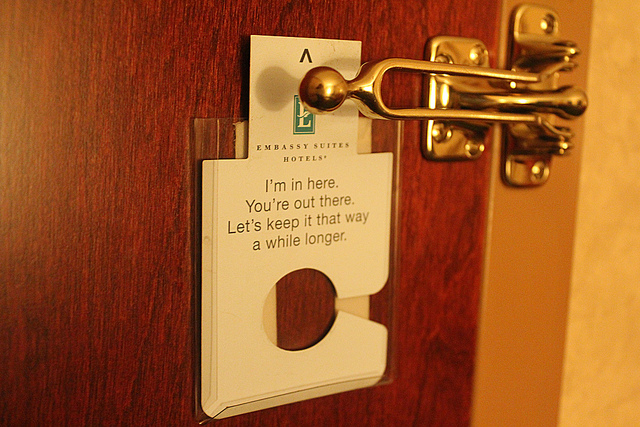
"I'm in here. You're out there. Let's keep it that way a while longer"
BlogMyers-BriggsMyers-Briggs In-Depth

Myers-Briggs In-Depth: Energizing: Introversion vs Extraversion – Part I

by Ron Potter February 16, 2015

MeyersBriggsIn-Depth

This function is responsible for more misunderstandings and confusion than any of the others. At least that’s my observation.  This is why I always spend more time on understanding this function when I’m working with teams.

There are some very natural dynamics in place here that often sabotage our ability to balance this function in team meetings. Team meetings are, by definition, extraverted affairs.

“Why did we call you all together for this team meeting? To talk!”

So right off the bat, team meetings are designed for and often run by extraverts. Even if the team meeting leader or facilitator happens to have a preference for introversion, the extraverted crowd often takes over the dynamics of the meeting without even realizing it or intending to do so.

Let me start with the introverts (which we seldom do in team meetings). I often ask one question of my introverts in team meetings “How often have you left a meeting and as soon as you walk out that door right there (pointing to an exit door) do you think to yourself,

  • I wish I had thought of that.
  • Oh, now I know what Sue was getting at.
  • I wish I could have gotten a word in edgewise because I’ve really given some thought to this issue.

In one form or another every introverted thinker says “All the time.” “Every meeting.” “Often.”

Missing Half the Brain Power

Isn’t that interesting that we called a meeting, brought all of the high powered and high priced brains into the room together to solve a problem or come up with an innovative approach and yet because of the dynamics of the meeting process we let half that brain power walk out of the room without ever hearing their ideas or taking advantage of their well thought ideas. What a loss!

Introverted Energy

Why does this happen? Remember that this is our Energizing function. Our extraverts gain energy from the conversation while our introverted partners get energized by reflective thought and a moment of quiet. Because our team meetings are naturally extroverted environments, our extraverts come in with the goal to get the conversation started and keep it going (adding energy all the way) from:

  • the brainstorming (information gathering divergent stage) right though
  • the prioritizing (consolidation of ideas into a few good options convergent stage) right up to and through
  • the decision making phase.

Meanwhile, unless our Introverted thinkers have a moment to reflect and gather their thoughts and re-energize between these three phases, they:

  • lose energy
  • drift away
  • give up on getting their thoughts injected and will even dig in their heels and try to halt or delay the decision making phase if they
  • haven’t had sufficient time to get on top of their thoughts through all of the conversation.

Bringing Balance

So how do we get on top of this function and bring the balance required to get the best out of both types of functions? The easiest and most profound approach is to define and separate the phases of a meeting. All meetings in one form or another have three phases:

  1. Brainstorming, idea gathering, learning and understanding divergent phase
  2. Prioritizing – consolidation of ideas, narrowing down potential options convergent phase
  3. Deciding

Image Source: Quinn Dombrowski, Creative Commons

Let’s Keep Talking

As we stated earlier the extraverted types would prefer that we keep talking right though all three phases non-stop because that feeds their energizing needs. However, by simply separating the phases of the meeting with a brief pause for reflection and thought between each stage we allow our introverted partners to get re-energized through the process.

In coming blogs we’ll discuss many of the techniques that will help balance the functions between extraverted and introverted as well as the other functions on the Myers-Briggs chart.

Extroverted or Introverted?

Do you know if you’re extraverted or introverted? It’s not just about talking or enjoying yourself at parties. It’s about your energy. What gets your juices flowing? How do you grapple with difficult issues or problems or decisions that must be made? Do you need to engage in conversation or after the conversations do you need to withdraw and reflect, think, contemplate what was discussed?

Share with us some of your experiences from both side of this equation. What do you wish the other preference type would understand about how you get energized?



Myers-Briggs In-Depth is a blog series in which I dive into each MBTI function with more detail, providing some practical applications for creating better dynamics and better decision making. Click here to read the entire series.
Interested in an overview of each of the four Myers-Briggs functions? Click here to read the Using MBTI to Great Advantage series.

1 comment
0 FacebookTwitterEmail
BlogTeam

Hard Choices

by Ron Potter February 12, 2015

I read Jeffrey Katsenberg’s book, “Hard Things About Hard Things.”

I just listened to Ruth Chan’s TED talk, “Hard Choices.”

So here’s the Hard Thing about Hard Choices:

Ruth explains that any choice that can be quantified is an easy choice because all numeric values can be related to each other based on their comparative amounts but hard choices are based on values.
Values can’t be quantified and compared to each other. Values are based on who we are and who we want to be. Ruth goes on to look at the dilemma from a person’s point of view and concludes that taking the quantitative approach is the safest way out. Making a value based decision forces us to choose who we want to be. I agree. This is a great personal growth philosophy.

But here’s the hard part: I work with corporate leadership teams where I help individuals make their own personal value and growth decisions through my personal coaching. The problem is we also have to make hard team decisions.
I believe most corporate teams fool themselves into believing they only make logical, fact based decisions or believe all decisions can be reduced to a number exercise so that the >=< analysis can be made. But as Ruth explains, hard choices are not quantitative in nature; they’re value based.

So how do you get a bunch of MBA trained financial experts, engineers, marketers, and scientists to make the hard choices based on value?

You need to build team.
Not just a team with defined roles and responsibilities, not just a team with clearly defined interfaces and decision gates. Not just a team of various functions that get together to discuss and coordinate the business. Not a team, but TEAM!
Teams are built on respect and trust. Teams honor and appreciate the diversity of thinking, attitudes, and beliefs that we bring to the table. Teams know who we are and what shapes us and what values we hold dear and what values we won’t violate.

These teams are fully capable of making the hard decisions and are fully capable of making them work.
If you want to build a great company, build a great TEAM.

Have you been fortunate enough to be part of a great team? Share with us how that happened. What made it work? What’s keeping your current team from being a great team?

0 comments
0 FacebookTwitterEmail
BlogTrust Me

Four Qualities of a Humble Leader

by Ron Potter February 9, 2015

In the last post, we talked about rigid, proud leadership and how that affects a company. But what about a humble leader? How do they meet their responsibilities and yet be open to the guidance of their direct reports?

They take a much different approach.

Humble leaders are not so self-absorbed as to think that they don’t need to listen and be open. Their spirits are not critical because they are always open and scanning their employees, customers, and systems for new and better ideas. Following are some qualities of humble leaders.

A humble leader:

  1. is teachable
  2. never shuts the door on educating themselves
  3. remains open themselves to the ideas and concepts of others—including their followers
  4. enriches an organization and helps it stay ahead of the competition.
Image Source: Rob Bashar, Creative Commons

Image Source: Rob Bashar, Creative Commons

A teachable leader is open to personal and organizational change. This kind of leader is quick to understand that old routes are not always the best or the fastest. Conditions change.

Research from the Center for Creative Leadership (CCL) shows that people can optimize their personal abilities as well as turbocharge their organization’s adaptability and response to competitive challenges when they are committed to learning. According to researcher Ellen Van Velsor:

If things are going to continue to change, the one thing companies need above all else is people who have the ability to learn.

(See also “Learn or Die” by Edward Hess in my Reading List.)

To be teachable, one must devote a significant amount of time to learning.

A humble leader is flexible. An old proverb reminds us that “We cannot direct the wind, but we can adjust the sails.” Many of us have spent our time trying to be in control, but a humble leader learns how to be effective without being in control. Humble leaders know that they cannot control people or circumstances. The irony is that the more they loosen their grip, the more they gain. The more flexibility—rather than control—that they can build into themselves, the more they succeed.

A humble leader welcomes change. Change often equals growth. But not change for the sake of change. A humble leader needs to discern the right change, a skill that is developed by being open and teachable.

Humility leads to personal openness, teachability, and flexibility. Humility casts fears aside and frees leaders to energize and build their organizations toward common goals and vision. Humility is the fertile ground where the seeds of trust sprout.

Being humble and teachable means learning to trust others and their opinions and instincts. It means listening with the intent of learning instead of simply responding. It means seeking personal development from every situation, experience (both good and bad), and transaction.

What in your life do you need to let go of so you can become more humble?

Have you shared your vision with your colleagues? Have you asked them to participate? If not, why haven’t you?

Whom in your organization can you mentor—develop to his or her full potential?

What can you do to improve your listening skills?           

0 comments
0 FacebookTwitterEmail
BlogLeadership

Pay Attention

by Ron Potter February 5, 2015

What are you willing to pay for?

Maybe it’s that nicer car or maybe just the nicer option package on the car you’ve already decided to buy.

Maybe it’s shopping at Whole Foods versus another grocery store.

Maybe it’s those concert tickets in the center stage seats.

There are certain things beyond our necessities that we’re willing to pay for. But why? That less expensive car still gets you from point A to point B. Sitting farther back at the concert may even provide better sound. So why do we pay for these items? Perceived value!

Image Source: 401(k), Creative Commons

Image Source: 401(k), Creative Commons

We’re willing part with our hard earned resources because our perception is that it will provide us with value that we appreciate.

Have you noticed that from our elementary school days, we’ve been told to pay attention! Why do we have to pay to give someone our attention? Because it takes focus, concentration, discipline, and, most importantly, there will be a value received for the price paid.

Therein lies the problem. If we don’t actually believe that we’ll learn something by paying attention or that the other person has nothing of value to offer, we’re not willing to pay. This relates closely to another blog I wrote about listening with the intent to understand. If we’re not willing to discipline ourselves to truly understand the other person or pay to give someone our attention then we’re exposing our own ego and arrogance.

When our ego and arrogance is the driving force behind our inability to understand another person or we’re not willing to pay the price of granting another person our attention, we’ve violated the first principle of great leadership: humility.

When great leaders are willing to work from a foundation of humility by offering to pay to give others their attention in order to truly understand the other person, they begin to create a culture that develops great teams that are able to grow together to generate a synergy that surpasses their own expectations.

Be willing to pay attention, you’ll be blown away by the value you’ll receive.

I think of doctors in clinical environments. I consider my cardiologist one of the best doctors I’ve ever had because while he is with me it seems that I’m the only thing that matters to him. Although I know he is paying a great price by giving me his attention and not being distracted by all of the commotion going on outside the room. I appreciate the price he pays.

Share with us about the time when someone paid the price to give you their attention.

0 comments
0 FacebookTwitterEmail
BlogMyers-BriggsUsing MBTI to Great Advantage

Using MBTI to Great Advantage – Work Life

by Ron Potter February 2, 2015

Using MBTI to Great Advantage is a blog series in which I’ll do an overview of each of the four Myers-Briggs (MBTI) functions and then in subsequent blogs will dig into each one in more depth with some practical applications for creating better dynamics and better decisions making. Click here to read the Series Introduction.


Work Life Overview: Judging vs PerceivingMBTI series header

Myers-Briggs (MBTI) calls this your “living” function but I never quite knew how to relate to that word so I’ve modified this slightly to “Work Life”. How do you like your work life structured around you? Our Judging types like their life organized and structured. Plan their work and work their plan. Our Perceiving types like things a little more open ended. Be ready for changes and surprises. React to the moment. Figure it out as you go.

Our business schools and businesses have taught us the need for organization and structure so I tend to see an overabundance of Judging types in the business world, until I ask people how they like their vacations structured. The most organized business person in the world might say to me “Totally unstructured! All I want to do is get away from the rat race for a while and be completely in the moment and do whatever I decide to do at the time. Or maybe simply decide to do nothing!” I find that many people are well trained and disciplined at work but as soon as they can get away from it will revert to their more natural Perceiving type on their own time. We’ll talk about the need for Balance, Balance, Balance in future blogs as well as some deeper and often hidden implications of this function playing out in the work place.

Four Functions and Three Rules. So there you have a quick overview of the four functions of Energizing, Perceiving, Deciding and Work Life and I hope you’ve already gotten the message that the best way to manage these functions is through Balance, Balance, Balance. Teams that accomplish this balance in a trusting, respectful manner are always the best teams. They make better decisions more quickly that are more universally accepted than teams that never figure out how to use their diversity. This is one of the best technique and mental model that you can ever implement for overall better teamwork!

Sixteen Types. It’s also important to understand that it’s not just the individual function dichotomies that make a difference, it’s the combination as well. An Introverted preference may function very differently when it’s part of an ISTJ preference set than when it’s part of an INFP preference set. All of this to say, don’t become the arm chair psychologists and assume you can figure out someone’s type and therefor figure them out. You can’t. Your best bet at success is to master the process that brings out the best of all of the fourteen type preferences.

The Four Functions:
1. Energizing
2. Perceiving
3. Deciding
4. Work Life

The Three Rules:
1. Balance
2. Balance
3. Balance

Over the next several blogs we’ll take a more in-depth look at each of the functions and learn some great techniques to create balance, balance, balance.

0 comments
0 FacebookTwitterEmail
BlogLeadership

Consensus: The Split at the Top

by Ron Potter January 29, 2015

I just love Scrat, the saber-tooth squirrel from the Ice Age movies. He always creates some minor little crack that looks harmless, but as the crack propagates, it begins to create all kinds of havoc in his world with major consequences. Such ‘cracks’ can be destructive and debilitating in corporations.

Image Source: Lars Hammer, Creative Commons

Image Source: Lars Hammer, Creative Commons

I was working with a couple major functional divisions within one corporation, trying to do some team building. These functions needed to cooperate with each other in order for the company to be healthy and thrive, they just couldn’t seem to get along. After a few of the normal approaches to overcome differences didn’t seem to produce any progress, I began to dig deeper.

The story that began to emerge was that the people in the functions had no problem working with each other and, in fact, preferred it. The problem was that their top leaders wouldn’t allow or, more impact-fully, didn’t want the cooperation to happen.

When I sat down with the first of the two senior VP’s that were responsible for one of the functions and asked about the oppositional position he had with the other senior VP, his response was, “Oh, there’s no opposition between us. We worked that out long ago.” I thought great, an answer exists, we just need to get the message down to the functions. So I asked, “Tell me about the solution the two of you worked out.” His response? “We simply agreed to disagree!” Well, that was very gentlemanly (and lady like in this case) of him but very destructive.

The difference between them didn’t go away, but like Scrat’s minor crack, propagated deeply into the organization. As I would talk to members down in either organization, they knew that their ultimate bosses disagreed and many of them took it on as their job to make sure the other function failed in a belief that their particular boss would be vindicated or somehow pleased.

Senior leaders cannot agree to disagree. They must build consensus. (More about how to build consensus later.) They’re part of a leadership team. If members of a team agree to disagree, there is no team.

Have you experienced a peer who just didn’t agree with you but was also unwilling to even work on the issue, preferring to agree to disagree?

How has disagreement of leaders above you on the org. chart impacted how you work with your peers?

1 comment
0 FacebookTwitterEmail
BlogTrust Me

No Soup for You! & Rigid Leadership

by Ron Potter January 26, 2015

One of the more popular episodes of the Seinfeld television series was the Soup Nazi. The story line centered on an aggressive man who owned a small restaurant where the locals stood outside in long lines to enjoy takeout orders of his delicious soup concoctions. However, these same customers were forced to tolerate this man’s rigid rules:
“Only one customer in the restaurant at a time.”
“Place your order immediately.”
“Do not point.”
“Do not ask questions.”
“Pay and leave immediately.”

Customers were forced to do what this man said, or they were told, “No soup for you! Come back in three months!”

Image Credit: Seinfeld, Season 7, Episode 6, Shapiro/West Productions, Castle Rock Entertainment

Image Credit: Seinfeld, Season 7, Episode 6, Shapiro/West Productions, Castle Rock Entertainment

Leaders with a Soup-Nazi style have one way of doing things—their way. Their focus is totally on themselves. They do not want (nor do they take) any suggestions. They “know” what is best for the organization and everyone in it. They “allow” people to “help,” but only under their carefully prepared set of rigid rules. They are a proud leader.

An “unhumble” leader is notoriously self-focused. Writer and scholar Henri Nouwen once said,

“It seems easier to be God than to love God, easier to control people than to love people.”

Isn’t that the perception most people have? It is far easier (and seemingly satisfying) to be focused entirely on ourselves and not on the needs of others or the opportunities presented by others.

A proud leader seems to “know” the truth and are usually its source. They take every measure to protect their point of view; they deny any effort to clarify the thought process; they do not encourage debate; they resist building a community of advisers.

A proud leader is critical. Such leaders develop self-centered standards and then tend to criticize anyone who does not follow their rules or who shows creativity and independence.

Yet, in today’s fast changing environment we need creativity and independent thinking and ideas more than ever.

Why are so many leaders resistant to change and innovation?

  1. They only want self-initiated change. Leaders who lack humility seek to develop only their own ideas. They have no interest in others’ opinions.
  2. They fear failure. We have seen so many potential leaders paralyzed by fear of failure. They fail to reach out for new territory because they are so afraid of losing. They do not understand the positive or learning side of failure.
    Baseball stars strike out more often than they hit home runs. However, they keep swinging for the fences. The best golfers in the world hit the green in regulation (two strokes under par) only about 75 percent of the time. One-fourth of the time they miss the mark. These golfers accept their failures, however, and give it their best to get back on track.
  3. They are too comfortable. Many times present realities give us hope that we do not need to change. We sit in our current situations, do the same thing every day, and hold on for dear life to past achievements.

A leader willing to change brings about change in the organization. Embracing change fosters an attitude of success and can deliver us from the quagmire of sameness.

Have you demonstrated willingness to:
Change?
Be open and seek new, maybe novel ideas?
Help your teams understand and experience experimentation?

Check your need for control or your fear of failure. It’s a great barometer of future success.

1 comment
0 FacebookTwitterEmail
BlogLeadership

Perspective Changes

by Ron Potter January 22, 2015

In my executive coaching work, both with individuals and teams, one of the most useful techniques is bringing alternate or multiple perspectives. We so easily get entrenched in our own perspective, it can be difficult to see solutions or other possibilities.

I recently experienced heart bypass surgery. During one session in the post op process, I was lying in the hospital bed with the doctor on my right, his physician’s assistant on my left with my two nurses at the foot of the bed, and my wife over my shoulder.

At one point when the pain was severe, even the nurses had to look away. I thought, “I’m not sure how much the human body and psyche could stand more pain than this.”

But my mind immediately shifted to my father, lying in a muddy field hospital, (I’ve seen some of the hospital photos.) 4,500 miles away from home with no family around, with doctors and nurses who I’m sure cared very much, but had no time to spend comforting a patient, having his leg amputated.

Image Source: Ulf Klose, Creative Commons

Image Source: Ulf Klose, Creative Commons

My conditions, while seeming extreme, were nothing compared to what my father had experienced during WWII. My change in attitude and experience at that moment were such that even the doctor noticed and later asked me about what happened.

Nothing really, just a change in perspective. Perspective is very powerful. It can even change the level of pain we’re experiencing.

The next time you’re in that extremely “painful” corporate situation, see if you can help yourself and your team gain a different perspective. It often takes a jarring experience or question. “What would this look like to a chimpanzee? How would this be viewed from a four person jazz band? How about a 100 person symphony orchestra?” None of these questions make sense or they certainly are all out of context. But that’s the point! Get out of your context. Look at this from a new perspective, not just a different point of view from the same context; “How would our competitor view this issue?” Shake it up! Gain a new perspective.

Tell us about the last time that four year old child asked you a question that shook your perspective? Share with us a story or two.

0 comments
0 FacebookTwitterEmail
BlogMyers-BriggsUsing MBTI to Great Advantage

Using MBTI to Great Advantage – Deciding

by Ron Potter January 18, 2015

Using MBTI to Great Advantage is a blog series in which I’ll do an overview of each of the four Myers-Briggs (MBTI) functions and then in subsequent blogs will dig into each one in more depth with some practical applications for creating better dynamics and better decisions making. Click here to read the Series Introduction.


Deciding Overview: Thinking vs. Feeling

MBTI series header

Now that you’ve “perceived” (the first decision making function) the world around you (see previous MBTI blog), how do you then finally decide (the 2nd decision making function)?

As we work our way through the Myers-Briggs Type Indicator (MBTI), we once again encounter two words that carry a lot of pre-conceived baggage. Most business leaders assume (incorrectly) that business decisions should be made on a purely logical, fact based, “thinking” basis. There isn’t any room for touchy-feely in business decision making.

Well, the Feeling side of this function isn’t necessarily touchy-feely and in fact some of the most hard-nosed leaders I’ve met actually fall on the Feeling side of this equation. It’s not about emotion it’s about values and the “right” thing to do. Our Thinking types can lay out an argument that is purely logical, based on facts, and structured top to bottom building a clear argument for their case. Our Feeling types may look at all those facts and logic and actually agree with the conclusion but at the same time say “Who cares? Is this the right thing to do for our employees, customers, shareholders?”

Emotional Thought. This balancing act is often referred to as “Emotional Thought.” In his book Learn or Die: Using Science to Build a Leading-Edge Learning Organization, Edward Hess says”

 “Neurobiological research has shown that certain aspects of cognition, such as learning, attention, memory, decision making, and social functioning, are ‘both profoundly affected by emotion and in fact subsumed within the processes of emotion.’” (Bolds are mine)

This one is tough. Balancing this one becomes particularly tricky but has profound impact if we achieve the right balance. Also, all of the latest brain research that has been exploding over the last ten to fifteen years points to the fact that we as human beings actually make our decisions based on the Feelings side of this equation and then justify our decision based on logic (Thinking). We’ll have a lot more to learn about this one in coming blogs.

But, once again, the three rules for being more effective at decision making are:
1. Balance
2. Balance
3. Balance

This one may be the more difficult one to personally balance. What have some of your experiences been either successful or unsuccessful?

1 comment
0 FacebookTwitterEmail
Newer Posts
Older Posts
  • Facebook
  • Twitter
  • Linkedin
  • Rss
  • About This Site
  • About
    • Clients
  • Services
  • Resources
    • Trust Me
    • Short Book Reviews
  • Contact

About this Site | © 2024 Team Leadership Culture | platform by Apricot Services


Back To Top
Team Leadership Culture
  • Team
  • Leadership
  • Culture
  • Myers-Briggs
  • Trust Me
  • Short Book Reviews