
Team Leadership Culture
  • Team
  • Leadership
  • Culture
  • Myers-Briggs
  • Trust Me
  • Short Book Reviews
Top Posts
Obituary
REPOST: Four Functions, Three Rules
ROUNDUP: The Rise of AI
REPOST: Facing Adversity Series
ROUNDUP: Curiousity
ROUNDUP: Deep Work
REPOST: Character vs. Competence
REPOST: Opposite of Victim
REPOST: Listening With the Intent to Understand
REPOST: Performance vs Trust
  • About
  • Services
  • Resources
    • Trust Me
    • Short Book Reviews
  • Contact

Team Leadership Culture

  • Team
  • Leadership
  • Culture
  • Myers-Briggs
  • Trust Me
  • Short Book Reviews
Author

Ron Potter

Ron Potter

BlogCulture

Communication

by Ron Potter August 5, 2021

You’ve heard me talk often about the need to listen with the intent to understand.  The better you get at this the better you’ll understand what’s being said.

But the other side of communication is talking.  Just because you said something doesn’t mean your listener understands.  Simon Sinek says “Communication is about ensuring others hear what we mean”.  Just because you said it doesn’t mean your listener(s) understood it.

Communication

Our word communication is from the Latin communcare, meaning to share.  “The act of developing meaning among entities or groups through the use of sufficiently mutually understood signs, symbols, and semiotic conventions.”  To quote Simen Sinek again “Communication is not about saying what we think.”

Act like an owner

I once worked with a client that was publicly owned and had a leadership team from all over the world.  It seemed to the CEO that there was too much command and control attitude coming from his leadership team so he began talking with them about acting like owners, not just managers running a company that was owned by the stockholders.  He was hoping this “Act like an owner” attitude would institute a more caring and inclusive approach by his leadership.

However, one member of the leadership team seemed to “double down” on the command and control approach to his leadership.  The CEO asked me to talk with the individual to see if we could figure out why the message didn’t seem to be getting through.

I talked with the VP and asked what he thought of the “ownership” approach.  His response was very positive.  He agreed that the entire team should act like owners and that should produce some great results.  I was having a hard time aligning his words with his actions so I asked him what “ownership” meant to him.

As it turns out the neighboring country had invaded his homeland 600 years ago.  They took over all the land and essentially enslaved the native population.  To him, that was ownership.  Complete control to rule the land as they wanted with a complete command and control attitude.  His reaction was that the leadership team should absolutely act like owners!

Communication is about conveying meaning

“Communication is about ensuring others hear what we mean”   Ownership meant one thing to the CEO and an entirely different thing to the VP.  The meaning had not been communicated.  Because this leadership team was a globally diverse team, it became almost necessary that we parse the language to assure the meaning was understood— to ensure others hear what we mean.

Extraversion vs Introversion

I began to see a similar issue a few years later working with the Asian culture.  In North America, it seems that our extraverted, outgoing leadership style is the style that is associated with a lot of corporate leaders.  In Asia, it seems that the introverted, quiet, thoughtful style is the one that is more revered by the culture.

I began to observe that in North America if someone was walking past and the CEO was sitting quietly, apparently “not doing anything” it would be a good time to stick their head into the office and interrupt the “not doing anything” moment with a question or a statement.  In the Asian office, if the CEO was sitting quietly, the person would silently tip-toe past the office so they wouldn’t interrupt the CEO’s deep thought.

Two different cultures with different beliefs about the same action.

Communication is about sharing meaning

Our corporate world is becoming more global all the time.  The Covid pandemic has accelerated the use of virtual meetings which puts even more emphasis on speaking and listening with the intent to convey and understand meaning.

Communication is a two-way street:

  • Learn to listen with the intent to understand
  • Speak with the intent of ensuring others hear what we mean

We must do both for the betterment of everyone and the company.

0 comments
0 FacebookTwitterEmail
BlogLeadership

Leaders Don’t Lack Curiosity

by Ron Potter July 29, 2021

“Journalists were once marked by their curiosity. Now the only thing that’s curious about many of them is their lack of curiosity when a story doesn’t fit their priors.”

That is an interesting statement by Gerard Baker in the Wall Street Journal

Change in Journalistic Standards

I once read that there was a change in our journalistic schools during the Watergate Break-in when Woodward and Bernstein worked with their secretive informant that became known as Deep Throat.   Their reporting eventually led to Richard Nixon’s resignation from the presidency.

The change at the journalism schools was described as a move from reporting the news to making the news.  The students now felt they could become the newsmakers rather than just reporters.  I believe this eventually led to Mr. Baker’s statement in the WSJ that journalists were no longer curious if the story didn’t fit their priors.

The definition in Webster’s dictionary for the word prior is: taking precedence (as in importance).  This means that a journalist’s prior belief of what is right or wrong or if it is the right agenda takes precedence over being curious.

Being curious used to be what was important to report the news.

Leadership Priors

Leaders have priors.  There are things they believe about leadership, their corporate mission, the marketplace, and many other spaces.  However, knowing that you have those beliefs and still keeping an open mind, curious about what others think or believe is the hallmark of great leadership.

Scott Fitzgerald is quoted as saying: “The test of a first-rate intelligence is the ability to hold two opposing ideas in mind at the same time and still retain the ability to function.”   Leaders should possess first-rate intelligence.  That means that opposing thoughts may both be valid.

I believe the best leaders and leadership teams should constantly be dealing with the dilemmas they face.  As Fitzgerald says, that first-rate mind still retains the ability to function.

With dilemmas, there are no right and wrong answers.  That’s what managers are dealing with.  Leaders should be dealing with dilemmas where both answers are equally good or bad, right or wrong.  “Being on the horns of a dilemma” means that you’re going to get gored either way.  You’re just picking the horn that will or won’t gore you.

Leaders retain the ability to function even when faced with dilemmas!

Beliefs and Convictions

Our current society tries to lump us together in certain categories.  While some of us may have very similar backgrounds, we each have a different set of beliefs and convictions.

I often ran an exercise with the teams I was working with that I called “Human Beings, not Human Doings.”  At work, we’re often thought of by what we do.  But if we leave our understanding strictly on what they do, not who they are, it leads to many of the conflicts and bad feelings that can happen in the workplace.

One of the topics I’ll use in the exercise is to ask “what person and/or event has shaped who you are today?”

I grew up in a very small, homogenous, rural community in southern Michigan.  On the surface, it looks like all of my classmates came from the same mold.  But we have each been shaped by different people and events.

For instance, I grew up with a father that had lost a leg during WWII.  Of all my classmates, I was the only one with a father who only had one leg.  His hard work, entrepreneurial spirit, and no complaining attitude shaped me.  I had much less patience for consulting clients who tended to whine and complain and shift the blame for their own behavior.

Because of my father, my belief was that you worked hard, did your best, and took responsibility.  I had a different experience than all my “homogenous” classmates.  And they had different experiences than I did.  We must get to know the human being, behind what they do for a living.

We are Each Unique

It’s been said that no two snowflakes are alike.  I believe that about humans as well.  As my brother and sisters and I have talked during our adult years, it’s obvious that each of them is unique and different from each other.  And yet we grew up in the same house in the same small town with exactly the same two parents.

Get to know the human beings on your team.  It will add a great deal of understanding and closeness that is needed to build great teams.

0 comments
0 FacebookTwitterEmail
BlogTeam

Curiosity Killed the Cat

by Ron Potter July 22, 2021

My first reaction is that I’m glad I’m not a cat because I’m very curious.

The saying originally meant don’t be too nosey!  It was related to the term “busy body”: someone who seemed to be nosey about everyone else’s business.

But in 1912 the saying was altered to say—

Curiosity killed the cat, but satisfaction brought it back

While curiosity may harm you, the satisfaction of finding knowledge or the truth is worth it. So be curious, strive to find the truth and gain knowledge!

I liked this addition much better.  Curiosity that seeks knowledge and truth brings great satisfaction.  So how do we be curious to seek knowledge and truth while not being nosey?  I think there are two ways of accomplishing this goal.

Blame Game

People who are seeking enough information so they can assign blame (to anything or anyone other than themselves) are nosey.  That’s the kind of curiosity that killed the cat and will kill open and honest discussions.  We know these people.  They want to make sure that it’s never their fault.  They are always looking to shift the blame as an excuse for their bad behavior or poor decisions.  It’s never their fault.

Avoidance Style

Human Synergistics has a leadership assessment titled Life Style Inventory (LSI).  In this assessment, they identify a style they call Avoidance that has similar characteristics.  Their list includes:

  • A strong tendency to deny responsibility for one’s own behavior.
  • Fear of failure
  • A preoccupation with one’s own concerns
  • Lack of self-disclosure that eventually leads to emotional isolation.

If you’re interested in this assessment, find out more on their website.

Being Curious without being Nosey

The other way of satisfying your curiosity for knowledge and truth is to practice Listening with the Intent to Understand.

You’ve seen this concept in many of my blogs.  But the fact that I keep coming back to it is a testament to how important this is as a skill.

When you listen with the intent to understand, people notice.  You’re truly curious about what they think, what experiences they’ve had, and what would lead them to their conclusion.  People not only notice, they feel respected and empowered and want to share to great depths.  And in addition, they become much more curious themselves about what you think.  It’s a two-way street.

Be Curious

Be curious, but be curious to learn, grow, and understand.  If you’re genuine, this will keep you from being a busy body.  Learn, grow, and Listen with the intent to understand.  It brings great satisfaction.

0 comments
0 FacebookTwitterEmail
BlogTeam

Thinking on 3 Thoughts Together

by Ron Potter July 15, 2021

My mind is a little bit crazy.  I often find that three very different ideas come together in my head at a particular moment. I have learned to pay attention to and think more about these three things.

It happened to me recently when three thoughts came together:

  1. Commute times.  Working with companies in New York, Boston, and California exposed me to commute times that I was unfamiliar with living in Michigan.
  2. American Express Travelers Cheques division moving from New York City to Salt Lake City
  3. Hearing leaders talk about the increased productivity they’re experiencing in the new virtual world

Commute Times

The first time I worked in New York City as a consultant I showed up at the office on east 42nd street at 8:00 am assuming that was the normal start time.  The office was empty.  People didn’t really start settling into their office until around 9:00.  As I got to know some of the team I would be working with I found out some of them lived in Pennsylvania.  They would take a bus from their community to the rail station, take the train to New Jersey, take the ferry to Manhattan then either cab or walk from west 42 Street to the office on east 42 Street.  It was nearly impossible to arrive before 9:00.

Then the office would begin to empty out by about 3:30 pm as the reverse commute took place.  I had similar experiences in Boston, Chicago, and California.  I always found it amusing in California when I would ask how far it was from one location to another.  The answer was never explained in distance (4 miles) is was always explained in time (2 to 4 hours depending on the time of day).

American Express

I was living in Salt Lake City when American Express moved their Traveler Cheques Division from New York City to Salt Lake City.  As I was reading about the move in the local papers, an American Express Official expressed how impressed they were at the increased productivity that came with the move.

Let’s think about that for a minute—

  • New York City business day: 9:00-3:30.
  • Sale Lake City business day: 8:00-5:00.

And you’re acting surprised by the increase in productivity?

Virtual Meetings

I’m having the same reaction about all of these articles from business leaders (most in major corporations in major cities) expressing surprise and pleasure about the increased productivity they’re seeing from working virtually.

Let’s see—

  • Commute times even in reasonable locations: 30 to 60 minutes.
  • Commute times for a virtual meeting: 3 to 6 minutes.

Increased productivity?  I don’t think so.  Just increased availability.

Teamwork

While this virtual world that we now find ourselves in may seem to be or even be more productive, it still takes more than that to build the kind of teams that will be trusting and innovative.

A client the other day asked me how to build a better team in this virtual environment.  I didn’t have a great answer.  It’s very difficult.  There is something very real about the shaking of a hand or sitting down to talk face-to-face and being able to look into each other’s eyes.

Virtual One-on-One

I believe we can do some of this in a virtual environment but it takes planning and commitment.  I have often done an exercise called “Assessment-Commitment”.  This exercise can be accomplished in the virtual world but it takes time and commitment.

Each pair of people on the team must commit to spending virtual time one-on-one.  Once this is accomplished, the team needs to meet (virtually) to discuss together the learnings that were accomplished in the one-on-one sessions.  This means that the virtual meetings can’t be all about productivity, assignments, and getting things done.  There must be time spent building the team!

Because we now find ourselves in this virtual world, don’t forsake the effort and time it takes to build great teams.  It may take a bit more effort but it will reward you and the company many times over down the road.

0 comments
0 FacebookTwitterEmail
BlogLeadership

7% Increase in Shareholder Returns

by Ron Potter July 8, 2021

Did that title capture your attention?   What company today wouldn’t like to provide that kind of increase to their shareholders?

185 CEO’s

A research paper looked at 185 CEO’s and the performance of their companies in the S&P 500 between 2000 and 2013.  The conclusion was that the more humble leaders produced 7% higher value to their shareholders.  The paper used modesty, fairness, and sincerity to measure their “humbleness”  Let’s take a look at these three characteristics.

Modesty

A dictionary definition says “the quality of being unassuming or moderate in the estimation of one’s abilities.”

Unassuming.  There are several areas where a person can be unassuming or assuming.  Any of them can be good or bad.  One statement I like comes from Jordan Peterson in his book, 12 Rules of Life.  Rule number 9 says “Assume That The Person You Are Listening To Might Know Something You Don’t.”  That’s a good thing to assume and it makes you unassuming.  When leaders make this assumption about their team, it’s inspiring and leads to great conversations about the business.

Moderate about one’s abilities.  I think the word moderate is key.  Not too high, not too low.  It’s interesting to me that team members often prefer to work for a boss that they consider above average or even higher.  It only becomes an issue if the boss starts believing her own press and assuming she knows more than everybody else on the team.  Remember Jordan Petersons rule number 9.  As long as the leader remains unassuming, the team loves a strong, knowledgeable leader.

Trust Me

In my book, Trust Me: Developing a Leadership Style that People Will Follow, the number one characteristic is Humility.  The word has lost its original definition over time.  The early definition was “tremendous strength under complete control.”  As I mentioned earlier, people like leaders who have great strength and ability but are modest or humble at the same time.  That’s the winning combination.

Many leaders exhibit power and strength in their roles.  They may get things done but they don’t build great teams and they don’t develop shareholder value.

Be a humble leader.  The rewards are high and the relationships you develop will be tremendously valuable over time.

0 comments
0 FacebookTwitterEmail
BlogLeadership

The World’s Top Executive Coach?

by Ron Potter July 1, 2021

I spent much of my career being an executive coach, so I was very interested to see who the Wall Street Journal had named the World’s Top Executive Coach.

So who did the Wall Street Journal identify?  Queen Elizabeth!

My wife and I have been big fans of the TV drama The Crown.  Several times in the series The Queen met with the then-current Prime Minister.   Her very first such meeting was with Winston Churchill in 1952 when she was 26 years old.  That sounds like a pretty intimating start to me!

Giving Orders

British law forbids the queen from giving orders or publicly taking sides on matters of state. Her only constitutional right is to be kept informed.  However, she is free to ask questions and offer her point of view.  It’s amazing how powerful genuine questions can be.

As Britain’s longest-serving monarch, Queen Elizabeth views herself as an impartial advocate for the people. But her primary motive, it seems, is to be helpful. She often ministers to her ministers.

Broader Perspective

The article says that “One of her greatest assets is an unrivaled wealth of historical perspective.  I have found this broader perspective to be useful in many settings.  Sometimes I will hear my grandchildren (becoming young adults now) say things because they’ve heard some of our misguided public officials say so.  I’m sure I sound like an old man to them much of the time but I simply try to help them see a subject from a much broader perspective.  Even if I restrict that perspective to my own lifetime, it covers over 50 years more than theirs.  I watched socialism form, turn to dictatorships, and collapse.  They have none of that experience when they seem to talk fondly of a more socialistic government.

Safe and Secure Place to Talk

The article talks about how The Queen gives the prime ministers a safe place to speak openly without fear of reprisal.

I used to meet with one CEO an afternoon every month.  I would show up after lunch and we would talk about anything on his mind sometimes running well past the 5:00 quitting time.  Leaving the meeting late one evening his personal assistant asked me (a little too seriously I might add) if I was selling drugs.  My response was of course not but why would she ask me such a thing.  She said that the CEO never gave anyone more than an hour of his calendar.  I would show up and we would spend several hours talking and laughing.

The Queen also provides prime ministers with something few world leaders ever get— a safe place to speak openly without fear of reprisal.

Queen Elizabeth’s role isn’t vastly different from that of a traditional executive coach. Most business leaders who employ coaches tend to swear by them. One recent study found that 71% believed coaching improved the performance of their companies, while 69% reported making better decisions.

Truly great coaches are a rare breed. It’s hard to find someone who possesses both vast experience and a keen sense of the present. But Queen Elizabeth’s approach to the job suggests that great coaches need something else, too— a deep reservoir of restraint.

Most great mentors will often have a better grasp on a tricky situation than the person they’re advising. But they’ll resist the urge to be a helicopter coach. The only way to help leaders learn and grow is to allow them to make their own mistakes.
The only responsible method is to let them speak openly, guard their secrets and, once in a while, try to redirect their thinking incrementally. Doing that requires humility—and lots of practice.

Good at powerful questions

This is something everyone should understand.  If you look at that heading again you’ll notice that coaches (I suggest this applies to everyone though) are good at using powerful questions.  If said another way, good questions are powerful!

One source you can turn to is the book A More Beautiful Question by Warren Berger.  The subtitle is “The Power of Inquiry to Spark Breakthrough Ideas.”  In his book, Berger refers to a recent research study of thousands of top business executives which found that the most creative, successful business leaders have tended to be expert questioners.

Berger is a source I’ve mentioned many times in this blog.  Listen with the intent to understand, don’t listen with the intent to respond.  Also in his book, Berger says “throughout his life Einstein saw curiosity as something holy.  To see curiosity as holy, you must ask questions with the intent to understand.  Be Curious!

Leaders and Coaches

I don’t care if you’re a leader, a team member, or a coach.  Being good at any role requires—

  • A broad perspective
  • The integrity required to make conversations safe and secure
  • The curiosity to listen and learn.


0 comments
0 FacebookTwitterEmail
BlogCulture

My Elastic Mind is Getting Stiffer

by Ron Potter June 24, 2021

I’ve mentioned many times that Shane Parrish of Farnam Street is the blogger I read most consistently.  He was very instrumental in getting me started with blogging.

One recent article he wrote was titled, Elastic: Flexible Thinking in a Constantly Changing World.

His opening paragraph says,

The less rigid we are in our thinking, the more open-minded, creative, and innovative we become.

As we’ve been focused on our rapidly changing world in our last few blogs, things are changing fast as we look for and understand the new normal.

Come gather ’round people
Wherever you roam
And admit that the waters
Around you have grown
And accept it that soon
You’ll be drenched to the bone
If your time to you is worth savin’
And you better start swimmin’
Or you’ll sink like a stone
For the times they are a-changin‘

Sorry, I just couldn’t resist the lyrics of a Bob Dylan song.

Elastic Thinking

Share refers to a book by Leonard Mlodinow, Elastic,  in which Mlodinow explains elastic thinking as:

  • the capacity to let go of comfortable ideas and become accustomed to ambiguity and contradiction
  • the capability to rise above conventional mind-sets and to reframe the questions we ask
  • the ability to abandon our ingrained assumptions and open ourselves to new paradigms
  • the propensity to rely on imagination as much as on logic and to generate and integrate a wide variety of ideas
  • and the willingness to experiment and be tolerant of failure

Let Go of Comfortable Ideas

Like our bodies, our brains are lazy.  It’s much easier and less taxing if we just stick with comfortable ideas rather than contemplate new ideas or new approaches.  I think this is one reason that this new virtual world we find ourselves facing is so taxing.  We’re getting warn down just because of meeting virtually rather than in person.  See my post on Zoom Fatigue from May 13, 2021.

Reframe the Question

One of the greatest assets I’ve observed in business is the ability to reframe questions.  One of the best books on this topic is A More Beautiful Question: The Power of Inquiry to Spark Breakthrough Ideas by Warren Berger.  This has always been a great asset and I have found it at the root of the more innovative companies.  But in this rapidly changing environment, we find ourselves in today, I believe it is essential.  If you’re still framing questions based on the old “normal” you will find yourself quickly losing ground and even your footing.

Abandon Ingrained Assumptions

I think of this one as being slightly different than the reframing questions above.  Assumptions get us in trouble.  One of my early mentors used to say: Assume makes an ass of u and me.  Don’t assume.  I believe that avoiding assuming requires listening to understand.  If we’re really trying to understand another person, we must listen with the intent to understand.  If we’re not doing that, we’re assuming we know the answer or we know what is right.  Assume and make an ass of u and me!

Balance Imagination and Logic

I find very few leadership teams that are good at this.  Although the word imagination is used, I’m going to change it slightly to emotion.  I believe it is essential to balance emotion and logic to make the best decisions.  Many leaders and leadership teams believe that all decisions should be logical.  “Fifth Avenue” figured out long ago that we make decisions based on emotion and then justify those decisions with logic.  I’ve told this story before but I believe it’s worth repeating here.  Years ago while my wife and I were in a Chevrolet dealership waiting for a very practical and inexpensive sedan to be brought upfront for a test drive, the salesperson and I were drooling over a Corvette convertible.  Pretty soon my wife said, “I see no logical reason to buy a Corvette”.  Both the salesperson and I looked at her in complete disbelief.  Finally, I said, “No Corvette was ever sold based on logic.”  All decisions are made based on emotion and then justified based on logic.

Tolerate Failure

It’s not easy to tolerate failure.  Especially when it’s your own.  We are often afraid to admit failure because we believe that people will think less of us or we’ll lose the power to lead.  But I have found it to be quite the opposite.  As long as we’re honest and straightforward with admitting our failures, we actually become better leaders.  People like following people who are human.

Frozen Thoughts

Mlodinow talks about “frozen thoughts” as being the opposite of having an elastic mind.  Don’t let your thoughts become frozen.  As Dylan says, “For the times they are a-changin”.  I believe we’re in one of those mega shifts where things are moving and changing so fast we can’t even figure out the new normal yet.  You’ll never make it with frozen thoughts.

0 comments
0 FacebookTwitterEmail
BlogLeadership

Is it a Wonderful Life?

by Ron Potter June 17, 2021

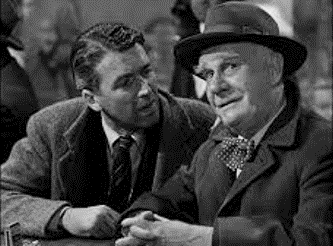
From the movie “It’s a wonderful life” George Bailey and his angel, Clarence.

Clarence was a wonderful gift for George.  Unlike us, Clarence was able to show George what life would have been like if he had never been born.

What did George learn from that experience?

Background

Let’s take a minute to remember the overall storyline.  Many of us have seen the movie at Christmas time through the years.

In the movie, George has a great yearning to travel and see the world.  Right after he is married and on his way for their first adventure with his new wife, the stock market crashes.  George worked for his father’s local building-and-loan business.  When it was obvious that something was wrong, George abandoned his trip and went into the building-and-loan to help with the chaos.  Pretty soon, George found himself stuck in the life he wanted to get away from.

Something Just Crashed and Went Wrong

Not only are we facing the changing world of Covid, as I wrote about last week, but the United States suffered the weakest growth for the ten years following the 2008 crash and recession.  It seemed that we were being told by our own government “get used to it, this is the new normal”.  I found myself getting depressed and worried over that attitude.

I also find myself even more worried today as I watch my grandchildren (ages 13-20) face this very scary new norm.  One article I read said, “many young people have lost hope seeing their labor produce so little reward”.  I consider myself very blessed in that all of my grandchildren have a good work ethic.  I even mentioned to one granddaughter that I lose track that she’s only a junior (now senior) in high school because she works so hard.   She seems all grown up going to school and working most afternoons and evenings.

And yet I hear her and some of her cousins speaking fondly of socialism.  But as one article said, “when the rewards for working and sweating end, prosperity withers and freedom dies”.

The Gift of Clarence

In the movie, George is actually able to meet his angel …it’s a movie.  It doesn’t fit with my Christian beliefs 😉 and this pays off in a wonderful reward.  George is thinking he would be better off if he had never been born.  Clarence allows George to see the world as if he had never existed.  George sees a very dismal world because he was not in it working hard, caring, helping, and loving.

Be a Clarence

Be a friend.  Be a mentor.  Be a parent.  Be a grandparent.  Help others —young people, children, and grandchildren see and experience A Wonderful Life.  It may not seem like they’re listening at the time but you would be amazed how much it sticks with them.  I remember mentors from decades ago.  I still remember their words, the circumstances of the situation, and the fact that they cared enough to share with me.  I may not have told them how much it meant but their words still stick with me today.

Be a mentor.  Share with someone.  Take time to talk with someone.  You may not be immediately rewarded but the lessons and wisdom you pass on will pay rewards for years to come

0 comments
0 FacebookTwitterEmail
BlogCulture

The Coming Ice Age: Leading Beyond the Blizzard

by Ron Potter June 10, 2021

As we try to figure out the new normal, many comments and images have been tossed around.  I ran across this article by Andy Crouch, Kurt Keilhacker, and Dave Blanchard of Praxis that gives us a good overview of what we’re facing.

Blizzard, Winter, Ice Age

For a minute, put your own thoughts to each of those words.

Blizzard

Years ago when my children were young, my wife and I decided to drive from Salt Lake City where we were living at the time back to her family farm in Michigan for Thanksgiving.  Everything went great getting there as was our time with family at a very comforting time of the year.  But then it was time to drive back from Michigan to Utah in early December.  Things were going fine until I woke up (my wife was driving at the moment) and realized that we were spinning (a full 360) on the Interstate along with the cars and trucks near us.  We had hit a blizzard in Nebraska.  No one crashed and no one was hurt and we were able to get to the first exit which had a Holiday Inn where we checked in for a couple of days until the blizzard passed and the roads had been clear.

It was a scary experience!

Even after we were able to restart our journey, there was this anxiousness in the back of our minds as we headed out on the plains of Nebraska and into the mountains before making it to Salt Lake.

Blizzards are like that.  Scary.  They can be dangerous.  And the possibilities can linger in our mind even after they clear.

Winter

Unlike blizzards that can come upon you quickly, we know that winters are coming.  The calendar tells us so.  The only thing we don’t know is how severe the winter will be and how long it will last.  Keep in mind that we live in Michigan near the Lake Michigan side of the state.  A couple of winters ago, we had an extremely cold spell of a couple of weeks during winter.  Temperatures were below negative 20 degrees for nearly two weeks.  When it’s that cold you need to protect people and things and be prepared if you lose your power.  Even things in our garage began to freeze.  But just like blizzards, we know that it will end sometime and things will get back to normal.

Ice Age

Back when I was a kid, we didn’t hear about global warming; we heard about another coming Ice Age.  (Both based on science… supposedly.)  We have beautiful, great lakes and terrain in Michigan because of the last ice age in which glaciers reached what is now the southern border of the state.   It must have been impressive and awesome and it created and left a beautiful environment.  But it was uninhabitable!  The last Ice Age lasted about 12,000 years.  Ice Ages create new normals.

What Are We Facing

Which category —Blizzard, Winter, or Ice Age— do you place our current Covid situation and the virtual workplace it has spawned?

Blizzard

I believe it’s clear to all of us that this is not a blizzard.  We may have had some hope of that a year ago.  We may have thought that “this will be over soon” and we would get back to normal.  It is now obvious that is not going to happen.

Winter

I’m often asked why I continue to live in Michigan when I could live anywhere.  My answer is that when you have a perfect day in Michigan, there is nothing like it anywhere else in the world.  I’m sure it’s the result of the great lakes and beautiful forests.

But with Covid, we don’t get a summer full of beautiful days.  We’re at least in winter.  There will be no “perfect” days with Covid.  We will not return to “normal”.

Ice Age

We may even be into an Ice Age with Covid and virtual work.  Things are not likely to return to “normal” in our lifetime.  It will be a much more cautious and virtual world.  Because I have children and grandchildren who live in other countries of the world, I’m very familiar with virtual connections.  But I can’t wait until I can be with them again to give them each a big hug.  And with the teams I work with, there is nothing like that shake of a hand, that pat on the back, and being able to look directly into the eyes of each other when dealing with difficult issues.

New Norm

This is the new norm.  We’re never quite sure what the new normal will actually look like.  We only know that it will be different (and confusing) until the new normal emerges.

We haven’t really figured it all out yet.

I know that many of our collaboration platforms (Zoom, MSTeams, Webex, and others) are working fast and furious trying to figure it out.  But I do know that they’ll miss the mark if they rely on transactional measurements rather than personal relationships interactions to create the new normal.

Trust

As the team from Praxis says, “Out greatest resource is trust”.  Trust is difficult to cultivate virtually, although I believe it can be done with focus and effort.  It’s more important than ever in this time of winter and/or ice age to build trust.  It will be hard work but it will also be worth it.

0 comments
0 FacebookTwitterEmail
BlogCulture

People are Crazy

by Ron Potter June 3, 2021

The son of a friend of mine just graduated from law school.  When asked what type of law he would like to pursue, his response was: “I’m good at writing and I enjoy research.  Plus, if I go into research I don’t have to deal with people.”

As my friend was telling me this he told me this story,  he said “I never listen to country music but when I got into my car, somehow the radio had been switched to a country music channel and the repeating line of the song being played was:

‘God is great, beer is good
And people are crazy’

People are Crazy

Throughout my career, I’ve dealt with fairly healthy people.  And they’re all crazy!  Including me.  One of my clients said that everybody is 15% crazy.  And if their 15% matched her 15%, everything was good.  But if their 15% was at the opposite end of the spectrum from her 15%, they were going to have real problems, because they were crazy!

Smart People are Crazy

I think people with large IQ’s are particularly stubborn when it comes to crazy.

  • They’re smart.
  • They’re logical.
  • They can think through things.
  • They assume there is no other way to see a problem or solution.

Our reaction to them is that… “They’re crazy.”

Untrustworthy People are Crazy

When people are untrustworthy, devious,  or manipulative they can be seen as crazy.  If someone acts one way in certain circumstances and another in others, they are not seen as having integrity.  They can be termed crazy.

If you feel you’re being manipulated by another person (and we always seem to know) one of our reactions is “Are they crazy?”  People with integrity are seldom seen as crazy.

Overcoming Crazy

We mentioned integrity above.  That’s a big part of overcoming crazy.  Another trait is humility.  Humble people don’t believe they know it all.  They don’t seem crazy.  A third is curiosity; it requires good listening.  I’ve often talked about listening with the intent to understand.  When you’re really curious, it requires that you learn something while you’re listening and asking questions.  Listening with the intent to understand really cuts down on craziness.

Where is your Crazy?

People are crazy!

Have you thought about where you seem crazy to other people?

  • Think about it.
  • Ask about it.
  • Do something about it.

Being less crazy will help you be better at everything you do.

0 comments
0 FacebookTwitterEmail
BlogLeadership

Elements of Trust

by Ron Potter May 27, 2021

In the Harvard Business Review was the following article:

The 3 Elements of Trust by Jack Zengar and Joseph Folkman.

Three Elements of Trust

I think Zenger and Folkman are right on when they identify

Positive Relationships
    • Stay in touch on the issues and concerns of others
    • Balance results with concern for others.
    • Generate cooperation between others.
    • Resolve conflict with others.
    • Give honest feedback in a helpful way.
Good Judgement/Expertise
    • They use good judgment when making decisions.
    • Others trust their ideas and opinions.
    • They can anticipate and respond quickly to problems.
Consistency
    • Are a role model and set a good example.
    • Walk the talk.
    • Honor commitments and keep promises.
    • Follow through on commitments.
    • Are willing to go above and beyond what needs to be done.

Let’s unpack each one of those.

Positive Relationships

Of the five points that Zenger and Folkman make, the three I would pick as the most powerful would include, concern for others, resolving conflict, and giving honest feedback.

Concern for Others

Human beings have an amazing ability to determine if someone really cares for them or is just using them to accomplish a task.  Don’t kid yourself, you can’t fake this one.  If you don’t truly care for the other person, they will do what they are told because of your position but nothing more.  To build winning teams, you need more.  You need people’s energy, creativity, and cooperation.

Resolving Conflict

Resolving conflict relies on good listening.  I identify this skill as

Listening with the intent to respond vs Listening with the intent to understand

It takes a great deal of energy to listen with the intent to understand.  First, you must suspend what you “know”.  People know when you’re just lining up your points to make as soon as you see an opening in the conversation.  It’s even worse if you create that opening by interrupting with your points to counter their points.  They know you’re not trying to understand them.

There is a great deal of talk about diversity these days.  Listening with the intent to understand and teaching others to do the same, actually takes advantage of the diversity.  It’s not about our origins, race, gender, or whatever is being thrown into that diversity bucket these days, it’s about understanding.  The diversity identities being tossed around today don’t mean anything if we’re not listening to understand.  Individuals will have very different belief systems, even if they’re part of the same category of people.

Good Judgement/Expertise

The biggest issue to watch out for in this category is what Robert Quinn in his book “Deep Change” identifies as the “Tyranny of Competence”.  Some of my more difficult consulting and coaching times occurred when I had to convince and then help leaders dismiss people who fell into this category.  The first word in this title is “tyranny”.  People who fall into this category are incredibly competent and knowledgeable in their subject matter.  However, they use that competence as an excuse for not developing good relationships.  Every time the person who lives by the Tyranny of Competence is asked to leave, I’ve observed teams blossom into highly effective teams based on trust.

Zenger and Folkman put three elements in this category: Good judgment, trust of others, and they respond quickly.  I believe the middle point of the three —”Others trust their ideas and opinions”—is the hinge that makes the other two work.  One reason that the trusts exist is that there has been listening with the intent to understand.  I can’t emphasize enough how much this element builds trust.  Because good leaders have listened well and built trust, they tend to have good judgment and can respond quickly to threats.

Consistency

I believe consistency requires Integrity.  Integrity comes from the Latin word “integer”— meaning whole or complete.  Integrity means that you are the same person regardless of the circumstances or the people present.  It has a foundation of honesty and character.  Are you a person of integrity?  Are you always the same person?  When you have integrity and are consistent, it builds trust.

Elements of Trust

Evaluate yourself.  Get feedback from others.

  • Do you develop positive relationships?
  • Do you exhibit sound judgment?
  • Are you consistent and would people say you are a person of integrity?

Regardless of the environment, be it leader, team member, family member, or citizen, nothing will carry you farther than developing trust.

0 comments
0 FacebookTwitterEmail
BlogLeadership

PREgret

by Ron Potter May 20, 2021

Years ago I was thinking about the regrets in my life.  I was asking myself if there were things I should have or could have done to eliminate or reduce the number of regrets.  As I was thinking about the topic, I notice a familiar pain in my sternum.  I began to realize that I had a physical manifestation when I regretted something I had said or done.  I began to ask people I knew where their regret pain manifested itself.

Where is the pain?

Everyone seemed to have a different answer.  I heard locations like:

  • Neck
  • Shoulders
  • Forehead
  • The base of the skull
  • Forearms
  • etc.

The answers were many and varied, but the pain was a given.  No one questioned the pain itself, they just had different answers of where it was located.

“Listen” to the pain

If the pain always shows up somewhere,  become familiar with it.  The pain can and will become very familiar.  If the pain is present and identifiable, you will “know” you are in one of those moments that will result in regret.  Here’s the key, “will result in regret”.

Regret Pre-Indicator

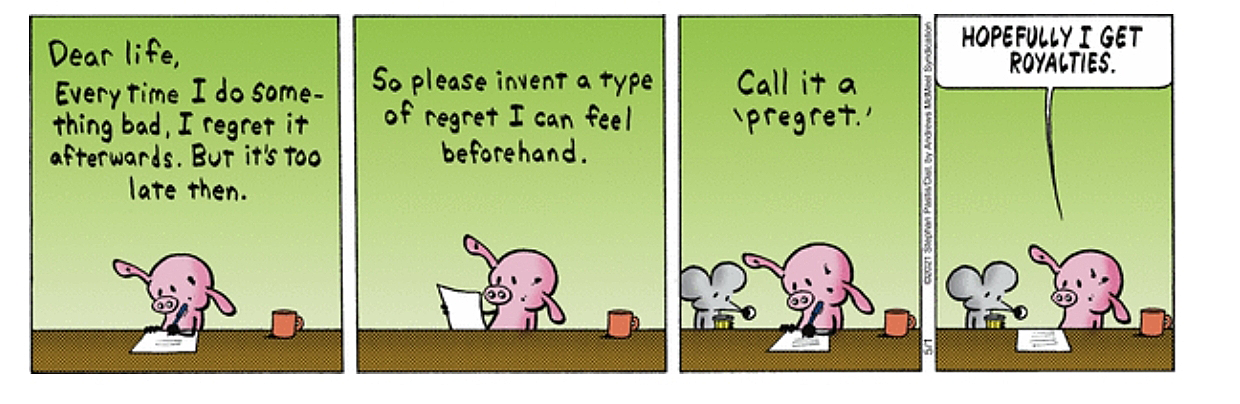
Through experience, I began to learn that the pain was a precursor of regretful actions.  I eventually read some science about how these neurotransmitters work and indeed, there is an early warning system.  That means that the pain you become familiar with is actually a precursor to the thing you’re about to do or say will cause regret— PREgret!

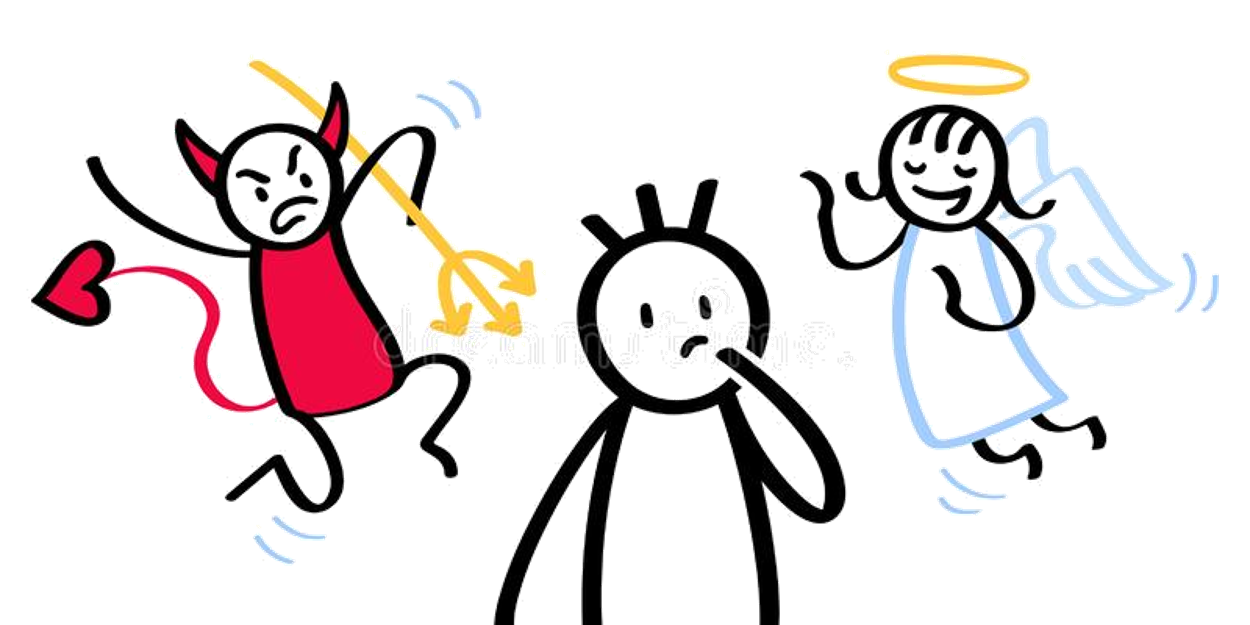
I don’t know if this is a good thing or bad thing but I have become so aware of my “regret pain” that it often triggers a debate in my head:

You’re about to say something that you’re going to regret.

I know, but I think it needs to be said.

But you will regret it!  Maybe you should just back off a minute.

But it needs to be said.  I’m going to say it anyway.

REGRET

Where does it hurt?

Become familiar with your “regret” pain.  If you tune into it, you’ll have a lot fewer regrets in life.


0 comments
0 FacebookTwitterEmail
Newer Posts
Older Posts
  • Facebook
  • Twitter
  • Linkedin
  • Rss
  • About This Site
  • About
    • Clients
  • Services
  • Resources
    • Trust Me
    • Short Book Reviews
  • Contact

About this Site | © 2024 Team Leadership Culture | platform by Apricot Services


Back To Top
Team Leadership Culture
  • Team
  • Leadership
  • Culture
  • Myers-Briggs
  • Trust Me
  • Short Book Reviews