
Team Leadership Culture
  • Team
  • Leadership
  • Culture
  • Myers-Briggs
  • Trust Me
  • Short Book Reviews
Top Posts
Obituary
REPOST: Four Functions, Three Rules
ROUNDUP: The Rise of AI
REPOST: Facing Adversity Series
ROUNDUP: Curiousity
ROUNDUP: Deep Work
REPOST: Character vs. Competence
REPOST: Opposite of Victim
REPOST: Listening With the Intent to Understand
REPOST: Performance vs Trust
  • About
  • Services
  • Resources
    • Trust Me
    • Short Book Reviews
  • Contact

Team Leadership Culture

  • Team
  • Leadership
  • Culture
  • Myers-Briggs
  • Trust Me
  • Short Book Reviews
Author

Ron Potter

Ron Potter

BlogLeadership

Time Management

by Ron Potter May 31, 2010
Image Source: Nick, Creative Commons

Image Source: Nick, Creative Commons

I was scheduled to teleconference with one of my clients last week. We had one hour for our conference call but were not able to connect until 15 minutes before our time was up. What do you think the topic was that he wanted to talk about when we finally did connect? Time management!

This client is actually at the top of his game and in many respects at the peak of his career. He’s doing wonderful things at the top of a company that is improving quarterly and is a highly respected leader and team member. But he was feeling overwhelmed and over run. What could he do to improve and get back on top of things?

When we did talk a week later, these are a few of the topics that were discussed:
• Meetings
• Quadrant II – Urgent vs Important (discussed in an earlier blog)
• Planning and early execution
• Empowerment/Delegation
• Systems and Support

Let’s discuss meetings.

How much of your time for the week or month is pre-booked in meetings before you even start? Even if you’re working 50 or 60 hour weeks, if 90% of your time is booked in meetings before you even start your week, than you really only have 5 or 6 hours for the week to get your non-meeting work done.

I hesitate to call non-meeting work your “real work” because much of your real work is conducted in well run meetings. But, if you have more than 60% of your available time pre-booked in meetings before you even start the week, you should probably question if you need to be in the meeting or not.

Efficiency and Effectiveness of meetings

Even if the meetings are important, how much effort is put into analyzing the efficiency and effectiveness of the time spent in the meeting? This topic can have multiple sub-headings but a couple right off the top should be:
• Who’s running/facilitating the meeting?
• What’s the purpose of the meeting? Information? Prioritization? Decision making?
• If a decision is to be made, what type of decision? Consensus? Consultative? Unilateral?
• If it should be a unilateral decision, why are we having this meeting?
• If it’s to be consensus, who are the right players and are we willing to take the necessary time?
• If it’s to be consultative, who owns the decision?

You might enjoy a book titled: Death by Meeting: A Leadership Fable…About Solving the Most Painful Problem in Business


The links in the post above are “affiliate links.” This means if you click on the link and purchase the item, I will receive an affiliate commission. Regardless, I only recommend products or services I use personally and believe will add value to my readers. I am disclosing this in accordance with the FTC’s 16 CFR, Part 255: “Guides Concerning the Use of Endorsements and Testimonials in Advertising.”

0 comments
0 FacebookTwitterEmail
BlogCulture

Bloging is Easy

by Ron Potter May 20, 2010
Image Source: Dwayne Bent, Creative Commons

Image Source: Dwayne Bent, Creative Commons

Blogging is easy.

Writing is difficult.

I started blogging for two reasons. The main was that many of my clients were asking for some regular input and reminders of the many things we talk about during our consulting and coaching engagements. The second reason was that I wanted to experience the technology of this relative new media form and for the discipline of writing. Well, I’ve experienced it and found myself to be lacking in the skill and discipline of writing.

I’m surrounded by writers. My wife has that wonderful ability to write well. She can finely craft the written word in ways that just amaze me and has at times done professional writing. Both of my daughters are also talented writers. One of them could make a living as a professional writer and the other one writes very witty blog posts. Because I’ve “written” a book, one of my clients asked me where I learned my skill because he wanted to upgrade the writing skills of his team. I had to admit that I had not learned the skill but rely on my writing partner, Wayne Hastings, for our published materials.

Blogging is easy. Writing is difficult.

But, when I take the time and make the effort, I enjoy the practice of writing. I’m concerned that through texting, email and powerpoint presentations we are losing the art of well written documents. We recently discovered a newspaper published by my great grandfather (another writer in the family) in Colorado in 1892. That newspaper was written for the common man in a small town west of Denver. The vocabulary and writing structure was well above what we receive today in the few papers that even put out a printed edition anymore.

Consider doing more writing. It forces you to organize your thoughts more than texting, emailing or powerpoint presentations.

0 comments
0 FacebookTwitterEmail
BlogLeadership

Getting Back on Track

by Ron Potter May 16, 2010
Image Source: Ricardo Bernardo, Creative Commons

Image Source: Ricardo Bernardo, Creative Commons

I know, I know, I haven’t posted a blog in forever. While that issue has been nagging at me for weeks it took the gentle reminder of a close friend that I had neglected this duty (thanks Armin).

Several things strike me about this situation:
1) I actually needed the reminder from a friend to respond to the nagging
2) For me, blogging is a difficult task that requires discipline to accomplish
3) I’m reminded almost every day from clients that time management is an issue
4) Even if doing something is enjoyable, you may not be good at it

Many years ago I was attending a professional golf tournament. At the time Tom Watson was at the peak of his career (which is interesting to say when he recently came within a stroke of winning the British Open (THE Open) even though he’s in his sixties). But, at that moment in time there was probably no one in the world who knew more about the game of golf and in particular his ability to play the game. However, as I watched Tom play that day, he began to have problems with his drive on the last several holes. He developed a draw which turned into a nasty hook. After his round I watched as he gathered his coach and headed for the practice range. Although I was out of hearing range, you could tell by the body language what was going on between Tom and his coach. Tom was animated and angry while his coach was trying to both listen and calm Tom down at the same time. Finally the coach asked Tom to hit a few balls while he watched. Tom’s first attempt delivered a severe hook that nearly missed the driving range on the left. Tom immediately reacted with animation and anger. Once again the coach tried to calm him down and asked him to make minor change in his stance. Tom acquiesced and addressed another ball. This time while the ball still faded to the left, it did not follow the path of the severe hook. Tom nodded and hit a few more balls which all followed the same path. The coach then suggested another slight change to Tom’s grip. The next shot was magnificent. The ball boomed off the club face, started out low and true and slowly climbed into the sky almost reaching the limits of sight. Tom simply turned and smiled at his coach. For the next half hour Tom launched ball after ball true and straight down the driving range.
Even the best in the world sometimes need that outside observer to slightly adjust their already plentiful skills to keep them tuned up and on the right path.

Do you have that trusted confident that will give you the feedback to keep your shots flying true and straight? We all need them.

0 comments
0 FacebookTwitterEmail
BlogWork-Life Balance

Work-Life Balance – Transition

by Ron Potter February 19, 2010

Why are so many feeling that our Work-Life Balance is out of whack? In this series, I will explore four categories of issues that contribute to the feeling (and actuality):

  • Connectedness 24/7
  • Email Boundaries
  • Time Management (Quadrant II)
  • Transition and Transformation


Another moment in our career lives when things seem to get out of balance is during times of transition or transformation.

A photo by lee Scott. unsplash.com/photos/_VTgctRg0tATransition

I was working with a client recently who may be one of the smartest and quickest people I work with. She had recently (about 8 weeks ago) taken over a new division within the company that was going to require the exercising of new leadership and management muscles that she hadn’t developed in her previous assignment. When I met with her she was expressing a great deal of personal frustration that she still didn’t know how to answer questions in certain areas and more importantly, didn’t know if a certain question or piece of information might be critical or just another piece of information.

During times of transition there seems to be two time frames that exhibit some consistency. The first is that it just takes about three months for you to get a handle on a new job. My client had stepped into her new role at the beginning of November. So, while she had been in the job for two months, with all of the holidays and vacation time taken during that time of year, she had really only experienced about a month of actual job time. I encouraged her to keep her frustration in check for a couple of more months and felt sure she would be feeling better about her job knowledge by the end of February.

The second time frame to pay attention to is something called the “window of opportunity.” The window usually opens about nine months into a new assignment and closes again at about the one-year tenure. If possible I recommend that new leaders not make any major changes (people, organization, vision, mission, etc.) before the window opens up at about nine months. If a leader makes these major moves before about nine months, people often wonder if they gave the incumbent person, system or process time to prove themselves. If the leader is still running things as usual after a year, people also wonder what new value the leader brought to the position. Now, there are always exceptions to this rule but if you’re feeling the stress of a new assignment, you might evaluate what are realistic expectations at this point in the transition.

Transformation

Transformation happens when you or someone else (or outside condition) is forcing a major transformation change on how work gets done. If you are the one being affected by the transformation, there is always the natural fear that you won’t have the ability or skills to perform and thrive in the new environment. This is the time to devout yourself to being open and learning what the new requirements and expectations are going to be. It is not the time to complain or lament about the way things used to be. Change happens. Get ahead of it.

If you’re the one driving the transformation, one thing I have always observed is that you will come to a point where it feels like failure. The new environment or approach hasn’t taken hold, the new vision or expectations are not emerging, or people are complaining and wanting to go back to the old way of doing things. To get through this one, turn to chapter 16 of my book “Trust Me” that’s titled Endurance. If you’ve taken all of the right steps (previous chapters) and know you’re headed in the right direction, stick with it. It’s always the darkest before the dawn.

1 comment
0 FacebookTwitterEmail
BlogWork-Life Balance

Work-Life Balance – Time Management

by Ron Potter February 2, 2010

Why are so many feeling that our Work-Life Balance is out of whack? In this series, I will explore four categories of issues that contribute to the feeling (and actuality):

  • Connectedness 24/7
  • Email Boundaries
  • Time Management (Quadrant II)
  • Transition and Transformation

Several years ago I learned some very interesting lessons about time management. I was working with a high level leadership team, all vice-presidents and above. While we were offsite spending time on leadership development issues one of the VP’s on the team finally stopped the process and said something like the following:

“Ron, we think all of these leadership issues you’re trying to teach us are wonderful and important, but until you help us with our time management problems, we can’t even think about putting more effort into improving our leadership skills. We’re all working at least 60 hours a week as it is. We’re destroying our health and our families. Help us with our time management first and then we’ll be ready to learn new leadership skills from you.”

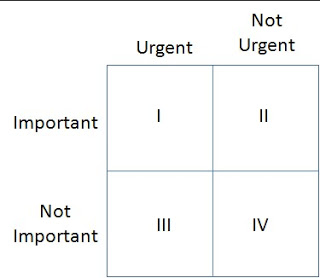
He was right. They were worn out and suffering. I turned to a time management model put forth by Steven Covey in his book The 7 Habits of Highly Effective People: Powerful Lessons in Personal Change. In that book, Mr. Covey indicated that all of our time fits into quadrants of a two-by-two grid.

Quadrant II Frame

His premise was that once we fulfill all of the tasks in Quadrant I (both urgent and important) we tend to go on to tasks that fall primarily in Quadrant III (Urgent but not necessarily important).

I sent the team off to record where all of their time went over the next two weeks. When they returned with the record of approximately 120 hours each had expended over the last two weeks, we listed every activity for each participant on a flip chart and posted it on the wall. Then we went through a very interesting exercise. Line-item by line-item we went through each chart and identified into which quadrant it should be placed. A very interesting pattern began to emerge. On several of the line-items, the owner of the sheet would say that he/she had spend a number of hours producing a particular report (as an example) that was urgent but not important and they intended to stop performing that task in the future. However, once stated, there always seemed to be a challenge from the room. Someone would say, “If you don’t produce that report, I can’t get my job done. It must be placed in the important row.”

But, when we began to look into what data in the report was required, there often seemed to be a simple solution to the second persons needs that still eliminated the effort needed to produce the report (it’s on the web site, a quick email, it can be found in another location, etc.) The problem was solved and the bulk of the work eliminated.

Once we completed all of the “negotiations” around the room and everyone had agreed on the quadrants into which all work had been placed, a horrifying statistic emerged. Only 20% of all the work fell into the “Important” row. One VP hung his head and said:

“Do you mean to tell me that I just spend 24 hours of meaningful work over the last two weeks and all the rest was just thrashing?”

I’m afraid so.

The lessons that I have learned from this experience (conducted now several times) include:

  • It’s difficult (impossible) to determine on your own how much of your work falls into which quadrants. There is always someone else that needs to be brought into the negotiations.
  • It takes team support to stick with the decisions. Even after everyone agrees that you have some quadrant III work that can be dropped, there will be those who still want you to do it. It takes a team to help you say “no”.
  • If more than 70% of your work falls into quadrant I (both urgent and important), you’re headed for burn out and failure somewhere down the line because you are not doing enough important but not urgent work (prevention, production capability, relationship building, big picture thinking, etc.)

The links in the post above are “affiliate links.” This means if you click on the link and purchase the item, I will receive an affiliate commission. Regardless, I only recommend products or services I use personally and believe will add value to my readers. I am disclosing this in accordance with the FTC’s 16 CFR, Part 255: “Guides Concerning the Use of Endorsements and Testimonials in Advertising.”

2 comments
0 FacebookTwitterEmail
Short Book Reviews

A Thomas Jefferson Education

by Ron Potter January 9, 2010

Ron’s Short Review: A great model for education, both in the classroom and in the corporation. Fascinating discussion on how our public education system has failed to produce the leaders that we need.


Amazon-Buy-Buttonkindle-buy button

0 comments
0 FacebookTwitterEmail
BlogWork-Life Balance

Work-Life Balance – Email Boundaries

by Ron Potter December 9, 2009
Image Source: Jypsygen, Creative Commons

Image Source: Jypsygen, Creative Commons

Why are so many feeling that our Work-Life Balance is out of whack? In this series, I will explore four categories of issues that contribute to the feeling (and actuality):

  • Connectedness 24/7
  • Email Boundaries
  • Time Management (Quadrant II)
  • Transition and Transformation

I have to share a story one of my colleagues told me about Work-Life Balance (Connectedness). She is working with a client that has a culture that is starting to burn people out. No Work-Life Balance. Another consultant had suggested to the leadership team that the situation was getting bad enough that they should do something to help people regain some balance. So the leadership team put out a memo that no one was required to answer e-mails after 8:00pm.

WHAT?

How about a memo that says everyone is required to stop sending e-mails after 6:00pm? No one is going to put their head on the chopping block in a fast paced culture and not read e-mails after eight. But, if you put the restriction on the sending end then the culprit clearly stands out. And my guess is the leaders are the culprits.

I started working with the head of a large division (400+ people) several years ago and he had a reputation of being a hard task-master, expecting people to work above and beyond the call of duty. One of the first things I observed is that he would send emails any time of the day or night and any time on the weekend. His response to the situation is almost identical to the explanation I always get. He would say

“I don’t expect people to respond to me immediately, that’s just my work style. As soon as I think of something I’ll write an email (sometimes to himself) and send it off immediately. I don’t expect my people to respond at night or over the weekend, that’s just my crazy work habits.”

The first thing I asked him to do was learn how to use the delay-send function in Outlook and not let evening emails go out until early the next morning or weekend emails go out until early Monday morning. Within weeks people were making comments to me like:

“I don’t know what you’ve done but things sure are calmer around here these days. It’s a much better place to work.”

Email can be a great tool. Just be careful how it’s being used and pay attention to the unintended consequences.

2 comments
0 FacebookTwitterEmail
Short Book Reviews

Play

by Ron Potter December 9, 2009

PlayRon’s Short Review: My first question is often, “Are you having fun?”  It seems to be the best indicator of things going well or not.

Amazon-Buy-Buttonkindle-buy button

0 comments
0 FacebookTwitterEmail
BlogWork-Life Balance

Work-Life Balance – Connectedness 24/7

by Ron Potter November 21, 2009
Image Source: Jed Sullivan, Creative Commons

Image Source: Jed Sullivan, Creative Commons

Why are so many feeling that our Work-Life Balance is out of whack? In this series, I will explore four categories of issues that contribute to the feeling (and actuality):

  • Connectedness 24/7
  • Email Boundaries
  • Time Management (Quadrant II)
  • Transition and Transformation

I started my first real job in 1969. That means that my working life has now spanned 40 years. That 40 years has roughly been distributed with 10 years in the engineering/construction business, 10 years in the software industry, and the last 20 years as a consultant to a whole range of industries including pharmaceutical, auto, food, high-tech and others. And I must admit that I don’t see people working any harder or longer hours today than I have at any time over the last 40 years. So why is there so much talk about the lack of Work-Life-Balance?

Connectedness!

In the 70’s we communicated by phone or fax. Think about a vacation in Hawaii when the only mode of communication was phone or fax. Not much communication happened with the east coast in particular. It was a real vacation.
I carried my first Compaq “luggable” computer in 1983 (28 pounds). I used email for the first time in 1985. I still remember the day I sent an email to a client in Scotland and he responded within the hour… from Japan! Astounding!
The internet? That didn’t really happen until the mid 1990’s.
I bought one of the very first Blackberry’s in 1999 when they had been on the market for only a few months. It took 5 years for them to sell their millionth Blackberry. Think about that, it was only five years ago that there were a million Blackberrys and virtually no other smart phones. Today, iPhone alone sells nearly 5 million a quarter. And don’t get me started about Facebook and Twitter.
We never get away from it. 24/7 we’re connected. Maybe it’s because I spent much of my career without all of this modern connectedness that I’m a little better at managing it rather than it managing me (my wife will laugh at that statement). But, different than many of my younger colleagues, I believe it is ok to shut it off, not answer that phone, don’t respond instantly to that incoming message. I believe it’s because we don’t shut off this connectedness in the evening when we should be focused on family, or weekends when we should be focused on R&R and getting that job-list done or on vacation when we should be re-creating that our work-life balance seems out of whack.

Don’t get me wrong, I know there are many of you out there working long and hard through difficult times. But this has been going on forever. The difference today is that we never get away from it. Not for a minute, not for a day, and certainly not for a week or more.
Think about it and let me know what you think or what your experiences have been.
I’m going to follow with a few more blogs about Work-Life-Balance. Besides this 24/7 connectedness, I see a few other issues that seem to impact our sense of balance.

1 comment
0 FacebookTwitterEmail
Short Book Reviews

Opposable Mind

by Ron Potter November 9, 2009

Opposable MindRon’s Short Review: Holding opposing views in our mind at the same time helps us with decision making.

Amazon-Buy-Buttonkindle-buy button

0 comments
0 FacebookTwitterEmail
BlogTeam

It’s Not Rocket Science

by Ron Potter October 25, 2009
Image Source: Matt Biddulph, Creative Commons

Image Source: Matt Biddulph, Creative Commons

During one team session we were working through a difficult topic and seemed to be moving farther and farther away from an acceptable solution. In an effort to disarm some of the volatility in the room I shifted the conversation away from the topic itself and began to focus the team on techniques for giving and receiving better feedback. As each side began to understand better where the other side was coming from and the gulf between the two opinions began to narrow, one of the team members invoked the old adage:

“Well, it’s not rocket science.”

Well, actually it is rocket science.

During the early days of rocketry when Van Braun, Goddard and others were making their first attempt at developing functional rockets, they quickly discovered that they could build a rocket with enough thrust. Thrust was not the problem. The problem was they couldn’t hit a target. They actually had to spend more time, effort and resources to develop what they began to call feedback mechanisms, a term they coined to describe the process of firing off a rocket, taking measurements on the trajectory, and feeding back those calculations to adjust the thrusters so that they could eventually hit a target.

Look around any team meeting today. Thrust is usually not the problem. There is enough education, experience, energy, dedication and desire to accomplish a goal. The problem is actually keeping all of that energy adjusted and headed for the same target. It takes strong feedback mechanisms to actually hit a target. Without good feedback systems on style, skill sets, culture, decision making processes and conflict resolution, the team simply scatters and dissipates the thrust in multiple directions that will never be capable of hitting a target.

Actually, it is rocket science.

0 comments
0 FacebookTwitterEmail
BlogLeadership

Story Telling & Trust

by Ron Potter September 18, 2009
Image Source: Sarah Browning, Creative Commons

Image Source: Sarah Browning, Creative Commons

Building trust is an essential part of leadership, but people aren’t likely to trust you if they feel they don’t know you at all. That was the problem with a manager I was asked to help.

Her biggest issue is that she didn’t let people in. She was a leader – people reported to her – but her people didn’t feel like they understood who she was. She seemed very distant and aloof.

And it was intentional. When I spoke with her about it, she said:

“I don’t want to have people from work in my personal life. I don’t want them knowing what I do, or what sort of person I am.”

Her problem wasn’t arrogance or disdain. She felt vulnerable. She was trying to protect herself.

My challenge was to show her there was a way to connect with her people that didn’t involve the sort of intimacy she feared. I spent our first-day session together modeling how to do this. When we got to the end of the session, I asked, “How well do you think you know me now?”

She replied, “I know a phenomenal amount about you.”

“Really?” I said. “How is that?”

“Every time I asked you a question, you told me a story that related to that topic.”

I told her I did that deliberately because people remember stories, and they also connect with the person telling the story. She was feeling like she knew me almost intimately after just one day, and all because I told her six to eight stories as we were talking.

“You can do the same thing,” I said. “You don’t have to bare your soul with people. You just need to start telling stories about the things you’ve done and how you’ve learned what you know.”

It was a very powerful lesson for her. She walked out of the session thinking, “I can do that. I can tell stories.” I think it made a huge difference in her leadership ability.

0 comments
0 FacebookTwitterEmail
Newer Posts
Older Posts
  • Facebook
  • Twitter
  • Linkedin
  • Rss
  • About This Site
  • About
    • Clients
  • Services
  • Resources
    • Trust Me
    • Short Book Reviews
  • Contact

About this Site | © 2024 Team Leadership Culture | platform by Apricot Services


Back To Top
Team Leadership Culture
  • Team
  • Leadership
  • Culture
  • Myers-Briggs
  • Trust Me
  • Short Book Reviews