 Ron’s Short Review: We spend a lot of time doing things. How much of it is actually relevant?





Ron’s Short Review: We spend a lot of time doing things. How much of it is actually relevant?
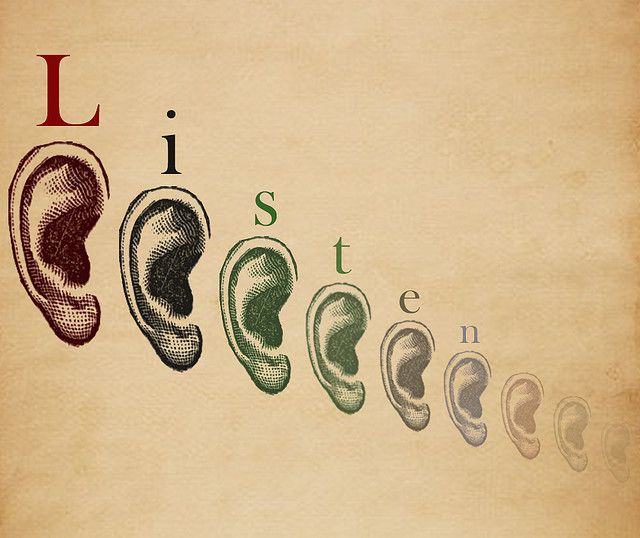
But, Lack of Curiosity killed the DOG (DialOGue)
Dialogue is a wonderful experience. Unfortunately, most of the time we end up discussing topics. As shared in previous blogs, the word discussion has the same root word as percussion; Banging the drum; Beating on the table; Clanging the symbol. Discussion is “won” by percussing the loudest or most persistent. Not the best way to reach conclusions on difficult or contentious issues.
So why do we discuss rather than dialogue?
Because discussing is taking a side, defending your beliefs, getting your point of view across, winning an argument. Dialoguing is being open to others ideas; opening up your mind to alternatives or innovative ideas that haven’t been discovered yet.
The form of listening you use will go a long way in determining whether you discuss to win a point or dialogue to reach a better solution.
Image Source: Ky, Creative Commons
When we listen with the intent to respond, we’re preparing for discussion. We’re loading up our ammunition to either counter or reinforce any and every given point that is being discussed. We’re getting ready to beat our drum louder
But, when we listen with the intent to understand we’re preparing for dialogue. We’re getting as clear as we can about the issues, belief and assumptions and goals of each participant. The best way to accomplish this is through curiosity. There are many things in our lives that we’re curious about. When we’re curious about a topic we listen deeply, we probe to improve our understanding, we read as much as we can about the topic, we want to know why and when things happen, we want to know the meaning behind the causes.
When you’re facing a tough decision with strong opinions on each side, start with curiosity. Listen with the intent to understand. Dialogue the topic by getting everyone on the same side of the table and actively improving each side of the argument one side at a time. You’ll discover improved decision making.

 Ron’s Short Review: Great book on the dynamics of team, decision making and mass movement.

Image Source: True New Zealand Advent, Creative Commons
I am not a trekker. Although I do own a trekking stick (very high tech with a camera mount on the top) and for a while I did subscribe to a trekking magazine with wonderful, high gloss photos of small groups of people in their hiking boots, cargo pants and trekking sticks walking across pristine landscapes in Scotland and Ireland with periodic stops for wine and cheese and their porters ferrying their luggage to be waiting for them at the next B&B. While adventuresome is portrayed a very serine and safe journey.
But recently, I read an article about Carmichael. His day time job is the CEO of a high-end coffee supply company. His avocation is Trekking. Real Trekking! Having accomplished treks across some of the most remote and inhospitable places in the world, his latest challenge is Death Valley. Hard-core trekkers regard Death Valley as undoable and there is no known record of any human being accomplishing the task. He had just failed at his second attempt to trek across the valley. Listen to some of his words:
“Everyone focuses on risk and failure. What happens if you fail? How do you mitigate the risk? I look around and see people who live in the safest places in the world, and they are preoccupied with anxieties and fears because they don’t know what risk is anymore.”
Once he said it I realized that I observe this exact behavior in all of the people I meet and even in the corporate cultures that I work with. Some people take on entirely new careers in their lives while others make one shift to a different team in a company they’ve worked at for twenty and think “phew, I made that leap without failing”. Some corporate cultures are moving into emerging parts of the world with processes and technology totally different from what they’ve used for fifty years while others will make a merger offer and then back away from it as too risky when a slightly increased counter offer is presented. We seem to use the same scale for measuring risk as if we are a kid contemplating jumping across a puddle or if we’re walking steel 200 feet in the air (a personal experience of mine ;-).
After his second failed attempt to trek across Death Valley, Carmichael said “That’s it. It’s over dude.” At that moment of failure he didn’t see any way that he would ever attempt this one again. But later he had begun to absorb his experience.
“The word that goes through your mind is fail, fail, fail. But once you get some perspective you realize that you learned something important. In the end, it’s not about how many tries you needed to get something done. It’s about not quitting and keeping at it until you achieve the goal. So, no, I didn’t fail. Failure is if it broke me. I just didn’t make it – this time.”
How do we break out of our own ring of risk? That bubble that we live in where the most risky thing inside our bubble looks like the riskiest thing anywhere? We get outside of our bubble! We get to know people who live in other bubbles. We learn of their efforts, failures, successes, heart aches, joys and start seeing the world through a different set of eyes. Suddenly when we look back into our own bubble, we realize that that daunting risk that we’ve been facing is nothing more than a little puddle. If you only see the world through your own perspective, it can become a very risky place and you will become very risk averse.

Image Source: Corey Leopold, Creative Commons
Well, I haven’t actually solved the education problem but I think I have the solution. And it’s not exactly my idea but it’s still a great idea. In other words, for the first time I believe the solution is out there to our education problem. And we do indeed have an education problem. In spite of what we might hear from the NEA or the government, ranking in the bottom half of the top 34 countries of the world is a complete failure of the system as near as I can see.
Over the last several years, I’ve had a great concern and burden for our education system. Beyond the global rankings it seems to me that the system is failing on all fronts. In depressed areas like Detroit, the percentages of kids that even make it through the secondary system in abysmal. And even in areas where there is a functioning high school system, look at the number of parents who are choosing either home schooling or private schooling while still carrying the tax burden of supporting their local public schools simply because they can see that the public school is not going to prepare their children for the globally competitive future.
I’ve done a great deal of reading, thinking and talking to people about how we solve this problem. Bill Gates and his foundation have donated a great deal of money to the system and haven’t come up with much yet. One of the more inspiring books I’ve read is A Thomas Jefferson Education: Teaching a Generation of Leaders for the Twenty-First Century
So, what’s this great solution that “I’ve” come up with? Sal Khan is the guy who really came up with the solution. If you haven’t already seen what’s he’s doing (and yes, he has also caught the eye of Bill Gates) check it out ASAP. I immediately wrote to my two daughters and recommended that if they want their kids (actually they’re my grandkids, I just loan them to their parents while they’re growing up) to get a great education, tap into the Khan Academy. There is way too much to explain in this blog so I’ll let you explore on your own (the YouTube reference will give you a great overview) but I do want to focus on a few of the elements that I believe provide the solution to our education system.
The first thing that struck me is that the teachers no longer teach, they help the kids learn. That shifts us from a teaching environment to a learning environment. In a teaching environment we’re dependent on the skills and knowledge of the teacher. Recently a teacher that I know said that 70% of his class was failing and didn’t even seem to understand it was an indication of teacher failure, not student failure.
It also eliminates the one-size-fits-all approach to teaching. Once the teacher finishes a segment, the exam is taken, the student receives their score (A to E) and we move on to the next segment. How many students achieve mastery of the topic? Virtually none and based on the current system, it doesn’t make any difference anyway. The teacher disseminated the information, the students were scored, move on!
But, once we shift to a learning environment, the students are encouraged to experiment, fail and finally master the subject. Can you imagine the power instilled in the student when they actually master a topic? They can’t wait to get to the next level. And, they’re better equipped to master the next level. Under the current system, a good student might get 85% on the exam. But, what happens when that 15% lack of understanding makes it even more difficult to learn at the next level. And so-on and so-on. It’s a system that will indeed produce failure at some point.
I think there is much more to learn about this topic and I want to encourage as many of you as possible to check out the Khan Academy and talk to parents in your local public, private or home school. This will change your own kids (grandkids) lives and improve our education system. Notice that the Khan Academy is available to the world, not just the United States. If we don’t adopt this approach, we will rapidly fall even farther behind.
I will pick up on this topic more in future blogs and I also believe there is great learning here to be applied to leadership as well. Enjoy and be inspired by my solution to the education system. Ha!

 Ron’s Short Review: Dry academic book. But many of my clients deal in a world of mergers and acquisitions.

 Ron’s Short Review: Tough slog of a book for me but some interesting parallels in history.

Image Source: /\ \/\/ /\, Creative Commons
Some people I’ve worked with have what we might think of as that victim mentality. The Leadership Style instrument I use (LSI from Human Synergistics) measures two areas titled Dependent and Avoidance that collectively describe a style that starts with the assumption that they are the victim in most circumstances. Some of the descriptions include:
A tendency to be easily influenced, not taking independent action
A strong tendency to deny responsibility or accountability
A passive attitude
Feelings of helplessness and/or guilt over real or imagined mistakes
The presence of rapid change or traumatic set-backs
A lack of self-respect
Extreme fear of failure
Someone asked me the other day what was the opposite of the victim mentality. That ignited a lively dialogue which came to the conclusion that Creativity is the opposite of victim mentality. Isn’t that a great picture? If we eliminate policies, procedures, governance, or leadership styles that create or assume a victim mentality, we unleash creativity. Although my work is focused on leadership within corporations, the first thing that came to mind was our law makers. Start evaluating all of the bills that are coming through congress (or ones that have been part of the landscape for many years) and begin to evaluate them in terms of “Do they create victims or do they instill creativity?” Many of the laws of this nation seem to start with the assumption that you are (or should be) a victim. And then they tend to perpetuate that belief. Our only opportunity in this rapidly changing global economy is to be creative and innovative. Shouldn’t we stop passing laws that push us toward or assume we are or should be victims?
But, closer to home, can you evaluate your or others leadership style on this victim-creativity balance beam? It’s always easiest to see it in others but the first step in great leadership is self-awareness, self-assessment, and humility. Have a discussion with your team. Maybe start by evaluating the group of people that work for you. Do they behave as victims or creators? What about our leadership style is causing that? How do we change the way we lead to increase the creative nature of our company?
My wife and I recently had the opportunity to listen to Condoleezza Rice when she made a speaking engagement in our home town. During the question and answer period one of the first question was “How did a young person of color from Birmingham, Alabama make it all the way to Secretary of State?” The first words out of her mouth without hesitation were “We were never allowed to be victims!”

Image Source: Jack Snell, Creative Commons
In my last post, I talk about getting the wrong person off the bus. In this post I want to share three patterns that I have seen through the years.
Self-Selection
One is the story in the previous People on the Bus post when a person for various reasons decides to self-select out. They quit, they retire, they take another job but it’s their decision. And then as soon as it happens, you immediately experience the relief and freshness in the organization that feels like everyone exhaling a deep breath and then saying, “let’s get to work” with a renewed energy.
Still in Place 1.0 to 2.0
Every organization I’m working with is going through some sort of transformation. Things in this world are changing rapidly and it requires continued renewal and reinvention to keep up with the changes. It’s very easy to keep dancing to the tune that got you here. Although I see this in many cases of varying degrees, I’m thinking of one individual who has been very successful in his career for nearly thirty years. He has run large chunks of an organization, has been rewarded with bonus, salary and promotions through a steady career of successes. However, while he is currently responsible for over one hundred people, technology advancements in recent years have rendered what they do redundant. The entire organization needs to stop what they’ve been doing for the last couple of decades and begin doing things differently to continue to add value to the company. He’s in charge of the transformation. But, he doesn’t know what to do. He’s also afraid that he won’t be valued in the new environment. He’s spent thirty years honing skills that have been rewarded and now he’s getting the message that those skills are no longer valued. If he actually transforms his organization into what they need to be, there won’t be a need for his job (how he’s done it for the last many years). He can’t (or is not willing) to reinvent himself therefore he is not transforming his organization. Something will break soon. The company can no longer afford to have this large group of people producing daily work that is no longer of value.
But what about the leaders in this situation you might ask? Why is his boss allowing this to go on? This gets tough. Here is a guy who has performed well for three decades. He may know more about the job (as it used to be) than anyone else. As recently as two years ago he had received nothing but the highest annual evaluations and a steady string of promotions. And, he’s a great guy! “What am I supposed to do, fire him?”, asks the boss. Maybe.
It has become obvious that he is now the wrong person on the bus. We don’t want to just put him off the bus standing by the curb. And we certainly don’t want to throw him under the bus. But we do need to get him on a different bus or maybe in a different seat on the bus if he wants to go to the new destination where the bus is now headed. Leaving him where he is will become increasingly detrimental to himself, his team and the company.
Steady but Slow Improvement
A third thing that makes it difficult to get the wrong people off the bus is that they actually get better. Slowly.
Realistic time frames can be one of the most effective ways for dealing with getting the wrong people off the bus. In most cases the leaders (and even the individual themselves) know what the new behavior and approach needs to be and how it should work. And in many cases, the leader does a really good job of identifying the six (or 5 or 8 or 10) changes that need to take place in order for the person to be successful and valued on the new bus ride. The problem happens when after setting these new behaviors and competencies as goals for individual growth; the person only gets better at one or maybe two of the areas of required growth. During their performance review a year later they’ve improved performance on one of the areas but still need improvement in the other five. Then another year later they’ve improved a little bit on another area of the list but only marginally. However, because she see’s improvement the leader is reluctant to take the steps to get them off the bus. But a year or more has gone by and they haven’t moved on from behavior 1.0 to rev 2.0. In the meantime things are changing so rapidly that they really need to be transforming from 2.0 to 3.0. What I have experienced is that it takes nearly six months of consistent new behavior to develop some level of competency and acceptance and another six months of consistent behavior for it to sink in as second nature. But, if a person is still working on a new behavior in a year without essentially conquering it, it’s not likely that they will accomplish the needed goal in a reasonable time frame. It’s now time to help them onto another bus.

Image Source: MD111, Creative Commons
I was reminded the other day that when I was in kindergarten, I invited a friend to come home with me on the bus. Now, we didn’t make official arrangements like checking with parents or getting permission, I just asked this friend to get on my bus as we were headed home after school. As an adult I can now imagine the turmoil that must have ensued when this five year old girl ended up on the wrong bus.
Jim Collins in his book Good to Great: Why Some Companies Make the Leap…And Others Don’t
Jim Collins focuses on getting the right people on the bus but I think the harder part of leadership is getting the wrong people off the bus. My young friend and I were unaware of the great disturbance we had caused by enjoying our ride home and looking forward to playing together. It was the adults, the supervisors, the leaders that could easily see the chaos caused by our decision and their efforts were focused on getting the wrong person off this bus and back on the right bus.
Today when I was with a client, I was notified that a person in the company had decided to resign. While no one was really rejoicing, it was very obvious that there was a relief in the room and a sense of “finally, we can move on” because this had been one of those people who were on the wrong bus. Now, before you jump to conclusions I want you to know that he was a fine human being, with a long track record of great success in a highly visible (and paid) leadership position. This was not some sloth who everyone knew should depart. It’s just that the school bus was on a new route and he hadn’t adapted to the new route and scenery. He remained stuck in doing things the way they had always been done. He had not re-invented himself (new word for change) along with the company and the team as they were re-inventing themselves to cope with the new realities.
In my next post, I’ll talk about three patterns that I see of the wrong person on the bus.
 Ron’s Short Review: Good to Great is one of the best researched business book. Collins continues his journey on understand why some become great and others don’t.

 Ron’s Short Review: Our economy is based on much more than the old supply and demand understanding. This is about being relevant in today’s economy.