 Ron’s Short Review: Great follow-up book to Daniel Pink’s “Whole New Mind”. Now that the world is in a state of perpetual change, how do you lead?




Ron’s Short Review: Great follow-up book to Daniel Pink’s “Whole New Mind”. Now that the world is in a state of perpetual change, how do you lead?

 Ron’s Short Review: Pink’s third book that really helps us understand our own motives and approaches.
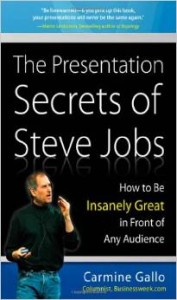 Ron’s Short Review: It may be that only Steve Jobs could pull some of these off but they sure are good techniques. Read also Gallo’s “Talk like TED.” They compliment each other.

Image Source: Kristina D.C. Hoeppner, Creative Commons
In previous blogs you have heard me talk about the difference of listening with the intent to understand versus listening with the intent to respond. So often while we’re “listening” our minds are working rapidly trying to figure out how we are going to respond to what the person is saying rather than trying to figure out what they’re trying to communicate.
Two of my readings recently touched on the power and aspect of listening. One comes from an HBR blog by Ram Charan of June 21, 2012 titled “The Discipline of Listening.” In the article Ram gives several good practical approaches to improving your listening skills but I want to share a few words with you from the end of his blog:
“For leaders, listening is a central competence for success. At its core, listening is connecting. Your ability to understand the true spirit of a message as it is intended to be communicated, and demonstrate your understanding, is paramount in forming connections and leading effectively. Truly empathetic listening requires courage – the willingness to let go of the old habits and embrace new ones that may, at first, feel time-consuming and inefficient. But once acquired, these listening habits are the very skills that turn would-be leaders into true ones.”
Notice that it’s the difference between “would-be” leaders and real ones. So many people believe that it’s what they know that makes them great leaders. In reality it’s what they continually learn that make them great leaders. You can only learn through listening.
I’ve also just begun reading The Corner Office: Indispensable and Unexpected Lessons from CEOs on How to Lead and Succeed
Adam poses an interesting question at the beginning of the Passionate Curiosity chapter:
“Imagine one hundred people working in a large company. They’re roughly the same age, around thirty five. They’re all vice presidents and share many of the same qualities that got them where they are. They’re smart, collegial, and hardworking. They consider themselves team players. They have positive attitudes and they’re good communicators. They’re conscientious about their jobs. They have integrity. If everyone shares these qualities, what is going to determine who gets the next promotion?”
Adam goes on to discuss a few key principles that allows some of these hundred people to eventually make it to the office of CEO. Number one on that set of principles is Passionate Curiosity. He says of these people:
“They wonder why things work and the way they do and whether those things can be improved upon. They want to know people’s stories and what they do.” Adam goes on to say “The CEO’s are not necessarily the smartest people in the room, but they are the best students. They learn, they teach, and they understand people and the business world, and then bring all that knowledge together to drive their organizations forward.”
In all the research that has been done in the world, we have never found any correlation between success and being smart. However, we find great correlation between success and listening.
Are you truly listening today or just trying to help other people see how smart you are?

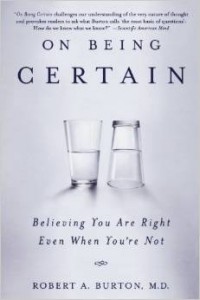 Ron’s Short Review: This one will scare you because it scientifically proves that when we’re the most certain, we’re probably also the most wrong.

Image Source: Alex Juel, Creative Commons
I recently spent a day with Fritz Seyferth, one of my consulting colleagues. Fritz has a unique background and style that makes him one of the most effective Leadership, Team Building and Culture building consultants I know. Check out his “Foundation of Winning”.
One of the principles that Fritz emphasizes in his consulting work is the importance of boundaries. Boundaries help set and define the culture. Boundaries actually demand more creativity and innovation to keep organizations moving forward. Boundaries are very important and useful for the health and growth of an organization (and individual). But, aren’t boundaries restrictive and inhibiting?
As usual I often learn more from observing my grandchildren then they ever learn from me. Both sets of grandchildren have fenced in back yards. In the back yard fences keep them safe, secure and contained. And in fact, the “boundaries” of play and activity tend to stay inside a parameter that is even within and smaller than the space defined by the fence.
As I observe some corporate cultures I notice that when leaders erect “fences” employees seldom even test the boundaries. In fact I often hear of hidden or invisible rules that keep people away from the fences.
“Oh, we’re not allowed to do that.”
“That would never be acceptable to our boss.”
“There are consequences for going there.”
The playing field actually becomes smaller than the playing surface.
Front yards however are defined by boundaries. There are no fences and the boundaries have to be clearly pointed out and defined to the children.
“That’s the neighbor’s yard.”
“Don’t go into the street.”
“You’re not allowed to go past the corner.”
However, boundaries are almost continually tested and reset. Unlike the backyard the entire world is beyond the front yard boundaries. If we don’t test and continually expand the boundaries of the front yard, we will never explore the world or discover what’s possible.
I’m beginning to think that we should be very clear in our businesses what is a back yard fence and what is a front yard boundary. I work with companies in the pharmaceutical, food and automotive industries among others. Drug and food safety better be a back yard fence. Manufacturing quality better be a back yard fence. There should be severe and immediate consequences for climbing over the fence.
However, when we’re exploring the world in front of us we better be thinking more of boundaries. If people violate our boundaries here we want to know why. We need to have the conversation about why someone stepped out and tried something new and radical. Should that be acceptable? Have things changed? Did they discover a new environment with new opportunities? We certainly should not simply abandon our boundaries. But, innovation happens at the boundaries. New ideas come in from the boundaries. Opportunities are seen from the boundaries.
I think it’s important for you and your company to discuss what is a back yard fence verses what should be a front yard boundaries. There are actually dire consequences if we confuse or don’t distinguish the two. Leaving back yard quality and safety to a boundary discussion will kill a company. Fencing in the front yard will arrest our growth and development keep us from exploring what the world has to offer.

Image Source: Martin Fisch, Creative Commons
“Boy do we have a dilemma!”
“This has presented a real dilemma.”
“This decision is so hard to make because it’s a real dilemma.”
I hear these kinds of statements all the time in my corporate world as well as in my civilian life. What are people saying when they talk of having a dilemma? Usually they want to make the “right” decision but it’s difficult to figure out which is the right decision or the best decision or the least damaging decision. Do you notice that there is a sense of right vs wrong or better vs best or least vs most in those words. Well, if that’s the case, you’re not faced with a dilemma, you’re just making a tough decision. The decision will (or should be) made for the right, best or most side of the scale, it’s just hard.
A dilemma is presented when you’re faced with making the right vs right, or the best vs best or the most vs most. Dilemmas are equally right! That’s what makes them a dilemma.
The original definition (without getting too deep into the word construction) meant the horns of a bull; thus, being on the horns of a dilemma. The idea is that you are about to get gored by one or the other horn, but you get to choose. Note that you’re going to be gored either way. Choosing which decision to make will not prevent you from getting gored! Now that’s a dilemma!
In the rapid paced world of today with global implications, I believe we are faced with more and more decisions that become true dilemmas. It’s not the case anymore that we’re faced with five “must do” activities to keep us competitive and all we need to do is prioritize them. No, today we are faced with five must do activities but we only have the resources and time to accomplish three of them. Which ones do we decide to kill (read the earlier blog on “Have We Decided Yet?”)? Now we’re facing a dilemma.
It’s when the goring for our decision happens at a later date when no one remembers (or admits to remembering) that we chose to get gored by one side of the decision. Today we’re getting beat up (gored) by the boss or the market place for lower sales volumes when we knew that would happen based on the price increase we took because of global commodity increases.
When you’re faced with a dilemma it’s important that you decide which alternative to kill, publicly execute the alternative and publicly record the expected consequences of that decision. Don’t look for someone to blame later, look at the consequences of your decisions to see if they were what you expected. Congratulate yourself if they are what you expected. Analyze your decision making process for improvement if they were not what you expected.
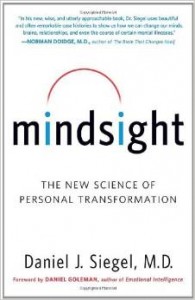 Ron’s Short Review: Understanding and using your mind properly.
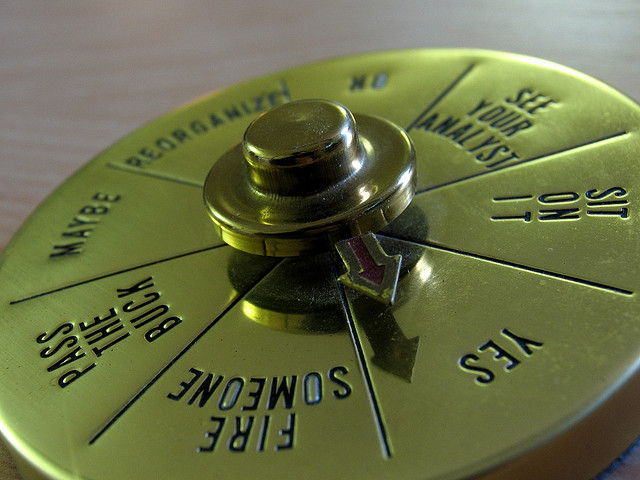
Image Source: Garrett Coakley, Creative Commons
One of my clients (thanks Mindy) recently introduced me to a book called The Primes: How Any Group Can Solve Any Problem
What do the words pesticide, homicide, fungicide have in common? They (and many others) all end in “cide.” The – cide ending originates from the Latin word caedere meaning to kill. It concerns death, destruction, extermination and deliberate killing. There is even a public execution connotation to the word meaning “to put to death.”
In our corporate world we’ve mistakenly come to believe that when we decide, we’re making a decision about what “to do.” But when we decide what to do, we never decide what to stop. It’s a little bit like the overwhelming morass that our governments have gotten into; every year our legislatures add more and more laws to the books, they just never kill any and so our laws and regulations have become so voluminous we can hardly act freely any more. In our corporate life when we continually decide what to do and seldom decide what to stop doing we spread our precious resources thinner and thinner.
See if you can make this shift with your team. When faced with a decision, spend more time figuring out which alternative you are going to kill. Figure out the consequences of killing that particular option. You’ll notice some deep seated attachment and engagement that you never uncovered when you were decide which alternative to “do.” There will be many people in your organization that may have spent many years honing their skills performing the alternative that you’re about to kill. How do you think they’ll react? They’ll do everything they can to preserve their job and skill set. They’ll do it overtly. They’ll do it covertly. But this is exactly what happens when you decide what to “do” versus what to kill. While the priorities have shifted to the more important task that you decided to “do”, nobody told the people doing the other alternative to stop or shift their resources to the higher priority item or to cut their project to the bare essentials. Thus, we are constantly looking for resources to accomplish all of the high priority items and we create work forces that feel overwhelmed and over extended.
Instead, try deciding. Try deciding what to kill. Try dealing with the fall out and consequences of telling people that we’re no longer doing that activity or project. Help them get reassigned, retrained, more engaged in the activities that you’re not killing.
Maybe you’re very good at prioritizing your work. However, when you prioritize your list of 30 activities rather than deciding which ones to kill, you will still have a huge amount of resources working on priorities 16-30. If you will decide, you’ll notice that you have more than enough resources to accomplish the top 15 priorities.
Start de-ciding! You’ll find yourself and your company suddenly much more productive.
 Ron’s Short Review: Denison’s culture survey is still the only one that I know of that relates culture to bottom-line performance. More examples from companies around the world.

Image Source: Azhar Khan, Creative Commons
My recent blog on Getting Past Failure reminded of me an experience I had with a client years ago.
I was working with a new president of a major company. He had taken over an organization that had just seemed to be stagnant for many years. His first instinct was to spend time out in the field riding with his sales representatives to find out what their daily experiences were like. He was looking at the organization from the ground up. His early impressions were that the organization was simply hesitant to make any decisive moves. He thought there were sales to be made and market share gains to be had but the entire organization was simply too cautious, afraid to make any major mistakes and not even willing to ask customers for a commitment.
At the same time, I had seen a National Geographic special that had followed a pride of lions. The lead female is the hunter for the pride. She will decide which prey to attack and direct the hunting party how to help her gain an advantage over the targeted animal. But she is the one who makes the kill. As she was in hot pursuit of her targeted zebra she rapidly moved in to make the kill and leaped for the attack just as the zebra came to a fallen log. The zebra jumped over the log and at the same time kicked hard at the attacking lion and caught her right in the side of the head. This kick sent the lion tumbling through the brush and the kill was lost. For the next several weeks the routine seemed to be exactly the same as it had always been but just as the lioness came to the moment of kill, she shied away. She was obviously afraid of being kicked in the head. Over the coming weeks as the pride became more and more hungry, younger females and even a few of the younger males began to challenge her dominance and position as the lead hunter. Rebellion was increasing when she finally regained her confidence or more likely overcame her own fear and finally made another kill. She and the pride quickly returned to their normal and successful routine.
The company above had experienced some of their own “kicks in the head.” They had received a regulatory citation about some of their sales practices. They had experienced some product failures as well as some competitor products gaining great advantage over their own. And they had experienced their own leadership failing to help them out of this funk. They were acting like the lioness who had been kicked in the head.
As the new president began to instill a level of confidence in their sales ability, in the quality of their products and in their strategic plan for being successful in the market place (through a combination of face-to-face meetings as well as large scale meetings) you could see the “pride” begin to return. Sales began to climb (even with no change to the product mix or market conditions) and by the time they launched a new product the following year (that product became the largest selling product in its category) the team was pumped up and ready to go. He had helped them recover from their kick in the head. In overcoming fear, the new president was able to lead his team to success.
Where have you and your team been kicked in the head? Things happen beyond our control. I’ve mentioned before a great book titled The Road Less Traveled, Timeless Edition: A New Psychology of Love, Traditional Values and Spiritual Growth

Image Source: Steven Depolo, Creative Commons
I recently participated in my first clinical trial. Fortunately I was in the healthy comparison group and not the afflicted group. While the trial was related to a cancer study, it was focused on the cognitive aspect of cancer and the immune system. I know, I know…. having me in the healthy cognitive group is amusing. However, it was a fascinating study.
During one section of the study that was looking at the ability to stay focused and concentrate even while being distracted, I was asked to watch the computer screen for long periods of time and quickly identify the direction of various arrows when they appeared on the screen while other information was also being displayed. The test itself was simple in nature but it was the instructions provided by the facilitator that fascinated me.
In preparing for the test she talked with me about handling failure. Because the arrows will quickly flash on the screen and I must indicate the direction of the arrow as quickly as possible, there will be times when I make a mistake. However, it was important that I put that mistake behind me and keep going. She explained the pattern they see when people make a mistake (which your brain realizes a split second after the arrow disappears) they will often make several mistakes in a row because they’re still upset about the one they missed. Interesting! This was not about life decisions or major corporate decision, it was simply hitting one key or another indicating the direction of an arrow. And yet, they could clearly see a pattern that when we make a mistake the guilt (horror, worry, embarrassment, or whatever) can often linger and result in several mistakes just because we didn’t quickly get past it.
We all make mistakes: individuals, teams, corporations… The trick is to not let failure lead to several others just because we didn’t get it behind us quickly enough.
So what causes these lingering affects? Several possibilities come to mind:
How are you at getting past failure quickly? Talk about this with your team. I believe you will discover that because you’re not putting legitimate mistakes behind you quickly you are creating additional mistakes and a risk averse, low accountability culture that is not serving you in these times of rapid change.