
Team Leadership Culture
  • Team
  • Leadership
  • Culture
  • Myers-Briggs
  • Trust Me
  • Short Book Reviews
Top Posts
Obituary
REPOST: Four Functions, Three Rules
ROUNDUP: The Rise of AI
REPOST: Facing Adversity Series
ROUNDUP: Curiousity
ROUNDUP: Deep Work
REPOST: Character vs. Competence
REPOST: Opposite of Victim
REPOST: Listening With the Intent to Understand
REPOST: Performance vs Trust
  • About
  • Services
  • Resources
    • Trust Me
    • Short Book Reviews
  • Contact

Team Leadership Culture

  • Team
  • Leadership
  • Culture
  • Myers-Briggs
  • Trust Me
  • Short Book Reviews
Author

Ron Potter

Ron Potter

BlogTrust Me

Calming Chaos

by Ron Potter June 20, 2016

photo-1456207242739-ff52c0c7413c

The world we live in is chaotic. A great leader learns how to leverage chaos into creativity, to bring a sense of tranquility to a crazy world.

Dealing with new technology, profit expectations, continual new-product development, the fickle shopper, and global competitors and global teams requires perpetual change and lightning-fast reactions. Markets change, old competitors consolidate, new competitors emerge, and attempts at re-engineering threaten our daily bread. Both leaders and employees can soon feel under siege and at the mercy of chaos.

A creative, energy-filled calm is what we need. A word picture may aid our understanding of this. Imagine you are a surfer. There you are with your board, waiting for the “big one.” If you are in Hawaii, the waves you are playing in might rise to twenty feet. All around you is surging, frothy chaos. Currents, tides, and the weather have combined to create a uniquely unstable environment. Conditions are always changing; every moment the ocean is different. If you try to catch a wave exactly the way you did yesterday, you will take a hard fall. You must stay alert and react quickly to every nuance of water, tide, and wind.

Gutsy leaders confront chaos. No one who is content to just paddle a surfboard beyond where the waves break has ever caught a “big one.” Neither has such a person ever wiped out. If you want to ride a wave, you have to enter into the chaos. If you panic while riding a big wave, you are sure to wipe out. If you stay calm, you can have a wonderful ride while tons of water crash down around you.

Creating calm in the office requires a similar ability to assess the environment, to act quickly, and to stay calm. The economy, products, competitors, consumers, and employees all constantly change. Someone has to have answers; someone must be an independent thinker, able to calmly think things through.

I’m familiar with a banker who had a client ready to sell a branch location of his business. The main location seemed to be prospering, but this particular branch appeared to be a drain on energy, time, and resources. The business owner was upset, but the banker remained calm. He took the time to analyze the underlying causes of the owner’s problems. He visited the location, recast the numbers, and advised the owner not to sell the branch but to move and resurrect it. In reality, the branch location was producing extra cash, and the owner, following the banker’s advice, turned his entire business around.

People will follow leaders who stay steady in the turbulence and work with them to create new answers, new plans, and a new future.

Whatever you do, don’t slip into what we call the “arsonist’s response to chaos.”

The Fort Worth Star-Telegram reported that firefighters in Genoa, Texas, were accused of deliberately setting more than forty destructive fires. When caught, they stated, “We had nothing to do. We just wanted to get the red lights flashing and the bells clanging.”

Do you know any leaders who intentionally start “fires” so they can get the “red lights flashing and hear the sirens”?

Leaders in a client’s organization proudly described themselves as “firefighters.” They were proud of the fact that they were good at hosing down crises. But when they were asked, “Is it possible you might also be arsonists?” it caused a great deal of reflection within the company.

The goal is a creative, steady productivity—not an out-of-control environment that squanders energy and resources on crisis management.

0 comments
0 FacebookTwitterEmail
BlogMyers-Briggs

Lights! Camera! Action! An Introvert Living in an Extraverted World

by Ron Potter June 16, 2016

My friend Mark Storrs sent me a note saying how much he identified with the post about an Introvert living in an Extraverted world. Mark has years of experience in learning & development and communications and is currently a Human Resources Business Partner for Blue Cross Blue Shield of Michigan so I was very interested in his thoughts. I asked him to send me a story and the following is what he shared with me. He said “I witnessed a technical lead providing a project update to the executive team, and I watched how nervous he was, how his leader was coaching and supporting him.” I think it’s a great story.


bsrOzgDkQhGRKOVC7Era_9X6A3584

“You’re doing a great job working on the project. I’d like you to present a strategy and status update to the executive team.”

We’ve all been there. Writing code for a new application your company is working on. Supporting a major project behind the scenes. Perhaps even informally leading a small team on that project. Then the unthinkable happens… you get recognized for your work, and your boss wants you to take what is often seen as the next logical step – visibility with leadership. But you’re an introvert and you don’t see visibility as the next step. That’s somebody else’s job. You’re perfectly happy in your behind-the-scenes individual contributor role.

[Oh no, I can’t do that. I don’t want to do that! You can’t make me!!]

“No, that’s not necessary. But I’ll be glad to write something up for you, and you can present.”

“No really. I want you to give the update to the project sponsors.”

[OH NO!!!!]

And there you are. You’re stuck. You can’t get out of it. You have to present. Now comes the stress…

[How detailed do I have to be?]
[What should I wear? I don’t want to be too casual, but I don’t want it to look like I’m trying too hard.]
[Can I use notes and talk from them? Or do I have to memorize it all?]
[But if I memorize it, I’ll sound like a robot!]
[It’s 3am and my presentation is in 6 hours! I’m not ready!]
[I haven’t had any sleep. Surely they’ll see bags under my eyes.]
[Must get to sleep… wait! What if I oversleep???!!!]

“Good morning. I want to give you a status update on Project X…”

[They hate me already.]
[And they deserve to hate me. I’m a fraud. I shouldn’t be up here.]
[I wonder if I sound too rehearsed? Be natural…be natural.]
[I can feel the sweat. I wonder if they can see me sweating?]
[The VP is checking her phone – she’s bored! I’m such a fraud!]

“And that concludes my update. Any questions?”

[Please, dear Lord, don’t let there be any questions!!]
[This awkward silence is deafening! It must be 30 minutes now!]
[Whew, I’m glad that was over. I bombed! Well the good thing is I won’t have to do that again.]

And that’s how it is for an introvert who’s taking those first steps in an extroverted world. A terrifying experience! But with these type of presentations being part of the next step up the corporate ladder, just what is an introvert to do?

So many times, we think we have to change our personalities to do something new like this. But that’s just not realistic. An extreme introvert is simply not going to just change and be bubbly and outgoing simply because there’s a change in job responsibilities. It’s just not going to happen. The trick is to not focus on changing yourself, but to think of yourself as an actor. That’s right – you’re an actor playing a role! You’re an introvert playing the role of an extrovert!

Think about it. Actors embrace different characters, put on different personalities. And that’s just what you’re doing here. You’re embracing the role of a presenter, giving an update about the project that you’re an expert on.

And just like actors, you have to practice at it to get good. An actor doesn’t just start out on Broadway or in a blockbuster film. They have to hone their craft. They go to acting classes, participate in different workshops focusing on various aspects of acting, learn from other actors, etc. They have to get comfortable with acting.

It’s the same for an introvert who finds him/herself in the strange new world of extroverts. You go to class… Study up on personality styles, read up on meeting facilitation techniques, learn how to use your introverted nature as a strength in developing your own presentation style. Watch other presenters, see how they make eye contact, work the room, engage all participants. Ask others to be your practice audience, give the presentation to them and then absorb their feedback like an actor does with his acting coach.

Your acting career starts out slow, with small presentations. You’ll be nervous, you may even fumble a little. And that’s OK. Because like an actor, you learn from those early experiences, you develop your own “acting” style, and you get better. One presentation at a time.

Over time you find yourself getting more and more comfortable in this new world of extroverts. You may even get to a point where you fool some into thinking you’re one of them. But deep down you know you’re not.

You’re just an actor.


Mark may not know it but a large portion of stand-up comedian performers identify with the Introverted side of the scale. And they’re really good! Introverts can be very entertaining, even in an extraverted world.

0 comments
0 FacebookTwitterEmail
BlogFavoredTrust Me

Favored Are Those Who Calm the Waters

by Ron Potter June 13, 2016

A passionate man turns even good into evil and easily believes evil; a good, peaceable man converts all things into good.
—Thomas à Kempis, The Imitation of Christ
photo-1427606694672-8f86d75947ce
Does it seem puzzling to find the term peacemaker included in a list of qualities necessary for a trusted leader? Does peace sound a bit too passive in today’s business environment?
We are desperately in need of some peace and quiet. Work—all of life—is more stressful than ever before. James Citrin writes:

Late nights in the office. Early mornings to clear overnight e-mails. Weekends to catch up on all the things you didn’t have time to do during the week. Most people in business simply cannot work harder or faster than they are at present—we’re all sprinting just to keep up. As the old saw says, the race goes to the swift. And in the now-distant boom times, being first to market and hurrying obsessively to get out ahead made working in overdrive the norm.
But in our collective rush to get ahead, maybe we have lost something…certain actions, decisions, and initiatives do have their own rhythms, and we should be sensitive to them. Don’t you agree that on some days, things just flow, while on other days, no matter how hard you push, things just don’t move forward?

A peacemaker is a leader who seeks to create calm within the storms of office politics, decision making, shareholder demands, cash-flow crunches, and the endless change of things the organization cannot control such as the economy, the weather, the fleeting loyalty of today’s consumer, and a host of other constantly evolving issues.

One of the jobs of a leader is to prepare the organization for times of great demand. There have been many studies on the effects of overtime work. When additional hours of work are initially introduced, productivity climbs. However, research also shows that if the overtime continues for more than about two months, productivity falls back to its original level in spite of the additional hours worked. Leaders who neglect to give the organization rest will not be prepared when the real push comes. And, in fact, they are not getting a good return on their investment by keeping everyone working long hours over extended periods of time.

Leaders need to know when to let the organization (people) slow down and rest a bit so that they are ready to go when those two or three tough times during the year require that extra effort.

Take a look at your world. Some people on your team are fed up with the daily push and shove. They are overworked and worn out. They feel vulnerable and fearful, and they are seeking personal peace to do a job they feel they can do but for whatever reason cannot.
A good leader knows the value of bringing some calm to stressful situations. As Jesus once said to those under his leadership, “Peace I leave with you.… Do not let your hearts be troubled and do not be afraid.”

Peace means equilibrium, understanding, justice, mercy, caring, and harmony. To be a peacemaker means to quench the desire for revenge and replace it with the desire to put others first for their well-being.

However, peacemaking does not mean seeking peace at any cost, for the peacemaker realizes that peace at any price will usually result in events that are anything but peaceful. A peacemaker is not an appeaser. He or she is not a person who is easy to shove around and who refuses to take a position. We are not talking about wimpy leaders who avoid confrontation. Quite the contrary. A peacemaker understands the positive role of conflict in building a solid team. A peacemaker is one who through strength and knowledge establishes good relationships between estranged parties—relationships based on truth and fairness.

Peacemaking leaders encourage open discussion and honest debate, which actually improves relationships. Harmony comes from the trust that is developed, not from the suppression of discussion and debate. In fact, great peacemaking leaders create more energized debate than normal.

0 comments
0 FacebookTwitterEmail
BlogTeam

What Would Jack Welch Do?

by Ron Potter June 9, 2016

photo-1444201716572-c60ec66d0494
Rich Hill is a friend, colleague and mentor of mine.  Along with being a great consultant and coach to many recognizable companies, Rich was also the Executive Director of the Dow Leadership Center at Hillsdale College and the Director of Human Resources for General Electric Plastics when Jack Welch took over the division.  In essence, he was one of Jack’s first HR directors.

Rich dropped me this note the other day:

I really like the post on Mentally Ill Teams.  How many times have I seen these dynamics exist in my many years of work with organizations? The point of “The attempt to avoid the suffering simply causes more and deeper suffering” is so true.

Rich goes on to talk about a process he titled “Contracting for Change”.  Notice a couple of elements of the process as he explains it:

One of the key elements in the process was putting charts up on the wall for each team player with three columns:

  • Things I should do more of/or better
  • Things I should do less of
  • Things I do well and should not change.

Each chart had additional columns to assess the Priority of each response relative to Top Priority or secondary Priority.  Each of the other team players were given tags to write on for each of the three elements.  Feedback!

Once all the feedback tags were up on each person’s chart the entire team moves to a given chart and the owner of that chart first suggests what the comment means to him or her and then asks for individual clarification of the statements – such as

  • Can you give me a specific example?
  • Where have you seen this characteristic in play?

We used these clarification statements especially if the owner’s interpretation didn’t quite square with the person who put the tag point up. This approach assures better mutual understanding by all members of the team.

Rich goes on to explain the next step of prioritization on the Do More Of and Do Less Of columns only done by all other team members, not the person’s own chart.

But I think the next step was the most powerful:

The next step deals with negotiating the key items on given charts to enhance both individual and team effectiveness (emphasis mine).  If successful, the final understanding is put into a written contract between the parties.  90 days out we reconvene the teams and go over contracts to see how much progress was made.  I used it with several organizations and always got good results.
As you can imagine there was some suffering as a result of the clarity of issues between people, but it often led to good results.

I don’t really know what Jack Welch would do in this case, but I do know what one of his first HR directors would do.  Working with executives at the level where Rich worked probably made the statement “some suffering” a bit of an understatement.  But the power of feedback and dealing with the direct pain and suffering cannot be denied or overlooked as a powerful tool for leadership and team improvement.

Thanks Rich, I really appreciate the time you took to send some feedback.

1 comment
0 FacebookTwitterEmail
Short Book Reviews

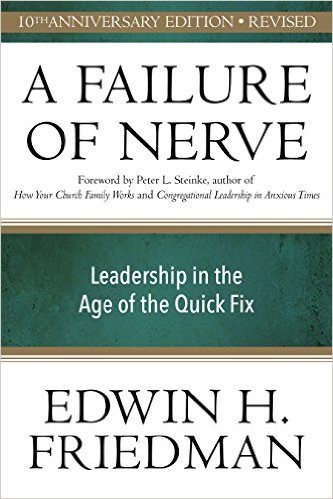
A Failure of Nerve

by Ron Potter June 1, 2016

Ron’s Short Review: Maybe the most profound book I’ve read in a long time. Goes a long way in explaining the cause of poor leadership and teamwork (as well as government, education and parenting). It will take me a while to unpack all that is contained in this book but it really gets at the core of many issues.

0 comments
1 FacebookTwitterEmail
Short Book Reviews

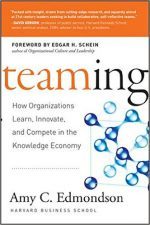
Teaming

by Ron Potter May 31, 2016

TeamingRon’s Short Review: Fantastic book that turns the noun “team” into the verb “teaming.”  Great concept.  Our corporations today need to be teaming on almost all fronts.  It’s more than building great static teams (still needed).  Teaming as an attitude is what creates the greater impact.

Amazon-Buy-Buttonkindle-buy button

0 comments
0 FacebookTwitterEmail
BlogTrust Me

The Integrity of Quality

by Ron Potter May 30, 2016

0Ad9yHP8QdCYBUqKxoiw_Stockholmsnow

Many believe that quality and productivity will define the economics of the twenty-first century. One of the principal events of the last century was Japan’s postwar emergence as an economic superpower. This came about primarily because of the quality revolution among Japanese manufacturers of automobiles and electronics, who zoomed past their American counterparts as consumers demonstrated with their wallets a preference for imports and the quality (perceived or real) of the products brought to the marketplace. In the process, American companies exported millions of jobs and, at the same time, were jolted into the reality that American consumers wanted, and even demanded, the highest quality.


To stop the outflow of consumer dollars, American manufacturers instituted many programs to improve quality. Total Quality Management (TQM) became more than just a popular catch phrase. It became a process driver for hundreds of companies and the focus of many leaders.


Authors Tom Peters and Nancy Austin wrote: “Any device to maintain quality can be of value. But all devices are valuable only if managers—at all levels—are living the quality message, paying attention to quality, spending time on it as evidenced by their calendars.”


The spotlight on quality remains. Today, consumers expect every product and service to be of the highest quality. Joseph Juran, publisher of the classic Quality Control Handbook, states, “We’ve made dependence on the quality of our technology a part of life.”


Clearly, American leaders need to emphasize quality in every aspect of their organizations. Whether they are service-driven or product-driven, company leaders must completely understand the need for quality and communicate that message down the line so that everyone in the organization fully understands the importance of maintaining and improving quality.


This addresses organizational quality, but what about personal TQM?


In the wake of the Volkswagen scandal as well as other corporate meltdowns, investors have lost hundreds of billions of dollars and tens of thousands of people are out of work. Cooked books, deceitful executives, and lackadaisical board members have caused a collapse of inconceivable proportions. The disintegration of these companies represents an unimaginable failure of leadership and governance. What has happened to personal quality?


As you learn and apply the principles of trustworthy leadership presented in my book, Trust Me, you will become a leader known for personal “total quality.” Specifically, no leader can have a life of quality without integrity. And the same is true for the entire organization. Without integrity, it will be impossible for the organization to have a truly high-quality reputation with customers, employees, peers, and shareholders.

Integrity is absolutely necessary for the success of a leader and an organization. A total quality life insists on integrity.

0 comments
0 FacebookTwitterEmail
BlogTeam

Mentally Ill Teams

by Ron Potter May 27, 2016

photo-1422246358533-95dcd3d48961

“Life is difficult. This is a great truth, one of the greatest truths. It is a great truth because once we truly see this truth, we transcend it. Once we truly know that life is difficult – once we truly understand and accept it – then life is no longer difficult. Because once it is accepted, the fact that life is difficult no longer matters.”

These are the opening lines in M. Scott Peck’s book “The Road Less Traveled.”

Dr. Peck essentially spends the rest of his book explaining that:

“The attempt to avoid legitimate suffering lies at the root of all emotional illness.”

How many teams have you worked with a team that seems to exhibit emotional illness?  No one ever quite speaks the whole truth.  Taboo topics never seem to come out in the open except in those moments of complete frustration when someone just can’t take it anymore.  No decisions seem to get made or if they do they certainly don’t seem to stick.  One voice is always (or seems to think) they are the smartest voice in the room.  Another is so conflict averse that even the hint of disagreement will be taken “off line” to be fixed behind closed doors.

These are all signs of emotional illness and they are just as real in teams (maybe more so) than in individuals.  Note that Dr. Peck identifies the root cause as the attempt to avoid legitimate suffering.  Pay attention to the word attempt.  The effort really never does avoid the pain and suffering, it just attempts to avoid it.  And in fact by doing so it actually makes things worse because the suffering is never dealt with openly or cleanly and simply leads to more misunderstanding, conflict and hurt feelings.  The attempt to avoid the suffering simply causes more and deeper suffering.

Also note that he describes it as legitimate suffering.  As the opening sentence of his book says, “Life is difficult.”  Life is difficult.  People are difficult.  Teams are difficult.  Organizations are difficult.  The market place is difficult.  Customers and clients are difficult.

Yes, it’s all difficult.  Decisions are going to result in suffering.  It’s a dilemma.  It means a choice between equally unfavorable alternatives.  You’ve heard of being on the ‘horns of a dilemma.’  It refers to the two horns on a bull.  Both unfavorable alternatives.  You must choose one horn or the other but you’re going to get gored either way.  Life is difficult.  Most tough corporate and team decisions are dilemma’s.  Either alternative is equally unfavorable but you have to choose one and you’re going to get gored either way.

Trying to avoid the legitimate suffering from facing dilemma’s simply leads to emotional illness.  Don’t avoid it, face it, be open about it and deal with it.  Then take your medicine.  You and your team will be much healthier.

0 comments
0 FacebookTwitterEmail
BlogMyers-BriggsYou Might Be Surprised

You Might Be Surprised: Thinking or Feeling – Part II

by Ron Potter May 23, 2016

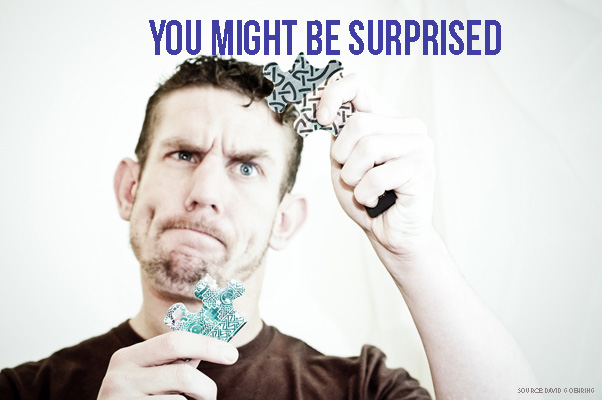
You Might Be SuprisedAfter years of being totally compatible in almost every area, are Dave and Charlie discovering that they’re really quite different?

Spoiler alert!!!  To fully appreciate this blog take just a minute and read our last blog that sets the stage for understanding the apparent conflict between Dave and Charlie and how they view each other.

After Dave erupted in utter disbelief which was turning into complete distain for the validity of the Myers-Briggs instrument we tried to calm things down long enough to turn this into a good learning opportunity.  After a few false starts we finally hit on a question that fairly and accurately painted a picture of the differences between Dave and Charlie.

We asked Charlie if he felt he was located in an accurate position on the Deciding (Thinking-Feeling) scale now that he had learned the difference between the two approaches.  With Dave still staring at him in disbelief Charlie indicated that he felt it was a fair and accurate assessment and he actually felt very comfortable with the outcome.  Once again Dave couldn’t contain himself with a very loud “No Way!”

But then the question:  Dave, what process do you use to purchase a new car?  Dave was quick and precise; he would first determine the class of vehicle he currently needed (truck, SUV, sedan, etc), then he would research all new entries into the market, do a complete analysis of performance, maintenance and long-term care and finally use all the modern tools available on the web to find the absolute best price before finally approaching a dealership armed with all of the ammo he needed to make his purchase.

Charlie, what process do you use to purchase a new car?  “Well, I’ve had one car salesman that I started using right out of college.  He’s taken good care of me through the years and we’ve actually become pretty good friends.  I trust him and I believe he has my best interest at heart so when he calls and says it’s time for me to purchase a new car, I ask him for his recommendations and have always purchased what he suggested.  It’s always worked just fine for me.”  Charlie made his decision based on the values of friendship, loyalty and trust.  It works for him.  Charlie comfortably fit on the Feeling side of the Deciding function.

Dave of course sat there with his mouth wide open.  When he regained his composure enough to control of his jaw muscles, he finally said to Charlie “You have always seemed to have cars that fit your need and personality so I guess we can still be fishing buddies.”

Be very careful when you think you really know someone and their Myers-Briggs functions, they might just surprise you.

0 comments
0 FacebookTwitterEmail
Absurd!BlogIn-Depth Book Reviews

Absurd!: The More We Communicate, The Less We Communicate

by Ron Potter May 19, 2016

photo-1451968362585-6f6b322071c7I’m continuing my series on an in-depth look at a wonderful little book that’s twenty years old this year.  The title is “Management of the Absurd” by Richard Farson.  You may want to consider dropping back and reading the previous blogs about ABSURD!  I think it will put each new one in great context.

“The notion that people need to communicate more is perhaps the most widely accepted idea in management, indeed in all human relationships.  Whether it’s called counseling, team building, conflict resolution, or negotiating, it boils down to one idea – that if we talk it over, things will get better.”

I just finished another Culture Survey’s with a client. (Actually I dealt with three client surveys over the last six weeks.)  There are a couple of items that always get low scores on every company’s survey and one of them is the need for more communication.

Unfortunately, most corporate leaders respond to the noted lack of communication with more information.  Seldom do people want more information.  Every organization and person I know, including myself is overrun with information.  We carry around the knowledge (and information) of man in our hand in a device we ludicrously call a phone when it uses about 0.001% of its capability to provide phone service.  What we don’t carry around with us is the wisdom of man.

People don’t want more information; they want more meaning.  What does this mean?  How should we interpret these numbers?  Give us meaning.  Tell us stories.  Help us understand.

Our author says:

“Almost all of this information is quantitative rather than qualitative and is of little use to top managers, who are dealing with predicaments that seldom yield to logical analysis.  What these executives require is more likely to come from the advice of their colleagues than from comprehensive displays of data.”

Simon Sinek notes that great leaders inspire action by starting with Why!  If you haven’t seen his video check out YouTube for “Why, How, What” or Simon Sinek below.  Why starts with meaning.  People are seldom interested in what you do but they are often interested in why you’re doing it.

The more we communicate, the less we communicate.  The more with inspire with meaning and helping people understand why, the more we communicate.

0 comments
0 FacebookTwitterEmail
BlogCultureOrganizational IntegrityTrust Me

Organizational Integrity

by Ron Potter May 16, 2016

photo-1462871287569-28d4c9a0ab7bHow can you build a team integrity? By modeling some key qualities.

Vulnerability

A leader who is approachable, available, and open to other ideas, thoughts, and even criticism has learned to be a humble person and further develops his or her integrity.
Executives often overlook the power of vulnerability. They confuse vulnerability with being weak. Too often, and for whatever reason (fear, circumstances, office politics, and so on), leaders build walls around themselves. They add one brick at a time until one day they become walled off from their people and their peers. The walls give them protection, but at the same time, the walls hide them from the harsh realities that confront every leader and keep them from communicating effectively. They are insulated and protected, but they are also cut off from others. Behind the walls, they can control and be hidden from failure. Behind the walls, they do not need to trust others or be vulnerable.
Gates, instead of walls, give others access to leaders, which enables leaders to demonstrate that they are trustworthy, open, and humble. Gates also allow leaders to share their visions and values with others. Open gates allow leaders to be vulnerable, to let go, and to trust others, which in turn builds others’ trust in their leaders.
Once a leader takes this step of vulnerability, others will give back, and an effective team can be built on interpersonal integrity.

Self-Disclosure

Leaders need to be the first to share what they stand for, what they value, what they want, what they hope for, and what they are willing to do in order to get where they want to go.
Self-disclosing leaders also need to be willing to risk trusting and being open with others if they want people’s trust and openness in return. The only way to receive others’ trust is to first trust others yourself.
Self-disclosure is risky for a leader. However, most people will appreciate the openness and will buy into a leader’s plans, vision, dreams, and actions more easily than if a leader is walled off.

Prioritizing People-Development

Daniel Pink in his book “Drive” helps us understand that the three main driving forces of motivation are Autonomy, Mastery, and Purpose. People have a strong need to direct their own lives, a great desire to get better and better at something and a yearning to accomplish things in service of something larger then themselves. Giving people a purpose and then helping them grow and develop so that they become capable of doing great things on their own and with others adds to the integrity, wholeness of a team.

Learning to Change

Another way a leader builds team integrity is through a willingness to make changes. How does a leader do that? How does a leader react when challenged or confronted by peers or subordinates?
Tom Peters is no stranger to change. He insists that embracing change is the single most competitive weapon in business. He suggests the following major points to help leaders effect change:

  • Trust/respect/don’t underestimate potential.
  • Insist upon (and promote) lifelong learning.
  • Share information.
  • Get customers involved.
  • Emphasize ‘small wins.’
  • Tolerate failure to the point of cheerleading.
  • Reject ‘turf’ distinctions.”

Trusting Others

When leaders work to create high-trust cultures within their organizations and to ensure a sense of security, people feel that they can trust one another.

0 comments
0 FacebookTwitterEmail
BlogTrust Me

Trust and Integrity

by Ron Potter May 9, 2016

photo-1452690700222-8a2a1a109f4cTo have a great organization, integrity must be widespread. It won’t do to be a saintly leader of highest integrity if the rest of the team consists of liars, backbiters, and thieves. Integrity must exist from top to bottom.
As leader, you are the key. If you are a person of integrity, you will be trusted, and “trust has been shown to be the most significant predictor of individuals’ satisfaction with their organization.”
Integrity and trust are inseparable—one cannot exist without the other. According to Charles O’Reilly and Karlene Roberts,

Leaders who build trusting relationships within their team are willing to consider alternative viewpoints and to make use of other people’s expertise and abilities. They feel comfortable with the group and are willing to let others exercise influence over group decisions. In contrast, managers in a distrustful environment often take a self-protective posture. They’re directive and hold tight the reins of power. Those who work for such managers are likely to pass the distrust on by withholding and distorting information.

In a research study several groups of business executives were asked to be involved in a role-playing exercise. The groups were given identical factual information about a difficult policy decision, and then they were asked to solve a problem related to that decision. Half of the groups were briefed to expect trusting behavior from the members of their group; the other half were told to expect untrusting behavior (“You cannot openly express feelings or differences with members of your group”).
After thirty minutes of discussion, each group member as well as those who had observed the role playing completed a questionnaire. The responses were in harmony with each other: The discussions among members in the high-trust group were significantly more positive than the discussions among members of the low-trust group. In fact, people in the low-trust group who tried to be open and honest were virtually ignored. Hostility was caused by a mere suggestion, and it quickly spread throughout the group. The people in the low-trust groups realized that the lack of trust kept them from high achievement. They did not feel free to be vulnerable due to the actions and rejection of other group members.
Here are some findings on the high-trust group:

  • Members were more open about their feelings.
  • Members experienced greater clarity of thinking.
  • Members searched for more alternative courses of action.
  • Members reported greater levels of mutual influence on outcomes.

The high-trust group opened the gate of personal vulnerability, and the result was a better team and a model of integrity-based leadership.
When people do not trust one another, it is difficult for the organization to succeed and for the people within the organization to feel completely fulfilled. People who feel trusted and who trust their leaders are more satisfied, and their work environment is less stressful. There exists a feeling of openness and confidence and a greater ability for people to believe they can take risks.

0 comments
0 FacebookTwitterEmail
Newer Posts
Older Posts
  • Facebook
  • Twitter
  • Linkedin
  • Rss
  • About This Site
  • About
    • Clients
  • Services
  • Resources
    • Trust Me
    • Short Book Reviews
  • Contact

About this Site | © 2024 Team Leadership Culture | platform by Apricot Services


Back To Top
Team Leadership Culture
  • Team
  • Leadership
  • Culture
  • Myers-Briggs
  • Trust Me
  • Short Book Reviews