Team Leadership Culture
  • Team
  • Leadership
  • Culture
  • Myers-Briggs
  • Trust Me
  • Short Book Reviews
Top Posts
Obituary
REPOST: Four Functions, Three Rules
ROUNDUP: The Rise of AI
REPOST: Facing Adversity Series
ROUNDUP: Curiousity
ROUNDUP: Deep Work
REPOST: Character vs. Competence
REPOST: Opposite of Victim
REPOST: Listening With the Intent to Understand
REPOST: Performance vs Trust
  • About
  • Services
  • Resources
    • Trust Me
    • Short Book Reviews
  • Contact

Team Leadership Culture

  • Team
  • Leadership
  • Culture
  • Myers-Briggs
  • Trust Me
  • Short Book Reviews
Author

Ron Potter

Ron Potter

5 Steps to Standing for Something GreaterBlogLeadership

5 Steps to Standing for Something Greater – Part V: Recognize the Cost

by Ron Potter March 19, 2018

People do not like to be put in boxes, and just as important, people do not like to be in the dark, outside the door where company values and vision are shaped. People are less energized and tend to drift when they are unsure of how they should be operating within an organization. People need to see their leaders’ commitment to values, and they want a part in helping to shape their organization’s core values and vision.

So how do you show this? There are five steps to helping your company and your team stand for something greater and this week, we’re digging into step 5.

Recognize the cost

Standing for something greater often exacts a significant price. Senator John McCain, speaking at the 1988 Republican National Convention, told the story about a special soldier whom he met while a prisoner of war in Vietnam.

McCain spent over five years imprisoned by the North Vietnamese in what was called the “Hanoi Hilton.” In the first few years of his imprisonment, McCain and the other soldiers were kept in isolation. Then in 1971 the North Vietnamese put the prisoners in more open quarters with up to forty men in a room.

One of the men in Senator McCain’s cell was Mike Christian. Mike was from the rural south and had joined the navy when he was seventeen. Eventually he had become a pilot and, after being shot down in 1967, was captured and imprisoned.

As the prison rules eased, the men were allowed to receive packages from home. McCain stated, “In some of these packages were handkerchiefs, scarves and other items of clothing.” The prisoners’ uniforms were basic blue, and Mike Christian took some white and red cloth from the gifts and fashioned an American flag inside his shirt.

Mike’s shirt became a symbol for the imprisoned Americans. Every day, after lunch, they would put Mike’s shirt on the wall and recite the Pledge of Allegiance. You can imagine that, for these men, this was an emotional and significant daily event.

One day the Vietnamese found Mike Christian’s homemade flag. They destroyed it and later that evening, as an example to the other prisoners, beat Mike for over two hours.

McCain remembers, “I went to lie down to go to sleep. As I did, I happened to look in the corner of the room. Sitting there beneath that dim light bulb, with a piece of white cloth a piece of red cloth, and another shirt and bamboo needle was my friend, Mike Christian. Sitting there with his eyes almost shut from beating, making another American flag.”10

Lt. Commander Mike Christian is a real-life example of how leaders can shift their focus away from themselves, their power, and their potential to something (or someone) outside themselves, seeking the greater good for others as well as for the organization and the community at large.

Standing for something greater moves leaders past their own interests to something that benefits everyone. It takes controlled strength not to fall back to the shortsightedness of doing things only for selfish gain or selfish reasons.

In a POW camp Mike Christian was willing to stand for a symbol of the country he loved. His actions inspired others to stand strong as well and not to surrender hope. That’s the power of commitment to something greater.

0 comments
0 FacebookTwitterEmail
Balance on the High WireBlogCulture

Balance on the High Wire – Part IV: Human Needs

by Ron Potter March 15, 2018

The world is becoming a very fast paced environment. With each step of increased travel velocity, the world has become more interconnected than ever. With the advent of the internet and pipeline speed that velocity has become almost infinite in nature. It seems like a Niagara amount of information, data and connectivity are swirling around us every moment of every day. With each passing day, it becomes more difficult for us to maintain our balance. Without balance, bad things happen.

Over the last few of blog posts, I’ve introduced that Balance is the key ingredient of great decision-making, health, and happiness (human needs). Today let’s explore Human Needs.

A couple of years ago I wrote a short post on human needs described by Tony Robbins. I’m sure Tony didn’t invent these needs, they have been known and observed through human history as being part of who we are as humans. But, Tony has done a nice job of observing and describing the drives behind each.

The six (in my words) are:

  • Certainty—Uncertainty
  • Belonging—Standing out
  • Learning—Teaching

Certainty-Uncertainty

  • I’ve watched corporate leaders attempt to boil down the big-data they need so that it fits on their laptop or tablet. They are searching for certainty and assume that if they have all the data at their fingertips they’ll always make the right decision. If that’s true, why do we need the human element at all? Just let the big-data make the decision. Leadership is dealing with the ambiguity of the situation and making the decision despite the fact you don’t have all the data. Decisions are about the future. The future is difficult (impossible) to know. Life is full of ambiguity and people in general and good leaders are better at dealing with ambiguity than computers.
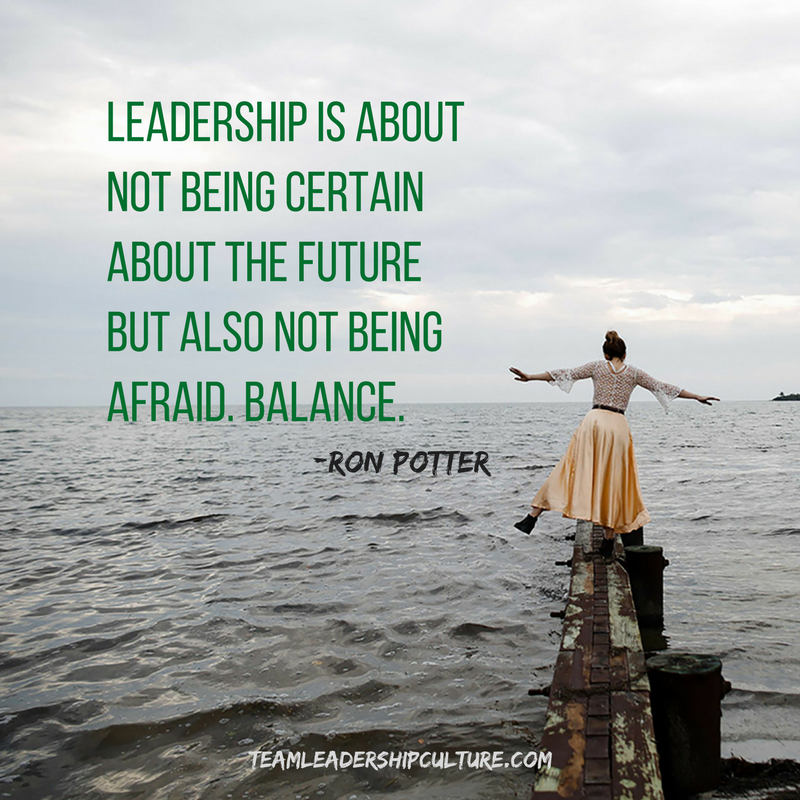
  • Leadership is about not being certain about the future but also not being afraid. Balance.

Belonging-Standing Out

  • This one is difficult to balance. I believe it takes a trusting team to accomplish. A great team encourages unique abilities, encourages them and helps develop But the goal is to serve the team, not the individual.
  • Individuals have a difficult time accomplishing just the right balance without trusting feedback. One of our great American philosophers, George Carlin once said: Everyone driving faster than you are idiots. Everyone driving slower than you are Morons. Which means you are one or the other to all others on the road. Balance.

Learning – Teaching

  • When both learning and teaching are taking place, both experiences are better. One of my clients explained to me that I provided the greatest value to them when I was teaching them about what I was learning. My energy and enthusiasm came through when I shared with them the insights of what I was learning through my reading and experiences. Balance

I started my career walking steel up to 200 feet in the air. No safety equipment. Just you, the breeze and balance. Up there, balance was life and death. Balance, Balance, Balance!

0 comments
0 FacebookTwitterEmail
5 Steps to Standing for Something GreaterBlogLeadership

5 Steps to Standing for Something Greater – Part IV: Seize the Higher Ground

by Ron Potter March 12, 2018

People do not like to be put in boxes, and just as important, people do not like to be in the dark, outside the door where company values and vision are shaped. People are less energized and tend to drift when they are unsure of how they should be operating within an organization. People need to see their leaders’ commitment to values, and they want a part in helping to shape their organization’s core values and vision.

So how do you show this? There are five steps to helping your company and your team stand for something greater and this week, we’re digging into step 4.

Seize the higher ground

“John Gardner, Stanford professor, former secretary of Health, Education, and Welfare and founding chairperson of Common Cause, has written that there are four moral goals of leadership:

  • Releasing human potential
  • Balancing the needs of the individual and the community
  • Defending the fundamental values of the community
  • Instilling in individuals a sense of initiative and responsibility.”

Gardner notes that concentrating on these aspects will direct you to higher purposes. They take the focus off of you and place it on the people around you. They enable you to let go of the things in life that do not matter and instead make time and create energy for the things that do matter: the welfare of others, the organization, and the larger community.

When working to plant a vision and sense of a greater cause in a team, you must first ensure that values are understood and owned. This is accomplished initially by cataloging the personal values of individual team members. When the personal values of individuals are understood, team values begin to emerge.

0 comments
0 FacebookTwitterEmail
Balance on the High WireBlogCulture

Balance on the High Wire – Part III: Stress and Health

by Ron Potter March 8, 2018

The world is becoming a very fast paced environment. With each step of increased travel velocity, the world has become more interconnected than ever. With the advent of the internet and pipeline speed that velocity has become almost infinite in nature. It seems like a Niagara amount of information, data and connectivity are swirling around us every moment of every day. With each passing day, it becomes more difficult for us to maintain our balance. Without balance, bad things happen.

Over the last couple of blog posts (Balancing Act and High Wire), I’ve introduced that Balance is the key ingredient of great decision-making, health, and happiness (human needs). Today let’s explore Stress and Health.

Stress

The biggest issue in dealing with stress is founded in the ancient Serenity Prayer:

  • God grant me the serenity to ACCEPT the things I cannot change,
  • the COURAGE to change the things I can,
  • and the WISDOM to know the difference.

It’s the wisdom to know the difference that contains the real power of the Serenity Prayer. In their book “Performing under Pressure – The Science of Doing Your Best When It Matters Most” Hendrie Weisinger, J. P. Pawliw-Fry do a great job of helping us distinguish between pressure and stress. (See the TLC Short Book Reviews)

Stress refers to the situation of too many demands and not enough resources to meet them: Time, money, energy, etc. In a stressful situation, reduction is the goal.

Pressure is when you perceive that something at stake is dependent on the outcome of your performance and there are good and bad consequences. In a pressure moment, success is the goal.

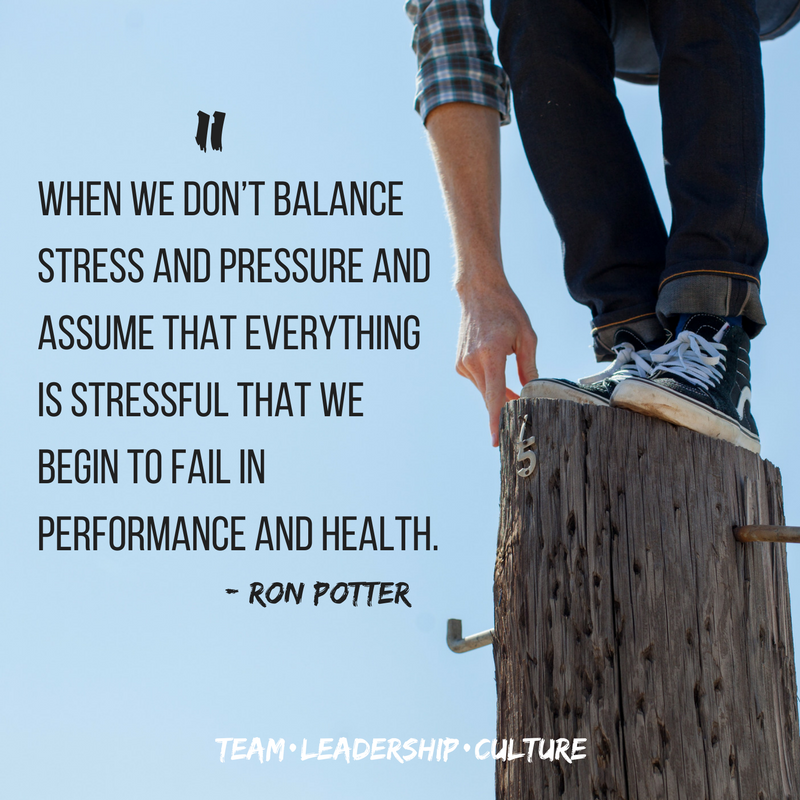
It’s when we don’t balance these two and assume that everything is stressful that we begin to fail in performance and health. Knowing the difference between stress and pressure (wisdom) has a tremendous impact on our health.

Work-Life Balance

I’m going to toss this topic into the Stress category because I see them as interconnected in our work lives. Because of the stress, or by turning even pressure situations into stressful ones, it seems we begin to lose our work-life balance.

Nigel Marsh, author of several books on developing a good work-life balance says “Work-Life Balance is easy when you have no work!” Nigel says it’s too simplistic and destructive to think that it’s simply work vs life. Life is made up of many aspects:

  • Career
  • Family/Friends
  • Significant Other/Romance
  • Fun & Recreation
  • Health
  • Money
  • Personal Growth
  • Physical Environment

It’s when we make the small investments in the right places at the right time that our life feels balanced. Allowing our lives to get out of balance and sacrificing one or more of these areas leads to poor health and a shortening of life.

Balance, Balance, Balance.

Health

Microsleep is defined as a period of mere seconds when

  • Eyelids will partially or fully close
  • The brain becomes oblivious to all channels of perception including visual
  • There is no awareness of any event that occurs during a microsleep

The main victim of microsleeps is concentration. It’s impossible to concentrate when your brain is using microsleeps to recover from sleep deprivation. How much deprivation causes these microsleeps?

  • One night of missed sleep (pulling an all-nighter) causes a 400% increase in microsleeps.
  • Four hours sleep per night for six nights causes the same 400% increase in microsleeps. Eleven nights of 4-hour sleep is equivalent to two back-to-back all-nighters.
  • Ten days of six hours sleep per night is also equivalent to an all-nighter.

Eight hours of sleep per night provides nearly perfect levels of concentration with no microsleeps.

Being awake for 19 straight hours (5 am to midnight) produces the same impairment as being legally drunk.

Long hours of “dedicated” work seems to have gained a level of admiration in corporate circles. It shouldn’t. Longer hours of impaired work and concentration is dangerous for the company and dangerous for the individual. Let alone the shortcomings that are created with the work-life balance issues listed above. Stop doing it. Stop encouraging it. It’s healthier too:

Balance, Balance, Balance.

0 comments
0 FacebookTwitterEmail
5 Steps to Standing for Something GreaterBlogLeadership

5 Steps to Standing for Something Greater – Part III: Elevate People to a Higher Purpose

by Ron Potter March 5, 2018

People do not like to be put in boxes, and just as important, people do not like to be in the dark, outside the door where company values and vision are shaped. People are less energized and tend to drift when they are unsure of how they should be operating within an organization. People need to see their leaders’ commitment to values, and they want a part in helping to shape their organization’s core values and vision.

So how do you show this? There are five steps to helping your company and your team stand for something greater and this week, we’re digging into step 3.

Elevate people to a higher purpose

Lincoln motivated people by leaving his office and spending time with everyone in the government and military hierarchy. One hundred and twenty years later, Tom Peters dubbed this kind of management style as “management by walking around.” When a leader gets out and interacts with all the people, the vision is communicated, the values are acted upon, the leader is observed, and the people are inspired.

Whether or not leaders literally walk around, the important factor is elevating and transforming people to serve a higher purpose. People respond by seeking higher moral standards for themselves and the organization. A higher purpose serves to develop common ground, and the common ground leads to energy in attaining goals. It creates a center of importance around which the team can rally and be unified.

How are you seeking to develop common ground for your team or organization? Have you seen any benefits to “management by walking around” in your own management style?

0 comments
0 FacebookTwitterEmail
Short Book Reviews

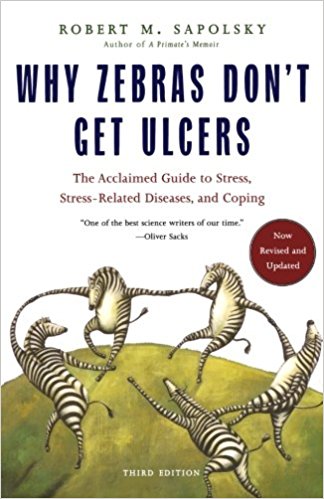
Why Zebras Don’t Get Ulcers

by Ron Potter March 1, 2018

Ron’s Short Review: Fun, well-written guide for the human race and how to handle stress better.

0 comments
0 FacebookTwitterEmail
5 Steps to Standing for Something GreaterBlogLeadership

5 Steps to Standing for Something Greater – Part II: Examine Your Values

by Ron Potter February 26, 2018

People do not like to be put in boxes, and just as important, people do not like to be in the dark, outside the door where company values and vision are shaped. People are less energized and tend to drift when they are unsure of how they should be operating within an organization. People need to see their leaders’ commitment to values, and they want a part in helping to shape their organization’s core values and vision.

So how do you show this? There are five steps to helping your company and your team stand for something greater and this week, we’re digging into step 2.

Examine your values

While attending seminary, Martin Luther King Jr. read extensively in the areas of history, philosophy, and religion. With each book and each discipline, he questioned what he truly believed. As he read, learned, and reflected, he molded his values and vision on the anvil of discovery.

This kind of personal searching is essential for every good leader. How can you clarify values, set vision, get beyond yourself, and stand for something greater if you have not participated in the intense, personal struggle to clarify, define, and establish who you are as a person? As a leader you will be asked many questions—economic, moral, and personal. How will you know what answers to give unless you have wrestled with some of the questions? How can you shape who you are without struggling with opposing values?

The result of this struggle is personal integrity and credibility. Abraham Lincoln did not just “discover” his vision for America. As a young man, he saw the ravages of poverty and exclusion. As a lawyer, he defended the rights of people. As a father, he witnessed the death of two of his children. Lincoln struggled and fought with others as well as himself, and the result was a clearer picture of his personal values and a more defined vision. The result was also a president of high integrity and purpose.

0 comments
0 FacebookTwitterEmail
Balance on the High WireBlogCulture

Balance on the High Wire – Part II: Decision Making

by Ron Potter February 15, 2018

The world is becoming a very fast paced environment. With each step of increased travel velocity, the world has become more interconnected than ever. With the advent of the internet and pipeline speed that velocity has become almost infinite in nature. It seems like a Niagara amount of information, data and connectivity are swirling around us every moment of every day. With each passing day, it becomes more difficult for us to maintain our balance. Without balance, bad things happen.

Over the last couple of blogs (Check out Balancing Act and High Wire), I’ve noted that Balance is the key ingredient of great decision-making, health, and happiness (human needs). Today let’s explore decision-making.

Myers-Briggs teaches us that human decision-making is a two-stage process of taking in information (Perceiving) and then making our decisions based on that perception. It has been my experience through 25+ years of team building and leadership development that we must keep those processes in balance.

My data is rather old (meaning more than a day at this point) but the last I remember seeing is that we create over 50,000 GB of data per second. I’ll let you look up what the size of that number really means.

The human mind can’t come anywhere near absorbing that much data (or even a fraction) every day to use in our decision-making processes. So, the mind needs to use shortcuts, models, and tricks to help us survive and make everyday decisions in our daily lives. Each of us uses a different method of taking in data related to a decision that we’re making. The two key areas that Myers-Briggs describes are:

  • Sensing
    • Facts
    • Details
    • Data
    • What do we know in the present?
    • What have we done so far?
    • What are the next steps?
  • Intuition
    • Bigger picture
    • Future
    • Implications
    • Where are we trying to go in the future?
    • What will the possibilities be?
    • What is the ultimate goal?

As you look at the written list you would likely agree that we need all that information in order to make a good, well-informed decision. The problem is that in our every day lives, our brain tends to focus on and give greater priority to either Sensing or Intuition. It takes a team and a good process to maintain a healthy balance. Without balance you’ll tend to be either too short-term or long-term focused. If this function isn’t balanced it can cause the business to fail.

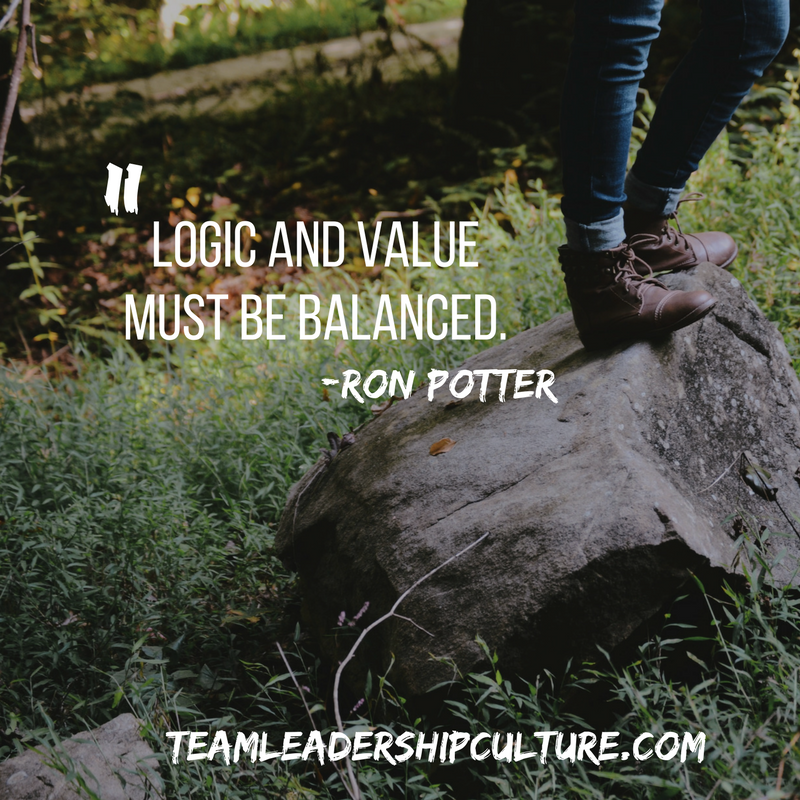
Once the perceiving function is completed (and hopefully balanced) our “deciding” function kicks-in. Myers-Briggs identifies these as our Thinking and Feeling functions. A better way to think of these is logic and values. All too often in the business world, “feelings” are discounted as being too emotional. Decisions should be made on logic. But values are important to every organization. When values are violated, the culture begins to crumble, and the organization loses a sense of being. Logic and value must be balanced.

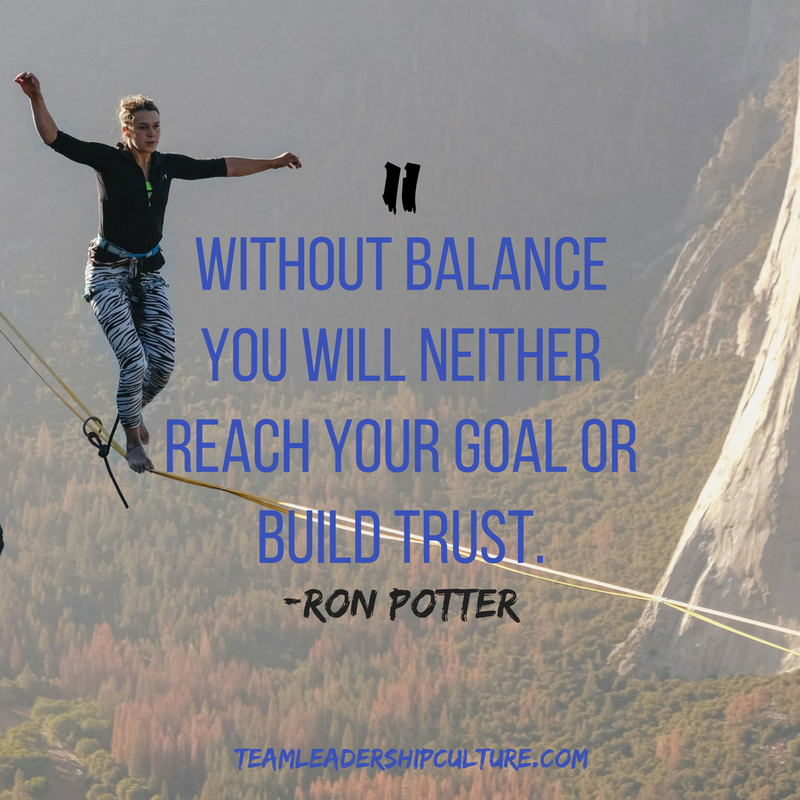
Just like on the high wire, goals cannot be met, and trust cannot be build when we lose our balance.

Balance, Balance, Balance.

0 comments
0 FacebookTwitterEmail
BlogCulture

Balancing Act

by Ron Potter February 8, 2018

My first job right out of college was working on large engineering projects. When I showed up for my first day of work I was given my assignment… my excitement quickly faded. The project I was working on was in the early stages of construction. The concrete foundation was complete and the majority of the structural steel was in place. My assignment? Make sure the structural frame was straight and plumb and then mark every column at every level so that the coming equipment could be placed properly and would align with all the other equipment to be installed in the plant. Oh, did I mention that the structural steel rose over 200 feet in the air. That’s roughly the height of a 20-story building.

Off I went, riding the construction elevator to the top of the building to begin the several week’s process of working my way down through the building marking columns as I went. Each floor was nothing more than structural steel beams, 6 to 10 inches wide depending on their location and generally 20 feet apart. Nothing else. No floors. No walls. Nothing. Just open air, empty skies, and 200 feet straight down. This was also the days before safety equipment. No nets. Not belts. No safety harnesses.

Focused on a goal

I slowly developed a technique that allowed me to walk across that 20-foot span from one column to the next, step by step on my 6” wide structural beam “sidewalk.” I would stand with my back tightly pressed against a column as I studied the column that was my goal. I would search and search my goal until I could find a visible flaw or mark in the steel where I could lock my eyes. Looking down was death. Once I spotted my goal I would begin to slow my breathing and my heart rate so that I could maintain my focus on that distant spot. When everything seemed to be under control, step one. Followed by step two, three and however many steps it took until I reached that far goal. Never looking down, just staying focused as I moved forward.

After my first couple of days, I thought I had learned a valuable lesson. Picture your goal, stay focused and move forward. But that was just the beginning.

Up in that structural steel with this rookie engineer were veteran and seasoned ironworkers. They would run around up there like they really were on sidewalks. And they were often bored while waiting for the next structural member to be lifted to them by the nearby crane. Bored people look for entertainment. I was entertainment!

Noticing that I had gained a little bit of confidence in my approach to walking steel, they decided to shake up my world a bit. One day as I had completed my routine and was about a third of the way across the beam, an ironworker slid down the column I had targeted and began walking toward me. Now I stood about halfway across the beam, facing a smiling, unshaven, cigar-chomping ironworker with my target column nowhere in sight.

Before going up in the steel I had been taught how to pass someone in these circumstances but certainly never thought I would be using the teaching. The technique required us to get toe-to-toe on the beam, lock each other’s wrists, lean back until our weights were perfectly balanced and then begin a slow swivel keeping our toes on the beam until we were now on opposite sides. In the middle of that process, each of our bodies is suspended over nothingness, 200 feet in the air.

Once we completed our maneuver, the ironworker bid me a good day and walked off laughing in the other direction. I was left with racing breath, heartbeat and a need to find a new focal point so I could make it back to the column. The wrong column because I was now facing in the opposite direction.

Trust your teammates

After I gained some confidence in the maneuver, I thought I had learned the real lesson, trust your teammate. If at any time during that maneuver either one of us had lost trust in the other and tried to take control, the result would have been death for both of us. It amazes me even more now that the ironworker put his life in my hands!

Balance

After all these years I think the real lesson is balance. It doesn’t stand alone: you must be focused on a goal and without trust, you’ll always fall short but my real goal in those situations was to maintain balance. I’m going to start a series on balance and how important it is in many aspects of teams, leadership and culture but I wanted to share my personal journey with you first.

Balance, Balance, Balance.

0 comments
0 FacebookTwitterEmail
5 Steps to Standing for Something GreaterBlogLeadership

5 Steps to Standing for Something Greater – Part I: Clean Up Your Act

by Ron Potter February 5, 2018

People do not like to be put in boxes, and just as important, people do not like to be in the dark, outside the door where company values and vision are shaped. People are less energized and tend to drift when they are unsure of how they should be operating within an organization. People need to see their leaders’ commitment to values, and they want a part in helping to shape their organization’s core values and vision.

So how do you show this? There are five steps to helping your company and your team stand for something greater.

Clean up your act

It is difficult to convince others to stand for something greater if your own life and values are mediocre. Make no mistake: Regardless of what you hear from assorted voices, your personal moral standards are inseparably linked to long-term leadership success.

I once worked with a vice president of a large company who appeared very successful but did not adhere to high personal standards. He was very good at what he did and had a magnificent reputation. He had also successfully navigated through some tough spots for the company.

This V.P. liked to call himself “a player.” Essentially, being a player meant that he messed around outside of marriage. He did not see this as wrong (pride talking) and told us it would not affect his people or the quality of the job they were doing (pride again). In his arrogance he thought he could keep his two worlds—work and extramarital cheating—separate.

Twenty-four months later, the vice president’s inability to control his pride and lust cost him everything, including his job. His clever scheme fell apart. His self-focus swallowed him up.

It’s fun to be a leader, flattering to have influence, and invigorating to have a room full of people cheering your every word. It is a powerful boost to set a direction for the troops and then draw them out to march toward the goal. However, nothing will spoil this pretty picture more quickly than a willful, proud attitude.

Author and speaker Joyce Meyer writes,

How can you tell you have a problem with pride? Examine yourself. If you have an opinion about everything, you have a problem with pride. If you are judgmental, you have a problem with pride. If you can’t stand to be corrected, you have a problem with pride. If you rebel against authority, if you want to take all the credit and glory to yourself, if you say “I” too often, then you have a problem with pride.

Pride can cause an uncontrolled will, which is fatal in a leader’s life.

0 comments
0 FacebookTwitterEmail
Short Book Reviews

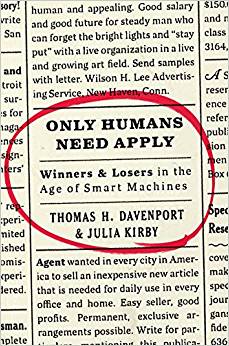
Only Humans Need Apply

by Ron Potter February 1, 2018

Ron’s Short Review: The shift to technology-based work is pushing us beyond the information age. If you’ve been an “Information Worker” you should learn how to augment technology to keep yourself relevant.

0 comments
0 FacebookTwitterEmail
Balance on the High WireBlogCulture

Balance on the High Wire – Part I: Introduction

by Ron Potter January 25, 2018

In 1974 Phillppe Petit walked a tight rope between the World Trade Center buildings (the ones that came down during the terrorist attack). They were nearly 1,800 feet in the air.

In 2012, Nik Welenda walked a tight rope across Niagara Falls. While Nik’s wire was only about 180 feet in the air, that one seemed more difficult to me. Why, because beneath him the Niagara River was rushing over the falls. Everything was moving. This is not to diminish what Petit did. Both would be terrifying. But it just seems more difficult to me to maintain your balance when everything around you is moving.

I’ve walked structural steel. I’ve also walked over the catwalk of a dam with rushing water under me. Both were terrifying, but it was harder to maintain my balance over the moving water.

In my story about walking structural steel I progressed through three lessons from the experience:

  1. Figure out your goal and stay focused
  2. Reaching your goal requires trust
  3. Balance, Balance, Balance. Without balance you will neither reach your goal or build trust.

The world is becoming a very fast paced environment. With each step of increased travel velocity, the world had become more interconnected. With the advent of the internet and pipeline speed that velocity has become almost infinite in nature. It seems like a Niagara amount of information, data and connectivity is swirling around us every moment of every day. With each passing day it becomes more difficult for us to maintain our balance. Without balance bad things happen.

Over the next few blog posts I’m going to talk about balance with a focus on three key areas:

  • Decision Making
  • Stress and Health
  • Human Needs

It seems that we are all living on the “High Wire” of life these days.

  • How do we maintain our balance?
  • Why is it necessary to maintain our balance?
  • What happens when we lose our balance?

Balance, Balance, Balance.

0 comments
0 FacebookTwitterEmail
Newer Posts
Older Posts
  • Facebook
  • Twitter
  • Linkedin
  • Rss
  • About This Site
  • About
    • Clients
  • Services
  • Resources
    • Trust Me
    • Short Book Reviews
  • Contact

About this Site | © 2024 Team Leadership Culture | platform by Apricot Services


Back To Top
Team Leadership Culture
  • Team
  • Leadership
  • Culture
  • Myers-Briggs
  • Trust Me
  • Short Book Reviews