
Team Leadership Culture
  • Team
  • Leadership
  • Culture
  • Myers-Briggs
  • Trust Me
  • Short Book Reviews
Top Posts
Obituary
REPOST: Four Functions, Three Rules
ROUNDUP: The Rise of AI
REPOST: Facing Adversity Series
ROUNDUP: Curiousity
ROUNDUP: Deep Work
REPOST: Character vs. Competence
REPOST: Opposite of Victim
REPOST: Listening With the Intent to Understand
REPOST: Performance vs Trust
  • About
  • Services
  • Resources
    • Trust Me
    • Short Book Reviews
  • Contact

Team Leadership Culture

  • Team
  • Leadership
  • Culture
  • Myers-Briggs
  • Trust Me
  • Short Book Reviews
Author

Ron Potter

Ron Potter

BlogCulture

The Most Important Asset in Your Life

by Ron Potter November 26, 2020

“The Most Important Asset in Your Life” is an article by Zat Rana. I find it a well thought out and researched article.

One of the first quotes that may strike you (at least it did me) is that “Money is a means, not an end.” All too often, people think that if they just make enough money (an end), they’ll be happy. There is way too much research and general observation to get caught in that trap anymore (although many people still do).

Research shows that money is not a motivator that keeps people in jobs. People don’t leave jobs because of money! Nor do they stay in jobs for the money.

Interviews with entrepreneurs that have become very rich indicate that it was the work, trying something new, working on something they loved that kept them going. None of them spoke of the desire to get rich, that was a by-product of doing something they loved. Of course, they also didn’t talk about being dirt poor just so they could follow their dream. The point is, money didn’t enter the interview either good or bad.

But the real zinger comes when Zat says, “The most important asset in your life isn’t time, but attention. The quality of the experiences in your life doesn’t depend on how many hours there are in the day, but how the hours have been used”.

Attention

That is the key! We still have a limited amount of time in our lives and everyone has the same 24 hours per day. It’s not how much we do or don’t have, it’s how we use it. Where do we put our attention?

Today’s world is against us

I’ve written previous blogs on the need for deep thought. Today’s world is designed to keep us from the process of deep thought. The Googles, Twitters, Facebooks, etc. that fill today’s world are designed to capture our attention and keep it as long as possible. This diverts our thinking and pulls us away from deep thought on our desired topic. They are very good at what they do and are getting better (or worse) every day.

Zat mentions three things that help us focus and keep our attention on what is important:

Mindfulness

This is what helps us from getting distracted by what the world attacks us with and helps get us into and keeps us in deep thought. Zat says “By forcing yourself to focus your mind on one thing, you train your brain to develop a sense of control over your attention.” The world (high tech) wants to distract us and keep our attention on its ecosystem.

Ruthless Single-Tasking

Studies that I came across years ago said that only fighter pilots can multi-task and only because they are highly trained to multi-task because their life depends upon that ability. Zat says that single-tasking with deep focus (thought) for extended periods helps fight the adverse side-effects that are actually harmful to the brain.

Routine Detachment

Zat says that “Every time you pull out your phone to scan your social media accounts, and every time a 10-minute internet break turns into an hour-long binge, your brain is building a habit loop that reinforces itself to encourage such behavior.”

I’m not the best at some of this but there are a few things that have worked for me:

• I stopped watching TV news over a decade ago. It’s focused on the immediate and controversial. I’m interested in the long-term and unity. All TV, be it weather, financial, or whatever category, is entertainment. Once again, it’s designed to capture your attention and keep you away from deep thought.
• I get away. I’m writing this blog today in a cabin in the northern woods. There is almost nothing here to distract me. It helps me get into deep thought.

Find what gives you routine detachment. Everyone has a different approach but it’s important that you find what your’s is and do whatever you can to make your detachment (from the distractions of the world) into a routine. Routine means you do it on a regular basis. Don’t just assume that you’ll somehow work it into your life. Make it a routine and discipline yourself to follow that routine.


0 comments
1 FacebookTwitterEmail
Blog

How to Remember What You Read

by Ron Potter November 19, 2020

How much do you read?  I guess by most standards I read quite a bit.   I read almost everything on my Amazon Kindle.  Every year Amazon sends me statistics on how much I read in a particular year.  In my most prolific year, I read 50 books.  That’s an average of a book per week.  I guess I do indeed read quite a bit.

How do I remember

So how do I remember what I read?  I highlight what I read and then I write up my highlights.  I started that practice when I was reading hardcover books.  I would highlight with a yellow marker than when I was finished, I would go back through the book page by page and type all of my highlights into a Word document.  Very time-intensive.

I love the fact that Kindle keeps track of all my highlights and puts them in one location.  Now I go to that app once I’ve finished a book and simply copy all of my highlights into a Word document.  Very time-efficient.   However, because I don’t type my highlights, I find that I don’t remember as much as I used to remember when I was typing.

So when Shane Parrish of fs.blog wrote an article about remembering what you read, I was very interested.

I believe Shane is one of the best bloggers in the business.  He reads an abundance of books.  He interviews people who are influential in may topics.  He has deep thoughts and has an interesting perspective on those thoughts.  He does not get caught up in the daily news or social media.  They are short team.  He is interested in the long term.

I cannot remember the books I have read

Shane starts his article with a wonderful quote by Ralph Waldo Emerson

“I cannot remember the books I have read any more than the meals I have eaten; even so, they have made me.” (Italics are mine)

If you are actively engaged in the books you read, they will make you.  It’s not what you read, it’s how you read.

Here are a few highlights from the points Shane makes in his blog.  I hope they change how you read.

  1. Quality matters more than quantity.  Reading a bad book doesn’t add much to your life or understanding.  I used to think that if I started a book, I should finish it.  Google says there are somewhere between 600,000 and a million books published per year in the US alone.  Believe me, they can’t all be good.
  2. Speedreading is bulls**t.  The only way to read faster is to read more.
  3. Book summary services miss the point.  Even as I’ve thought about providing me readers with more in-depth notes from the books I’ve read, I realize that the highlights are from my perspective.  So are the summary services but I believe they’re written from an even more elementary perspective.
  4. Don’t read stuff you find as boring and finishing a book is optional.  See note #1 above.

Filter your reading

This isn’t school as Shane says.  Focus on some combination of books that:

  • Stand the test of time
  • Pique you interest
  • Resonate with your current situation

Intelligent Skimming

I’m really bad at this aspect.  I just don’t seem to gain any knowledge or understanding by skimming the index or other lists of subject-matter.  I don’t see myself getting much better with this one.

Know your why

Shane encourages us to understand why are you reading this book?

  • Entertainment?
  • To understand something or someone you don’t know?
  • To get better at your job?
  • To improve your health?
  • To learn a skill?
  • To help build a business?

Any one of these reasons are valid.  In fact I’ve had the experience multiple times where I’ll read something that will help me get better at my job, only to see the same subject in an entertainment book, only to see an article in WSJ or Forbes or some other source.  But none of that happens if you don’t read.

Notes for remembering more

Shane finishes his blog with seven things that will help you remember what you read.

  • Take Notes
  • Stay Focused
  • Mark up the book
  • Build a vivid mental picture
  • Make mental links
  • Keep Mental Models in mind
  • Stop when bored

As I said at the start, I believe Share Parrish is one of the best bloggers in the business.  But there is one major piece of advice for remembering what you read.  That advice is to start reading!

If you feel like you need to improve your life or environment, start reading.

Read for your life!


2 comments
0 FacebookTwitterEmail
BlogLeadership

Understanding Speed and Velocity: Saying “NO” to the Non-Essential

by Ron Potter November 16, 2020

Shane Parrish said in one of his blogs “It’s tempting to think that in order to be a valuable team player, you should say “yes” to every request and task that is asked of you. People who say yes to everything have a lot of speed. They’re always doing stuff but never getting anything done. Why? Because they don’t think in terms of velocity.”

Speed vs Velocity

I learned the difference between these two elements in engineering school.  Most people don’t know the difference between the two and use them interchangeably.  I admit that in most cases, it doesn’t really matter that people use them incorrectly.  But I believe that part of great leadership is saying what you mean and meaning what you say.  You can’t do that if you’re using words incorrectly.  People understand different words differently and it’s important to clarify what you’re saying.

Speed

Speed is a scalar measurement.  It tells us how far we’ve traveled in what amount of time.  It is distance divided by time.  Our roads have “speed” signs along the way.  Our state increased the speed on rural interstate highways from 70 miles per hour (mph) to 75 mph.  This means that I can cover more miles in the same amount of time.  My speed increases.

But speed doesn’t indicate direction.  I may merge onto the interstate and increase my speed to 75 mph.  I’ll be making good time.  But if I entered into the northbound side of the divided highway and my intended destination is to the south of my starting point, my speed is meaningless.  I may drive for an hour at 75 mph but at the end of that hour, I will be further from my desired destination than when I started.  It doesn’t have much value to go fast if you’re headed in the wrong direction!

Velocity

Velocity, on the other hand, is a vector measurement.  It includes direction.  Going 75 mph to the north is the same speed as 75 mph to the south but has very different velocities and very different destinations.  Just going fast doesn’t necessarily get you to your desired destination.  In fact, you may have a faster speed but take longer to your destination if you have the wrong velocity.

Saying No

The title of this blog indicates that you must say no to the non-essentials.  If you don’t, you’re just going fast!

There must be a purpose or a destination in mind to achieve the greatest velocity.

Some people just can’t say “no.”   Even when they say yes to non-essentials.  They’re just going fast.  This leads to burnout, stress, health issues, and missed targets.  Without a clear destination, there’s no value in going fast.  It’s just that some people feel that if they’re going fast then they’re more valuable.  Wrong!

Successful People say No

I’ll close this blog with a quote from Shane Parrish’s blog:

The difference between successful people and very successful people is that very successful people say ‘no’ to almost everything.
– Warren Buffett

If I were to rank the CEO’s I’ve worked with through the years, the one at the top of my list (best CEO) said ‘No’ more than all the others.  There is a tremendous demand for the time of the CEO.  And the demands are almost all worthwhile.  But the best CEO I ever worked with made it very clear the three things they were focused on in any given year.  When a demand arose that required them to spend time on something other than the three things that were the focus for the year, they immediately said ‘No’ and recruited someone else to accomplish the task.  It’s usually ego that drives them to spend their time on the non-essentials.  Good CEO’s overcome the ego.

Increase Your Velocity

Three things are listed in the blog that will help increase velocity

  1. Ruthlessly shave away the unnecessary tasks, priorities, meetings, and BS.  See the paragraph above to help with this item.
  2. Don’t rely on your willpower to say no; instead, create systems that help you fend off the distractions.
    I think this is a really good suggestion.  Just believing you have the willpower to say no when the time comes will fail.  Rely on a visible system (to you and others) to put demands in the ‘no’ category.
  3. Say “no” to your boss.  This may be the most difficult one for most people.  But, if you have a good boss, you will be respected for saying ‘no’ based on your system.  If you are not respected for saying ‘no’ for the right reasons, look for another job (boss).

If you’re all about speed, you’ll simply experience burnout.  Velocity indicates you have a meaningful destination.  Velocity will lead to success and satisfaction.

0 comments
0 FacebookTwitterEmail
BlogLeadership

Oxygen – Part III

by Ron Potter October 29, 2020


Over the last couple of weeks we’ve looked at the Project Oxygen findings at Google related to high-performing teams.

This list is from the book Work Rules by Laszlo Bock who is the person at Google that has helped shepherd the project.

The eight findings that help teams perform at their peak include:

  1. A good coach
  2. Empowers the team and does not micromanage
  3. Expresses interest in and concern for team members’ success and personal well-being
  4. Is productive and results-oriented
  5. A good communicator – listens and shares information
  6. Helps with career development
  7. Has a clear vision and strategy for the team
  8. Has key technical skills that help advise the team

In this week’s blog, we’ll cover the last three findings.

6.  Helps with career development

As I’ve mentioned in previous blogs on this topic, it’s difficult for me to distinguish between Leadership issues and Team issues.  This has mainly to do with my Mental Model of Team, Leadership, Culture.

This is not to say that Laszlo’s approach is incorrect, it’s just that I come at it from a different perspective.

In my mind, it’s difficult for a team to help a member in their career development.  Teams can certainly contribute but it is often the leader who is in the best position to help with career development.  What comes to mind is the lack of career development.  I have often been hired as a consultant to work with an individual who has “gone off the rails” in the mind of their leader.  The leader will tell me that unless this person deals with the issue, they will no longer have a position at the company.    In every case, the individual has held a senior position in the company, often they have been Vice-Presidents.

Shocking News

When possible, I have looked back over several years of performance reviews.  It’s always been amazing to me that if the person has worked for the company for any length of time, their annual performance reviews mention the issue I’ve been hired to help them deal with.  And yet, when I mention to the individual that unless they correct this issue they will no longer have a position with the company, they’re shocked.  They’ll say to me something to the effect that “no one has ever mentioned to me that my continued employment depends on me fixing this problem.”

People Pleasing

Why is there such a disconnect?  The person dealing with the issue says “no one” has ever told me it could cost me my job.  The person hiring me to tell the person will say, “I’ve put this issue in every performance review for the last several years.” Why the disconnect?  I believe it’s because almost everyone wants to be a people pleaser and believe that giving people bad news counters that desire.  Managers will say to an employee “you must fix this issue.”  They might even say “unless this issue is fixed I can no longer keep you in this job.”  But, because people don’t like to give bad news, they’ll almost immediately shift their conversation to tell the person all the things they do well.  The bad news never sinks in or is dealt with.  Think about that for a minute.  My boss says to me: you must fix this issue.  It can’t go on like this.

Yet almost immediately they will say: but I love how you handled such and such or you’re great at dealing with certain kinds of problems.  What does the employee hear?  Blah, blah, blah, but I love how you handle this or how you deal with these issues.  You’re doing great!

If there is an issue that must be dealt with

  • state the issue
  • don’t accept excuses
  • don’t move on until the is a plan in place
  • make sure there are milestones to fix the issue
  • make sure the consequences are clear if the issue is not fixed
People Caring

The way to be people-pleasing is to be people caring.  If people feel they are being held accountable with caring and support, they’ll be the happiest.

7.  Has a clear vision and strategy for the team

Once again this sounds more like a leader issue than it is a team issue.  However, while a leader should have a clear vision and strategy for the team, it should never be used to dictate to the team a course of action.

Team members need to be bought into the strategy/vision

If team members don’t have a shared strategy or vision, the team will never grow and develop together.  I’ve worked with too many teams through the years that didn’t take the time or make the effort to develop a shared strategy/vision.  In every case, competition develops as managers try to implement their own vision at the expense of others.  It becomes a tremendous waste of resources.

Leaders must have a strategy/vision but leaders must also be humble enough to see beyond their own vision and they must have enough grit to bring the team together around a joint vision.

8. Has key technical skills that help advise the team

This final “Oxygen” is true at both the leader and the team member levels.   Trustworthy teams and members must have both character and competence.  It never works to have one or the other, there must be both.

Information Technology

From a leadership standpoint, I believe the Information Technology (IT) area of the business is the most vulnerable.  The IT portion of the business is:

  • Complicated
  • Fast-moving/changing
  • Many faceted

I’ve seen too many IT leaders that fall short on one or all of these issues.  When that happens, the IT department can buffalo the leader.

Tyranny of Competence

With team members, I have more often seen what Robert Quinn calls the “Tyranny of Competence” in his book, Deep Change. This happens when an individual has so much competence in a given area that it is felt the competency must be protected at all costs and therefore, the individual may have a lack of character and there are no consequences.

Character and Competence must be present for teams to thrive.

Project Oxygen

This covers the eight elements found to be meaningful in building great teams.  Think about them.   Incorporate them.  Discuss them.  The more you can build these into your own makeup or a team’s makeup, the more success and satisfaction you’ll experience in life.

0 comments
0 FacebookTwitterEmail
BlogLeadership

Oxygen – Part II

by Ron Potter October 22, 2020

Last week we talked about the Project Oxygen findings at Google related to high-performing teams.

This list is from the book Work Rules by Laszlo Bock who is the person at Google that has helped shepherd the project.

The eight findings that help teams perform at their peak include:

  1. A good coach
  2. Empowers the team and does not micromanage
  3. Expresses interest in and concern for team members’ success and personal well-being
  4. Is productive and results-oriented
  5. A good communicator – listens and shares information
  6. Helps with career development
  7. Has a clear vision and strategy for the team
  8. Has key technical skills that help advise the team

Leadership or Team membership

As I said last week, my mental model puts some of these in the Leadership category and some in the Team category.  Some fit both.  I’ll distinguish how I see each of these but you can fit them into your own Mental Model.

2. Empowers the team and does not micromanage

The word empower has been misunderstood and used in recent years.  Most of the time we’re actually talking about delegation, not empowerment.  In this case, I believe either word can apply.

Empowerment

The word “empowerment” refers to influence.  The purpose is to build up confidence and self-esteem.  If you are empowered with a piece of the business, you can influence that piece of the business, but the authority clearly lies with the leader.  Empowerment is granted by the leader to grow confidence and self-esteem.

Delegation

Delegation, on the other hand, means that a piece of the business has been entrusted to you.  With teams, most of them should be entrusted with their piece of the business.  Entrusting a piece of the business requires trust and respect between members.

3.  Expresses interest in and concern for team members’ success and personal well-being

Individual success is one part of this equation.  Helping members of a team be successful will help the team be successful.

The other aspect of personal well-being is often overlooked.  With almost every team I ever worked with I ran an exercise (regularly) that I called “Human Beings, not Human Doings.”  In this exercise, team members got to know each other based on who they were, not what they did.  Often, after running this exercise someone would make a statement that expressed the fact they had known and worked with an individual for many years (15+ in one case) and they never knew “that” about that person.  All of a sudden, many actions seemed to make sense and there was a true sense of caring and empathy for the person which often helped them be more successful and better understood.

4.  Is productive and results-oriented

Team members must be trustworthy.  We’ve looked many times at character and competence which are the two elements of being trustworthy.  An individual must have character and at the same time, they must be competent at the same time.

A person may be the most honest, high integrity, highly principled person there is (great character) but if they don’t know how to do their job, they are not trustworthy.  A person may be the best at their job (highly competent) but if they don’t also have high character (honesty, integrity, principled) they will not be trusted by the team.  They will not be trustworthy.  Both need to be present.

5.  A good communicator – listens and shares information

The key to this one is listening with the intent to understand, rather than listening with the intent to respond.  If you’re listening with the intent to respond (as most of us do most of the time) we’re running a little checklist in our brain as we’re “listening” to the other person.  This checklist may include things we agree with, things we don’t agree with or anything that we want to reinforce or negate as soon as there is a break in the talking.  However, the goal is not to understand, the goal is to respond.  When we listen to understand we start asking a whole different set of questions and the other person feels we’re making an effort to understand them.  When the other person feels that way, they are much more interested in what we have to say when it’s our turn.

Google Oxygen Project

Next week we’ll wrap of the last of the eight findings of the Google Oxygen Project.


0 comments
0 FacebookTwitterEmail
BlogLeadership

Oxygen – Part I

by Ron Potter October 15, 2020

Have you ever been near drowning?  When I was a kid I don’t know how “near” I was but I was afraid that I was drowning.  Swimming at our local swimming hole I got stuck under the 55 gal drum that we had used to create a raft.  There was a point when I thought I was done for but eventually broke free and surfaced to suck and gulp oxygen into my lungs.  That oxygen gave me my life back!

Project Aristotle

in 2012 Google set out on the task of figuring out which teams performed the best and why.  They called it Project Aristotle.  The main researcher at the time was Abeer Dubey.  He said, “At Google, we’re good at finding patterns.”  The problem was that they didn’t find any solid patterns.

Then they looked at the work of Amy Edmondson at the Harvard Business School.  Amy and her team found something they called Psychological Safety.  Psychological Safety meant that team members felt safe for interpersonal risk-taking.  Team members felt confident that they would not

  • Be embarrassed
  • Rejected or
  • Punished for speaking up

They were safe within the team!

This type of team climate is characterized by

  • Interpersonal Trust
  • Mutual Respect

Work Rules

Now comes a book titled Work Rules by Laszlo Bock.   Laszlo leads Google’s People Operations.  Laszlo does a good job of summarizing the findings during that time of searching for what makes the best teams.

Oxygen

So what does this have to do with Oxygen?  In my 30+ years as a coach and consultant to leadership teams, I saw too many people who were going through their days feeling like I did when I was underwater and running out of oxygen.  I experienced this first during one of my summer jobs during college.  It was in a factory and I would watch the employees go through the shift like they were short of oxygen.  Then as soon as the whistle blew, it was like sucking in that oxygen when my head first broke the surface of the water.  They had new life.  They were energized.  They couldn’t wait to get going on whatever it was that gave them oxygen.

Project Oxygen Finding

Laszlo breaks the results into eight “Project Oxygen Findings”

  1. A good coach.
  2. Empowers the team and does not micromanage.
  3. Expresses interest in and concern for team members’ success and personal well-being.
  4. Is productive and results-oriented.
  5. Is a good communicator – listens and shares information.
  6. Helps with career development.
  7. Has a clear vision and strategy for the team.
  8. Has key technical skills that help him/her advise the team.

I’m going to ask forgiveness from Laszlo at this point but as I categorize these elements into my mental model (Team Leadership Culture) I see many of them fitting into the Leadership category more than the pure Team category.

This is not to say they are incorrect, it’s just a different mental model.

A Good Coach

Future posts will cover each of the eight findings but I’ll close today’s blog with the number one finding – A Good Coach.

Why is a good coach necessary?  Can’t teams just get better on their own?  Do they really need that outside source to figure this out?

The answer to these (and other Team questions) is yes, but!  As good as teams get, sometimes it’s valuable just to have an outside observer and someone who has no fear of voicing opinions.  Good coaches can do that.

One of the projects that I’ve talked with you about in the past is our GPS4Leaders app.  It has been our opinion right from the start that an app will never replace the need for a good coach but can go a long way toward bringing a team closer to the Trust and Respect levels that is required for strong teams.

Project Oxygen Finding

Over the next few weeks, I’ll unpack each of the findings from Project Oxygen.  Stay tuned.


0 comments
0 FacebookTwitterEmail
BlogLeadership

Competency will get you…. Nowhere!

by Ron Potter October 1, 2020

Amy Cuddy has written at least three very profound books:

  • When They Trust You, They Hear You: A Modern Guide for Speaking to Any Audience
  • Leadership Presence  – Part of HBR Emotional Intelligence Series (14 Books)
  • Presence: Bringing Your Boldest Self to Your Biggest Challenges

Amy says the first two things people want to know when they first meet you are:

  1. Can I trust this person?
  2. Can I respect this person?

Psychologists refer to these dimensions as warmth and competence, respectively.

Warmth is not measured on corporate evaluations

I often run an experiment with teams where half the team gets a list of characteristics found in a fictitious person.  The other half of the team gets a similar list of characteristics on another fictitious person.

Both lists contain words such as:

  • Intelligent
  • Skillful
  • Industrious
  • Determined
  • Practical
  • As well as a few other descriptions

There is one (and only one) difference in the two lists:

  • One list contains the word “Warm”
  • The other list contains the word “Cold”

I then have the whole team vote on characteristics such as:

  • generous vs. ungenerous
  • unhappy vs. happy
  • reliable vs. unreliable
  • frivolous vs. serious
  • imaginative vs. hardheaded
  • dishonest vs. honest
  • There are 16 total comparisons

(Remember that the lists are identical except for the words warm and cold.)

The group that has the word “warm” in their descriptor attributes the more positive characteristic to their fictitious person.

The group with the word “cold” in their descriptor attributes the more negative characteristic to their fictitious person.

Is a person warm or cold?  This one factor will set our expectations for that person and can be the difference of our trust factor!  Be a warm person.  It pays rewards.

Respect or Competence

In the book, Speed of Trust, author Stephen M. R. Covey lists four characteristics that need to be present before we trust someone.  This list has often helped my consulting when there is obvious (at least to me) mistrust on a team.  However, when I ask the team if they trust each other, the answers are almost always a positive yes.

But when I break down trust to this subset of characteristics, there is usually one where people have a concern.  “Yes I trust the person but….”

The list is

  • Integrity – Is the person always the same person no matter who they are talking with or what the circumstances are?
  • Intent – This one usually revolves around the issue of what is best for the team or company vs. what is best for the individual.  Is their intent focused on the best for others or the best for themselves?
  • Capabilities – The person may be sharp and accomplished but do they have the experiences necessary to work through the situation they face?  Are they capable?
  • Results – Has the person actually produced positive results.? Often people talk a good line or more likely have a list of reasons why something didn’t work.  Did they actually produce results in spite of the difficulties they faced?

When you break down the question of trust into these four components, it’s easier to deal with and identify.

Trust/Respect

Is trust more important than competency?  Or is competency the supreme measure of success and reliability?  If you think competency is the superior measurement, you need to read a chapter from Deep Change by Robert Quinn.  The chapter is titled “Tyranny of Competence”.

Amy Cuddy says “But while competence is highly valued, it is evaluated only after trust is established. And focusing too much on displaying your strength can backfire”.

Be trustworthy first!  It’s the only way your competency will have value.

0 comments
0 FacebookTwitterEmail
BlogCulture

Heeeeere’s Johnny!

by Ron Potter September 24, 2020

I’ve recently noticed there are Johnny Carson reruns from his old “Tonight” show on one of the networks.  I always considered Carson the best night-time TV host so I began to watch a few.  Overall, I have not been disappointed.

Humility

While I’m sure that Johnny Carson had a reasonably big ego, it seemed that he treated every guest with equal respect and humility.  It didn’t make any difference if the person was the hottest movie star of the day or had just won a contest for catching gumdrops in their mouth.  The person had accomplished something and Carson respected them for it.  He would often join the person on stage and attempt to duplicate their effort almost always failing miserably.  Once again to demonstrate their accomplishment and respect them for it.

Monologue

But the real topic of this blog is listening!  Elizabeth Bernstein wrote an article for the Wall Street Journal titled No One is Listening?  Maybe You’re the Problem.

I’ve written several times about listening with the intent to understand vs. listening with the intent to respond.  Many of our communication problems happen because we’re preparing our response rather than trying to listen and understand what the other person is saying.

But Ms. Bernstien made one point in the article that many talkers engage in monologue rather than dialogue.

Carson always started his show with a monologue.  While he certainly was listening to the audience for clues about how funny his statement was, he simply went on with the rest of his monologue just as he had written and practiced it.

The WSJ article said “Often talkers engage in a monologue rather than a dialogue.  They drone on and ignore the listener’s clues that he or she is disengaged.”

They’re speaking in a monologue while seemingly engaged in a dialogue.  And then rate the “listener” poorly for not being engaged.

Dialogue

But once Johnny had a guest sitting across the desk from him, he seemed to fully switch to a dialogue.  He listened.  He made eye contact.  He asked open-ended questions.  He encouraged the other person to elaborate.

Let’s examine the word Dialogue for a minute.  I have observed teams that use:

  • Debate
  • Discussion
  • Dialogue (although very few understand or have been taught what it means to dialogue)

Debate

Many of you have been on debate teams in high school or college.  If you’ll recall, you were often given positions on a topic that you may not have even believed.  But you still had to debate and in fact, were graded on your debating skills whether you believed in the topic or not.  The goal of the debate was to “win.”  If your goal in a team meeting or engaging with another person is to win the debate, you may actually accomplish the goal but over time will be ignored and shunned for your lack of dialogue abilities.

Discussion

Most teams will tell me that they’ve learned the negative aspects of debating and have avoided them by making sure the team is having a good discussion.  While their intentions and often their actions are good, they don’t really know the root of the word discussion.  The word discussion has the same root as percussion.  I played in the percussion section in my high school band.  When we were out marching in a parade or other pageantry, I played the snare drum and my job was to play it as loud as possible to help the band stay in order and be heard over the crowd.  All too often, teams turn to discussion where the loudest person wins through sheer force and percussion.

Dialogue

Dialogue has a pattern that will help a team reach a unified position.  There is much to be learned about dialogue and it can be modified to the team’s particular needs but in general, follows this pattern:

  • Boil the issue down to two positions so that you can decide (eliminate one of the options)
  • Once down to two positions, dialogue them one at a time.
    • This means that for a period of time “everyone” on the team is on the same side to help lead the position to great success.
  • Once each position has been dialogued, decide.  Eliminate one position and put all the team’s energy into the chosen position.  It’s amazing how quickly one position can be reached when the debate and discussion are removed from the process.  It’s also amazing how powerful one position can become when everyone is behind its success.

Heeeeere’s Johnny!

Treat each other with respect!

Treat each topic and position with dignity!

Get the entire team on the same page!

You’ll experience power and speed beyond what you imagined possible.

0 comments
0 FacebookTwitterEmail
BlogCulture

Growth Mindset

by Ron Potter September 17, 2020

Fritz Seyferth is a great friend of mine and a wonderful executive coach and counselor.  He promotes Growth Mindset as the first requirement of great leadership.

I recently read a short article by Andrew Cole titled “Adopting a Growth Mindset”  on Linkedin.

Growth Mindset vs Fixed Mindset

Andrew talks of a Growth Mindset with a quote: “Failure is an opportunity to grow,” and a Fixed Mindset as “Failure is the limit of my abilities.”  I think these are excellent summaries of each mindset.

Andrew also does a great job of using short statements to help you understand each mindset type.

Growth Mindset

  • I can learn to do anything I want
  • Challenges help me to grow
  • My effort and attitude determine my abilities
  • Feedback is constructive
  • I am inspired by the success of others
  • I like to try new things

Before I list the points of a Fixed Mindset, review each one of these in a silent moment of reflection.  Do you fully believe one, some, or all of them?  Are there elements of each that you don’t believe you possess or could accomplish?

Think about them for a minute.  Think about them over time.  Write down your thoughts and answers. (There’s something about writing that solidifies ideas and brings your thoughts to life).

Can you really learn anything you want?  As I thought about that one I felt there were things I couldn’t learn.  As I thought about them more, I began to realize they were things I didn’t want to learn.  Why not?

  • Was I afraid I couldn’t learn them?
  • Did I really see no use for them in my life?
  • If I was able to learn them, would that enhance my life or open new doors for me?

As I began to think about the answers to these questions, I realized that I had to be very clear about what I did want to learn in my life and why.  Where was I headed?  Was I stuck?  How would I rate my happiness level?  Am I spending my time working on things that are meaningful to me now or will be in the future?  All of that from examining one simple statement.  That’s what a Growth Mindset can do for you.

Fixed Mindset

  • I’m either good at it or I’m not
  • My abilities are unchanging
  • I don’t like to be challenged
  • I can either do it or I can’t
  • My potential is predetermined
  • When I’m frustrated I give up
  • Feedback and criticism are personal
  • I stick to what I know

It was fascinating that as I wrote each one of these statements the name of another person came to mind.  I could quickly and easily see the Fixed Mindset attributes in others.  As with many things, it’s easy to see things in others and difficult to see them in ourselves.

But don’t just skip over these Fixed Mindset Attributes.  Just like the Growth Mindset, examine yourself.  It’s likely you’ll learn more than you did when you questioned the Growth Mindset attributes.

Learning About Yourself

One of the statements that Andrew Cole makes in his article says,

In adopting a growth mindset, my worries about my perceived intelligence or abilities have dramatically dissipated.  I no longer value my ‘self-validation’ in the world.

I’ve realized how to ask better questions.  Questions framed to generate conversation as a means of establishing trust with others.  (italics are mine)

The subtitle on Fritz’s home page says

FS/A elevates leaders and connects individuals and teams to their purpose to positively alter the trajectory of organizations.

Growth Mindset

Do you have a growth mindset?  Do you need a growth mindset? Only if you want to be happy. 😉

  • Examine yourself
  • Check out the LinkedIn article and what else Andrew Cole might have to say.
  • Contact Fritz at FS/A to get you and your team on a Growth Mindset trajectory.
0 comments
0 FacebookTwitterEmail
BlogLeadership

Wasting Time

by Ron Potter September 10, 2020

This concept was brought to me by my favorite author, Shane Parrish, through his farnamstreetblog.com.

It’s a review of the book “How to Live on 24 Hours a Day” by Arnold Bennett.

While I believe this fits into today’s issues, Bennett wrote this book in 1910.

This is one of the things written about in 1910:

The 1910s were a time of great change in American industry. The managerial side of industry was growing and American corporations were reorganizing and becoming more efficient. Technology was available to make corporations run more smoothly and increase production.

A few of the things happening in 2020:

The 2020s are a time of great change in American industry. The managerial side of industry is shrinking and American corporations are being forced to reorganize and become more efficient. Technology is available to make corporations run more smoothly, increase productivity, and help teams run virtually.

What are you doing with your time?

Shane pulls out a few quotes from Bennett’s book.

You cannot draw on the future. Impossible to get into debt! You can only waste the passing moment. You cannot waste tomorrow, it is kept from you.

Remember: You have to live on this 24 hours of time. Out of it you have to spin health, pleasure, money, content, respect and the evolution of your immortal soul. It’s right use…is a matter of the highest urgency.

So, what are you doing with your time?

One of our blogs a couple of weeks ago included the following quote:

Executives who were bracing for a months-long disruption are now thinking in terms of years. Their job has changed from riding it out to reinventing.

Reinventing

Our work-life is changing.  You may have been “bracing for a months-long disruption” to your work life.  But now we’re starting to think in terms of years, or maybe even forever.

How are you spending your time?  Another quote that Shane pulls from Bennett’s book says:

Newspapers are full of articles explaining how to live on such-and-such a sum…but I have never seen an essay ‘how to live on 24 hours a day.’ Yet it has been said that time is money. That proverb understates the case. Time is a great deal more than money. If you have time, you can obtain money-usually. But…you cannot buy yourself a minute more time.

You cannot buy yourself a minute more time!  Bennett makes another statement:

The supply of time is truly a daily miracle. You wake up in the morning and lo! your purse is magically filled with 24 hours of the unmanufactured tissue of the universe of your life! It is yours.

It’s a miracle!  Every day you wake up with a new 24 hours that are yours!

Don’t Waste Time

Even though you have a new 24 hours every day, the time that you waste will never be recovered.  Again, Bennett says:

You have to live on this 24 hours of time. Out of it you have to spin health, pleasure, money, content, respect and the evolution of your immortal soul. It’s right use…is a matter of the highest urgency.

Do you put the highest urgency on your time?

Don’t Be Busy

I’m not talking about being “busy.”  I was once told that the word ‘busy’ is represented by two symbols in the Japanese language.  The first symbol represents “people.”  The second symbol represents “destroyer.”  Therefore, a translation of the Japanese symbols for busy is “people-destroyer.”

Being busy is not productive.  Consciously deciding what to do with the time that we have is productive.  In fact, the word “decide” means to consciously figure out what not to do.

Don’t be busy.  Decide what you are not going to spend your time on and then consciously spend it on the things that are important. Those things should include (but not be limited to):

  • Health
  • Pleasure
  • Family
  • Your immortal soul
  • Reinventing yourself

Reinvent Yourself

Just don’t be busy!  Reinvent yourself!

Bennett says “You can turn over a new leaf every hour if you choose.”

We all have excuses for not taking the time to reinvent ourselves.

  • Too Young – not enough experience
  • Too Old – can’t change my habits
  • Too Poor – no resources available
  • Too Rich – need to “protect” the wealth
  • Too Secure – if I change I might fail.  I’ll lose my security

What’s your excuse for not reinventing yourself?  Believe me, the world is moving much too fast not to reinvent yourself!

My father’s generation didn’t have the urgency.  The country was rebuilding after WWII and he was riding the wave.

My generation has needed to reinvent a few times.  I went from engineer to micro-computer entrepreneur to executive coach/consultant to animator.

My kid’s generations have moved even faster as the world changes around them.

My oldest grandson graduated from high school this year and I’m already watching him reinvent himself as he goes.

Time is Limited

24 new hours a day is a great gift.  But it’s easy to waste 10 minutes here or 2 hours there.  Its right use is the highest urgency.

Don’t be busy.  Reinvent yourself.

0 comments
0 FacebookTwitterEmail
BlogLeadership

Perspective

by Ron Potter September 3, 2020

We’ve talked a lot about perspective lately.  Then I saw a short video by Barry Hall II.  I thought it was great and decided to make this a short blog by sharing.

Barry started with a video of a person spray painting some graffiti on a building that said

http://www.teamleadershipculture.com/wp-content/uploads/2020/08/Perspective-1.mp4


Just Do Nothing

That’s often a perspective that people take.  They think “If I ignore it, it will go away.  Just do nothing.”

Problems don’t go away.  Innovation doesn’t happen.  Nothing good comes from a perspective of “Just do nothing.”

His next frame was another person painting more graffiti on the wall around the corner that says

http://www.teamleadershipculture.com/wp-content/uploads/2020/08/Perspective-2.mp4


It is Impossible

Of all the possible perspectives, I may have seen this one the most often.  It’s just not possible.  If this is your perspective than there is no reason to try.  There is no reason to search for alternative perspectives.  Innovation will never happen.  It’s more than being difficult, it’s the belief that it’s impossible.

His final frame steps back at an angle so that both walls can be seen at the same time (an entirely new perspective).  Now the viewer sees a much different message than was provided by the first two sketches.

http://www.teamleadershipculture.com/wp-content/uploads/2020/08/Perspective-3.mp4


Just Do It, Nothing is Impossible

Step back, take a look at your situation from a different perspective and new possibilities might be seen.

The next time you’re faced with a difficult situation, listen.  What are you hearing?

  • Just Do Nothing
  • It is Impossible

More importantly, don’t just listen to voices outside your own head.  Pay attention to what you’re saying to yourself.  Do you start with Do Nothing or It’s Impossible?  It’s OK that we start there.  I think it’s part of our human nature.  But don’t leave it there!

Start thinking about how you could do things differently.  What perspective would be entirely new?

There are a few books that can help on this front.

  • A More Beautiful Question: The Power of Inquiry to Spark Breakthrough Ideas by Warren Berger
  • Do the Work: Overcome Resistance and Get out of Your Own Way by Steven Pressfield
  • Anyway: The Paradoxical Commandments by Kent Keith

Just do it, nothing is impossible.


0 comments
0 FacebookTwitterEmail
BlogTeamTeam Series

Riding it Out or Reinventing

by Ron Potter August 27, 2020

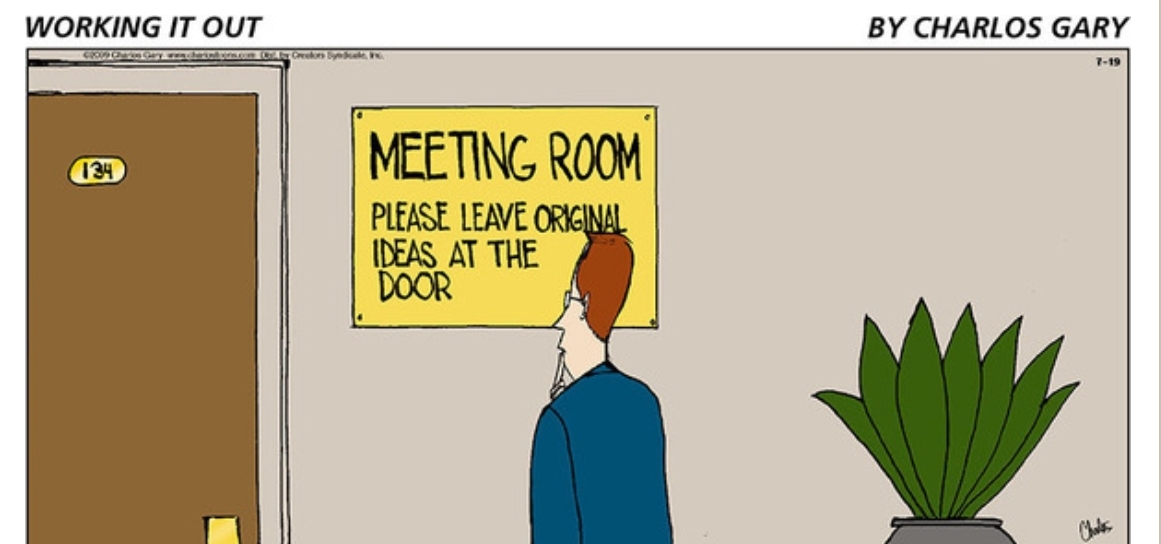
“U.S. Companies Lose Hope for Quick Rebound From Covid-19”  This was a headline in the Wall Street Journal the other day.  Buried in the body of the article was the statement, “Executives who were bracing for a months-long disruption are now thinking in terms of years. Their job has changed from riding it out to reinventing.”  On the same day (unrelated to the WSJ article) this cartoon appeared

I thought the cartoon was very appropriate because I’ve seen so many companies in my consulting career say they’re innovative but act like the cartoon.

Leaders Support Innovation

Leaders are not usually the innovators!  Good leaders support the innovators on their teams.

Let’s take a look at how innovation happens from a Team Leadership Culture framework.

Team Innovation

Team innovation can be the most difficult to pull off but at the same time the most rewarding as well.  However, it does take a few prerequisites for it to work.

Team Size

Many studies have determined that the best size of a decision-making team is seven, plus or minus two.

Once you get above nine people on a team, the ability to reach commitment on any given topic is greatly diminished.  There are just too many factions possible with 10+ people.

If you have fewer than five team members, it’s too easy for the team to form factions of three people vs. one person.  Even though that one person may have the most innovative idea, they will feel outnumbered and it’s too easy for the faction of three to treat them as an outlier or put pressure on them to go along with the majority.

Either way, the dynamics may be killing the innovation.

Keep decision-making teams to seven people, plus or minus two.

Team Attributes

TREC is the outline that brings the right attributes to an innovative team.

Truth.  Being able to speak the truth to each other without fear of reprisal is necessary for innovative teams.

Respect.  Each team member must be self-aware enough to know that their perspective is only a perspective.  It is not “the truth”.  It is not the only way of looking at an issue.  It’s only their perspective and each member has a valid perspective.  If the team trusts that all perspectives are valid, innovation is more likely to happen.

Elegance.   Coming up with an innovative solution that is also elegant (simple, understandable, actionable) is the best solution.

Commitment.  If the team is able to share the truth with respect, commitment can happen.  Even if your perspective was different (or even opposing) to the final direction, commitment means that no matter what, you express your commitment to the solution.  You’re able to do this because you were a member of the team that took all the perspectives into account and “committed” to a team solution.

Team Dynamics

If innovation is the goal, team dynamics becomes extremely important.  Teams have been conditioned to come together for a given amount of time (usually an hour), encouraged to follow the agenda, and finally, make decisions depending on the discussion or reports.  This feels very structured and efficient.  It’s just not good for innovation.

Innovative teams have a different dynamic.

  • They will start as a whole team to discuss the areas of possible innovation.
  • All the perspectives are shared, at least in an outline form.
  • The team then breaks up into smaller teams.  These can be as small as two individuals but should never be larger than three.
  • Deep Work is required.  Deep Work requires spending distraction-free time on the topic, pushing your cognitive capabilities to the limit.
  • Return to the full team with this new Deep Work perspective to hear what we’re learning and then discuss directions we could possibly head.
  • Rinse and Repeat.  Continue this large team, small team (maybe different small teams with each iteration) dynamics until the team begins to zero in on an innovative approach.
Team Decisions

Remember that the word “decide” means that you narrow your options down to a small number of choices (preferably two) and then you put one of those options to death.  You kill it.  You eliminate it.  You stop spending resources on it.  The commitment to the team direction should be powerful enough to put all of your resources towards the chosen innovative approach.

A Culture of Innovation

Moving the culture of an organization towards innovation usually centers around one word.

Decide!

As we’ve talked about the word “decide” lately, I hope it has become clear that the word decide means that you put one option to death in order to put your resources toward a different option.

Leaders and leadership teams will often decide on a direction but neglect to let the organization below them know that they’ve decided not to spend resources on other options.

Organizations are full of people who love the security of their job.  They’ve spent years learning the job, getting better at the job, and feeling secure that they can go to work every day and do the job.  They’re “secure.”

But, if you are now saying to them, “We’re heading in a different direction and we don’t know yet where it will all lead.”  They can often feel scared or at least insecure.  They may or may not mention this insecurity but they will wonder

  • Do I have the skill set to do the new job?
  • Will my job, group, division be eliminated?
  • Will I be asked to relocate to a different department or location?
  • Am  I back to ground zero in terms of my skills and worth to the company?

Without any clarity on these and other topics, people will tend to come to work every day and continue to do what they’ve always done.  They’ll seek security in doing the known rather than be lost in the unknown!

Open, Transparent, Humble

In times like these (which means now, in our current environment) it’s important that leadership is open with the organization.  Let them know everything that you know.

Be Transparent.  If people feel like they’re not getting the whole story, they’ll either go back to what they’ve always done or abandon ship.  Your best people, the ones you need the most will abandon the ship first.

Be humble.  Don’t give them the impression that you have all the answers when you don’t.  Let them know that you and the team are doing their best with uncertain circumstances.  Taking this approach will also bring forth more innovative ideas that you wouldn’t otherwise hear.


0 comments
0 FacebookTwitterEmail
Newer Posts
Older Posts
  • Facebook
  • Twitter
  • Linkedin
  • Rss
  • About This Site
  • About
    • Clients
  • Services
  • Resources
    • Trust Me
    • Short Book Reviews
  • Contact

About this Site | © 2024 Team Leadership Culture | platform by Apricot Services


Back To Top
Team Leadership Culture
  • Team
  • Leadership
  • Culture
  • Myers-Briggs
  • Trust Me
  • Short Book Reviews